To avoid these ads, REGISTER NOW!

PB Swiss interchangeable blade screwdrivers

AJHD

Well-known member
Joined
Jan 4, 2020
Messages
3,032
Location
AZ
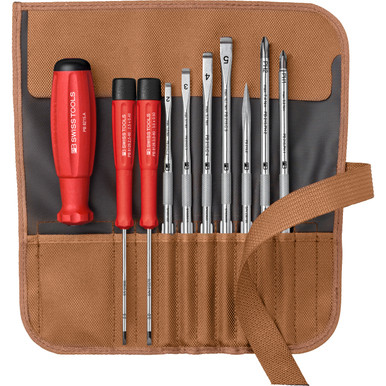
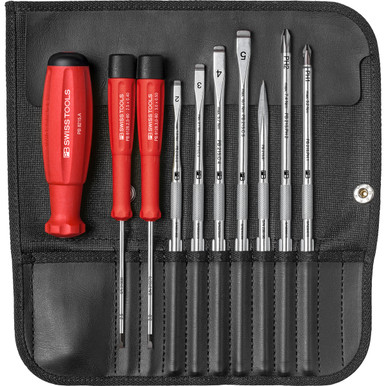
Does anyone own and actually use these PB Swiss screwdrivers with interchangeable blades?

Model #8215/#8218

If yes, what do you use them for? How strong are they? Would these hold up to automotive use (in a non-shop environment)?


Attachments

  • Screenshot_20231019-022337.png
    Screenshot_20231019-022337.png
    1.6 MB · Views: 21
  • Screenshot_20231020-040730.png
    Screenshot_20231020-040730.png
    1.7 MB · Views: 22
To avoid these ads, REGISTER NOW!

134k

Well-known member
Joined
Oct 1, 2017
Messages
100
I have and use the 215 series for work regularly (Field Service Engineer for industrial additive manufacturing). It's a strong set, but I'd be weary about using the Santoprene handles around any motor oil or gasoline. It'll eat it away.
 

tamaraw

Well-known member
Joined
Jun 6, 2022
Messages
843
I haven't used those particular sets but I would not doubt that PB Swiss probably has the best interchangeable blade drivers out there.

That said, having owned a cheap set in the distant past, I wouldn't really recommend them for automove work.

The advantage of interchangeable blades are:

1. You can carry tooling for many different fastener types with you at a minimal weight/volume vs a set of fixed drivers. This is ideal for handyman, electricians, or other mobile applications where you don't know what you might encounter.

2. Compared to the more common hex bit driver, blades give you a much higher quality bit (generally the same as a forged fixed blade) and a more secure fit in the handle, albeit at a higher price.

3. Undeniably cool 😎

The drawback is that they are less convenient to swap back and forth or identify in any situation where space/volume is not at an absolute premium.

Automotive work is typically done in a garage or house with available tool storage and also rarely requires more than a handful of different drivers. Or for an in-vehicle kit for basic roadside work, it's unlikely that you would need more than 2 or three drivers anyway.

I could see the space savings make sense on a motorcycle. But even for an in-vehicle kit for endurance auto racing, the simplicity of individual drivers would proutweigh the few grams of weight savings (pun intended).

Also, while I really like Swiss grip handles, I wouldn't recommend them for any automotive work outside of interiors because the texture and grippy surface attracts dirt and grime like a magnet.

Just my 2c, YMMV
 

Steve_P

Well-known member
Joined
Sep 15, 2010
Messages
5,185
Not sure why you'd want slotted drivers for automotive use if you're going for a minimalist set. Unless you're going to be working on something with a carburetor. You'd be better off with a P1, P2, and smaller torx bits for anything made after 1985.
 

tamaraw

Well-known member
Joined
Jun 6, 2022
Messages
843
Not sure why you'd want slotted drivers for automotive use if you're going for a minimalist set. Unless you're going to be working on something with a carburetor. You'd be better off with a P1, P2, and smaller torx bits for anything made after 1985.
The square awl is a bit questionable for automotive as well, lol

You might use flat head drivers as pry tools, but the PB stepped parallel tip design isn't very good for that (although it would be excellent for brass carb fittings)

They do offer torx, hex, pozidriv, bit holders, square drive adapters, nut drivers, etc. individually as well. It seems they have two lines, the 215 series (ear-based mounting interface) that OP posted as well as the 225 series (hex-based mounting interface).
 
To avoid these ads, REGISTER NOW!
OP
A

AJHD

Well-known member
Joined
Jan 4, 2020
Messages
3,032
Location
AZ
I wouldn't get too hung up on the included bit types. PB Swiss offers hex, torx, phillips, 1/4" bit holder and even a 1/4" square drive which could be used with 1/4" sockets.

I'm more concerned with construction, strength, function and long term use. For example how the handle interacts with fluids which is definitely a good thing to point out and think about.

After all, this is a tool forum where we share opinions and experiences and have discussions. I've not seen this particular tool set discussed until now.

PB Swiss interests me. I've been looking at a lot of their tools lately. But yes, I don't think they really market themselves towards mechanics from what I can see.
 
Last edited:

bpwoodworking

Well-known member
Joined
Jul 6, 2023
Messages
254
I find the fit between the interchangeable shanks to be very precise. There is zero rotational slip between the two.
 

Dave455

Well-known member
Joined
Mar 19, 2013
Messages
5,821
Location
Sussex, England
I own, and use, these - with the No.215 hard handle. Owned some of these for probably 25 years. Superb tools, but not for every application. tamaraw above, pretty much echoes my own thoughts.
B4E3CB9F-A6D9-4EE5-9C63-6D1DF753345B.jpeg

They are perfect for mobile “service sets”, especially if you are working on equipment with recessed screws, and can’t use 1/4” hex bits. Even if you don’t need this feature, they can be preferable, as there’s little risk of losing bits.

They are great to carry doing, say, electrical installations. Again, you can access recessed terminal screws, and you can carry a complete set of slotted / Phillips / Pozidriv / hex / Torx for very little bulk. I tend to carry mine on even a simple job, in case I encounter a screw I’m not expecting.

I find them superb for assembly work. The blades are incredibly durable for repetitive tasks, and the handle size is more sensible than many dedicated tools for small sizes.
BBEE67B3-741B-43DF-8307-510D7B512A94.jpeg

I’m not convinced these are as good for automotive use. You may need say a Ph 3, and the “one size fits all” handle doesn’t really work that big. Compare a 215 handle with a PZ3.
0561F366-24DA-4B34-B017-1DC57D5FFADF.jpeg

The 215 handle isn’t as good as a Snap On hard handle in greasy environments, although they are fine with any fluids I’ve encountered. (They are CAB - so very tough). The soft Santoprene handles are worse though, as they won’t wipe clean.

If you get any grease or dirt inside the handle it will cause problems locking the blade. A 1/4” hex bit driver is easy to clean out.

Much of the time for automotive work you need a short or long shaft driver. Easy with 1/4” hex bits, not so with fixed length blades.

For automotive maybe consider the 225 series. The handles are better sized, and the blade retention is more suited to the task. The PB ratchet units are lovely - the smoothest out there - and always a pleasure to use.
D8A209EC-3A04-4408-8537-AD6E800FCAF2.jpeg6905F276-7863-4382-B7B9-2B7F4E5691D3.jpeg

Overall, I’d say these are perfect for servicing electro mechanical equipment, installing electrical fittings, and all manner of cleanish tasks, but a couple of 1/4” hex bit drivers are generally preferable for automotive work.
 
Last edited:

HannibalLecter

Well-known member
Joined
Aug 26, 2023
Messages
402
I'd be weary of using any type of insert bit in general. There are situations you can't avoid them ( not having to carry a full set of drivers 1 mile away as a field mechanic probably), but in general I'd avoid them, even from pb swiss, especially for automotive use. I have the stubby hex driver and it has a lot of play in it. If these are the same it's pretty annoying. For automotive hard use and for using the flat heads as prybars occasionally, or striking them, I'd buy wera cchiseldrivers, the full set.I'd reserve pb swiss for more clinical work in the bench
 

KnurledNut

Well-known member
Joined
Jan 28, 2011
Messages
8,160
Location
n/a
These PB Swiss are very precise and well designed.
However, I would not consider them heavy duty.
More than that, the proprietary bit design is extremely limiting.
They would be okay for clean auto work, interior, body/trim.
For interchangeability, I would recommend going with the common 1/4 hex instead.
 
To avoid these ads, REGISTER NOW!
Top Bottom