
You are using an out of date browser. It may not display this or other websites correctly.
You should upgrade or use an alternative browser.
You should upgrade or use an alternative browser.
Penens vs Fleet vs Challanger
- Thread starter 81CJ-7
- Start date
Oldtuleguy
Well-known member
- Joined
- Nov 4, 2017
- Messages
- 10,486
See this thread
 www.garagejournal.com
Pendleton (plombpire) brands show them here!
As we all know Plomb began not only acquiring other brands, such as Cragan (Bog), P&C, Tubing Appliance Corporation, J.P. Danielson and later Duplex, but creating their own, such as Challenger Fleet and Penens. They also supplied tools for department stores such as Wards and Sears, the...
www.garagejournal.com
I read through the entire thread, and unless I missed something, no one addressed what the difference is(if any) between Penens, Fleet, and Challenger. Why would Pendleton/Proto have 3 different sub-brands, all with the same address, and similar(if not exact) products? I would think that paying to have different dies made to stamp different names on the same product for no good reason would be expensive, and not a likely course of action.
Private Lugnutz
Well-known member
I haven't participated in that thread, so I can't address that, but we've discussed it a little, sporadically, at best, on the Plomb, Proto and Fleet threads. Frankly, your "(if any)" caveat is on point, in my opinion. Finding a hierarchy between PENENS, Fleet, and Challenger would be nie impossible, especially over time. They were all considered economy relative to the flagship Proto brand. The Plomb Tool Company bought the former Bog/Cragin plant and operation in Chicago and made it their subsidiary in 1940, changing the name to PENENS Tool Corp in 1941. PENENS Tool Corp registered the name "Fleet Quality Tools" as a TM in 1949, changed their name to Fleet Tool Corp in 1960, and registered the name "Fleet" as a TM in 1965. The Plomb Tool Company used the Challenger name briefly in 1939 and 1940, but only in catalogs and on labels, and then started using it again in 1950-ish or so as a brand and whole line of tools secondary to their Proto branded tools. The Plomb Tool Company became Pendleton Tool Industries Inc in 1957. It was in the PTII era when the various incarnations of PENENS, Fleet, and Challenger branding exploded. When Ingersoll-Rand bought PTII in 1975, they named the whole division Proto.I read through the entire thread, and unless I missed something, no one addressed what the difference is(if any) between Penens, Fleet, and Challenger.
I don't think a clear definitive answer will ever proffer itself. Someone would have to gather and study a crazy amount of variants and literature over a few decades at a time when they were offering a dizzying array of choices seemingly without much rhyme or reason.
Thank you for the response. I have been gathering and studying various Proto empire tools trying to find differences and only coming up with speculations. My best theory is that Proto itself was after the industrial market, and perhaps Challenger was their economy industrial brand. Penens, then Fleet was then marketed for the auto/mechanic industry. But this is all speculation, I have no documented evidence to support this theory
d42jeep
Well-known member
I have had quite a few examples of all of those brands and haven’t really been able to see much quality difference between them. Perhaps the marketing theory was to give the consumer lots of choices to perhaps increase their market share. Along with the brands mentioned, P&C continued to be marketed for quite a while.
-Don
-Don
Oldtuleguy
Well-known member
- Joined
- Nov 4, 2017
- Messages
- 10,486
I read through the entire thread, and unless I missed something, no one addressed what the difference is(if any) between Penens, Fleet, and Challenger. Why would Pendleton/Proto have 3 different sub-brands, all with the same address, and similar(if not exact) products? I would think that paying to have different dies made to stamp different names on the same product for no good reason would be expensive, and not a likely course of action.
There is no substantial difference! If you noticed, some of challenger sets in that thread came with tools marked pennens. Fleet pennens challenger and proto marketed the same exact tools in some cases, just different brands. Proto was definitely the flagship brand, and marketed to people who worked with their tools for a living.
Ricky Joe
Well-known member
Lugz response made me think a bit. Perhaps we are focusing in the wrong direction. In an era of corporate sales of companies, it could be that Pendleton was positioning itself to be able to sell brands without going out of business. When Plomb bought Bog, Bog was out of business. With so many brands duplicating product, Proto, Challenger, Penens, etc., could be sold off as a brand without affecting the value of the remaining catalog. Reaching, but makes sense. Triangle bought Herbrand, Bonney, and Utica and essentially duplicated product in the same Orangeburg factory, possibly for the same reason. The value of the brand was not impaired.
The Plomb/Proto Empire as it is sometimes called had to be the most schizophrenic tool company ever, followed perhaps by Duro/Indestro. We've seen examples in threads of identical ratchets bearing one of these different brand names; sometimes even the model numbers are the same across the brands, sometimes different. Their are different model numbers for otherwise identical ratchets within a given brand name itself. Other than a supposed grade difference between Proto and its other siblings, there seems on the surface little to distinguish one from the other. My Dad gave me a set of tools in the late 1960s that contained both Proto and Challenger combination wrenches in the sizes over 3/4" where the Challengers had a less refined finish and less metal in the beams than the Protos, so it was fairly obvious that the Challenger was meant to be the lesser tool.
However, there had to be a corporate reasoning behind Proto offering these four different brands. It's reasonable to conclude it was not random or meaningless. With the thought in mind that there had to be a logical purpose behind it, we can proceed in attempting to distinguish that purpose with some degree of confidence, knowing that there has to be a workable explanation.
I've not seen a ton of examples from each brand, but one of the distinctions I've noticed in the lower tier brands is with the Penens open end and combination wrenches, which all seem to have recessed handles or what might be called an 'I-beam' design. This is consistent with Lectrolite in the 1950s-early 1960s with its TruFit budget line being I-beam and its top-tier Lectrolite brand being full beams. Less metal=lower cost. None of the Fleet or Challenger DOE or combo wrenches have this I-beam design. What's interesting is that the Penens DBE wrench beams seem to be identical with the Challenger or Fleet wrenches. Yet the I-beam design of the Penens DOE and combo wrenches appears to be unique among these several brands, which strongly suggests that Penens was intended to be sold as the lowest bottom tier line of the four.
Considering that many of the tools themselves can appear identical to each other across the brands, especially within the three lower tier brands, it seems that the most logical deduction is to attribute the branding primarily to a marketing strategy. It's an aspect of the business that we are often less mindful of, thinking more about the quality and features of the tools themselves than the sales and marketing 'white-collar' part of the business, especially since it's a largely invisible, behind-the-scenes aspect of the business.
An event in my office furniture experience caused me to think about a hidden aspect of the marketing, which came about with the rise of the office 'superstores' like Office Max, Staples, Office Depot and the like in a field dominated by individual furniture and stationery dealers, almost all small companies in comparison, many which were mom & pop operations. The superstores were able to buy in such quantities that they could easily undersell the small, traditional stores on the exact same items. Dealers started flipping out on the furniture manufacturer sales reps. So the manufacturers solved this by altering the products sold to the superstores. Hon, for example, was a huge file cabinet brand at the time. What Hon did was to shorten the 4-drawer filing cabinets sold to the superstores by 4" so that the dealers had the full 52" high files while the superstores had only a 48" high. Global did a similar move with its seating, making chairs for the superstores that still bore the Global brand but were of a noticeable, cheaper construction than the dealer products. This is how they kept the peace with their traditional dealers while satisfying the superstores. The smaller dealer could then say to the customer, "See? Our product is different and superior to what those cheap junk superstores sell." We know there were various kinds of tool dealers in the 1950s including chain stores and individual mom & pop retailers, and so I can't help but think Proto used their different brands at least in part to address the same kind of issue in the office superstore scenario. A retailer handling Challenger could not complain about Proto underselling them to other dealers if the competition was being sold Penens, for example.
All things considered, it seems that the answer may lie in the marketing. According to my understanding, Proto actually had two different target markets: professional and consumer. We've seen many examples of those auto parts sets in the budget metal tool boxes bearing the Challenger brand, so these were clearly targeted to the consumer. With this in mind, it may be that we err in thinking of Challenger as the budget version of Proto-branded tools during the time period in question; if we consider the consumer market as separate from the professional market, then it was actually the Challenger brand that was the top-tier flagship brand of the consumer line, with the Penens being the second tier line. On the professional side, it was the Proto brand that was the top-tier flagship with the Fleet brand being the professional second tier. The fact that one of their factories might make an identical tool for each of the four brands is a source of confusion, but not if we consider the brand marketing as the primary consideration, with certain tools that happen to be identical being a secondary consideration. It was no doubt more economical to have a single factory make the identical tool for all the lines and merely label them differently.
And so, I propose that we are looking at a marketing strategy in the 1950s-60s aimed at two different markets: Proto/Fleet as the top/secondary lines in the professional market, and Challenger/Penens being the top/secondary lines in the consumer market. The keys to me are the I-beam Penens (consumer-grade) and the sheer quantity of surviving Challenger sets that were obviously targeted to the consumer. Looking at it with this dual-market perspective seems to make this otherwise confusing brand menagerie suddenly fall into a logical and sensible order like a veil being lifted. Challenger was not the second-tier brand to the Proto brand: Challenger was the top-tier brand of the consumer market space. This makes much more sense to me than other previously suggested explanations, which we know from years of debate that these have proved to be untenable.
However, there had to be a corporate reasoning behind Proto offering these four different brands. It's reasonable to conclude it was not random or meaningless. With the thought in mind that there had to be a logical purpose behind it, we can proceed in attempting to distinguish that purpose with some degree of confidence, knowing that there has to be a workable explanation.
I've not seen a ton of examples from each brand, but one of the distinctions I've noticed in the lower tier brands is with the Penens open end and combination wrenches, which all seem to have recessed handles or what might be called an 'I-beam' design. This is consistent with Lectrolite in the 1950s-early 1960s with its TruFit budget line being I-beam and its top-tier Lectrolite brand being full beams. Less metal=lower cost. None of the Fleet or Challenger DOE or combo wrenches have this I-beam design. What's interesting is that the Penens DBE wrench beams seem to be identical with the Challenger or Fleet wrenches. Yet the I-beam design of the Penens DOE and combo wrenches appears to be unique among these several brands, which strongly suggests that Penens was intended to be sold as the lowest bottom tier line of the four.
Considering that many of the tools themselves can appear identical to each other across the brands, especially within the three lower tier brands, it seems that the most logical deduction is to attribute the branding primarily to a marketing strategy. It's an aspect of the business that we are often less mindful of, thinking more about the quality and features of the tools themselves than the sales and marketing 'white-collar' part of the business, especially since it's a largely invisible, behind-the-scenes aspect of the business.
An event in my office furniture experience caused me to think about a hidden aspect of the marketing, which came about with the rise of the office 'superstores' like Office Max, Staples, Office Depot and the like in a field dominated by individual furniture and stationery dealers, almost all small companies in comparison, many which were mom & pop operations. The superstores were able to buy in such quantities that they could easily undersell the small, traditional stores on the exact same items. Dealers started flipping out on the furniture manufacturer sales reps. So the manufacturers solved this by altering the products sold to the superstores. Hon, for example, was a huge file cabinet brand at the time. What Hon did was to shorten the 4-drawer filing cabinets sold to the superstores by 4" so that the dealers had the full 52" high files while the superstores had only a 48" high. Global did a similar move with its seating, making chairs for the superstores that still bore the Global brand but were of a noticeable, cheaper construction than the dealer products. This is how they kept the peace with their traditional dealers while satisfying the superstores. The smaller dealer could then say to the customer, "See? Our product is different and superior to what those cheap junk superstores sell." We know there were various kinds of tool dealers in the 1950s including chain stores and individual mom & pop retailers, and so I can't help but think Proto used their different brands at least in part to address the same kind of issue in the office superstore scenario. A retailer handling Challenger could not complain about Proto underselling them to other dealers if the competition was being sold Penens, for example.
All things considered, it seems that the answer may lie in the marketing. According to my understanding, Proto actually had two different target markets: professional and consumer. We've seen many examples of those auto parts sets in the budget metal tool boxes bearing the Challenger brand, so these were clearly targeted to the consumer. With this in mind, it may be that we err in thinking of Challenger as the budget version of Proto-branded tools during the time period in question; if we consider the consumer market as separate from the professional market, then it was actually the Challenger brand that was the top-tier flagship brand of the consumer line, with the Penens being the second tier line. On the professional side, it was the Proto brand that was the top-tier flagship with the Fleet brand being the professional second tier. The fact that one of their factories might make an identical tool for each of the four brands is a source of confusion, but not if we consider the brand marketing as the primary consideration, with certain tools that happen to be identical being a secondary consideration. It was no doubt more economical to have a single factory make the identical tool for all the lines and merely label them differently.
And so, I propose that we are looking at a marketing strategy in the 1950s-60s aimed at two different markets: Proto/Fleet as the top/secondary lines in the professional market, and Challenger/Penens being the top/secondary lines in the consumer market. The keys to me are the I-beam Penens (consumer-grade) and the sheer quantity of surviving Challenger sets that were obviously targeted to the consumer. Looking at it with this dual-market perspective seems to make this otherwise confusing brand menagerie suddenly fall into a logical and sensible order like a veil being lifted. Challenger was not the second-tier brand to the Proto brand: Challenger was the top-tier brand of the consumer market space. This makes much more sense to me than other previously suggested explanations, which we know from years of debate that these have proved to be untenable.
Last edited:
bmwrd0
Well-known member
I like this explanation, with the caveat that I think your line-up is a little skewed. Proto and Challenger, yes, I agree that those are the two "top" brands. But bellow them should be shifted to put P&C below Proto in the Professional brands, while Fleet should be moved over to the consumer side, albeit a different marketing version of Challenger, or possible between Challenger and Penens.
The reason for this is that Proto and P&C are the same down the line; ratchets, wrenches, sockets, pullers, etc. While Challenger and Fleet use the same ratchets, which are different than the classic 5442. These are descendants of the WF machined through type. And, lastly, those two brands, along with Penens, shifted to the round head ratchets, while Proto and P&C did not.
The reason for this is that Proto and P&C are the same down the line; ratchets, wrenches, sockets, pullers, etc. While Challenger and Fleet use the same ratchets, which are different than the classic 5442. These are descendants of the WF machined through type. And, lastly, those two brands, along with Penens, shifted to the round head ratchets, while Proto and P&C did not.
PowderKeg
Well-known member
My thoughts fall pretty much in line with ya'lls on diff brands to diff markets such as large chain auto parts/industrial suppliers vs mom 'n pop/unaligned parts/hardware stores etc. My guess is Proto as the top tier pro/industrial brand, with P&C supplying the smaller/lesser non-aligned pro level markets for auto/industry, at least until P&C was dropped as a brand for Proto to take the whole top level. Same for Challenger as a mid-level auto parts (I know I saw Challenger tools/boards in a lesser chain-aligned parts store way back in the day), and Fleet/Penens to the non-aligned and bottom tier markets, at least until they were put down in favor of the Challenger branding. Challenger may have gotten bounced around to different markets until things settled down and brands were dropped to consolidate.
To throw a little more into the mix, I've got 4 diff Challenger brandings on ratchets - Challenger, Challenger (Penens), Challenger (Proto), and Stanley Challenger. My guess is that's generally the evolution of the Challenger brand name/positioning from earliest to latest, as it won out over the other "lesser" brandings until Stanley came along and mucked everything up.
That's my nickel's worth at least.
To throw a little more into the mix, I've got 4 diff Challenger brandings on ratchets - Challenger, Challenger (Penens), Challenger (Proto), and Stanley Challenger. My guess is that's generally the evolution of the Challenger brand name/positioning from earliest to latest, as it won out over the other "lesser" brandings until Stanley came along and mucked everything up.
That's my nickel's worth at least.
My reasoning with regard to the proposed arrangement is focused primarily on the marketing aspect, which I believe is the fundamental consideration in unraveling the Plomb/Proto menagerie with the brands originally inquired about by the OP. The emphasis you've made on how many tools are identical or different across the brands is once again focusing on the tools themselves, which does nothing to help understand the branding. Focusing on the similarities between the tools themselves is a well-worn path that not only fails to shed any light on the purpose behind the different brands, but is also the very approach that has led to the ongoing difficulty in sorting out these brands (and, if I may, many "skewed" ideas). Calling out the many tools identical across the brands, while quite intriguing and a fascinating aspect of tool collecting, has proven to be largely irrelevant and even futile in the effort to determine the rhyme and reason behind the multiple branding. I propose that the only hope to sort this all out is in focusing on the marketing strategy behind the branding instead of how many tools are the same or different, which has led us nowhere. After all, if so many of the tools are identical, the only meaningful distinction is in the brands themselves, not in the tools. It is therefore purely a question of marketing.I like this explanation, with the caveat that I think your line-up is a little skewed. Proto and Challenger, yes, I agree that those are the two "top" brands. But bellow them should be shifted to put P&C below Proto in the Professional brands, while Fleet should be moved over to the consumer side, albeit a different marketing version of Challenger, or possible between Challenger and Penens.
The reason for this is that Proto and P&C are the same down the line; ratchets, wrenches, sockets, pullers, etc. While Challenger and Fleet use the same ratchets, which are different than the classic 5442. These are descendants of the WF machined through type. And, lastly, those two brands, along with Penens, shifted to the round head ratchets, while Proto and P&C did not.
For example, you've pointed out that period Proto and P&C tools are virtually "the same down the line." That's my very point! If the tools are identical, what is the purpose for two different brands? If the tools are the same, couldn't they all be sold under one brand instead? Looking at the tools themselves sheds zero light on this question. In order to sort this out, we need to at least temporarily step out of the traditional mindset of focusing on the physical tools themselves and instead pay attention primarily to the marketing strategy, which is, after all, the only remaining viable factor to consider that can distinguish the difference in the many instances where brands like Proto and P&C are otherwise identical.
When it comes to P&C, there's another aspect to consider. The reason why OP's question regarding Proto, Challenger, Fleet and Penens is so core to this issue is that Plomb actually created these latter three brands. Plomb created these brands, not merely from a corporate viewpoint to establish separate entities for legal or logistical purposes, but also marketed these tools to the public under these same brands. So this begs the question: why did Plomb create these different brand names to sell its tools under? There is only one plausible answer: marketing. So here again, comparing the physical tools themselves tells us nothing about the purpose behind the various brands they were sold under.
In this light, it's easy to see that P&C is a different animal than Fleet, Challenger and Penens. Plomb did not create the P&C brand--P&C had an established brand with both an existing name recognition and a following. The fact that so many of the P&C tools became identical to Proto is irrelevant to the question of branding--P&C had a different audience, and so Plomb's decision to perpetuate P&C as a distinct brand was entirely a matter of marketing. The P&C history site makes mention of the distinct ways in which the P&C brand was marketed, and even received a national award in 1963 from the National Wholesale Hardware Association for the company’s “contribution to the improvement of manufacturer wholesaler retailer relationship.” This mention of improvements to the manufacturer-wholesaler-retailer relationship--what is sometimes known as the distribution channel--is helpful in realizing that P&C was being marketed in its own unique way as an independent entity with its own distribution channel strategy distinct from the other Plomb brands.
For this reason, I did not include P&C in considering the consumer hierarchy of Challenger (top tier) and Penens (second tier) because P&C was not a part of the marketing strategy behind Plomb's creation of the Fleet, Challenger and Penens brands--P&C was maintained and marketed as its own, distinct brand. As is often the case with multiple brands from a single company, Plomb in a sense was running its own competition where P&C was more of a direct competitor to its Proto brand rather than being marketed to retailers as any part of a good-better-best relationship to be included with Plomb's created Challenger/Penens pedigree. One might come to this three-tier conclusion by focusing on the physical tools, but not when the focus is strictly on the marketing that gave rise to these different brands.
Again, trying to reckon the order behind the various brands in question based on studying the relationship between the physical tools has proven fruitless, which is the strongest clue that the key in unraveling the mystery is not in the physical tools themselves. A much clearer order emerges when we focus on the marketing aspect, the logic of which then becomes quite evident. That's because the marketing was the very purpose behind the existence of these multiple brands to begin with.
Private Lugnutz
Well-known member
And those brandings extended to the rest of the pieces in the sets those ratchets were attached to, PK. As I alluded to in post #4, Challenger was always a price point term for them, dating back to 1939 (see Pic 1), but not, they insisted, at the sacrifice of quality. And according to the great A.J. Foyt, that was apparently still the case in 1982 (see Pic 2)! Heck, in 1963 they eventually just re-named the whole darned company (PENENS, that is) to Challenger (see Pic 3) thereby alleviating at least some of the seemingly indiscriminate confusion.I've got 4 diff Challenger brandings on ratchets - Challenger, Challenger (Penens), Challenger (Proto),

Attachments


PowderKeg
Well-known member
Interesting Lugz, since I only (mostly) pay attention to ratchets I wasn't sure if the second (parent) brand appeared on the other ratchet set components or not. On another note after looking at the Challenger cat cover, I've only noticed the "helmet head" logo on wrenches, have yet to see a ratchet or any other tool with it as well as the name (haven't really looked either). Do you know of other Challenger tools of the helmet timeframe that the logo was included on?
Private Lugnutz
Well-known member
I wasn't sure if the second (parent) brand appeared on the other ratchet set components or not.

No, I don't. @Oldtuleguy might know better. Here's one on a socket set case, though.I've only noticed the "helmet head" logo on wrenches, have yet to see a ratchet or any other tool with it as well as the name (haven't really looked either). Do you know of other Challenger tools of the helmet timeframe that the logo was included on?

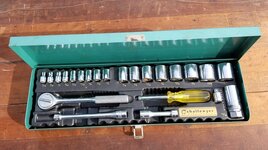
Oldtuleguy
Well-known member
- Joined
- Nov 4, 2017
- Messages
- 10,486
The helmet head on tools was short lived. And concurrent with the trophy logo on vlchek wrenches. I have only seen thet logo on wrenches
d42jeep
Well-known member
Here are some helmet head wrenches. I have had a helmet head pipe wrench as well.
-Don


-Don
As has been said in many different ways, the Plomb/Penens/Pennigton/Proto story is fraught with lots of WTF?
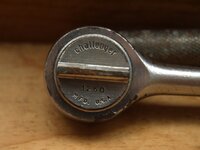
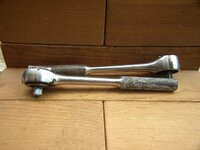
In the 1963 Catalogs — Challenger/Penens/Pennington — the 1260 Ratchet is labeled with lower case “challenger”, so one of the 1260 Ratchets pictured is from that period, presumably. The other is a “CHALLENGER BY PROTO”; same number, different design.
Just sayin’.
In the 1963 Catalogs — Challenger/Penens/Pennington — the 1260 Ratchet is labeled with lower case “challenger”, so one of the 1260 Ratchets pictured is from that period, presumably. The other is a “CHALLENGER BY PROTO”; same number, different design.
Just sayin’.
Attachments



jwilson645
Well-known member
I am researching these Challenger tools since I picked up this tool board over the weekend. Are the "helmet logo" tools from the early 60's? Looks like I can fill most of this board off of Ebay but I sure do like the hunt at various flea markets/estate sales.
Attachments

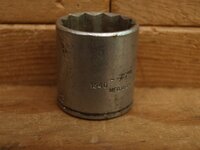
Fleet 1640 1/2-Inch Drive 1 1/4-Inch Socket
Attachments


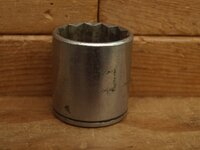



d42jeep
Well-known member
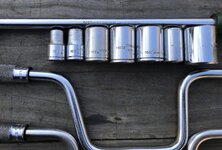
Here are some of my Challenger spares without the helmet head. They are 1/2” drive.
-Don
-Don
nadogail
Well-known member
The Penens brand tools I bought sometime about 1960 were purchased from a small auto supply store because they were lower priced than the tools sold at the major stores in my small city.