To avoid these ads, REGISTER NOW!

pex diameter? please share yours

wildlife

Member
Joined
Feb 23, 2013
Messages
12
Hi,

This is my first post and while the search feature is helpful, it doesn't respond when I search for pex. I am sure there is a better way to search and read more. Please forgive me as I imagine asking about pex size and spacing is a common topic. Any advice would be appreciated.

I just found this forum and have been starting to read. Looks like some impressive shops you all have. This will be our first shop and we want warm floors. We are in Northern Maryland and while the last two winters have been relatively mild, it does get too cold to work on equipment outside.

We are planning a shop with a floor that is roughly 38x21 and 6” thick. The pex will be tied to wire mesh that is 2” up on bolsters and all run as one zone. We have 2" rigid foam board for the perimeter and underside.

Probably start with an electric heat source and add in solar hot water in the future.

I have read that I want an oxygen barrier but am unclear about choosing diameter and type. Any tips on good reading to learn more that isn’t just a sales pitch?

What is your advice on the best size pipe to use in a 6" slab with solar and the best spacing from your experience?

I was thinking about using 5/8” on 12” centers. I see that lots of folks use ½” but I figured I would have 6” instead of the common 4” of concrete, and if I ever wanted to run glycol in the solar system then a larger diameter pex would be better.

I have had the online salesman try to sell me ½” up to 7/8”??? What diameter of pipe do I need for an efficient system?

Thanks for your advice. Looking forward to a warm floor in the winter.
Wildlife
 
To avoid these ads, REGISTER NOW!

Highbeam

Well-known member
Joined
Feb 15, 2011
Messages
2,292
Location
Mt Rainier foothills, WA
1/2" oxygen barrier pex on 12" centers is the norm. Loops under 300 feet in length and within 10% of each other. Whether the slab is 4" or 6" thick, no difference.

You don't need to elevate the pex in the slab and in fact, the easier way to go is to staple the pex directly to the foam and lay the mesh on top.
 

stingry

Well-known member
Joined
Oct 14, 2006
Messages
732
Location
Western Nebraska
1/2" oxygen barrier pex on 12" centers is the norm. Loops under 300 feet in length and within 10% of each other. Whether the slab is 4" or 6" thick, no difference.

You don't need to elevate the pex in the slab and in fact, the easier way to go is to staple the pex directly to the foam and lay the mesh on top.

Good advice, exactly what I did!!!!

Cheers
Steve
 
OP
W

wildlife

Member
Joined
Feb 23, 2013
Messages
12
1/2" oxygen barrier pex on 12" centers is the norm. Loops under 300 feet in length and within 10% of each other. Whether the slab is 4" or 6" thick, no difference.

You don't need to elevate the pex in the slab and in fact, the easier way to go is to staple the pex directly to the foam and lay the mesh on top.
Thanks for the response Highbeam and Stingry.

What is the downside to using the larger pex, say 5/8 or 3/4? Would larger pex require a stronger circulation pump? What about performance difference?
My instincts are to over build and am concerned about future solar.
 

stingry

Well-known member
Joined
Oct 14, 2006
Messages
732
Location
Western Nebraska
Thanks for the response Highbeam and Stingry.

What is the downside to using the larger pex, say 5/8 or 3/4? Would larger pex require a stronger circulation pump? What about performance difference?
My instincts are to over build and am concerned about future solar.

The larger diameters are harder to work with, stiffer, require larger radius bends, etc. Actually the larger the diameter, the less the friction losses, so you can have longer runs. Also, they can be spaced farther apart. You're overthinking this, go with the 1/2" and you will be fine!

Cheers
Steve
 

UpstateNY

Well-known member
Joined
Jan 2, 2012
Messages
662
1/2" oxygen barrier pex on 12" centers is the norm. Loops under 300 feet in length and within 10% of each other. Whether the slab is 4" or 6" thick, no difference.

You don't need to elevate the pex in the slab and in fact, the easier way to go is to staple the pex directly to the foam and lay the mesh on top.

Question: if you put the foam on top of the stone, then staple the Pex to the foam, and lay the mesh on top - wouldn't the mesh then only be about a 1/2" above the foam. On a 6" pour, that would put the mesh in the 1st 1/2 inch of the pour ? For a 6" pour, where should the mesh be ? 3" above the base foam (in this case) or midway through the floor ?
 

BadgerBoilerMN

Well-known member
Joined
Aug 4, 2011
Messages
837
Location
Minneapolis
Where are you?

A 6" slab? Running steel wheeled fork lifts are we?

1/2" is good for most homes and shops in N.America, though we have been using more 5/8" ID for bigger shops and smaller snow melts. Just starting 20,000 sq.ft. in N.D farm shop design.

On large more complex jobs, an ACCA Manual 'J' heat load will define the design water temperature, the minimum flow and temperature differential, all of which will dictate PEX, size length and pumps to drive them.

Solar thermal heating is for high desert plains with lots of sun and moderate temperatures.

Highbeam has it right, in the short hand.
 

Highbeam

Well-known member
Joined
Feb 15, 2011
Messages
2,292
Location
Mt Rainier foothills, WA
Question: if you put the foam on top of the stone, then staple the Pex to the foam, and lay the mesh on top - wouldn't the mesh then only be about a 1/2" above the foam. On a 6" pour, that would put the mesh in the 1st 1/2 inch of the pour ? For a 6" pour, where should the mesh be ? 3" above the base foam (in this case) or midway through the floor ?

What do you think the mesh is doing for you? and why do you think you want it in the middle.

Steel reinforcement gives concrete strength in tension. Concrete is strong in compression and weak in tension. Anyway, a slab or beam when loaded on top has the bottom 1/3 in tension the middle pretty neutral and the top in compression. This is why you want the steel as low in the slab as possible while sill far enough in the slab that it doesn't tear out. 1/2", one inch is plenty.

The other reason people use steel in concrete is to prevent cracks from heaving or opening farther. The steel acts, again in tension, to keep the broken chunks of concrete in something that more closely resembles a flat slab. In this case, the reinforcement can be pretty much anywhere in the slab so long as it doesn't tear out.

I like the mesh matts. They are easy to deal with and of relatively high gauge.
 
OP
W

wildlife

Member
Joined
Feb 23, 2013
Messages
12
Where are you?

A 6" slab? Running steel wheeled fork lifts are we?

1/2" is good for most homes and shops in N.America, though we have been using more 5/8" ID for bigger shops and smaller snow melts. Just starting 20,000 sq.ft. in N.D farm shop design.

On large more complex jobs, an ACCA Manual 'J' heat load will define the design water temperature, the minimum flow and temperature differential, all of which will dictate PEX, size length and pumps to drive them.

Solar thermal heating is for high desert plains with lots of sun and moderate temperatures.

Highbeam has it right, in the short hand.


Happy New Year!

It has been a while and I am ready to figure out the rest of my system. I have the metal building up over the slab that has 1/2 inch pex on 1' centers with three equal loops of 270'. What tools are available for me online to figure out what size heater and pump etc. I will need. I am thinking of using one of the glycol antifreeze additives in case we loose power and this will be a closed system with no connection to potable water. The only other variable is that maybe next year I want to add in a few solar panels to reduce the propane bill from the water heater.

Where should I start reading?

Are there online heat loss calculators that are good?

Have you built a similar system?

Thanks,
Wildlife
 

yeldogt

Well-known member
Joined
Jan 2, 2012
Messages
18,184
Did you do a heat load on the building when you put in the pipes ??

My experience with 6" slabs is they do benefit when the tubes are not at the bottom -- you get a bit faster response to outside temp changes -- thick slabs require a bit more control so as to not overheat if using for typical inside temps .. outdoor reset being the best.


You need to get the heat load and match to a boiler .. depending on how you are going to run it. With a 6" slab -- you can't bounce the temps around and expect it to perform.

Three loops is a simple system .... take a look at "pumping away" === copy the setup with correct boiler output.
 

raspy

Well-known member
Joined
Dec 16, 2010
Messages
103
Location
Wellington, Nevada
We are planning a shop with a floor that is roughly 38x21 and 6” thick. The pex will be tied to wire mesh that is 2” up on bolsters and all run as one zone. We have 2" rigid foam board for the perimeter and underside.

Probably start with an electric heat source and add in solar hot water in the future.

I have read that I want an oxygen barrier but am unclear about choosing diameter and type. Any tips on good reading to learn more that isn’t just a sales pitch?

What is your advice on the best size pipe to use in a 6" slab with solar and the best spacing from your experience?

I was thinking about using 5/8” on 12” centers. I see that lots of folks use ½” but I figured I would have 6” instead of the common 4” of concrete, and if I ever wanted to run glycol in the solar system then a larger diameter pex would be better.


Wildlife


Your design of 1/2" PEX on 12" centers, with three loops of 270' length will be fine for a shop. Remember that 1/2" PEX is actually 5/8" OD. Oxygen barrier tube is now the standard and allows cast iron pumps to be used. A non-toxic corrosion inhibitor is also a good idea to reduce corrosion even further and possibly help pumps last longer.

12" OC doesn't perform quite as well as 9" OC, but it's much easier to pour the concrete where boots can stand between the tubes and reinforcement wire during the pour. I also like 6" slabs because it's easier to get the reinforcement wire and tubing all in that thickness.

I think thicker slabs are better for solar because they load the system heavier and store more with less temp change. Since solar only works during the day, it's nice to be able to add energy in bursts with little temp change overall. This is a different theory than I use for gas heated slabs, but it works well with solar.

In my house I went with an 8' slab for the whole house and the garage. I used 3/4" PEX on, mostly, 12" centers. This allowed me longer loops and a more durable tube, as the wall thickness is about twice what 1/2" has. So there was less chance of damage during the pour and easier pumping later.

I have about 3,000 sq ft total with a 950 sq ft garage. It has (6) 4X10 collectors and 600 gallons of storage. I did not put any insulation under the slab, just around the perimeter. I suggest holding the heat back from the edges by about a foot from the inside of the walls.

Are you concerned about only having mesh as reinforcement and having your slab sitting on compressible insulation, while driving heavy equipment around on it?
 

Randy in Maine

Well-known member
Joined
Nov 21, 2010
Messages
2,176
Location
The Beach
I also have 6" 4000 psi concrete and used 1/2 pex roughly 12" OC. It works fine up here in Maine. If you have to bypass some of the concrete (like where the lift will go or something else) don't worry as you are heating up a big hunk of rock just as the Romans did many years ago.

My 21 cubic yards of concrete was 42 tons of thermal mass in just the slab. Don't skimp on the insulation.
 
To avoid these ads, REGISTER NOW!
OP
W

wildlife

Member
Joined
Feb 23, 2013
Messages
12
Your design of 1/2" PEX on 12" centers, with three loops of 270' length will be fine for a shop. Remember that 1/2" PEX is actually 5/8" OD. Oxygen barrier tube is now the standard and allows cast iron pumps to be used. A non-toxic corrosion inhibitor is also a good idea to reduce corrosion even further and possibly help pumps last longer.


12" OC doesn't perform quite as well as 9" OC, but it's much easier to pour the concrete where boots can stand between the tubes and reinforcement wire during the pour. I also like 6" slabs because it's easier to get the reinforcement wire and tubing all in that thickness.


I think thicker slabs are better for solar because they load the system heavier and store more with less temp change. Since solar only works during the day, it's nice to be able to add energy in bursts with little temp change overall. This is a different theory than I use for gas heated slabs, but it works well with solar.


In my house I went with an 8' slab for the whole house and the garage. I used 3/4" PEX on, mostly, 12" centers. This allowed me longer loops and a more durable tube, as the wall thickness is about twice what 1/2" has. So there was less chance of damage during the pour and easier pumping later.


I have about 3,000 sq ft total with a 950 sq ft garage. It has (6) 4X10 collectors and 600 gallons of storage. I did not put any insulation under the slab, just around the perimeter. I suggest holding the heat back from the edges by about a foot from the inside of the walls.


Are you concerned about only having mesh as reinforcement and having your slab sitting on compressible insulation, while driving heavy equipment around on it?


We do have more steel than mesh to stiffen the floor.

What kind of plumbing did you run on your solar?

What controls your pump? What is your plan if it gets too hot?
 
OP
W

wildlife

Member
Joined
Feb 23, 2013
Messages
12
Did you do a heat load on the building when you put in the pipes ??

My experience with 6" slabs is they do benefit when the tubes are not at the bottom -- you get a bit faster response to outside temp changes -- thick slabs require a bit more control so as to not overheat if using for typical inside temps .. outdoor reset being the best.


You need to get the heat load and match to a boiler .. depending on how you are going to run it. With a 6" slab -- you can't bounce the temps around and expect it to perform.

Three loops is a simple system .... take a look at "pumping away" === copy the setup with correct boiler output.


The pumping away stuff I have been able to find is helpful. Thank you.

I have never seen the supply feed into the Space between the air scoop and expansion tank but it makes sense.

The heat loss we calculated to 35k btu.

Going to try a 40 gallon, 40kbtu propane power vent hot water heater.

Want to connect solar flat plate to feed floor all day and then have propane just for if it’s cloudy for several days. Still looking for plumbing examples for that as a closed direct system running glycol.
 

Scsmith42

Well-known member
Joined
Nov 20, 2014
Messages
132
Location
New Hill, NC
Radiantec has some great info about pump sizing. They have top qualtiy components too, but you can also source more cost effectively off of e-bay.

In my 5,300 sq. ft shop in NC, I installed 1/2" pex on 24" centers across most of the floor (300' runs). At the perimeter I started with 9" centers, then moved to 12", then 18" and then 24". I did this because most of the heat loss is at the edges of the slab, and the closer spacing on the perimeter helps to keep the slab evenly heated.

It was a 6" pour with insulation on top of the rock. I have seen a lot of slabs that were porous on the bottom side of the slab (demo's), and so I used 2" slab bolsters with 6" mesh on top. The pex was tie wrapped to the underside of the mesh.

I did this in order to make sure that the pex was fully encapsulated in the concrete (better heat transfer), yet by having it underneath the wire I am able to drill and bolt to the floor anywhere in the shop as long as I don't exceed 3-1/2" (1/2" safety margin.

I used an expansion tank as well as an air eliminator. It's worked great for 8 years.
 

whtbaron

Member
Joined
Feb 18, 2018
Messages
15
Location
Manitoba, Canada
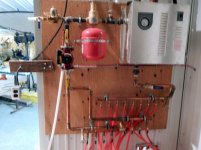
This is my electric boiler setup. It's been running since last fall and I love it. My son put a similar unit in his shop but it's got a cool piece of chrome checkerplate on the backboard. We both ran 1/2" Pex on about 16 " centers, with closer spacings near the outside walls. Works great.
 

Attachments

  • DSCN2159.jpg
    DSCN2159.jpg
    64.1 KB · Views: 38

raspy

Well-known member
Joined
Dec 16, 2010
Messages
103
Location
Wellington, Nevada
We do have more steel than mesh to stiffen the floor.

What kind of plumbing did you run on your solar?

What controls your pump? What is your plan if it gets too hot?

The solar is plumbed with copper supply and return.

If what gets too hot? Do you mean the house or the solar? The solar heats the 600 gallon storage and that heats the house according to the thermostat. If the tanks get to high limit, the solar drains back and waits. This is how it spends a lot of time in the summer, but in the winter it never high limits. Every night it drains back to a holding tank and the air that is waiting in the tanks fills the panels for freeze protection. When collecting, the air in the panels is trapped in the drainback tank while the collectors ware running. It is a closed system.

The solar is a closed loop drain back system that heats the storage with submerged coils. The floor is a another closed loop system with a boiler and heat exchanger. The 600 gallons of storage water is our domestic hot water, which we drink and that transfers the energy to the radiant heat exchanger to heat the floor. There are three separate water system that interact for collection, drinking and heating.
 
OP
W

wildlife

Member
Joined
Feb 23, 2013
Messages
12
The solar is plumbed with copper supply and return.


If what gets too hot? Do you mean the house or the solar? The solar heats the 600 gallon storage and that heats the house according to the thermostat. If the tanks get to high limit, the solar drains back and waits. This is how it spends a lot of time in the summer, but in the winter it never high limits. Every night it drains back to a holding tank and the air that is waiting in the tanks fills the panels for freeze protection. When collecting, the air in the panels is trapped in the drainback tank while the collectors ware running. It is a closed system.


The solar is a closed loop drain back system that heats the storage with submerged coils. The floor is a another closed loop system with a boiler and heat exchanger. The 600 gallons of storage water is our domestic hot water, which we drink and that transfers the energy to the radiant heat exchanger to heat the floor. There are three separate water system that interact for collection, drinking and heating.


Thanks. This will not be connected to any other system. Just fill with glycol and run solar through water heater and slab. Was thinking of running a little pressure and not a drain back. Would like the solar collectors on the ground and freeze protection in shop for if power was out for a while. Will then have to cover it in summer.

What kind of temps do you get back from solar and what temp fluid do you send through your slab?
 

raspy

Well-known member
Joined
Dec 16, 2010
Messages
103
Location
Wellington, Nevada
Thanks. This will not be connected to any other system. Just fill with glycol and run solar through water heater and slab. Was thinking of running a little pressure and not a drain back. Would like the solar collectors on the ground and freeze protection in shop for if power was out for a while. Will then have to cover it in summer.

What kind of temps do you get back from solar and what temp fluid do you send through your slab?

To get the most from the solar, design it to cool the collectors, not heat the water. This method keeps the panels as cool as possible, which means as efficient as possible, which means you extract the maximum energy from the panels. The hotter the return water from the solar collectors, the lower the overall efficiency. Never try to make the water hot or judge the performance by how hot the water can get.

If you fill your floor, water heater and solar panels all at the same time, without a means to drain the collectors automatically, they will stagnate when the floor gets to full temperature. This will mean that the temp goes up past the boiling point and creates steam. This raises the pressure to dangerous levels and pops the relief valve. It also may damage the glycol.

Having a simple expansion tank in the solar loop is not sufficient to control the stagnation pressures, if you don't drain the collectors. The only way you'll get away with that is if you have extremely inefficient panels, such as unglazed pool panels, and they will not perform in less than perfect weather.

Maybe I'm missing something in your design or question. Help me understand
 
OP
W

wildlife

Member
Joined
Feb 23, 2013
Messages
12
To get the most from the solar, design it to cool the collectors, not heat the water. This method keeps the panels as cool as possible, which means as efficient as possible, which means you extract the maximum energy from the panels. The hotter the return water from the solar collectors, the lower the overall efficiency. Never try to make the water hot or judge the performance by how hot the water can get.


If you fill your floor, water heater and solar panels all at the same time, without a means to drain the collectors automatically, they will stagnate when the floor gets to full temperature. This will mean that the temp goes up past the boiling point and creates steam. This raises the pressure to dangerous levels and pops the relief valve. It also may damage the glycol.


Having a simple expansion tank in the solar loop is not sufficient to control the stagnation pressures, if you don't drain the collectors. The only way you'll get away with that is if you have extremely inefficient panels, such as unglazed pool panels, and they will not perform in less than perfect weather.


Maybe I'm missing something in your design or question. Help me understand


I am still thinking it through so I am sure there are situations I am missing. Draimback makes sense but I was hoping to avoid more complications

If I have the correct number of panels can I just dump heat into the slab all day and it won’t overheat the collectors. I guess I might need to cover some of the collectors in early fall or late spring. This is a garage where room temperatures between 55 and 75 would be acceptable. And if below 55 in the room the propane hot water heater turns on.

With no summer use (covered)and glycol do you think I can get away pumping during sunlight and not use a drain back?
 

raspy

Well-known member
Joined
Dec 16, 2010
Messages
103
Location
Wellington, Nevada
With no summer use (covered)and glycol do you think I can get away pumping during sunlight and not use a drain back?

Yes. But you are going to a lot of trouble and building in continued maintenance to avoid doing it in a much better way. Besides, drainback is very simple to arrange.
 

walrus

Well-known member
Joined
Nov 12, 2008
Messages
11,672
Location
Maine
The pumping away stuff I have been able to find is helpful. Thank you.

I have never seen the supply feed into the Space between the air scoop and expansion tank but it makes sense.

The heat loss we calculated to 35k btu.

Going to try a 40 gallon, 40kbtu propane power vent hot water heater.

Want to connect solar flat plate to feed floor all day and then have propane just for if it’s cloudy for several days. Still looking for plumbing examples for that as a closed direct system running glycol.
My shop is solar only, no back up heat except wood stove. 4 loops 1/2 apex, 12 inches on center, 34 by 30 shop. 2 inch foam under and on edges. Build it solar type homemade collector. Glycol, no drain back. 10 by 16 collector built in South wall as I don't want heat in summer. Coldest I've seen shop is this winter, got into upper 30s but never froze. Generally runs in upper 40s to low 50s. Shop is heavily insulated. My signature has link to build

Sent from my SM-G950U using Tapatalk
 
OP
W

wildlife

Member
Joined
Feb 23, 2013
Messages
12
My shop is solar only, no back up heat except wood stove. 4 loops 1/2 apex, 12 inches on center, 34 by 30 shop. 2 inch foam under and on edges. Build it solar type homemade collector. Glycol, no drain back. 10 by 16 collector built in South wall as I don't want heat in summer. Coldest I've seen shop is this winter, got into upper 30s but never froze. Generally runs in upper 40s to low 50s. Shop is heavily insulated. My signature has link to build

Sent from my SM-G950U using Tapatalk

Your shop looks great. Thanks for the link. We don't have as much insulation but we hope it is enough for Maryland winters. Our heat load is about 35,000 btu. How did you size your collector to your load?
 

walrus

Well-known member
Joined
Nov 12, 2008
Messages
11,672
Location
Maine
Your shop looks great. Thanks for the link. We don't have as much insulation but we hope it is enough for Maryland winters. Our heat load is about 35,000 btu. How did you size your collector to your load?

I didn't size it to the load, I just went ahead and built it in the spot I had set up for it. I have solar DHW in my house so I had an idea when and how much time the panel would supply heat. For example I knew Thanksgiving to February would supply little heat as day length is so short and sun is so low. I thought my collector would be big enough but I really should have covered the whole south wall. At this time a year I get some heat in the slab on a sunny day but it still won't over heat the building. I don't have TStat, if the collector is 10 degrees warmer than floor pump starts to run. Takes a lot of BTUs to raise 20+ yds of concrete a few degrees. I built it based on www.Builditsolar.com
 
To avoid these ads, REGISTER NOW!
Top Bottom