To avoid these ads, REGISTER NOW!

PEX SIZING

Walkers

Well-known member
Joined
May 17, 2021
Messages
3,912
Location
Cave Creek Az
I need to connect the well on the property I bought to my house. The run is 135’. Every well connection in this area is made with 1-1/4” PVC. WHEN I look at 1-1/4 pex the price is about triple that of 1”. I have landscape and garden irrigation as well as household water use comin through this, so I don’t want to starve my system and have rotten showers when the garden sprinklers come on, but I have never seen a sizing chart for the supply line. Any ideas?
 
To avoid these ads, REGISTER NOW!

juddspaintballs

Well-known member
Joined
Sep 1, 2011
Messages
324
Location
Hedgesville, WV
Every well I've ever dealt with used black polyethylene tubing for the horizontal run. Poly tubing will have a larger ID than PEX will and should be significantly cheaper.

If you're concerned about shower pressure when the sprinklers come on, use a large pressure tank or multiple pressure tanks. It'll take longer to draw down, and thus take longer to refill meaning your pump won't be cycling on and off as often and you won't notice the pressure changes at the faucet nearly as much because they'll fluctuate more slowly.
 

rlitman

Well-known member
Joined
Oct 18, 2010
Messages
24,591
Location
Long Island
...Every well connection in this area is made with 1-1/4” PVC. WHEN I look at 1-1/4 pex the price is about triple that of 1”...
You're making an apples to bananas comparison. PVC is IPS sized while PEX is CTS sized, so the ID of 1-1/4" PEX (1.054" ID) is closer to that of 1" PVC (1.049" ID), and 1" PEX (.875 ID) is comparable to 3/4" PVC (.824" ID). So, you'd need 1-1/2" PEX (1.244" ID) to match the flow of 1-1/4" PVC (1.380" ID), since PEX does a little better without fittings.
 
OP
W

Walkers

Well-known member
Joined
May 17, 2021
Messages
3,912
Location
Cave Creek Az
You're making an apples to bananas comparison. PVC is IPS sized while PEX is CTS sized, so the ID of 1-1/4" PEX (1.054" ID) is closer to that of 1" PVC (1.049" ID), and 1" PEX (.875 ID) is comparable to 3/4" PVC (.824" ID). So, you'd need 1-1/2" PEX (1.244" ID) to match the flow of 1-1/4" PVC (1.380" ID), since PEX does a little better without fittings.
Ikm not necessarily concerned with that, justsaying I don’t want to have something like that happen because I made a bad choice in pipe size.
 
OP
W

Walkers

Well-known member
Joined
May 17, 2021
Messages
3,912
Location
Cave Creek Az
Every well I've ever dealt with used black polyethylene tubing for the horizontal run. Poly tubing will have a larger ID than PEX will and should be significantly cheaper.

If you're concerned about shower pressure when the sprinklers come on, use a large pressure tank or multiple pressure tanks. It'll take longer to draw down, and thus take longer to refill meaning your pump won't be cycling on and off as often and you won't notice the pressure changes at the faucet nearly as much because they'll fluctuate more slowly.
I was looking at pex because I have the tools. What is used to connect the black poly?
 

LopezBart

Well-known member
Joined
Oct 13, 2023
Messages
2,527
Location
Lopez Island, WA
Stainless hose clamps. Poly is used on all the service entries around here.

Black poly is very common here as well for both well piping and ditches. Buy the good stuff; my dad bought some that was apparently a bit thinner almost 50 years ago and my brother and I will be doing ditching at some point to replace it.
 

Eric S.

Active member
Joined
Jul 4, 2016
Messages
25
Location
Vancouver Island, BC
I ran polly. Also used the compression fitttings (made by Philmac) for the ends to switch over to NPT. Seemed better than the hose clamp and barb.
 

karoc

Well-known member
Joined
Dec 19, 2017
Messages
1,995
Location
Hemphill Tx
I always thought that irrigation systems for lawns came on at night, or maybe you could run yours at night
 
To avoid these ads, REGISTER NOW!

rayra

Well-known member
Joined
Dec 1, 2014
Messages
4,724
Location
Escaped from Los Angeles
re the OP's question, don't you have a holding tank between wellhead and pressure system? I mean does the diameter of the wellpipe really make a difference in your usage flow? Doesn't seem to me like it should matter. Well fills the tank, you use water out of the tank, your system ought to be sized so your use doesn't ever empty the tank.

/or I don't understand it. I'm trying to, I intend to use such systems on rural property in the future. But I'm intending to have some large tanks in the 3-5k gal size.
 

Hank11

Well-known member
Joined
Aug 19, 2019
Messages
1,145
Location
Tennessee
Does the well produce a large enough volume of water? That’s going to be pretty important. If not you need plenty of holding capacity.
 

LopezBart

Well-known member
Joined
Oct 13, 2023
Messages
2,527
Location
Lopez Island, WA
re the OP's question, don't you have a holding tank between wellhead and pressure system? I mean does the diameter of the wellpipe really make a difference in your usage flow? Doesn't seem to me like it should matter. Well fills the tank, you use water out of the tank, your system ought to be sized so your use doesn't ever empty the tank.

/or I don't understand it. I'm trying to, I intend to use such systems on rural property in the future. But I'm intending to have some large tanks in the 3-5k gal size.
Large tanks for water are unpressurized; you need a booster pump to move it to the house/sprinklers unless you're lucky enough to be able to elevate that tank 40 or more feet above your point of use. You end up w/ a float or pressure system to detect water level in the large tank, and then switch the well pump on and off as needed to refill the tank. A suitable amount of hysteresis is needed between on and off. A booster pump and a small pressure tank would provide water for the house.
This is all doable, and is necessary if the well produces water at a rate much lower than you wish to be able to deliver it. However, there's more to go wrong, and something will sooner or later.

Most wells are capable of providing enough water to meet immediate domestic needs, so a small (generally less than 75 gallons) pressure tank is used to avoid starting the well pump too often every time someone wants a drink of water.
 

36truck

Well-known member
Joined
Jul 13, 2010
Messages
980
Location
UP of Michigan
Use 160 pound black poly pipe. Our well driller only uses Poly pipe. I ran 1 1/4" poly pipe for 300 feet from my well to the house with no issues.
 

juddspaintballs

Well-known member
Joined
Sep 1, 2011
Messages
324
Location
Hedgesville, WV
I was looking at pex because I have the tools. What is used to connect the black poly?
As others have already said, you have a couple options. The easiest is to just use a barbed fitting and two stainless steel worm-drive clamps to hold it on. It is simple and inexpensive and doesn't require any tools other than a screwdriver or hex driver.
 

kaffine

Well-known member
Joined
Dec 13, 2009
Messages
3,610
Location
Henderson, NV
How much water flow are you going to have?

How much does your irrigation system use? your house?

If your main concern is how pressure when irrigation is on you could run 2 pipes one for irrigation the other for the house. Use 1inch for both. I would go and check friction loss on the pipe with expected flow though. Also what pressure are you running your well at? If you are running 25psi then a few psi drop is going to be a bigger issue than if you are running 80 psi.

When I replaced my water line for my house I used 2 inch HDPE IPS size pipe. I had a 700 foot run and ~15 feet of rise. I went overkill but the expensive part was the trench for me. I used HDPE due to cost vs PEX if I was to do it again I would probably use PEX as I spent a bit of money on specialty tools as I did fusion weld fittings.

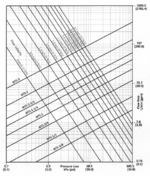
Looking at pressure drop per 100ft 1-1/4" pvc is 1.4psi at 15gpm. 1 inch pex is 12.72psi while 1-1/4" pex is 4.9psi, and 1-1/2" pex is 2.2psi.
 

csp

Well-known member
Joined
Mar 23, 2010
Messages
5,719
Location
Franktown, CO
We've used the higher PSI blue poly on the last four homes we've built. It's sized SDI, so it has thicker walls to meet the higher PSI ratings, usually 200 or 250 psi.
 
OP
W

Walkers

Well-known member
Joined
May 17, 2021
Messages
3,912
Location
Cave Creek Az
We've used the higher PSI blue poly on the last four homes we've built. It's sized SDI, so it has thicker walls to meet the higher PSI ratings, usually 200 or 250 psi.
What is the blue poly called, what is SDI?
 

kaffine

Well-known member
Joined
Dec 13, 2009
Messages
3,610
Location
Henderson, NV
What is the blue poly called, what is SDI?

It is HDPE pipe like the black poly, it is there has been a push recently to color code all pipes underground so it comes in blue for potable water. Not sure how many places if any are requiring this yet though.

SDI should probably be SDR for standard dimension ratio the SDR along with the actual type of HDPE determines the pressure rating. There are at least 2 different formulas in use one will provide a higher pressure rating with a thinner wall (higher number SDR).
 
Last edited:
To avoid these ads, REGISTER NOW!
Top Bottom