To avoid these ads, REGISTER NOW!

Phone line physical disconnect

pendragon1998

Well-known member
Joined
Mar 24, 2012
Messages
3,733
Location
NE Georgia
I'm a little paranoid about lightning strikes damaging my PC. It's happened in the past, when lightning came up the phone line, blew out my modem and fried my power supply (stopping there, thank goodness). I of course run a good quality surge protector and my phone line for my DSL runs through the surge protector also: phone line into protector, separate phone line to my router/modem.

Whenever there's a thunderstorm coming, I try and unplug everything too. I unplug the surge protector from the wall electical and I unplug the incoming phone line from the surge protector, reasoning that if the phone line is going into the protector and the protector fails, then the surge could continue up the phone line into my PC. Maybe it's paranoid, but I really can't afford to lose my system/data.

Anyway, crawling under my desk after the phone line is getting old, and the wall side is behind furniture so it's even more inaccessible. I'd like to have a little switch panel I could attach to my desk that would physically disconnect the phone line before it enters the surge protector, without leaving loose wires needing to be plugged back in. I just want a cheap switch to throw that would guarantee lightning can't travel past that point. Any suggestions?

Can y'all suggest something? Like this, but for telephone cords? Available on Amazon would be perfect.

337974-vintage-style-electrical-switch.jpg
 
To avoid these ads, REGISTER NOW!

aandpdan

Well-known member
Joined
Nov 12, 2009
Messages
849
Location
In between MA and PA
OP
P

pendragon1998

Well-known member
Joined
Mar 24, 2012
Messages
3,733
Location
NE Georgia
Yes, and to be clear, I'm always going to be unplugging my electrical end. I'm just looking for a telephone line solution. I see your point about signal degradation, that's no good.
 

A_Pmech

Well-known member
Joined
May 8, 2007
Messages
8,002
Location
IL
DSL modems are cheap. I leave mine plugged in 24/7/365

I connect to it via WIFI. In a storm I just unplug my laptop from the wall and continue surfing.
 

southalabama

Well-known member
Joined
Jan 10, 2011
Messages
5,547
Location
Brewton AL
Just run a plug with a female end to top of desk and tape it down. Then run another cord from modem.

Make the connection topside and avoid crawling under or around the computer
 

CharlieM

Well-known member
Joined
Jan 8, 2005
Messages
280
Are you sure it came from the phone line? If your DSL/pots line is installed correctly, there is minimal chance that a lighting strike will do that. If it was a strike you would be replacing a lot more than your modem/ power supply. Call your telco and make sure there's a box (nid) in or on the house that houses fuses and is grounded to a real ground.
 

volleyball

Well-known member
Joined
Aug 29, 2011
Messages
4,127
Location
NY, not NYC
Go add lightning rods to the exterior.
adding a jack that is easily accessible is much better than the knife switch.
 
OP
P

pendragon1998

Well-known member
Joined
Mar 24, 2012
Messages
3,733
Location
NE Georgia
Our internet options, here in the outskirts of town, are satellite (slow and expensive) or ATT DSL (via a telephone line). We don't have cable or UVERSE. We actually don't have a land line for telephone, just for internet.

The lightning strike I mentioned was at our old place. It hit a pine next to the house, went through the saturated ground, and up into our underground telephone line. The telephone jack was blackened and smoking afterwards, so it was definitely the culprit.

I guess I'll just get a short extension and attach it to the desktop. Might as well keep things simple.
 

APEowner

Well-known member
Joined
Oct 2, 2009
Messages
4,177
Location
Sunny, New Mexico
Just run a plug with a female end to top of desk and tape it down. Then run another cord from modem.

You could even go one step better (although you wouldn't be able to play with duct tape) and mount a surface mount pone jack on the desk or somewhere accessible.

You should also look at how all of the grounding is done on your house. The NID, cable entrance, satellite dish and power entrance should all be bonded to the same location. That can make a big difference in how equipment survives lightning hits.
 

Slednut

Well-known member
Joined
Dec 20, 2012
Messages
2,563
Location
Washington state
If you ever have a problem with your DSL, unplug it from your personal surge protector, we see these causing problems all the time.
 

MTW

Well-known member
Joined
Aug 6, 2013
Messages
294
Location
SE Michigan
You need a better system ground for your structure and contents. If you know a good sparky, ask him to look your place over for proper grounding and bonding connections.

All of your systems (electric, phone, internet, cable, water, antenna,gas) and mother earth ground, should be tied together at the same point. In this way when the potential voltage does rise, as can happen from time to time, everything rises together. When everything is at the same higher voltage, there's less destructive voltage difference between systems. Think of the tide, it raises all boats at the same time.

Surge suppressors and lighting arrestors don't really do anything, if the system is lacking low resistance / impedance connection to the earth. When there is a good earth ground connection, surge devices can be self sacrificial, and will often degrade over time, from repeated surges. The MOV's (metal oxide varistor) inside your devices will degrade with no outward signs to you. Therefore the best protection over time is a low impedance connection to the earth.

A lot of energy can come through any one or all of your systems very quickly. If it can't dissipate nearly as fast as it comes in something will burn. Take for example this ground clamp. This was being used on a copper water pipe to ground a business phone system. At the time the clamp was relatively clean, as was the pipe, I had repaired the connection myself before the incident. A surge came down the steel messenger supported phone line and melted this zinc die cast ground clamp. No harm was done to the phone system or computers. I only noticed the clamp was melted loose from the pipe later. Next time it got a brass clamp.

GND%20Clamp1.jpg


GND%20Clamp2.jpg


With a manual open switch as you are asking for. It would likely become a flashover point with nowhere else to go. If you want real lasting protection, you got to give it a place to go, and fast.
 

Charles (in GA)

Well-known member
Joined
Jan 11, 2006
Messages
12,489
Location
50 mi south of Atlanta
They do make lightning arresters and surge protectors for phone and cable

NOTHING stops a direct hit. That is why the OP physically disconnects everything. I do the same thing. Middle of the night, I am awakened by thunder. Jump up, shut everything down, unplug the power, the cable from the modem and TV, unplug all of the phones, and go back to bed.

Charles
 

Mustang51js

Well-known member
Joined
Jan 24, 2014
Messages
1,734
Location
Haskell nj
NOTHING stops a direct hit. That is why the OP physically disconnects everything. I do the same thing. Middle of the night, I am awakened by thunder. Jump up, shut everything down, unplug the power, the cable from the modem and TV, unplug all of the phones, and go back to bed.

Charles

I know that,seems a little crazy because you will have issues anyway if the house gets hit,my neighbor had a tree struck in his front yard and it blew out all the cable connectors, water meter melted,radon system shot and big hole in the meter pan.
 
To avoid these ads, REGISTER NOW!

Mustang51js

Well-known member
Joined
Jan 24, 2014
Messages
1,734
Location
Haskell nj
NOTHING stops a direct hit. That is why the OP physically disconnects everything. I do the same thing. Middle of the night, I am awakened by thunder. Jump up, shut everything down, unplug the power, the cable from the modem and TV, unplug all of the phones, and go back to bed.

Charles

I know that,seems a little crazy because you will have issues anyway if the house gets hit,my neighbor had a tree struck in his front yard and it blew out all the cable connectors, water meter melted,radon system shot and big hole in the meter pan. Do you disconnect the grounds to the cable and phone systems also
 

Slednut

Well-known member
Joined
Dec 20, 2012
Messages
2,563
Location
Washington state
Over the last 25 years of working for a phone company I’ve seen what lightning can do. Once it hit a pole, it took nice square chunks out of it. It traveled through 300 feet of C wire, it’s just an aerial cable with a pair of 14 gauge copper wires in it. The entire length of C wires copper had vaporized leaving just the insulation. The insulation had no burn marks, it just felt like a rubber band. Of course the strike also ruined anything outside and inside the house the C wire was feeding.
 

Dustball

Well-known member
Joined
Jun 25, 2011
Messages
2,081
Location
Hudson, WI
NOTHING stops a direct hit. That is why the OP physically disconnects everything. I do the same thing. Middle of the night, I am awakened by thunder. Jump up, shut everything down, unplug the power, the cable from the modem and TV, unplug all of the phones, and go back to bed.

Charles
What you described are the cheaper items in your home. What about all of your appliances? The furnace?


To the OP- how about this? http://www.amazon.com/dp/B003VKRE6Y/?tag=atomicindus08-20
 

Mustang51js

Well-known member
Joined
Jan 24, 2014
Messages
1,734
Location
Haskell nj
Over the last 25 years of working for a phone company I’ve seen what lightning can do. Once it hit a pole, it took nice square chunks out of it. It traveled through 300 feet of C wire, it’s just an aerial cable with a pair of 14 gauge copper wires in it. The entire length of C wires copper had vaporized leaving just the insulation. The insulation had no burn marks, it just felt like a rubber band. Of course the strike also ruined anything outside and inside the house the C wire was feeding.

You just reminded me of a job that I did to replace 12/3 uf wire, lightning strike in the area and about $75 feet of it was separated from the insulation inside of the outer casing, looking at it you couldn't see anything wrong until you cut the outer casing, all the wires were bare. Makes an easy way to strip copper haha
 

bry@n

Well-known member
Joined
Dec 29, 2008
Messages
2,785
Location
Ocean County, NJ
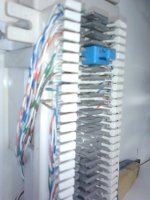
Not sure if this was mentioned, but you can just run the feed cable to one side of a 66 block, use bridging clips to connect the station side at the block.

when a storm is rolling in, just remove the bridging clips.
 

volleyball

Well-known member
Joined
Aug 29, 2011
Messages
4,127
Location
NY, not NYC
That is a lot of work. Not many have 66 blocks in their home. And if you have that many lines to use one, the storm will be over before you can get them all off.
If anyone thinks this is a good idea, send me money and I'll send you a block. Extra money if you want the punch down tool.
 

bry@n

Well-known member
Joined
Dec 29, 2008
Messages
2,785
Location
Ocean County, NJ
The block and bracket can be bought for under $25 at HD. He could also buy a half block. Heck, he doesn't even need to have the bracket.

My suggestion was based in the ability to physically disconnect. Doesn't matter how many lines. He has the ability to remove 25 connections if needed. The fact that he likely only needs 1 or 2 makes it simple.

The storm rolling over before he can disco the bridging clip
Is a bit dramatic and incorrect. With his finger, he can remove the clips from one side and have it be open. This is a quick process and should take him less than a minute to remove.
 

Slednut

Well-known member
Joined
Dec 20, 2012
Messages
2,563
Location
Washington state
That is a lot of work. Not many have 66 blocks in their home. And if you have that many lines to use one, the storm will be over before you can get them all off.
If anyone thinks this is a good idea, send me money and I'll send you a block. Extra money if you want the punch down tool.

I have a few 66 blocks. The bridge clip that is blue can be removed by hand.
 

Attachments

  • P82A0245.jpg
    P82A0245.jpg
    124.4 KB · Views: 19
  • P82A0244.jpg
    P82A0244.jpg
    137 KB · Views: 23
  • P82A0243.jpg
    P82A0243.jpg
    135.1 KB · Views: 21

LS6 Tommy

Well-known member
Joined
Dec 27, 2013
Messages
26,162
Location
Northern NJ
If you have a 66 block in your house removing the bridge clips probably won't protect you from squat if you have a direct lightning strike on your pots line. It'll most likely just jump across...

Tommy
 

westom

Well-known member
Joined
Aug 16, 2009
Messages
221
It's happened in the past, when lightning came up the phone line, blew out my modem and fried my power supply (stopping there, thank goodness).
It did not stop anywhere. First lightning was everywhere in a path to earth. Long later, only a few items conducting that lightning were damaged. Your existing protection is ineffective and may even make future damage easier.

MTW and others described what one must know before making any protection recommendations. Still some completely ignored what was relevant.

Nothing stops a direct hit. Not a switch, 66 block, or magic box. Many only assume unreliable disconnecting is effective. Disconnecting only works if an appliance remains in its box. Direct lightning strikes without damage are routine. That says nothing about 'stopping' lightning. And says nothing about solutions adjacent to an appliance. MTW and APEowner introduced what every protection solution must discuss. It answers this question: Where do hundreds of thousands of joules harmlessly dissipate?

Your telco's CO is connected buildings all over town. Telcos suffer about 100 surges per storm without damage. How often is your town without phone service for four days while they replace that $multi-million switching computer? Never. Because they use a different, well proven, less expensive, and superior solution that a homeowner also implements to suffer no damage. A direct strike without damage is routine. That superior solution is often tens or 100 times less expensive than what others discuss.

Too many use hearsay or wild speculation (ie open switch) to assume something will stop a surge. Or that some adjacent magic box can do protection. Slednut describes more problems created by the ineffective solution. Proper earthing of all wires in every incoming cable is undoubtedly, best protection proven by over 100 years of experience and science. Every useful answer also says where hundreds of thousands of joules dissipate.

Safety ground (third prong) on a wall receptacle is not earth ground. Many ignore an essential expression in MTW's post: "low impedance". No low impedance (ie 'less than 10 foot') connection to earth means a recommendation is bogus. Protection is always about what a surge connects to BEFORE entering a building. "Low impedance" and associated numbers are critical.

OP assumed lightning hit a phone line. Described was more likely lightning entering on AC electric. Phone lines (and cable) already have effective (proven) protection. Lightning is typically 'incoming' on a path without effective protection (ie AC electric). And 'outgoing' to earth on some other path (ie phone line). Why outgoing? Personally inspect what already exists and provides superior protection for phone lines (earth ground).

Without both electrical paths, then damage cannot happen. The surge did not stop in a power supply. Damage is often on an outgoing path. DSL modem damage means a surge was outgoing to earth destructively via its phone line.

Assuming a protector is protection is hooey. Even a $15 switch from Amazon would never and does not claim protection. Another solution that violates basic concepts summarized here. Protection is defined by this question: Where do hundreds of thousands of joules harmlessly dissipate? 'Low impedance' is critical.

Long before defining better protection, first, appreciate reasons that identify bogus recommendations.
 

volleyball

Well-known member
Joined
Aug 29, 2011
Messages
4,127
Location
NY, not NYC
I've been in hundreds of wiring closets, have the 66 and 110 tools and blocks along with boxes of clips but have never seen that blue double bridge clip thing.
And tommy is right about any arc big enough to do damage would be able to jump. The cuts on the bottom means a smaller gap than what you see in front.
Now that we have confused many with terminology, I am dropping talking about 66's
 

Falcon67

Well-known member
Joined
Jun 11, 2009
Messages
18,371
Location
Merkel, TX
If you're still on dial up - just use a good quality UPS like APC with a phone line filter/surge port. If you are on DSL, use a DSL router with wireless and get rid of the cord.
 
To avoid these ads, REGISTER NOW!
Top Bottom