Here's the full explanation:
For the 'British' sizes, the nut/bolt size corresponds to the spanner marking (i.e. a 1/2" W spanner fits a Whitworth bolt with a shank/thread diameter of 1/2"). The original Whitworth sizes were standardised in 1841 by Sir Joseph Whitworth (1803-87) and featured a significant head oversize to accommodate the crude tolerances of the production methods of the day. In 1908 the standard was revised to include the option for a finer thread and became BSF (British Standard Fine) and BSW (British Standard Whitworth). The BSW bolts/nuts use the same coarse thread as the original Whitworth proposal, which is suited to soft or coarsely crystalline materials (e.g. aluminium, cast iron), while the BSF bolts have the same thread profile but a finer cut (i.e. higher TPI value) and, with an adequate length of thread engagement, provide a stronger fastener and better vibration resistance for high tensile materials
The BSF head size was one step smaller than BSW (e.g. a 1/4" BSW bolt was the same head as a BSF 5/16" bolt, etc, avoiding the need for new tools) up to 1924 but there was demand for a similar BSW version so the "British Standard Whitworth (Small hexagon)" standard BSWS was introduced in 1929 in B.S. 129 (also known as "Auto-Whit" presumably from its use in the automotive industry). During the Second World War the standards were revised again as "War Emergency B.S. 916 : 1940" as an austerity measure to reduce steel consumption and this resulted in the normal BSW head sizes being reduced by one step, basically making the BSW = BSWS = BSF head size, also bringing them closer to the size range commonly used today:
- Across flats jaw size = bolt diameter * 1.5 (approximately, only the BA standard has a simple fixed relationship factor at 1.75)
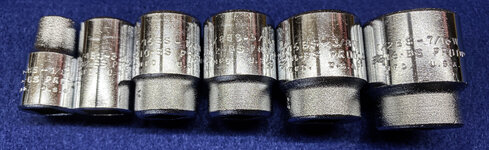
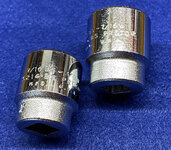
It is not clear post-WW2 if manufacturers returned to the older standard for BSW but it is unlikely as most changes were driven by the adoption of the American and metric systems. The British Standard B.S. 192 of 1924 states that spanners should be marked with both the BSW and BSF sizes, but by 1954 the revised B.S. 192 is referring to "Whitworth large hexagons" so the implication is the WW2 emergency change was permanent and the larger size unusual. That 1954 revision was using the example of 'BS' to refer to the BSF/BSW size and 'W' for the original large hexagon size. Thus you will see spanners marked along the lines of '1/4 W 5/16 BS' indicating the jaws are sized for a 1/4" large hexagon Whitworth bolt, or the next step up at 5/16" for BSF/BSW and that is probably of 1954 or later. However, you sometimes see them marked just as 'BS' and they are the typically the smaller BSF (and WW2-era BSW size), but also I have seen some just with 'W' and referring to the large (original) hexagon size.
Taken from:
Useful guide on spanner to nut/bolt relationships, and the selection and use of spanners and socket sets
www.crawford-space.co.uk





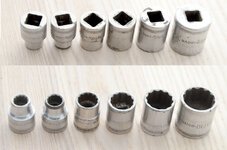

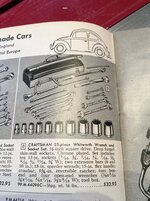


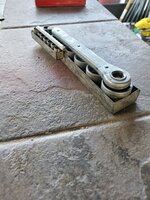
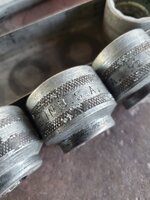

 Please explain it to a confused Colonial.

