To avoid these ads, REGISTER NOW!

Pioneer mini split install - vacuum question

tmshort

Well-known member
Joined
Dec 10, 2012
Messages
396
Location
Central IN
I’ve got my new 18K BTU system close to installed.

I bought one of these along with the kit:
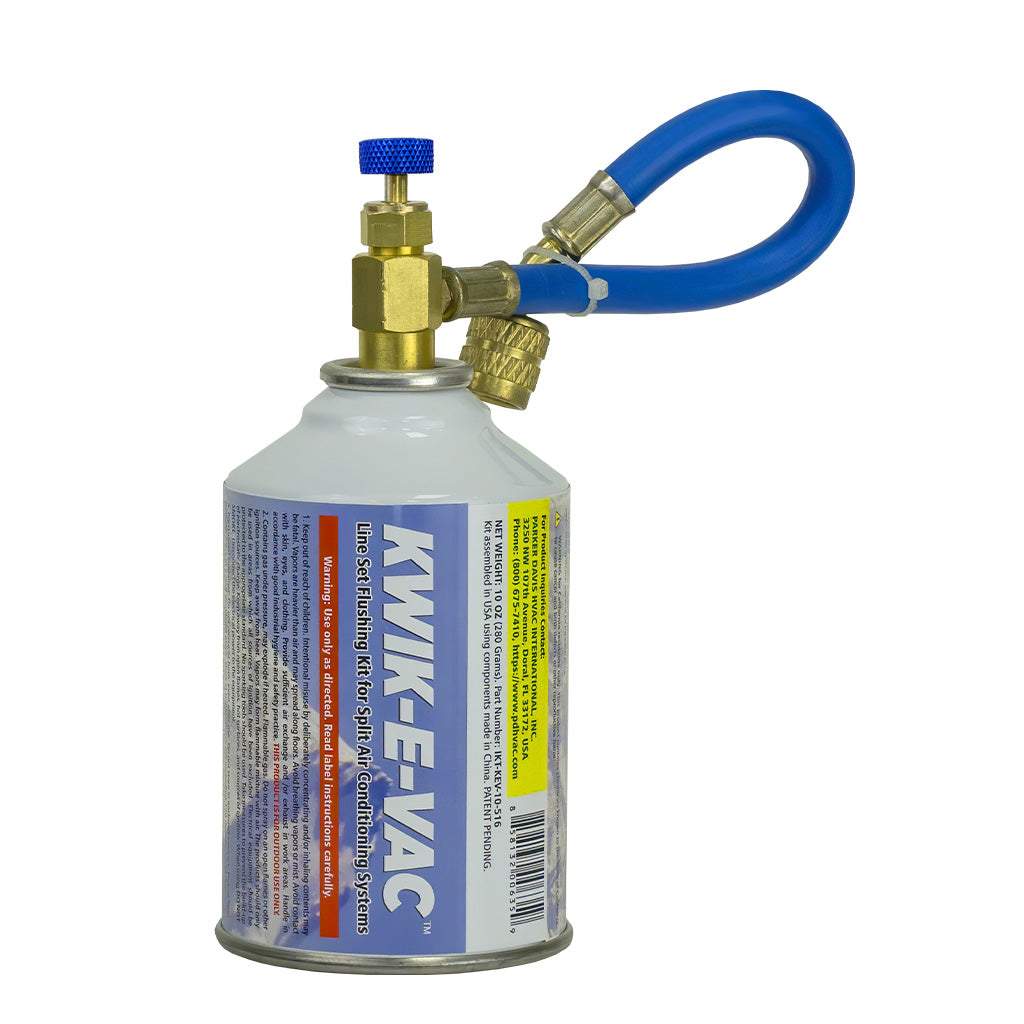

I’m still on the fence about using it (I have gauges and a pump and plan to pull vacuum). What I’m wondering is since I am pulling a vacuum on the system, should I use the kiwi-e-vac before or after? I‘m guessing after would be the best approach, but am not sure.

Anyone have experience with the kwik-e-vac kit?

Thanks,
T
 
To avoid these ads, REGISTER NOW!

slow

Well-known member
Joined
Feb 26, 2006
Messages
2,596
Location
near Orlando
subscribing, I see no reason to add anything to a new system like that, especially when you have the right tools, but I am not a pro. (but I do plan on a minisplit install in the next few months, so I am interested in other perspectives)
 
OP
T

tmshort

Well-known member
Joined
Dec 10, 2012
Messages
396
Location
Central IN
100%, I am going to vacuum the system.
I'm just wondering if I should use the evac in a can, and if so would before or after pulling a vacuum be better.
 

SALIV8

Well-known member
Joined
Dec 11, 2008
Messages
2,114
Location
chicago and s/w michigan
Follow your manufacturers instructions

if they don’t say, pressure test with nitrogen to 350-400# and then pull a vac and watch your microns.

thats what the tech I hired did I believe.
 

yeldogt

Well-known member
Joined
Jan 2, 2012
Messages
18,184
This is interesting --- in Africa and Asia in remote areas they never vac these. Not saying that this is the way it should be done .... it's the way it is done in many parts of the world.

Also -- due to buying power in many parts of the world .... these things are only a few hundred bucks. So if the thing blows up after 8 years ... it's still cheaper than the equipment to vac.

Remember many years ago asking a guy installing them -- why no clean and vac. His response was it's just tubing ... all the metering was in the compressor .. this is how they do them. Blow out the tubing and clamp it off while the refrigerant is flowing to expel the air. This was a major hotel in Korea ..

Interesting kit and idea.
 
Last edited:
OP
T

tmshort

Well-known member
Joined
Dec 10, 2012
Messages
396
Location
Central IN
Follow your manufacturers instructions

if they don’t say, pressure test with nitrogen to 350-400# and then pull a vac and watch your microns.

thats what the tech I hired did I believe.
The manual says pull vacuum. No mention of N pressure testing.
But they sell these kiwi-e-vac cans and say they can be used solo, no vacuum or pressure testing needed.

I am gonna cut and redo the factory flares, and plan to pull a vacuum. Still on the fence about the can of ****, I guess it could give me a little leak test (since the instructions say to release the last 1/3 into the lines and then spray leak test on the fittings). Certainly nowhere near the 3-400psi of nitrogen, but...
 
To avoid these ads, REGISTER NOW!

metlmunchr

Well-known member
Joined
Sep 10, 2011
Messages
1,281
The stuff in the can is R-152a. By using it you would displace the air in the lines and indoor unit, and the small amount of the gas in the lines and unit is compatible with the R-410a used in the mini.

Since you plan to evacuate the system, there's no need to use the can. Evacuation would be preferable to blowing the lines out due to vacuum's ability to remove moisture.

So long as there's liquid remaining in the can of 152a, its pressure should be about 90psi if the can is at 80°F so you could use it for a pressure test on your joints although at a reduced pressure as compared to using nitrogen or other inert gas.

IMO, if you remake the flares properly, and torque the joints to spec, the chances of a leak are slim. If you put the unit in the heat mode, it will put about 400psi on the lines and you can bubble check them at that time.
 

LS6 Tommy

Well-known member
Joined
Dec 27, 2013
Messages
26,162
Location
Northern NJ
This is interesting --- in Africa and Asia in remote areas they never vac these. Not saying that this is the way it should be done .... it's the way it is done in many parts of the world.

Also -- due to buying power in many parts of the world .... these things a only a few hundred bucks. So if the thing blows up after 8 years ... it's still cheaper than the equipment to vac.

Remember many years ago asking a guy installing them -- why no clean and vac. His response was it's just tubing ... all the metering was in the compressor .. this is how they do them. Blow out the tubing and clamp it off while the refrigerant is flowing to expel the air. This was a major hotel in Korea ..

Interesting kit and idea.
That's how the "Old Timers" did things ewehn I was starting out. Purge with refrigerant after reprairs or installation instead of performeing evacuation. They all said they never had an issue. I had to repair a lot of their "no issues" systems later.

Tommy
 

yeldogt

Well-known member
Joined
Jan 2, 2012
Messages
18,184
That's how the "Old Timers" did things ewehn I was starting out. Purge with refrigerant after reprairs or installation instead of performeing evacuation. They all said they never had an issue. I had to repair a lot of their "no issues" systems later.

Tommy
Time is always the best test .....

Conventional systems have a R/D in the system ... have not spent much time looking inside a mini compressor. Just had my oldest one serviced two weeks ago and the only thing I can say is the 30k BTU rotary compressor is smaller than expected. Should have looked inside a bit more .... don't know if they have a R/D inside. All my carrier systems have the R/D installed near the air-handler inside .... years ago these things were always outside.

We had a mini split in our home in Japan back in the late 60's -- these things have been around for a long time. I have 3 at my home in SA ..but, I have no idea how they were installed. They are in cape town -- so my guess as best as possible in SA. But -- other places ... I really don't think they get the full treatment

Would love to know how many of these things are just connected up and how long do they actually work ... the big problem with these things are leaks. IMO -- the flare still being the norm is the problem. The industry should move past this old connection ...

With all clean equipment and caped lines -- how much moisture will be in 30' of tubing after a purge. How much can a R/D capture ?

IMO -- the industry does not want this information out there or the better connections .... this makes it a homeowner product needing little upkeep.
 

jjrbus

Well-known member
Joined
Dec 8, 2018
Messages
628
Location
Florida
I became confused watching you tube videos when getting ready to DIY a mini system. Most sense I can make of it is the old R22 systems operated at much lower pressures and were way more forgiving than 410. Daikin testing specifies testing to 625 psi with nitrogen and evacuating to under 500 microns. There is also a go/no go flair gauge, specialized flairing tools and torque wrenches available.

Appears to me the good old days of bailing wire and duct tape, good enough are gone.
 
OP
T

tmshort

Well-known member
Joined
Dec 10, 2012
Messages
396
Location
Central IN
I ended up not using the can of Kwik-****.
I pulled a vacuum per the install manual, let it sit for a while (more than specified), and the needle didn’t move.
Opened the valve for 5 sec per the install manual, which got me ~50psi on the gauge. Let that sit for a bit (manual says “a few minutes”) and the needle didn’t move. Sprayed all the connections with leak check. No bubbles.
Released the gas and let the AC run. It’s putting out cold air, all seems fine. Repeat leak check under operating pressure (cooling, lower than heat) shows no bubbles so far...
 

tyyost

Well-known member
Joined
Jan 14, 2009
Messages
810
Location
Tunkhannock, PA
OP, I’m looking to add a mini split to our living room, spending some time doing the research and checking things out. What made you pick a Pioneer? From my end I’d be at least $500 less than other comparable in a 2 Ton units. I’m not sure if I should bite the bullet and pay now for a different unit or expect the same service life with a Pioneer?
 
OP
T

tmshort

Well-known member
Joined
Dec 10, 2012
Messages
396
Location
Central IN
@tyyost I spent a long time planning the project (probably more than a year) with tons of reading about different options.
Pioneer seemed the best fit for me. I didn't want precharged lines (Mr Cool), as I wanted to cut them to length.
The Pioneer units get good reviews, and I really haven't come across many long term negative reviews.

I just ordered a second 18K BTU unit for the upstairs of the shop.
 

Terry D

Well-known member
Joined
Mar 25, 2015
Messages
2,202
Location
St. Louis, MO.
@tyyost I spent a long time planning the project (probably more than a year) with tons of reading about different options.
Pioneer seemed the best fit for me. I didn't want precharged lines (Mr Cool), as I wanted to cut them to length.
The Pioneer units get good reviews, and I really haven't come across many long term negative reviews.

I just ordered a second 18K BTU unit for the upstairs of the shop.
Just a FYI, not all Mr Cool units are DIY.
 

tdkkart

Well-known member
Joined
Jun 17, 2006
Messages
6,887
Location
Eastern Iowa
Just in case someone is searching the Kwik-E-Vac setup, I can say I've installed 2 Pioneer 24k systems in the last week, used the Kwik-E-Vac on both and both systems are up and running just fine.

It makes sense, blow down the lines with an inert gas(Diphlorathane according to the label on the can), removes the moisture and other possible and once the lines are snugged down, provides an initial leak test under pressure. The kwik gas is then released and the freon is released from the condensor unit, which the provides approx. 150psi in the lines for an additional leak test.
No vacuum pump, no gauge set required.
 
To avoid these ads, REGISTER NOW!
Top Bottom