
You are using an out of date browser. It may not display this or other websites correctly.
You should upgrade or use an alternative browser.
You should upgrade or use an alternative browser.
Pipe tongs identification
- Thread starter rivkarm
- Start date


Private Lugnutz
Well-known member
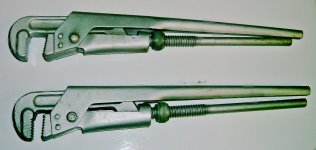
A very popular tool in Europe in the middle of the last century. Those aren't Rheidco, but Rheidco made them in that style and a similar very popular adjustable plier-wrench in the same style. No missing wooden handle, although they do have that appearance commonly eliciting the same thought. Yours is probably Russian. That branding looks Cyrillic. There is another similar example posted by @Fred Knox here...
 www.garagejournal.com
The Ancient and Independent Order of Oddfellows (Adjustables, that is...)
Snerk.
www.garagejournal.com
Last edited:
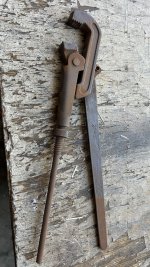
Hello!Any information on the age and maker of these? Is there a handle (wood?) missing on the thin round handle?
This wrench was manufactured in the USSR at the "Voroshilovgrad October Revolution Locomotive-Building Plant."
From 1970 to 1990, the city of Luhansk (Луганск), located in eastern Ukraine, was known as Voroshilovgrad (Ворошиловград). During the Soviet era, the city was renamed in honor of Marshal Kliment Voroshilov, an associate of Stalin.
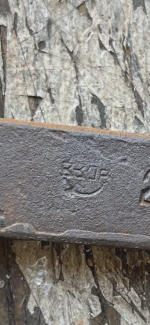
In Russian, the plant's name is written as "Ворошиловградский тепловозостроительный завод имени Октябрьской революции," and the stamp—the initials "В.З.О.Р." (V.Z.O.R.)—forms the Russian word "gaze".
The plant was founded by the German industrialist Gustav Hartmann in 1896 and originally produced steam locomotives. It was nationalized in 1918 following the Revolution and switched to manufacturing diesel locomotives in 1956. It still exists today, although production has been halted since 2016 due to the Russo-Ukrainian conflict.
The wrench was manufactured between 1971 (when this trademark was registered) and 1990, when the city’s name was restored to Lugansk and the plant was renamed "Lugansk-diesel-locomotive" (Лугансктепловоз).
In Russia, wrenches of this type are known as "pipe wrenches," "gas wrenches," or "Swedish wrenches." They are used primarily by plumbers to tighten or loosen pipes and fittings. This design was invented in the late 19th century by the Swedish inventor and industrialist Johan Petter Johansson.
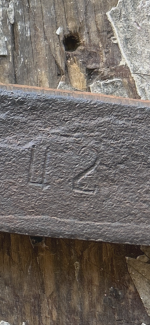
The numbers "20–50" indicate the nominal size range of the parts the wrench can grip. The letter "Ц" (Ts) is an abbreviation for «цена» (tsena), meaning "price." State price regulation was introduced in the USSR in the late 1950s, requiring manufacturers to mark prices on their products. Thus, the wrench cost 2 rubles. Average salaries in the 1970s and 1980s were around 160–190 rubles per month.
There is no wooden handle; the wrench looks exactly as it did when it left the factory, except for the paint.
Last edited: