To avoid these ads, REGISTER NOW!

Pipe wrench needed - but what kind?

Scewter

Member
Joined
Apr 18, 2017
Messages
7
Hi folks. Working on a plumbing project and ran across this short length of pipe that I'll need to remove. Never seen this type of pipe and was wondering if anyone has run into this before. Looks like it calls for a specialized type of pipe wrench, but I'm not sure.

Any help is really appreciated.

thnx20231216_131745.jpg
 
Last edited:
To avoid these ads, REGISTER NOW!

rlitman

Well-known member
Joined
Oct 18, 2010
Messages
24,591
Location
Long Island
that ****** is a water inlet for a hot water heater . the dip tub has been cut off short
a regular pipe wrench and an adjustable will work for you
I don't believe the blue is part of the dip tube. It looks to me like an ordinary dielectric heat trap ****** screwed onto a piece of stainless flex. Be aware that heat trap ******* are check valves, so the direction they get installed in is important.
 

DGersic

Well-known member
Joined
Mar 12, 2017
Messages
6,285
Location
DeKalb, IL
Hi folks. Working on a plumbing project and ran across this short length of pipe that I'll need to remove. Never seen this type of pipe and was wondering if anyone has run into this before. Looks like it calls for a specialized type of pipe wrench, but I'm not sure.

Any help is really appreciated.

thnx20231216_131745.jpg20231216_131745.jpg
I’d put slip joint pliers / channellocks on the indented part, and a wrench on the flats.
 

KnurledNut

Well-known member
Joined
Jan 28, 2011
Messages
8,106
Location
n/a
Nothing special needed. Shouldnt even need a pipe wrench. The supply line has a rubber washer inside. Its probably not that tight.
What are you trying to accomplish anyways?
 
OP
S

Scewter

Member
Joined
Apr 18, 2017
Messages
7
Thnx for the attention to this.

I should have said in the opening - this is one of two going into/out of a water heater. They're extensions (*******) that stick up out of the top of the heater housing when the top is fastened in place. I was considering replacing them with other's that are longer for installation of the unit. The blue plastic visible at the top is some kind of liner that extends down to the crimped area and no further.

The narrow or crimped portion of the ****** appears to be used for a tool to lock on to while attaching additional fittings.

I was thinking of using a regular pipe wrench until I started looing closely at this - which got me thinking these indents were meant for a specialized wrench to grab onto instead of using a pipe wrench?
 
To avoid these ads, REGISTER NOW!

Shiftless

Well-known member
Joined
Mar 9, 2014
Messages
14,504
Location
East Bay SFO
DIELECTRIC ******


Seems to me that part will function as a dielectric union without the convenience of disassembly.

Here is an explanation from the web.

A dielectric union is a plumbing fitting that is meant to join two dissimilar metal pipes so they don’t experience a galvanic reaction and begin to rust. This is especially true for copper and galvanized steel piping which is usually the case when a copper supply water piping line meets the galvanized steel pipe hookups of a hot water tank. If your supply lines are galvanized to match with your water heater tank then there is no need for a special union.

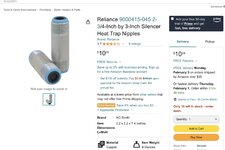
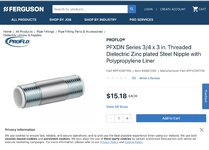
Here is a part called a heat trap ******. That’s a funny term. How would this part stop heat moving from the water heater to the house plumbing?

Anyway…here is a pic.

A dielectric union would let somebody more easily remove the water heater. If you don’t need a union, use a part like you have. Here is a pic of one called a dielectric ******.
 

Attachments

  • 7656C1BE-B3F8-4C3E-9494-FF89157C1E52.jpeg
    7656C1BE-B3F8-4C3E-9494-FF89157C1E52.jpeg
    390 KB · Views: 10
  • AE0F22CC-3659-41A9-BEB8-F438BEBA1570.jpeg
    AE0F22CC-3659-41A9-BEB8-F438BEBA1570.jpeg
    430.6 KB · Views: 8
Last edited:
OP
S

Scewter

Member
Joined
Apr 18, 2017
Messages
7
The ******* have not been removed - they're still installed from the factory.

I'll still need some kind of wrench to hold these ******* in place while attaching a fitting or coupling to them.
 

rlitman

Well-known member
Joined
Oct 18, 2010
Messages
24,591
Location
Long Island
...Here is a part called a heat trap ******. That’s a funny term. How would this part stop heat moving from the water heater to the house plumbing?...
The check valve portion is made of plastic. It prevents water from circulating in the vertical pipes above the tank due to convection, and the plastic liner provides a little insulation between the hot water inside and the metal. It's all in the name of reducing standby heat losses from the tank to the room.

There are several styles of these fittings. Some have everything happening in the plastic (usually with a rubber flapper), while others have a plastic ball floating inside. These appear to be the ball type, where the crimped ring is what traps the ball, as well as indicates the direction of flow to the factory installer.
heat-trap-ball-style.jpg

As Cobbler said, these fittings are not meant to be removed, and they are designed to be screwed directly into the water heater tank, but yes, they can be turned with an ordinary pipe wrench. Just be sure to install them in the correct orientation. The pictures in this thread show it in two different orientations. The first shows it with the dimples facing the flex, and the second shows it with the dimples facing the tank. ONE OF THOSE IS WRONG! Unfortunately, without handling it, I can't say for sure which is correct, but the wrong orientation will prevent water from entering your water heater (it is a check valve after all).
 

KnurledNut

Well-known member
Joined
Jan 28, 2011
Messages
8,106
Location
n/a
The ******* have not been removed - they're still installed from the factory.

I'll still need some kind of wrench to hold these ******* in place while attaching a fitting or coupling to them.
Is this a new installation?
The ******* are already tight. No need to hold them, just connect up.
Have a pipe wrench around just in case, but you shouldnt need it to install.
What fittings/couplings are you attaching?
I would recommend installing an expansion tank and also a shut off valve on the cold side while you’re at it. Leak pans are wise, but dont always fit the space.

Give us some details about your project. It’s hard to follow what you’re doing as the pictures show one thing and your words another.
 
OP
S

Scewter

Member
Joined
Apr 18, 2017
Messages
7
First off - thnx for all the posts and interest.

Task at hand is pretty simple - replacing a residential water heater. Was trying to make this thread a question about a new type of wrench - at least new to me anyway. In trying to keep it simple guess I missed the mark here. Anyway I think I got my answer which is this ****** doesn't take any type of specialized wrench to grab with - just use a common pipe wrench, or cobra pliers or slip joint pliers.

OK, moving on.

The ******(s) is not a check valve. I say that because it has no flap valve or ball in it. Just open pipe with that short plastic liner insert. Looking down through each you can see all the way down to the top of the tank. No obstructions.

The new tank is replacing a similar tank (50 gal) with identical hook-up. The new tank may be slightly taller than the existing one. There's an existing expansion tank attached along with a number of shutoffs. This tank feeds a 3/4" recirculation loop powered by a Grundfos recirculating pump.

That's about it.

thnx again.
 
To avoid these ads, REGISTER NOW!
Top Bottom