
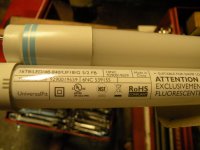
I've converted several of my old two-tube 48" fluorescent fixtures to LED's - I've used the Philips UniversalFit in the 4000K color. I really like them - tons of light, not too blue, not too yellow. Great.
I've converted several of my old two-tube 48" fluorescent fixtures to LED's - I've used the Philips UniversalFit in the 4000K color. I really like them - tons of light, not too blue, not too yellow. Great.
I have another fixture to convert, so got the exact same LED's, same color and all. They don't work. In fact, they are doing the same thing the old fluorescents were doing: one tube glowing dimly, the other doing nothing.
OK, stuff happens, so I called Philips tech support, who proceeded to explain that their LED's are only supposed to work with Philips ballasts, and might or might not work with others. Offered NO support or advice on how to proceed.
That is, to say the least, NOT UNIVERSAL. I don't care if they want to make their LED's so they only work with one special ballast, just SAY SO UP FRONT.
And so we come to the real point of this message. Can anyone out there in GJ-land give me a direction to proceed? I suspect the ballast is bad, but don't really know how to test it. I have a dim understanding that it's a kind of transformer, but that's about it. I did whip out a meter and measured 56 ohms between the red and blue wires, zero between the two reds and the two blues, and about 2 ohms between the yellows.
Does the ballast actually need to be there at all? don't really know how to test it. I have a dim understanding that it's a kind of transformer, but that's about it. I did whip out a meter and measured 65 ohms between the red and blue wires, zero between the two reds and the two blues, and about 2 ohms between the yellows.
Does the ballast actually need to be there at all?
Just for laughs I plugged it in without the tubes and measured 289VAC between the red and blue wires, and 6vac between the yellows.
I've converted several of my old two-tube 48" fluorescent fixtures to LED's - I've used the Philips UniversalFit in the 4000K color. I really like them - tons of light, not too blue, not too yellow. Great.
I have another fixture to convert, so got the exact same LED's, same color and all. They don't work. In fact, they are doing the same thing the old fluorescents were doing: one tube glowing dimly, the other doing nothing.
OK, stuff happens, so I called Philips tech support, who proceeded to explain that their LED's are only supposed to work with Philips ballasts, and might or might not work with others. Offered NO support or advice on how to proceed.
That is, to say the least, NOT UNIVERSAL. I don't care if they want to make their LED's so they only work with one special ballast, just SAY SO UP FRONT.
And so we come to the real point of this message. Can anyone out there in GJ-land give me a direction to proceed? I suspect the ballast is bad, but don't really know how to test it. I have a dim understanding that it's a kind of transformer, but that's about it. I did whip out a meter and measured 56 ohms between the red and blue wires, zero between the two reds and the two blues, and about 2 ohms between the yellows.
Does the ballast actually need to be there at all? don't really know how to test it. I have a dim understanding that it's a kind of transformer, but that's about it. I did whip out a meter and measured 65 ohms between the red and blue wires, zero between the two reds and the two blues, and about 2 ohms between the yellows.
Does the ballast actually need to be there at all?
Just for laughs I plugged it in without the tubes and measured 289VAC between the red and blue wires, and 6vac between the yellows.
Attachments


Last edited: