To avoid these ads, REGISTER NOW!

Plastic under outdoor concrete?

To avoid these ads, REGISTER NOW!

reggie

Member
Joined
Nov 24, 2007
Messages
24
not necessary - for interior it provides a vapor barrier but not for exterior
 

Morrisman

Well-known member
Joined
Nov 7, 2006
Messages
424
Location
Angeles City, Philippines
I put a proper damp proof membrane under my concrete garage floor in the UK, to stop moisture coming up and keeping the concrete eternally damp. Also had a damp proof course (plastic strip) under the concrete walls, so basically the entire slab and walls were not physically connected to the foundations.

If you live in a damp area you'll be thankful you did it, but it has to be proper stuff, not just a sheet of old polythene tossed down. Even one small hole renders it virtually useless.
 

MKIndustrial

Active member
Joined
Jan 19, 2011
Messages
26
Location
Boise, ID
I think for the price of plastic its worth the time and effort.. Although the one hole theory makes it tough to ensure it will really do anything but possibly create a piece of mind. IMHO
 

ConCretin

Well-known member
Joined
Jan 20, 2011
Messages
3,378
Location
Central Maine
I'll bite. It's a bit of a long shot but I'll argue that plastic under an outside slab might - in some parts of the world - be a bad thing. In areas subject to freeze/thaw, you need to use air entrained concrete. The plastic could prolong the time needed to get rid of bleed water. If the concrete is finished too tightly before the bleed water has dissipated, you could get surface de-lamination. Hey I said it was a bit of a reach. Either way, it won't provide any value so I'd skip it. Plus you might slip on it and break your neck.
 

pauls340

Well-known member
Joined
Jan 27, 2009
Messages
321
Location
North of Motown
golden40, without a doubt put that plastic vapor barrier under that slab! Everywhere in the world you will reach 100% relative humidity under a concrete slab, including in the middle of the desert. The goal here is to stop or slow down (to a tolerable rate) the moisture drive occuring in the concrete.
If you didn't do it and the concrete is placed, I would spray apply a product like Vapor Lock 5/5. VL will penetrate the surface and look for any free water in the slab. It will turn that free water into additional CSH gel...good luck.
 

DHS

Well-known member
Joined
Feb 9, 2009
Messages
1,054
Location
Central FL
It does give you a little more time to work the concrete, so if your not experienced it may help.
 

pauls340

Well-known member
Joined
Jan 27, 2009
Messages
321
Location
North of Motown
LL, assuming there will not be any admixture put in the concrete, ACI likes the plastic vapor barrier. It slows down the moisture drive thru that concrete. If he does nothing (use a vapor barrier or admixture) then he'll probably have many of the problems everybody talks about in this forum. IMHO, take the proactive road.
 

ConCretin

Well-known member
Joined
Jan 20, 2011
Messages
3,378
Location
Central Maine
It's obviously not a big deal either way - it will take 5 minutes and cost a couple bucks. If it makes you feel better go ahead and put it in.

Since there migtht be folks reading this who don't know a lot about concrete, it is probably a worthwhile discussion to continue.

The only purpose for a vapor barrier is to keep water vapor from passing through a floor and causing issues for floor coverings or the environment INSIDE a building. If the slab is outside, who cares if the water vapor passes through a slab. It won't hurt the concrete.

I've placed thousands of yards of concrete for anything from houses to wastewater treatment plants and I've never seen a vapor barrier under a piece of exterior concrete.
 
Last edited:

D.J.

Well-known member
Joined
Sep 16, 2009
Messages
1,116
Location
New Haven IL
One of my freinds builds grain bins and he says be sure to install a vapor barrier and not to forget the steel inside the concrete! He Has over 25 years experience in doing them this way! He advises use vapor barrier on all concrete projects even if you don't store anything on or in it!
 
Last edited:

ConCretin

Well-known member
Joined
Jan 20, 2011
Messages
3,378
Location
Central Maine
One of my freinds builds grain bins and he says be sure to install a vapor barrier and not to forget the steel inside the concrete! He Has over 25 years experience in doing them this way!

Makes sense. I wouldn't think water vapor would be a good thing for stored grain. Different situation than the OP asked about though.
 

Morrisman

Well-known member
Joined
Nov 7, 2006
Messages
424
Location
Angeles City, Philippines
Makes sense. I wouldn't think water vapor would be a good thing for stored grain. Different situation than the OP asked about though.

But if the top is open to the elements what would be the purpose of the vapour barrier underneath?

I hear what you're saying about the steel, which ideally should be painted properly before the slab is poured. How often do we ever see that though? :dunno:
 
To avoid these ads, REGISTER NOW!

csp

Well-known member
Joined
Mar 23, 2010
Messages
5,719
Location
Franktown, CO
But if the top is open to the elements what would be the purpose of the vapour barrier underneath?

The top isn't open in a grain bin. It's a controlled environment that in many times includes heaters to keep moisture levels in grain at an optimum level.

If the top was open the grain would mold and/or ferment and/or germinate.
 

1jjpop

Well-known member
Joined
Nov 24, 2009
Messages
481
Location
Central Iowa
I have been around concrete paving on roads for many years , they require you to place plastic or wet the grade down real good with water. If you pour on a dry grade ,the concrete will **** up what moisture that is there,if there isnt plastic or water on grade the concrete won't be as strong. That is the reason you put cure on top of concrete after pour , so to seal the top, so the sun won't soak up the moisture in top of concrete,and get hair line cracks.
 

Falcon67

Well-known member
Joined
Jun 11, 2009
Messages
18,371
Location
Merkel, TX
Can't add much to this, but FWIW - my old shop had no vapor barrier under it. In 12 years of use, I never had any issue with the floor epoxy or any water issues in any kind of weather - rainy season or total drought. The only real water issues were from water running under the plates in a heavy rain or with clogged gutter because it sat at grade level.

I will put plastic under the new one, just because.
 
Last edited:

Morrisman

Well-known member
Joined
Nov 7, 2006
Messages
424
Location
Angeles City, Philippines
The top isn't open in a grain bin. It's a controlled environment that in many times includes heaters to keep moisture levels in grain at an optimum level.

If the top was open the grain would mold and/or ferment and/or germinate.

I'm getting confused. I thought we were talking about a working space, like a garage or building, at the start, then it seemed we were talking about a open pad of concrete, 'an outside open approach', now it appears we are talking about a building or facility where it is necessary to keep the concrete base dry from underneath.

So, put a proper vapour barrier if you want the concrete base to stay dry and prevent damp rising up through from the underlying soil.

That is my take on it.
 

ConCretin

Well-known member
Joined
Jan 20, 2011
Messages
3,378
Location
Central Maine
I have been around concrete paving on roads for many years , they require you to place plastic or wet the grade down real good with water. If you pour on a dry grade ,the concrete will **** up what moisture that is there,if there isnt plastic or water on grade the concrete won't be as strong. That is the reason you put cure on top of concrete after pour , so to seal the top, so the sun won't soak up the moisture in top of concrete,and get hair line cracks.

Let me start out by saying that I don't disagree with anything you said.

It seems like we have reached a consensus that a vapor barrier is not necessary on exterior concrete but you have raised another issue - loss of mix water into a dry sub-grade.

On highway work with very high performance requirements this is a concern but I don't think it is an issue for the average garage apron. Unlike the machine-placed low slump concrete used on a road slab residential concrete is likely to be placed at a higher slump where there is actually excess bleed water.

I'd rather have some of that bleed water go into the sub grade than hang around the surface where it is going to make it harder to get a durable surface.

Surface de lamination and crazing rank right behind cracks as the biggest pain for garage owners. Managing bleed water is the key to avoiding these issues. Hope I haven't muddied the waters.
 

Frank The Plumber

Well-known member
Joined
Feb 19, 2011
Messages
2,644
Location
Chicago.
Any one who says that plastic under exterior concrete has either.
Never broken up old concrete
or
Never flipped a chunk over and examined it.
or in denial
So let's do this; bust up some.
And watcha see?
On the plastic lined piece we see a nice flat uniform bottom

On the non plastic bit we see a jagged lumpy hole impregnated chunk with voids and large divots.

Hmmm.

Why you suppose this is?
Well, concrete is mostly water. Concrete upon losing it's water, really does not set correctly, it needs the water to cure, that's why a lot of times you spray water on a nice deck. To give a better cure.
So if you use no plastic under your concrete all of your water leaches away, as much as 2 inches on the bottom does not cure correctly. On a 4 inch slab that's half.

Oh I'm sure there will still be an argument to the contrary, but the truth is that the plastic helps you to get a nice strong pour, it's cheap and easy to do.
 

ConCretin

Well-known member
Joined
Jan 20, 2011
Messages
3,378
Location
Central Maine
Well, concrete is mostly water. Concrete upon losing it's water, really does not set correctly, it needs the water to cure, that's why a lot of times you spray water on a nice deck. To give a better cure.
So if you use no plastic under your concrete all of your water leaches away, as much as 2 inches on the bottom does not cure correctly. On a 4 inch slab that's half.

Hate to be argumentative but you have a few factual inaccuracies.

Concrete is not mostly water. Water makes up a small but important part of the mix. it is needed to complete a chemical process called hydration, which 'hardens' the concrete.

The strength of concrete will be determined primarily by the water/cement ratio. The LESS water there is relative to cement the stronger the mix will be.

After concrete is placed, it should be protected from premature drying to ensure there is adequate water to complete the process. Spraying water on the slab just restricts evaporation and has nothing to do with hydration.
Curing is to protect the concrete from sun and wind. The damp soil under the slab will not draw out enough water to make any difference whatsoever. Your contention that the bottom 2" of a slab will not cure properly if you don't have poly under it is ridiculous.
 

Morrisman

Well-known member
Joined
Nov 7, 2006
Messages
424
Location
Angeles City, Philippines
..... The LESS water there is relative to cement the stronger the mix will be.

After concrete is placed, it should be protected from premature drying to ensure there is adequate water to complete the process. Spraying water on the slab just restricts evaporation and has nothing to do with hydration.

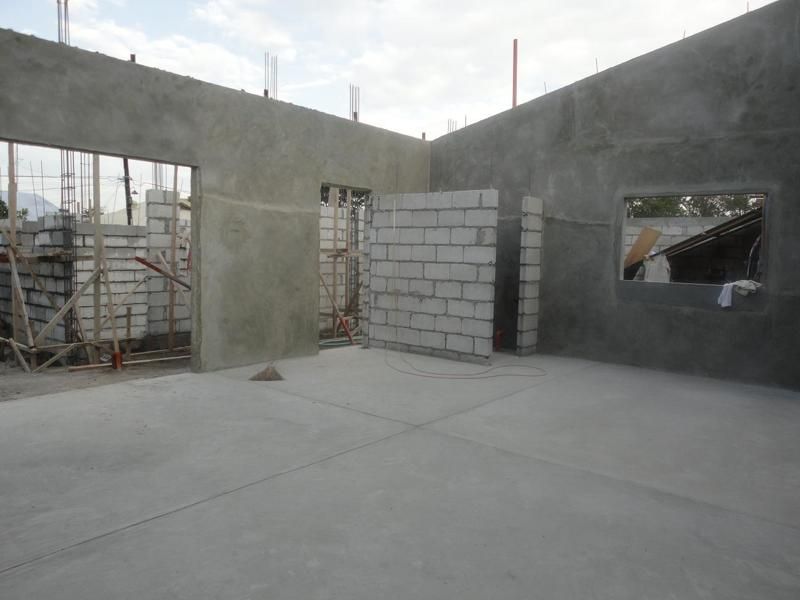
Something the guys here in the Philippines simply refuse to comprehend. They mix it literally like water, so it is easier to slop around and fill forms.

The guy building our house is American, and has taught these local boys how to really mix concrete. And he laid plastic sheet under my garage floor.

ff29e381.jpg
 

ConCretin

Well-known member
Joined
Jan 20, 2011
Messages
3,378
Location
Central Maine
Morrisman. Just to clarify, the OP asked about poly under EXTERIOR concrete. No disagreement about the need for a vapor barrier under interior concrete.
 

Frank The Plumber

Well-known member
Joined
Feb 19, 2011
Messages
2,644
Location
Chicago.
Not to argue nor insult but the modern concrete recipe benefits from a longer or prolonged cure or hydration cycle which prevents embrittlement and shrink stress cracking from heating and rapid drying rather than curing.
The primary cause of cracking in a concrete slab is caused by premature water loss.
For what a small sheet of plastic costs it's almost negligent to not use it and risk losing the water at the slab base.
If you are pouring over a properly compacted to 98% stone base that is hydrated you may not need the plastic but who has an ideal condition to do this.

The highway crews are using a saturation chemical block to keep the water in the slab base, Findings are that they can pour a thinner slab and get the same strength.

So the plastic barrier helps, required maybe not, but science supports the use of it, so not ridiculous.
Most people lose the whole slab strength by not compacting correctly, rolling the stone over with a pickup truck is not compaction. Some CA7 and a plate tamper or roller will add a lot of strength to a pad from below.
The OP is looking for optimum conditions. Pop a few slabs and flip them. There's the proof.
 

ConCretin

Well-known member
Joined
Jan 20, 2011
Messages
3,378
Location
Central Maine
FrankthePlumber, This is probably getting boring for everyone else and they'll probably boot us both but there are guys on here who want to know more about concrete.

I gotta disagree again. The most common cause of cracking in residential concrete isn't inadequate strength gain from lack of curing, it is contraction from excessive water i.e. high slumps. There is more than enough water in an average mix to allow the concrete to reach it's potential strength.

If you place on poly, the only place the bleed water has to go is up where it will increase the water cement/ratio even higher at the surface - right where you need the most durable concrete - especially for exterior concrete.

It's a trade off you make on interior concrete where a vapor barrier is needed but it's an unnecessary risk on exterior concrete.

You appear to have some experience with highway work a- as do I, but I'll argue that a garage apron is a difficult animal. I've been doing a commercial/industrial concrete for 25 years and I've never once seen poly spec'd under an exterior slab.
 

Frank The Plumber

Well-known member
Joined
Feb 19, 2011
Messages
2,644
Location
Chicago.
Of course LL, You and I know the reason the water is put in the mix at a high slump is to make it flow better cause the spreaders are not inspired. They can't do that with an engineered mix that is tested. Any spec mix is going to have samples pulled and the high slump will cause it to fail.
On a spec mix you get little top float because the engineered mix is low water content and you dont get a lot of "cream"
A DIY guy slab will for sure be higher water content, the guy pouring the slab will often have the truck add a ton of water, that will all float out and the slab will have a weak surface that spalls easily and micro cracks from that.
All I'm really saying is that if a DIY guy keeps from adding water to spread it and adds a bit of plastic he will have a better pour and a slightly stronger pad. Maybe.
The main reason you see a bad pad is cause you see the truck spinning for twenty minutes to add water cause the DIY guy crew is not inspired.
It honestly don't really make enough of a difference to be disagreeing with you. So I don't, it is not really required. The average DIY'er wrecks the whole job before the mix even hits the ground. I guess they like watching that drum spin while they sip a latte.
 

ConCretin

Well-known member
Joined
Jan 20, 2011
Messages
3,378
Location
Central Maine
FrankthePlumber. I'm with you 100%. Everyone would be well advised to keep an eye on their floor crew. It's a tough job and a lot of them try to make it easier by adding too much water. I'd pony up a few extra bucks for a mid range water reducer before I let them pour a 6" slump with just water.

We probably did beat the issue to death. Always interesting to debate these things. Thanks for your thoughts.
 

D.J.

Well-known member
Joined
Sep 16, 2009
Messages
1,116
Location
New Haven IL
Man, I guess I should have never posted the comment about the grain bin guys. I wish my comment would have been that if I was doing the pour it would get plastic under the pour. I also agree the a good compaction job is a key ingreadiant in the finished product. Many good points made buy Frank The Plumber IMO
 

mato

Member
Joined
Apr 17, 2011
Messages
22
Location
Cleveland, OH
Of course LL, You and I know the reason the water is put in the mix at a high slump is to make it flow better cause the spreaders are not inspired. They can't do that with an engineered mix that is tested. Any spec mix is going to have samples pulled and the high slump will cause it to fail.
On a spec mix you get little top float because the engineered mix is low water content and you dont get a lot of "cream"
A DIY guy slab will for sure be higher water content, the guy pouring the slab will often have the truck add a ton of water, that will all float out and the slab will have a weak surface that spalls easily and micro cracks from that.
All I'm really saying is that if a DIY guy keeps from adding water to spread it and adds a bit of plastic he will have a better pour and a slightly stronger pad. Maybe.
The main reason you see a bad pad is cause you see the truck spinning for twenty minutes to add water cause the DIY guy crew is not inspired.
It honestly don't really make enough of a difference to be disagreeing with you. So I don't, it is not really required. The average DIY'er wrecks the whole job before the mix even hits the ground. I guess they like watching that drum spin while they sip a latte.

FrankthePlumber. I'm with you 100%. Everyone would be well advised to keep an eye on their floor crew. It's a tough job and a lot of them try to make it easier by adding too much water. I'd pony up a few extra bucks for a mid range water reducer before I let them pour a 6" slump with just water.

We probably did beat the issue to death. Always interesting to debate these things. Thanks for your thoughts.

Both good arguments here, I'm gonna have to agree more with LLWillysfan. Bottom line, exterior slab that's exposed, with any type of vapor barrier is pretty much worthless.

Side note: Vapor barriers are not only used for moisture sensitive floor coverings but also to prevent radon gas from migrating through the slab.
 
To avoid these ads, REGISTER NOW!
Top Bottom