To avoid these ads, REGISTER NOW!

Please help ASAP!! Do I need to bolt down an air compressor?

To avoid these ads, REGISTER NOW!

evintho

Well-known member
Joined
Apr 6, 2006
Messages
1,358
Location
Santa Rosa, CA.
Where did you get those mounts at?

Big 5 Sporting Goods. I think it was $2.99 per hockey puck. The Redheads, 3" fender washers, regular washers and nylon locknuts were bought at Home Depot. The rubber pieces up top are shock absorber bushings (squashed) bought at Kragen Auto Parts.
 
OP
U

up4speed

Active member
Joined
Nov 12, 2006
Messages
36
Well, I started this thread as an emergency because my compressor was coming today and I wanted to have a plan. I got so excited as the truck backed up to my garage. The driver flung the door open, and there sat my beautiful new compressor. He then brought it down with the liftgate and to my dissapointment I saw that the whole belt guard was bashed in and there was oil leaking and it covered the whole side of the compressor!! I have to guess that the thing fell down at one point during shipping. Now I'm aggravated and have to wait a few weeks again for a new one to be shipped. These things always happen to me!!
:mad:
By the way, I found isolation feet at grainger for about $9 each. I think I'm going to start with those and not bolt it down. If it feels tippy, or it walks I will then bolt it down.
 

Nealcrenshaw

Well-known member
Joined
Mar 20, 2008
Messages
3,401
Location
Cleveland,OH
The 60 gal. tanks have a narrower base and they're lighter than the 80 gallons,they're easy to tip over by bumping into it. It's not easy to tip an 80 and a 120 gallon tank.
 
Last edited:

buening

Well-known member
Joined
Dec 17, 2007
Messages
1,338
Location
Decatur, IL
Where are you located up4speed? Those 60gals are definitely top heavy so if you are anywhere near an earthquake zone I'd bolt it down. I own an 80 gal and I have to use my entire body weight and grabbing the motor in order to even get mine to get off one leg, but the base of mine is larger.....then again mine may be taller but I'm not sure. Use your own judgement, if you can grab it and easily tilt it then bolt it down. If it takes your body weight to tilt it, odds are it won't be going anywhere. Definitely use isolation mounts or rubber pads. Mine is sitting on semi-truck mudflap squares and it hasn't moved at all from vibration.
 

Chris Adams

Well-known member
Joined
Oct 21, 2007
Messages
2,117
Since it keeps coming up, you don't 'bolt it down' for earthquakes.
You strap it. Something that will give a little, something that stops it from toppling, not something that anchors it.
A light to medium earthquake could, possibly, tip it over so the strap prevents that. A heavy earthquake and it will be going over, anchors, straps and wall.

If you hard fasten it to the floor you will likely get more damage in medium quake than if you just strap it.
 
OP
U

up4speed

Active member
Joined
Nov 12, 2006
Messages
36
I don't live in an earthquake zone, so I definitely don't have to strap it. I will have to see about bolting it down if it is top heavy though. As far as shipping time though, I am in NY, but I ordered from Northern tool. With Northern, these compressors are made to order, so I have to wait for the factory to make it before they ship it. They say about 15-17 working days.
 

Lookin4'67Galaxieconv

Well-known member
Joined
Jul 2, 2008
Messages
16,613
Location
Atlanta, GA
As far as shipping time though, I am in NY, but I ordered from Northern tool. With Northern, these compressors are made to order, so I have to wait for the factory to make it before they ship it. They say about 15-17 working days.

You should've had your compressor by now but b/c they couldn't get it delivered to you undamaged, how are they going to make that right? :headscrat

I've never heard of compressors being 'made to order'...what's so special about this compressor?
 

evintho

Well-known member
Joined
Apr 6, 2006
Messages
1,358
Location
Santa Rosa, CA.
Since it keeps coming up, you don't 'bolt it down' for earthquakes.
You strap it. Something that will give a little, something that stops it from toppling, not something that anchors it.
A light to medium earthquake could, possibly, tip it over so the strap prevents that. A heavy earthquake and it will be going over, anchors, straps and wall.

If you hard fasten it to the floor you will likely get more damage in medium quake than if you just strap it.

I have to interject here. I live in the San Francisco Bay Area and made it through the '89 Loma Prieta quake. When it hit, I was in the second story bathroom. I made it downstairs and out the door with my pants down around my ankles! The one thing I remember vividly, as I was running down the stairs was the house undulating like a roller coaster! I didn't have my current compressor then but looking back, I'm sure concrete anchors would have done the job properly. Straps would of had to been anchored to studs and the compressor would of had to been strapped in at least 3 different places. I stand by the concrete anchor method.

In addition, my house is bolted to the foundation with vertical bolts anchored in the concrete foundation and running through the stud plates, as per California Earthquake Code, much like the compressor mounting.
 

Chris Adams

Well-known member
Joined
Oct 21, 2007
Messages
2,117
I have to interject here. I live in the San Francisco Bay Area and made it through the '89 Loma Prieta quake. When it hit, I was in the second story bathroom. I made it downstairs and out the door with my pants down around my ankles! The one thing I remember vividly, as I was running down the stairs was the house undulating like a roller coaster! I didn't have my current compressor then but looking back, I'm sure concrete anchors would have done the job properly. Straps would of had to been anchored to studs and the compressor would of had to been strapped in at least 3 different places. I stand by the concrete anchor method.

In addition, my house is bolted to the foundation with vertical bolts anchored in the concrete foundation and running through the stud plates, as per California Earthquake Code, much like the compressor mounting.

Bolts will snap off clean in anything above 7 if you are near the epicenter.
Ask how I know...
I am in the center of the San Andreas, Landers and Big Bear faults. Almost the exact center...
The guide we got when I had retail stores basically told us to allow a little wiggle, as really hard stuff shears. Our buildings are set to 'float' when the quakes hit. If your building is too rigid, it snaps.
Most the casualties around here are from fireplaces exploding when the shockwave goes through.
Interesting anecdote; I have had some bookshelves made out of blocks in my smaller house.
You know, college style block and board shelves. Anyway, they are seven feet tall and 'free standing' in the middle of the floor in one of the back rooms.
Everyone that ever sees them says 'they will fall over in an earthquake'.

Most are surprised that they have been standing there since 1982.
Never lost a book.
The wall mounted shelves in my main house the books launch themselves from like it's snowing when I get anything over 5.5.
The free standing shelves wiggle like a snake, but don't go over. If you anchor them, they will shatter.
 
OP
U

up4speed

Active member
Joined
Nov 12, 2006
Messages
36
You should've had your compressor by now but b/c they couldn't get it delivered to you undamaged, how are they going to make that right? :headscrat

I've never heard of compressors being 'made to order'...what's so special about this compressor?

There is nothing special about this compressor, I just think that Northern Tool does not do enough business with I.R. to stock all the compressors. Therefore if they get an order for one, they submit it to the company at that time. I went with northern because they were significantly cheaper than any local place. I think the total from sears after shipping came out to about $400 more!! :shocking:
 

krooser

Well-known member
Joined
Jun 3, 2005
Messages
2,377
Location
Waupaca, Wisconsin
Tomorrow they are delivering my IR 60 Gal. upright air compressor, and I was wondering if I have to bolt it down? It seems like a big pain to bolt it down into the concrete. It is going to be on top of a MotoFloor (plastic tiles). Should I just bolt hockey pucks to the feet, or will it move? I was also thinking another possibility is to use a thick rubber pad to protect the floor. Or even a combination of hockey pucks on top of a thick rubber pad. Also, Do I need a disconnect box for the electrical connection? I have a dedicated circuit that I can hardwire right from a wall wall electrical box using BX cable, I don't really see the need for a disconnect. Any ideas? Thanks in advance.

No you don't... mine's been on an old rubber mudflap for 8 years and has never moved an inch... 80 gallon Bel-Aire 5 HP...
 
OP
U

up4speed

Active member
Joined
Nov 12, 2006
Messages
36
Thanks for all the info. Everyone had good input, but I need to pick your brains a little more. Now that I have more time to plan the arrival of my next compressor I would like to be fully prepared with everything I need. I am getting the 60 gal Ingersol Rand model SS5L5. I know I need an air filter for the air and a hose, but what size are the fittings? What fittings do I need to run the drain to an accessible point? Do I need a regulator? If so what fittings do I need and does anyone have photos of the plumbing so I can actually see it? I know I have many questions, but I would love to get it hooked up 1st shot when it finally comes. Oh yeah, what size fittings does the hose use? Should I get a 1/2" hose? I know some 1/2" hoses have 3/8" fittings which doesn't make sense to me because once the air is restricted what difference does the hose size make?Thanks in advance for all the help!!
 

Lookin4'67Galaxieconv

Well-known member
Joined
Jul 2, 2008
Messages
16,613
Location
Atlanta, GA
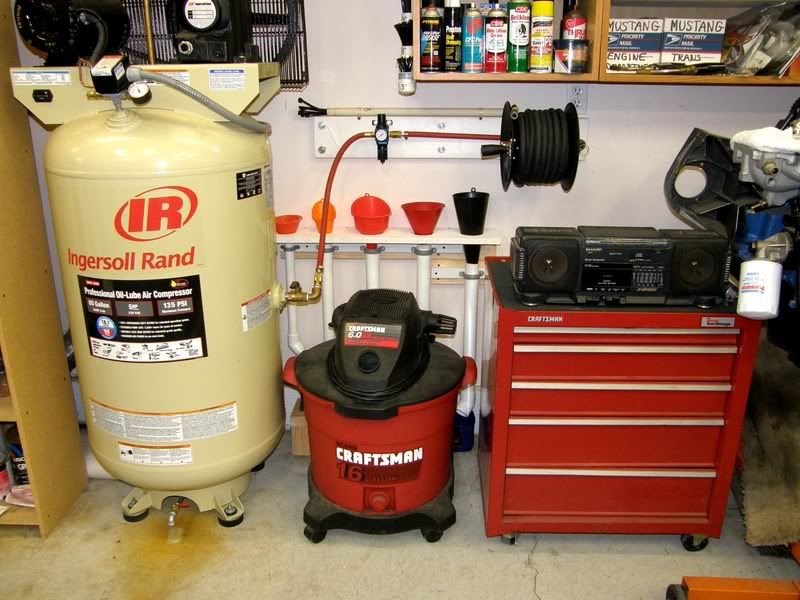
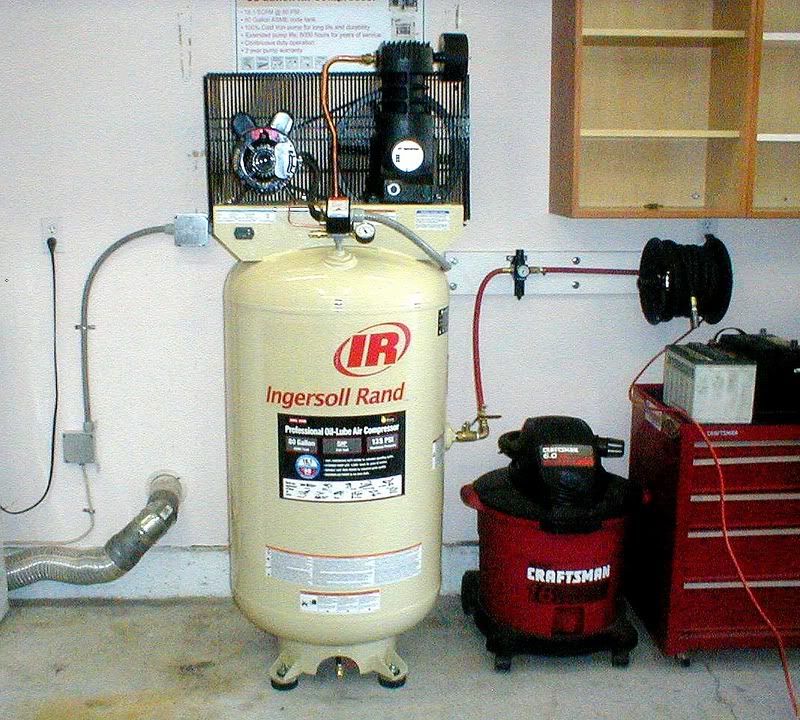
Here's some pictures of my setup. 3/8" 3' hose going to the filter. 1/2" 50 foot air hose it what I run off of it.

Airfilter_setup.jpg


Airfilter_setup_close.jpg
 
To avoid these ads, REGISTER NOW!

evintho

Well-known member
Joined
Apr 6, 2006
Messages
1,358
Location
Santa Rosa, CA.
Mine is an I/R SS5N5. The only difference being an 80 gal tank instead of 60 gal. A lot of guys will say run copper tubing around the perimeter of your shop, have lots of drops, blah, blah, blah. I have a 2 car garage so I kept mine simple and easy. The 1/2" ball valve came with the compressor (as I assume yours did). Go to Home Depot and get a 1/2" street elbow. Than runs off the ball valve. Buy a few high quality hose couplings and connect one to the 1/2" elbow. Run a short length of air hose to the filter regulator. Install a coupling on the other side of the filter/regulator. Run a short length of air hose to your reel. Mount the reel. Your done.
This is the only decent shot I have.........................

Funnelsysteminplace.jpg


Here are links to the regulator, drain kit and hose and reel. You need to pick up a 160 psi gauge for the filter/regulator also. Only a couple of bucks.

Wilkerson filter/regulator

Compressor drain extension kit

Air hose and reel


Bolts will snap off clean in anything above 7 if you are near the epicenter.
Ask how I know...
I am in the center of the San Andreas, Landers and Big Bear faults. Almost the exact center...
The guide we got when I had retail stores basically told us to allow a little wiggle, as really hard stuff shears. Our buildings are set to 'float' when the quakes hit. If your building is too rigid, it snaps.
Most the casualties around here are from fireplaces exploding when the shockwave goes through.
Interesting anecdote; I have had some bookshelves made out of blocks in my smaller house.
You know, college style block and board shelves. Anyway, they are seven feet tall and 'free standing' in the middle of the floor in one of the back rooms.
Everyone that ever sees them says 'they will fall over in an earthquake'.

Most are surprised that they have been standing there since 1982.
Never lost a book.
The wall mounted shelves in my main house the books launch themselves from like it's snowing when I get anything over 5.5.
The free standing shelves wiggle like a snake, but don't go over. If you anchor them, they will shatter.

Chris, I agree with you to a point. Bolts do shear when subject to violent side to side motion. There is considerable side to side motion as well as severe undulating during a tremor. I surmise the rubber, although hard rubber, of the hockey pucks will provide some flexibility. I'll let you know for sure when the BIG one hits! For those outside of earthquake country, you really need to anchor your compressors to the floor. For those inside of earthquake country I'd recommend anchoring to the floor as well as strapping to the wall studs. Vertical compressors have a small footprint as well as being top heavy (motor and pump topside). They will tend to topple over. However, any quake that's in the 7.0 range or above, rest assured, the walls will probably go too. At that point, the air compressor is going to be the least of my worries! :shocking:
 

fireguy

Well-known member
Joined
May 25, 2008
Messages
530
You're putting the cart before the horse.

Step 1: Drill 3 holes in concrete. :D


Step 1: Buy a hammer drill. You can never have too many tools.

I mount small compressor on sprinkler systems. I use the motor mounts from a 55-56 small block Chev, body washers, and lag screw and lead anchors. I use the rubber mounts to stop the transmission of noise through the concrete floor to nearby offices. Otherwise, I just use concrete anchors.

But, I do not use 80 gallon compressor either. In a large plant, we will use plant air for the initial air fill and a small compressor for make-up air.
 
OP
U

up4speed

Active member
Joined
Nov 12, 2006
Messages
36
evintho,
Thanks for the description and the photos!! Very nice. You opened some more questions though.
First, do you have any regrets on any of the equipment? Are they nice quality (reel, regulator, hose etc.)?
Second, where did you get the short lengths of air hose from? do I have to buy a short hose and cut it up, then put ends on it? if so, are they 3/8" NPT with a barbed fitting on the other end, and a hose clamp holding the hose on the barbed fitting?
Last, I noticed that the fittings were 1/2" NPT, but then you reduced them to 3/8" on all of the hose products. Would it be better to maintain 1/2" throughout the whole hose?

One more thing. I noticed that you used seal-tite to run the electric, but I don't see where it connects to the power source. Is there a knife switch to shut it off? Or does the compressor have an on and off lever on it? Does it always stay pressureized, or am I supposed to shut it off, bleed the pressure and drain the tank after using it? It will not be used daily, maybe 2-3 times per month.

Thanks again for any info you can help with!!
 
Last edited:
OP
U

up4speed

Active member
Joined
Nov 12, 2006
Messages
36

evintho

Well-known member
Joined
Apr 6, 2006
Messages
1,358
Location
Santa Rosa, CA.
No regrets whatsoever! I've been using it a few times a week for the last 3 years.
The regulator is a Wilkerson - top quality. The hoses and reel are Harbor Freight - chinese quality. It all works perfectly fine!

The short lengths of hose I cut up. I had a couple of Harbor Freight hoses from my last compressor. I cut 3' of the ends off. They had male ends already incorporated on them.
See the male ends...................

Harbor Freight 3/8" air hose

I screwed one into the regulator............

P9120003.jpg


and one into the reel. No barbed fittings. They screw right into the female threads of the regulator and reel.

All the couplings and hoses I had were 3/8". It was just a lot cheaper and easier to neck down at the ball valve than to go out and buy all new 1/2" couplings and hoses.

P9120004.jpg


If you were running a high volume shop you'd probably want 1/2" hoses. But then, if you were running a high volume shop you wouldn't be using a 5hp single stage compressor! 1/2" necked down to 3/8" with the compressors that you and I have is not going to make any difference with the work we do. With that being said, if you haven't bought your hoses yet, go ahead and spring for the 1/2".

The compressor has it's own on/off switch. There is no dedicated disconnect other than the circuit breaker. Our compressors are 220v. When I moved into my house 15 years ago I had an electrician come out and run a dedicated 220v line into my garage. It terminates at the lower junction box 'cause that's where my old compressor was hooked up. I ran the seal-tite up through another box and into the compressor. Don't forget, at least a 50 amp breaker in the breaker box on the circuit!

Overallcompressorhookedup.jpg


I usually just turn it on when I need it and drain it after each use. Although, sometimes when I'm feeling lazy, I'll leave it on for a couple of days.

One more thing. I highly recommend the drain extension kit I linked to earlier. It sure makes it a breeze to drain! BTW, you can make your own for half that price. Also, I'd purchase an hour meter and install it. Grainger has 'em. It'll keep track of how many hours your compressor has run. It's great for scheduling oil changes, maintenance, etc.

Hourmeter.jpg
 
OP
U

up4speed

Active member
Joined
Nov 12, 2006
Messages
36
Thank you, thank you, thank you!!! For the awesome answer as well as the photos. I truly appreciate the time you put into helping me. I have a plan now. As far as electric goes, I ran a dedicated 10 ga. wire with a 60a
breaker, so I'm good there. I think since I am buying everything new, I will probably go with 1/2" hoses. You are right that it is overkill for our purposes, but I usually like to do over kill on most things so I can't have regrets no matter what. One last and final question if you don't mind.
On the 3' cut sections, you mentioned that you didn't use barbed fittings. What are the hose clamps tightened on. Is it just threads? If so you don't have any leaking problems do you? Thanks again, now I just have to patiently wait for my new compressor to arrive!
 

WheelsNT

Well-known member
Joined
May 8, 2008
Messages
77
I'm no electrician, but I think the question on the disconnect is whether you have "line-of-sight" from the compressor to the panel -- I think if you don't, you're supposed to put a disconnect on it.
 

evintho

Well-known member
Joined
Apr 6, 2006
Messages
1,358
Location
Santa Rosa, CA.
You're very welcome! The hose clamps are just tightened on the threads of the *******. No leakage at all. Many times I've left the compressor on for a couple of days without using it and the pressure was the same as when I started.

I'm no electrician, but I think the question on the disconnect is whether you have "line-of-sight" from the compressor to the panel -- I think if you don't, you're supposed to put a disconnect on it.

The compressor has an integrated on/off switch. I'm not too worried about a disconnect. I don't think OSHA will be knocking on my door anytime soon!
 

alex71

Well-known member
Joined
Jan 19, 2009
Messages
2,819
Location
SE Florida
60A is wrong for this compressor. 30A is what you want... If it starts pulling more than 30, you want that breaker to trip.
 

nissan_crawler

Well-known member
Joined
Jan 12, 2008
Messages
9,638
Location
Wichita, KS
Thank you, thank you, thank you!!! For the awesome answer as well as the photos. I truly appreciate the time you put into helping me. I have a plan now. As far as electric goes, I ran a dedicated 10 ga. wire with a 60a
breaker, so I'm good there.

No you're not! That wire will burst into flames before that breaker trips. 10 gauge is 30 amp max, IIRC. I think 60amp requires 4 gauge, again, IIRC.

1. Read the manual to see what size breaker it requires.
2. Use the appropriate gauge wire for that breaker (or larger).
 
OP
U

up4speed

Active member
Joined
Nov 12, 2006
Messages
36
I consulted with a licensed electrician as well as the company. Normally you guys are correct on the amp ratings that you said, however with a 220 compressor things are ( to my surprise) a little different. I have a 10 ga. wire on a 25' run. Apparently with these compressors they pull only about 21amps continuous, but at startup can peak as much as 3x that for a split second!! Not enough time to heat up the wire, but enough to trip the breaker. I thought this was dangerous to put a 60a breaker on a 10ga wire also but the electrician insisted it was code for a large 220 motor. I then called Ingersol Rand who unprevoked gave the same EXACT answer! The guy said that for a year or two a 30a may work fine but as the motor gets older it will strain a little more an pop a 30a breaker. These are the reasons I thought I was fine. Oh and by the way, the garage has a sub panel with the breaker about 20' away. Thoughts please? Once again thanks in advance.
 
OP
U

up4speed

Active member
Joined
Nov 12, 2006
Messages
36
One more question regarding hooking up the regulator and hoses:

Can I hard pipe the regulator to the side of the tank, then run a soft hose to the hose reel? I can't really think of a reason not to do it this way, plus there is less of a chance of failure on solid plumbing. What do you guys think?
 

Kevin54

MEMBER EMERITUS
Joined
Jan 12, 2005
Messages
29,341
Location
Urbana, Ohio
You guys are giving the OP bad advise... Yeah, you can leave it on a pallet, but even though it works for you, you know that's not the right way to install a compressor.

Just putting some rubber feet on it without securing it to anything is a really bad idea. Put that garage full of tools to good use and mount it properly.

My IR 80 gallon is setting on rubber pads and not boted down. It has not moved in 5 years, the pads are probably stuck to the floor, and the compressor is probably stuck to the pads. The compressor is not top heavy so it is not going to fall over. If you live in an area prone to earthquakes, then bolt it down. Other than that, it is not going to move. If it is setting on bare concrete it will walk, but if you put isolation pads under it, you will be fine.
 

Charles (in GA)

Well-known member
Joined
Jan 11, 2006
Messages
12,489
Location
50 mi south of Atlanta
One more question regarding hooking up the regulator and hoses:

Can I hard pipe the regulator to the side of the tank, then run a soft hose to the hose reel? I can't really think of a reason not to do it this way, plus there is less of a chance of failure on solid plumbing. What do you guys think?

I mounted the shutoff valve, regulator and filter/water separator on the tank, as a temporary measure about three years ago. After about a year I realized one day that the compressor seemed to be running frequently. I found the ****** screwed into the tank had cracked in the threads from the weight of the components, coupled with the vibration (yes, compressors do vibrate), so I replaced the ******, and again, it cracked. This last time I installed a support brace to take some of the strain off the fittings. So far it has worked, but when I go permanent, the ball valve will be the only thing on the tank, then the 3/4 or 1" flex hose to the wall, then everything else.

Charles
 

Attachments

  • compressor outlet.jpg
    compressor outlet.jpg
    98.2 KB · Views: 52

ArthurPE

Banned
Joined
Jun 14, 2009
Messages
423
I don't think there is any circumstance you can use a 60A CB with #10

I'll have to look at the NEC tomorrow

irrc if there is no corresponding breaker for the wire rating you can go up to the next size

a 30A breaker (depending on type) can carry much higher current for a short period
as when a motor is starting, typically 5 to 7 times for a very short period, 3-5 seconds
there are curves, both for TD (heaters) and instantaneous (magnetic) trip times/points
for example, and these are for illustration only:

http://www.geindustrial.com/publibrary/checkout/Time Current Curves|GES-6201|generic

indefinitely 100% of rating
2 minutes 200%
15 sec 300%
5 sec 500%
2 sec 700%
1 sec 1000% (10 times rating)
etc.

what this means is you could have a 60A fault on 30A wire and the CB would not trip
 
Last edited:

alex71

Well-known member
Joined
Jan 19, 2009
Messages
2,819
Location
SE Florida
I stand by what I wrote. If you have a compressor shop install a compressor for you, they won't just place it on pads, even if you ask them to do it. Just because you are able to get away with something, doesn't make it right.


My IR 80 gallon is setting on rubber pads and not boted down. It has not moved in 5 years, the pads are probably stuck to the floor, and the compressor is probably stuck to the pads. The compressor is not top heavy so it is not going to fall over. If you live in an area prone to earthquakes, then bolt it down. Other than that, it is not going to move. If it is setting on bare concrete it will walk, but if you put isolation pads under it, you will be fine.
 
To avoid these ads, REGISTER NOW!
Top Bottom