
Hi, this thing came included in my grandfather's tools. It appears to be some kind of drill bit. I have been all over the internet trying to discover what this is called, and to what purpose it is used. Of course since I don't know its name, my searches are very limited. This site seems to be the perfect place to go.
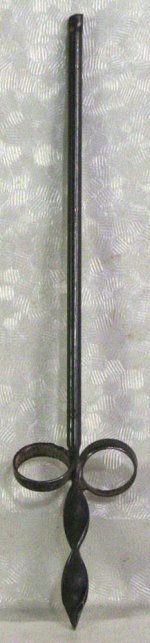
Hopefully you can see how "dainty" this bit is built. I can't imagine it cutting even the softest pine. Maybe styrofoam, or that pressed fiber / paperboard product my grandfather used to call Beaver Board.
The shank is about 1/8", and the bit is 6" long overall. The flutes are so large, and the land so small, it reminds me kind of a gimlet bit. But no, gimlets cut with the sides of the helix -- this is sharpened to cut with the point. The point is not beveled as you would expect. Instead of one cutting edge per flute, they are sharpened on both sides, like a knife blade. It will cut about a 1/4" hole.
You can also see the two rings soldered or braised to the back end of the flutes. They are each about 1/2" in diameter, and canted to be in-line with the spiral on the flutes. They are also sharpened. It is obvious to me (but not other folk I've shown this to), that the rings are meant to cut into the target material. If I'm right, the rings on this bit will ultimately cut a 1 1/4" hole.
Other features of interest: The end of the shank is pressed or flattened (you might see that in the photo). It is not pressed into the hexagon shape you would expect, if it went into a drill chuck. It was just flattened as if you squeezed it in a vise. [That also is how the spiral flutes were created -- by flattening, not milling.] Also at one time, it was chromed or plated -- even the flutes show evidence of plating.
That is a thorough a description as I can come up with. Does anyone have any ideas?
Hopefully you can see how "dainty" this bit is built. I can't imagine it cutting even the softest pine. Maybe styrofoam, or that pressed fiber / paperboard product my grandfather used to call Beaver Board.
The shank is about 1/8", and the bit is 6" long overall. The flutes are so large, and the land so small, it reminds me kind of a gimlet bit. But no, gimlets cut with the sides of the helix -- this is sharpened to cut with the point. The point is not beveled as you would expect. Instead of one cutting edge per flute, they are sharpened on both sides, like a knife blade. It will cut about a 1/4" hole.
You can also see the two rings soldered or braised to the back end of the flutes. They are each about 1/2" in diameter, and canted to be in-line with the spiral on the flutes. They are also sharpened. It is obvious to me (but not other folk I've shown this to), that the rings are meant to cut into the target material. If I'm right, the rings on this bit will ultimately cut a 1 1/4" hole.
Other features of interest: The end of the shank is pressed or flattened (you might see that in the photo). It is not pressed into the hexagon shape you would expect, if it went into a drill chuck. It was just flattened as if you squeezed it in a vise. [That also is how the spiral flutes were created -- by flattening, not milling.] Also at one time, it was chromed or plated -- even the flutes show evidence of plating.
That is a thorough a description as I can come up with. Does anyone have any ideas?
 That would be about right for the fish I catch though.
 WAG?
WAG?
