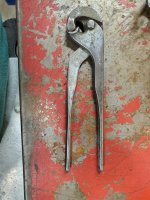
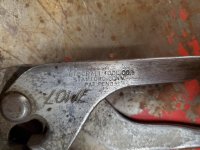
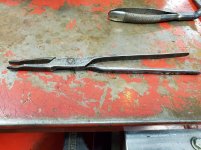
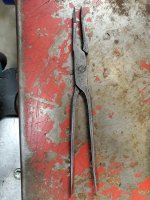
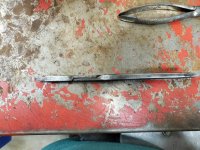
Hey guys, I have a few tools that I need help identifying. I bought a lot of tools off a guy who was able to tell me they were old body tools. Two of the items (not pictured here) have been identified as drip molding pliers. I have no idea what the rest of these are for, but understand that they are for bodywork of some kind. Please help!!! TIA!

You are using an out of date browser. It may not display this or other websites correctly.
You should upgrade or use an alternative browser.
You should upgrade or use an alternative browser.
Please help me identify tools
- Thread starter jkesselr
- Start date
MrSurly
Well-known member
The first looks like drip edge pliers (guessing) and further guessing the rest are variants of trim-clip removing tools
The first looks like drip edge pliers (guessing) and further guessing the rest are variants of trim-clip removing tools
They could be, I suppose, but they seem a little big for drip rails/moldings. That seemed to be the nature of the stuff I bought from the guy. I can see the trim-clip guess too. Thanks for weighing in!
John
RTM
Well-known member
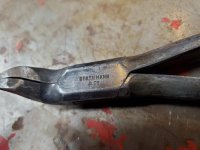
Geo Tiemann & Co currently make surgical tools, dating back to 1826 or so. So maybe not Auto Body.
J.A.F.E.
Well-known member
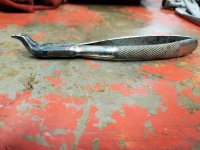
The second tool the pliers with the offset tips is a dental pliers used for yanking teeth.
SeisMec
Well-known member
The second tool the pliers with the offset tips is a dental pliers used for yanking teeth.
That style plier is sometimes handy for removing cotter pins.
MaverickDMD
Well-known member
I guess in a way they are for "body parts" as the OP suggests. The top right and middle left pictures are of a dental forcep. The bayonet style shown is popular for upper molar roots, particularly the larger conical palatal root. Forceps are generally identified by number, often visible on the inner handle or outer heel. The one pictured is most likely a 286, but could also be a 65 or 32.
The offset angle of the beaks allows good access to the back of the upper jaw. The sharp beaks also allow deep seating on the root where rotational forces will expand the socket and loosen the root. This is often a lot safer than pushing with an elevator (think small straight shoe horn) for vertical displacement as the palatal roots are often closely associated with the floor of maxillary sinus. No fun pushing a root in there if it can be avoided.
I often use old dental forceps around the house once in a while on non dental jobs where nothing else works. They're $125 new; this one's worth a couple bucks.
The offset angle of the beaks allows good access to the back of the upper jaw. The sharp beaks also allow deep seating on the root where rotational forces will expand the socket and loosen the root. This is often a lot safer than pushing with an elevator (think small straight shoe horn) for vertical displacement as the palatal roots are often closely associated with the floor of maxillary sinus. No fun pushing a root in there if it can be avoided.
I often use old dental forceps around the house once in a while on non dental jobs where nothing else works. They're $125 new; this one's worth a couple bucks.
Last edited: