Private Lugnutz
Well-known member
HAHA! Nice. I missed yours. I missed AK's, too, so not quite as scarce as the midget spinners. But still, not as common as early plastic or wood.WBM owned one

HAHA! Nice. I missed yours. I missed AK's, too, so not quite as scarce as the midget spinners. But still, not as common as early plastic or wood.WBM owned one

If my memory doesn't fail me, I'm pretty sure its @Mintgrun who has a plastic one that is shaped and built exactly like the wooden models. Not marked, as I recall, but looking exactly like a wooden jobbie, with plastic scales instead. Very odd. As if they were experimenting with that, then dropped it.Plastic ones couldn’t take the abuse and were the go to chisel or pry bar
I have seen those but they are never marked at all. I believe they are an off brandIf my memory doesn't fail me, I'm pretty sure its @Mintgrun who has a plastic one that is shaped and built exactly like the wooden models. Not marked, as I recall, but looking exactly like a wooden jobbie, with plastic scales instead. Very odd. As if they were experimenting with that, then dropped it.
Here are another couple examples. All my nut drivers are the more common handle design. I've had these long enough that I can't remember for sure, but I think I got them at the same time.Screwdrivers with the new shape (96xx) marked "PLVMB" are also scarce.
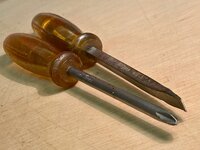
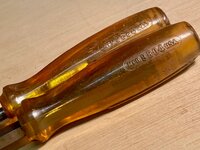
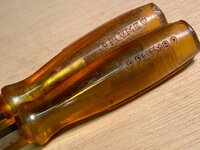


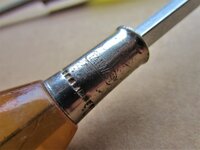


The most modern Proto handle you are referring to is called the Betr grip as it was called in advertising. The earlier screwdriver style we are referring to is what I would call 1st generation betrgrip. If you compare them there are slight differences and I like them even better than snap in hard handles.You have an impressive memory, Lugs. I have two now. One flat blade and another Phillips.
I was hoping the first one I found was possibly a transition piece (although doubtful) and feedback I got here was that they were knock-offs made off-shore (and it'd been discussed before). The Phillips proved that theory to be true. The markings on the shank say NO.1 FULLY HARDENED, (which I read as NOT, at first). It seems more like a NO.2 to me.
I saw a large bright translucent green handled flat blade screwdriver recently, but left it in the bin, due to the rusted through ferrule. I don't think I've ever seen a Phillips screwdriver with a square shank, other than this one. They may be out there though; because it sort of makes sense, the way the corners line up.
I took a group shot while up in the shop, showing most of the one's I've come across.
The early "square" handled Plomb stubby phillips is no surprise, but the lighter yellow Proto next to it (with the same style handle) seems like a throwback. A bunch of them sharing that handle design are labeled P&C.
The most common ones are the newest style Proto on the right side, but there is one little Proto that matches the rare late Plomb handle. That one is at the top/right of the assortment above. Is it my imagination, or did they put a pebble background around the MFD. part number?
Tom
EDIT, Rubicon's examples above answered my pebble question. Those are nice!


 I took this today of some sets in progress.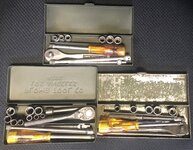
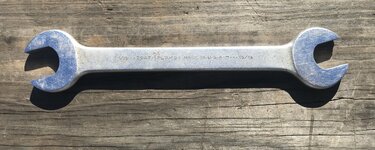
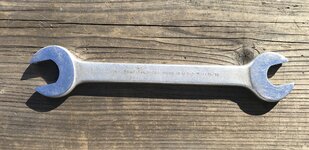
That starter wrench is specifically for Chrysler-Plymouth-Dodge-DeSoto starter motors.Tom, you and Smoke have impressive collections of screwdrivers! I'm envious. Sorry for changing topics but while I was taking pics I remembered I wanted to show off my latest obstruction wrench addition. I recently came up with this 6601 starter motor wrench and decided to also take a photo with my 1725, 1730 and 1731 while I was at it.

Same relative shape, and if I had to only guess, probably covered by the same design patent, but definitely more deeply fluted. As far as I can tell, introduced as early as 1952. The most interesting thing about the trademarked "BET'R GRIP" name is that they acquired it when they acquired J.P. Danielson. But Danielson used it for their adjustable crescent-type wrenches, which had a square instead of a hex throat.The most modern Proto handle you are referring to is called the Betr grip as it was called in advertising. The earlier screwdriver style we are referring to is what I would call 1st generation betrgrip. If you compare them there are slight differences and I like them even better than snap in hard handles.
It's hard to argue with heavy duty! Probably more popular and common during the production of both wood and plastic handled screwdrivers during the older style plastic handles, too. But note that the imbalance I brought up is the scarcity of new style plastic handle midget spinners marked "PLVMB" vs the new style plastic handle screwdrivers marked "PLVMB" in late '47, '48, and '49. They're clearly not very short run unicorns, as initially implied, with a few more (EDIT: including yours! very nice!) popping up already, but they are scarcer. Perhaps that's not as remarkable as I thought, though, now that I think about it, since screwdrivers were certainly more commonly purchased than midget socket sets. Maybe the ratio represented here in the last couple days (dozens of drivers to 3 spinners) is just about proportionally right to production.I think Smokeshow is right in that the wooden handles were more popular, and thus more common.
I haven't thought about the "sizes" of the plastic handles, Beemer, but if you mean the length of just the plastic handle, it looks like there were a few more than four (4). Between shank size, bit width, and overall length, Plomb made ten (10) different screwdrivers with round shanks and the same number with square shanks in 1948 and 1949. Doing some quick math between the overall lengths of each screwdriver and the lengths of the blades, it looks like the variety was much greater. I count maybe 6 or 7 different "sizes" in that chart.There were four different sizes of handle, as shown, and then the spinner handle.

Thanks for clarifying. Well, it looks like you have a good start at having one of each model they made, an achievement that would by default give you all seven handle sizes eventually!I was unclear, there are four distinct handle lengths in my collection
Design patents, covering general ornamental shape and features, are fairly liberal to begin with, but I don't think there's any doubt about the spinner handle being "THE LIKE" in the "FOR SCREWDRIVERS AND THE LIKE."it may fall under the same patent,
Slightly in shape, too, from what I can tell from here, from photos. You guys who own a spinner and a screwdriver with a handle of similar size could definitely do a much closer comparison. The general look is definitely the same, though, as opposed to the general look of the older style drivers and spinner, and again, I don't think there's much doubt they were both covered by the same design patent. In fact, neither the screwdrivers or the spinner look exactly like the patent drawing.Then again, the spinner handle is different in it's dimensions,
I'm not following you on this, though, sorry. The 4769 spinner in every midget set that came with a 4769 spinner in late '47, '48 and '49 would've had the new design handle, right? And they were available to purchase separately, as well. I don't see how their slightly different dimensions and shape from their screwdriver cousins would affect their production numbers (and therefore their survival numbers) vs. screwdriver handles with a slightly different shape.and that would be my guess as to why we see so few;


Shamefully, all I have in this general topic area is this measly PENENS spinner!


I definitely agree with this theory. We have seen them do this in the past with mixed tool box logos, mixed marking wrench sets, etc. details and consistency wasn’t their strong suit to say the leastGiven the technology of the time, and the volume of sales of each catalog item, I doubt that there was continuous production of any one variant (size, tip, or drive) during the era being examined. A particular item would be made in "runs" and the resulting stock sold off until the inventory got low and another "run" was scheduled.
Since we have no way to know what the inventory levels were, nor the sales volumes, it is all a guess about production of any one item. My guess is that there had been a recent production "run" of 1/4 drive spinners prior to the introduction of the new handle design, and Plomb waited until the inventory got down far enough to warrant a "run" of the new design handles.


I wish that there had been some wooden spinner handles, but what can you do?


Very creative.
-Don
Prime candidate to be put into a Proto wood handle to make a killer wood handled spinner!


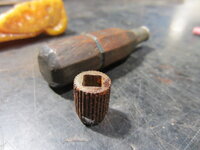

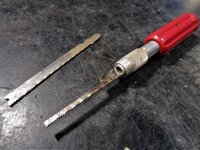
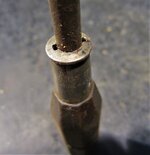

Awesome!...a one-of-a-kind spinner...




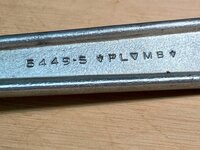

I was wondering what was different about that, other than the model number. I also find it quite interesting how they did all these variations of the standard design.I guess I should know better, but just when I thought I'd seen about every version of Plomb 1/2 drive ratchet out there I wind up finding this 5449-S recently.
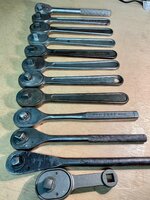
Wow, I haven’t seen this variation before. Super cool!I guess I should know better, but just when I thought I'd seen about every version of Plomb 1/2 drive ratchet out there I wind up finding this 5449-S recently. It is clearly the WF-38 design which wound up being labeled many different ways. I think I have 6 or 7 versions now and will take a group photo later. A quick search on this thread only resulted in one other reference to a 5449-S.
Thanks!Wow, I haven’t seen this variation before. Super cool!
I can't see anything at all different about it. I've not taken it apart, but wouldn't expect there to be anything different there either. I suppose there could be something different metallurgically with the ratchet body but its not obvious if so. I suspect it was one of many marketing efforts to move surplus product left over from the WF contract after the war.I was wondering what was different about that, other than the model number. I also find it quite interesting how they did all these variations of the standard design.