To avoid these ads, REGISTER NOW!

Plug in Solar - Virginia

larry4406

Well-known member
Joined
Jan 27, 2006
Messages
19,056
Location
Northern Virginia
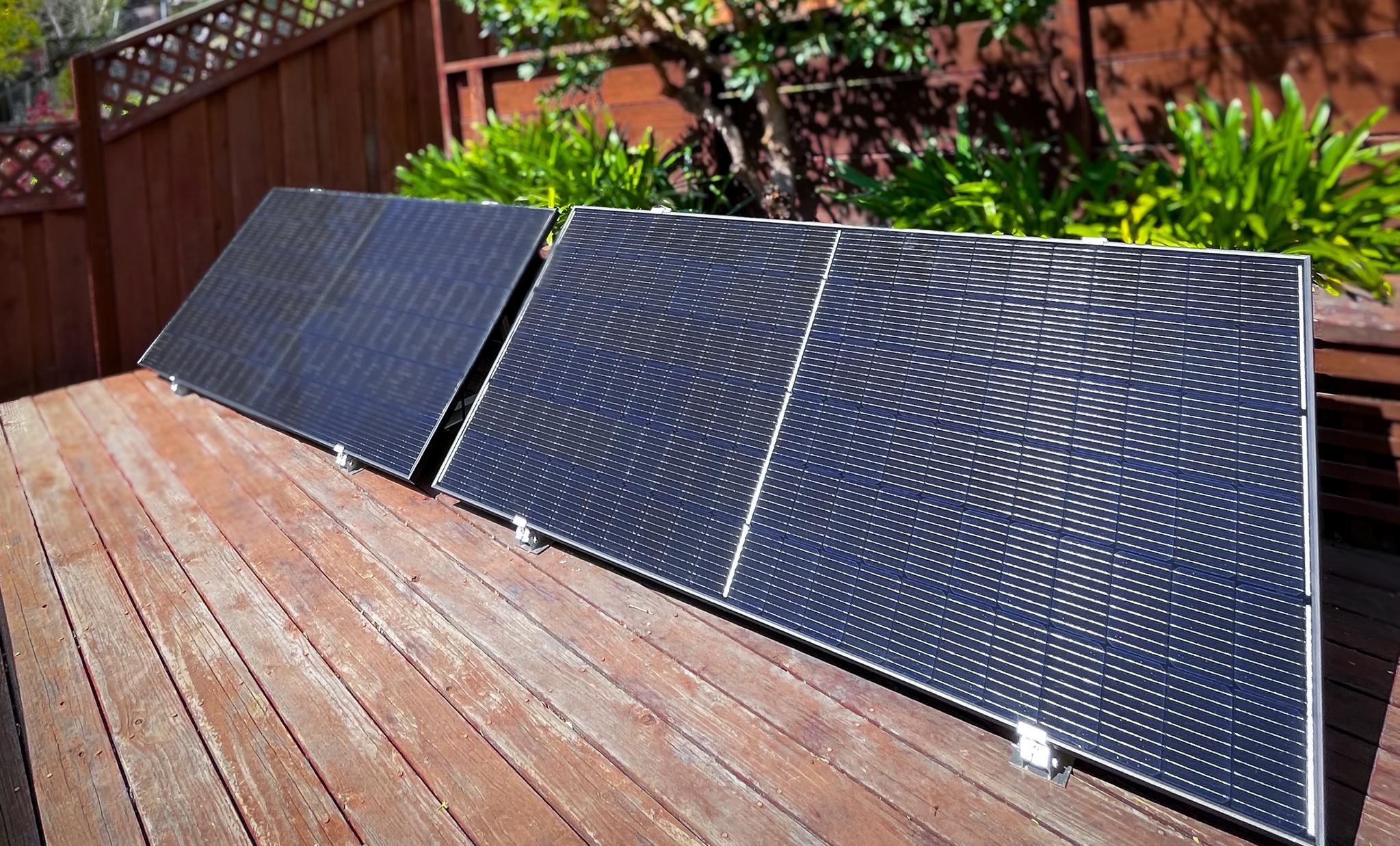
Virginia recently passed this into law.

Each dwelling is limited to a maximum of 1200W with not more than 3 systems reaching this cap.

For comparison hair dryers are rated more than this. In the old days, this was 12 100W light bulbs.

Is this even worth a damn? I’m thinking this is bottom fishing. I’ve not looked into the potential daily generation nor my electrical costs (which constantly rise…data centers out the ying-yang all around here).

My read is the units plug into a 120V outlet. At 1200W max, this is 10A max. So I assume this plugs into any exterior outlet which is either 15A or 20A?

Exterior outlets are supposed to be gfci protected. So I assume no issue here?

Anyone done this?
 
To avoid these ads, REGISTER NOW!

inphx

Well-known member
Joined
Feb 23, 2012
Messages
1,273
Location
Phoenix/Scottsdale AZ
These "consumer" devices need to sense grid power and the limit is because 10 amps can be tolerated by breakers. i dont how they do that with unit 2 or 3 randomly being added. You can do "off grid" setup and have more power like for an ev charge and avoid this.
 

mike93lx

ALLIANCE MEMBER
Joined
Dec 9, 2013
Messages
37,403
Location
Richmond, VA
My power is about 14 cents/kwh... Hard to justify any solar on that, even when the tax credits were available. 1200w is a waste of money
 

mm08822

Well-known member
Joined
Jan 13, 2012
Messages
5,860
Location
NJ
Compare installed cost against kw price. That tells you the break even point. Then wonder what the life of the unit is.

Not following the limit of 3 in a house.

Also those 3 could be plugged into the same circuit, not trip the cb and overload the branch circuit wiring .
 
OP
L

larry4406

Well-known member
Joined
Jan 27, 2006
Messages
19,056
Location
Northern Virginia
Compare installed cost against kw price. That tells you the break even point. Then wonder what the life of the unit is.

Not following the limit of 3 in a house.

Also those 3 could be plugged into the same circuit, not trip the cb and overload the branch circuit wiring .
Apparently the combined output of 3 small systems can’t exceed 1200W.

I’m thinking this is useless feel good law.
 

mm08822

Well-known member
Joined
Jan 13, 2012
Messages
5,860
Location
NJ
I don’t.

Saw the blurb on the news. Looked it up.

So apparently it’s just one at 1200W, (3) at 400W, or whatever combination of 3 systems does not exceed 1200W.

Cap of 3 systems per household

Cap of 1200W per household.
Not exceed 1200 b/c I comply with that or b/c the equipment limits it?
 
OP
L

larry4406

Well-known member
Joined
Jan 27, 2006
Messages
19,056
Location
Northern Virginia
Not exceed 1200 b/c I comply with that or b/c the equipment limits it?
1200W is the Statute cap invoked by law for plug in solar per household along with not more than 3 systems cumulative to achieve the 1200W cap. Zero regards to installed infrastructure.

All I got.

No idea why they picked that number. I’m guessing it’s just some margin of 120V10A max applied to some random existing 120V15A circuit and someone deciding that 10/15 or 67% is safe.

No clue the basis of this legislation.
 

pembol

Well-known member
Joined
Feb 13, 2014
Messages
268
In Colorado it is up to 1920W if you have a dedicated 20A outlet. Does it make financial sense? Maybe. You can figure it out for yourself using PVWatts: https://pvwatts.nlr.gov/

For my location 1900W system would yield about 2700 kWh per year - or about $300 per year, if you could use all of it. The payback is on the order of 5-10 years, so definitely in the ball park. For a 1200W system in Virginia the estimated production would be 1600 kWh per year - so not nothing.

The real benefit is it allows people who rent, live in condos, or are DIYers to deploy solar - they can decide whether it is worth it to them.
 
Last edited:

Innovate1

Well-known member
Joined
Jul 28, 2014
Messages
4,274
Location
Illinois near St. Louis, Missouri
Is this for a unit that plugs into an standard receptacle and supplements utility power? Interesting idea but guessing it wouldn't provide any power without the utility line to sync to? I had thought of doing a small solar system with panels, battery and inverter to provide very limited power during utility outages. Thinking I could avoid permitting for solar backfeed system by just running some fairly consistent loads from the batteries and topping up the batteries from the utilities if needed (such as long cloudy spells). So it can only take power from the grid. Utility said I still needed to have it inspected to verify it couldn't back feed. Still considering it but haven't gone farther.
 

pembol

Well-known member
Joined
Feb 13, 2014
Messages
268
Is this for a unit that plugs into an standard receptacle and supplements utility power? Interesting idea but guessing it wouldn't provide any power without the utility line to sync to? I had thought of doing a small solar system with panels, battery and inverter to provide very limited power during utility outages. Thinking I could avoid permitting for solar backfeed system by just running some fairly consistent loads from the batteries and topping up the batteries from the utilities if needed (such as long cloudy spells). So it can only take power from the grid. Utility said I still needed to have it inspected to verify it couldn't back feed. Still considering it but haven't gone farther.
Yes it is.

Depending on if/what your state adopts for plug in solar, this could make a small system like your are describing make a lot more sense. You can use a hybrid inverter both to charge a battery and back-feed the grid at what every the specified maximum power. If the grid goes down, what ever is plugged into the inverter stays up powered by the battery.

Furthermore, depending on how the regs are written, you may be able to over panel your system (say 3kW of panels for a 1200W max output) and use the batteries to provide the 1200W back to the grid for longer than the sun is shinning.

Anyway, this is not going to solve all problems for all people, but allowing plug in/balcony solar is a good thing.
 

Innovate1

Well-known member
Joined
Jul 28, 2014
Messages
4,274
Location
Illinois near St. Louis, Missouri
Yes it is.

Depending on if/what your state adopts for plug in solar, this could make a small system like your are describing make a lot more sense. You can use a hybrid inverter both to charge a battery and back-feed the grid at what every the specified maximum power. If the grid goes down, what ever is plugged into the inverter stays up powered by the battery.

Furthermore, depending on how the regs are written, you may be able to over panel your system (say 3kW of panels for a 1200W max output) and use the batteries to provide the 1200W back to the grid for longer than the sun is shinning.

Anyway, this is not going to solve all problems for all people, but allowing plug in/balcony solar is a good thing.
Did only a little searching for info on this. Apparently only Utah has this allowed and a few other states are working on it. And what I found was the units certified for this must have "anti-islanding" feature so it shuts down when the grid goes down. Hybrid inverters can do that and disconnect from the grid during outages and still power local things. Would be interesting to get some more details on this. My utility requires it to be set up to never push power to the grid.
 

Stuart in MN

Well-known member
Joined
Sep 8, 2005
Messages
23,007
Location
Minneapolis
My understanding is these systems have become popular in Europe. As for the power limit of 1200 watts, when you aren't using a hair dryer I suspect that is enough to cover most of an average household for much of the day, not counting HVAC - a few lights, a TV or computer and maybe a few other small items. Like mentioned by others you'll have to compare the purchase price to your kilowatt hour rate to see what the payback period will be.
 

pembol

Well-known member
Joined
Feb 13, 2014
Messages
268
Did only a little searching for info on this. Apparently only Utah has this allowed and a few other states are working on it. And what I found was the units certified for this must have "anti-islanding" feature so it shuts down when the grid goes down. Hybrid inverters can do that and disconnect from the grid during outages and still power local things. Would be interesting to get some more details on this. My utility requires it to be set up to never push power to the grid.

Plug in solar has now been approved in Utah, Maine, Virginia, Colorado, Maryland, New Hampshire, and Connecticut with more to follow. Ant-islanding is a safety requirement, but as you mention a hybrid inverter can still provide power to loads on the output side from solar and battery.
 
OP
L

larry4406

Well-known member
Joined
Jan 27, 2006
Messages
19,056
Location
Northern Virginia
So, below is a snipet from last months electric bill.

Says I used 1916 kWh for May 2026.

Lots of smeared charges in the bill. Ignoring the $78.44 distribution charge (it varies monthly, so its tied to amount consumed somehow) and the various surcharges and taxes, it looks like $221.74/1916 kWh or $0.1157/kWh.

Asking AI what my annual kWh solar generation for my 20187 Zipcode would be for a 1200W system, it says ~1680 kWh (also says a range of 1500-1900). So, this generation is worth around $193.22/year.

$0.1157/kHwh * 1670 kWh = $193.22.

For comparison, we average around 2200 kWh per month (~ annual of 26,400 kWh). So, this ~1680 kWh annual generation would be equivalent of about 76% of one month's usage or 6.4% of annual usage.


1780680135048.png

Asking AI again, how much a DIY 1200W solar system costs for my zipcode,

"A 1200W DIY plug-in solar system typically costs between $1,500 and $3,000 for all-in-one kits, while sourcing components individually can bring costs closer to $1,000–$1,300. These systems allow homeowners to plug directly into a wall outlet to reduce electricity bills without professional installation."

So, if the power it generates is worth $193.22, straight-line payback periods are:
  • 5.2 years for $1000 system
  • 7.8 years for $1500 system
  • 15.5 years for $3000 system

What am I missing?
 

pembol

Well-known member
Joined
Feb 13, 2014
Messages
268
So, below is a snipet from last months electric bill.

Says I used 1916 kWh for May 2026.

Lots of smeared charges in the bill. Ignoring the $78.44 distribution charge (it varies monthly, so its tied to amount consumed somehow) and the various surcharges and taxes, it looks like $221.74/1916 kWh or $0.1157/kWh.

Asking AI what my annual kWh solar generation for my 20187 Zipcode would be for a 1200W system, it says ~1680 kWh (also says a range of 1500-1900). So, this generation is worth around $193.22/year.

$0.1157/kHwh * 1670 kWh = $193.22.

For comparison, we average around 2200 kWh per month (~ annual of 26,400 kWh). So, this ~1680 kWh annual generation would be equivalent of about 76% of one month's usage or 6.4% of annual usage.


1780680135048.png

Asking AI again, how much a DIY 1200W solar system costs for my zipcode,

"A 1200W DIY plug-in solar system typically costs between $1,500 and $3,000 for all-in-one kits, while sourcing components individually can bring costs closer to $1,000–$1,300. These systems allow homeowners to plug directly into a wall outlet to reduce electricity bills without professional installation."

So, if the power it generates is worth $193.22, straight-line payback periods are:
  • 5.2 years for $1000 system
  • 7.8 years for $1500 system
  • 15.5 years for $3000 system

What am I missing?

It looks to me like your electricity rate is closer to $0.16/kWh (the distribution fees are typically per kWh), which makes the payback a bit shorter. For a 1200W system, you should be in the $1000 - $1500 range. Basically you need one of these , three 500W panels of your choice (~$0.50 / W) and some MC4 cables.

The harder part is whether you have net metering enabled on your meter, and/or is your base load high enough that a plug in solar system would just offset your usage? It looks like you use about 60kWh per day, or an average load of about 2.5kW, so you would probably do pretty well even without net metering.

The plug in systems are definitely much less impactful than a 'full' solar system with net metering, but they are also a small fraction of the cost, and are easy to DIY.
 
To avoid these ads, REGISTER NOW!
OP
L

larry4406

Well-known member
Joined
Jan 27, 2006
Messages
19,056
Location
Northern Virginia
It looks to me like your electricity rate is closer to $0.16/kWh (the distribution fees are typically per kWh), which makes the payback a bit shorter. For a 1200W system, you should be in the $1000 - $1500 range. Basically you need one of these , three 500W panels of your choice (~$0.50 / W) and some MC4 cables.

The harder part is whether you have net metering enabled on your meter, and/or is your base load high enough that a plug in solar system would just offset your usage? It looks like you use about 60kWh per day, or an average load of about 2.5kW, so you would probably do pretty well even without net metering.

The plug in systems are definitely much less impactful than a 'full' solar system with net metering, but they are also a small fraction of the cost, and are easy to DIY.
Very helpful. Thank you. With your numbers the loose costs like around $1100 or so.

Dominion Energy did upgrade my meter randomly 2-3 years ago to a smart meter. I happened to be home when it occurred. It’s all digital. Not sure if it’s net metering capable. I would hope so. Not certain how I could ascertain that.

Since these are “plug-in” does it matter where the plug-in occurs? For example, I have a detached barn with 4-wire 240V100A feed that is ~300 cable feet from the main 200A. panel. It has its own sub panel with UFER ground.

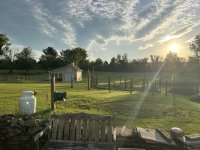
The barn gets full sun everyday and no tree shadows at all. It’s right roof slope faces ~160 degrees (south). It sees full sun from sunrise to late afternoon on that roof slope.

Picture of barn just now at 5:15 pm. Can see that the right side roof slope is just being fully shaded.

1780694257751.jpeg
 
OP
L

larry4406

Well-known member
Joined
Jan 27, 2006
Messages
19,056
Location
Northern Virginia
He is a picture of the barn this morning at 6:30 am. You can see the right roof is covered in sunlight. The barn roof is a 9/12 pitch so its at about 37 degree angle from the horizon. It faces ~160 degrees south.
IMG_5782.JPG

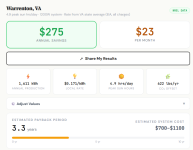
This plug-in solar calculator indicates that a 1200W system for my zip would save around $275 annually ($23/month) with a payback of around 3.3 years. It uses $0.171/kwh.

1780742544421.png

Doing some limited reading on the new VA law, some of the postings say the system cannot export power, only offset use. :dunno:
 

davejo

Well-known member
Joined
Oct 29, 2015
Messages
277
Location
(VA)
My understanding is these systems have become popular in Europe. As for the power limit of 1200 watts, when you aren't using a hair dryer I suspect that is enough to cover most of an average household for much of the day, not counting HVAC - a few lights, a TV or computer and maybe a few other small items. Like mentioned by others you'll have to compare the purchase price to your kilowatt hour rate to see what the payback period will be.
Makes more sense at twice the voltage as far as not overloading existing wiring. Living in a highrise with a bunch of these things hanging off balconies, no thanks.
 

pembol

Well-known member
Joined
Feb 13, 2014
Messages
268
Very helpful. Thank you. With your numbers the loose costs like around $1100 or so.

Dominion Energy did upgrade my meter randomly 2-3 years ago to a smart meter. I happened to be home when it occurred. It’s all digital. Not sure if it’s net metering capable. I would hope so. Not certain how I could ascertain that.

Since these are “plug-in” does it matter where the plug-in occurs? For example, I have a detached barn with 4-wire 240V100A feed that is ~300 cable feet from the main 200A. panel. It has its own sub panel with UFER ground.

The barn gets full sun everyday and no tree shadows at all. It’s right roof slope faces ~160 degrees (south). It sees full sun from sunrise to late afternoon on that roof slope.

Picture of barn just now at 5:15 pm. Can see that the right side roof slope is just being fully shaded.

1780694257751.jpeg
I am no expert on the rules and regs for VA, so you would need to read up on those. But from a purely physics perspective, plugging in to an outlet in the barn would be fine. That also looks like an ideal roof for solar.

I think you are also finding out one of the other benefits of these small DIY solar systems - it is kind of fun to tinker around with and generate some of your own power.

The whole point of plug in solar is to allow small systems which have some amount of power export, so I doubt the VA law prohibits export. If net metering is not supported, then you may not get any credit for the power you export, in which case you want to set up a system that maximizes self consumption. If you can, see if you can figure out your 'base load' which is the power consumption when nothing in specific is running.

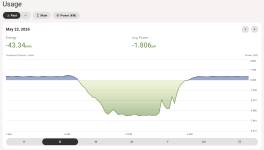
In my case it is about 600-700W - you can see it in the plot below in the middle of the night (note that I have a gird tie solar system which is why my consumption is negative for most of the day)
:
1780750369866.png
 
Last edited:
OP
L

larry4406

Well-known member
Joined
Jan 27, 2006
Messages
19,056
Location
Northern Virginia
Thanks for following along @pembol !

I logged on to our Dominion Energy account to see what I can learn regarding usage.

Screen shot of past year
1780755104071.png

Screen shot of daily usage for past month. Looks like around 60 kWh each day as you surmised.
1780755201233.png

Here is the past 24 hrs usage for 6/5/26.
  • Was quite warm yesterday (mid 90'sF) so you can see the ramp up starting around 10 am when AC would be working.
  • I think the 7 am blip was perhaps the hybrid heat pump water heater kicking on.
  • The big hit at 5 pm was the wall oven for dinner.
1780755324757.png

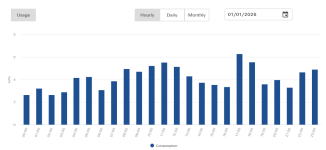
Here is the 24 hour usage for 1/1/26. I randomly picked this date as I knew the AC would not be running and we would be running the wood stove for heat with occasional backup heat via the heat pump. Interesting we have the same 5 pm hit from I presume the oven! We tend to eat at 6 pm nightly, so makes sense.

1780755768554.png

Interested in your thoughts as you study these graphs as you are more schooled in this than I.

I still kick myself for not taking the entire roof top solar array off of a house we demo'd. We took it all down and gave it away.
 

vavet

Well-known member
Joined
Mar 6, 2012
Messages
5,319
Location
Ashland, VA
There’s a certain dorky cool factor to having a solar array, even if it’s a single diy panel. My boss is very pro environment and wants to find a way to charge his ev with the power from his solar array. He will incur expense to store the power off grid and then use that to charge his car and he’s ok with that. To him, plugging into the grid with the array and his car, is not the same. not everything has to make logical financial sense.

i like the concept of plug in solar. I guess if the poco is ok with it, then I’m ok with it. Im mainly concerned about how cheap electronics/ safety systems can fail and backfeed the utility grid during a power outage, I guess linemen will know to check and hopefully even work as if the line is always live?
 
OP
L

larry4406

Well-known member
Joined
Jan 27, 2006
Messages
19,056
Location
Northern Virginia
There’s a certain dorky cool factor to having a solar array, even if it’s a single diy panel. My boss is very pro environment and wants to find a way to charge his ev with the power from his solar array. He will incur expense to store the power off grid and then use that to charge his car and he’s ok with that. To him, plugging into the grid with the array and his car, is not the same. not everything has to make logical financial sense.

i like the concept of plug in solar. I guess if the poco is ok with it, then I’m ok with it. Im mainly concerned about how cheap electronics/ safety systems can fail and backfeed the utility grid during a power outage, I guess linemen will know to check and hopefully even work as if the line is always live?
The regs require the microinverters to shut down on loss of grid power. No power to synchronize with, then down it goes.

The 1200W limit is to safely not overload existing circuits is my read.
 

mm08822

Well-known member
Joined
Jan 13, 2012
Messages
5,860
Location
NJ
The regs require the microinverters to shut down on loss of grid power. No power to synchronize with, then down it goes.

The 1200W limit is to safely not overload existing circuits is my read.
Anti-islanding is part of the UL spec that I'm sure the plug-in systems meet.

What I'm not seeing mentioned is any credit for overproduction during the day. So you may need to adjust your consumptions around daylight hours to not give away any kwh.

Eg- run run dishwasher and/or dryer around noon sequentially.
 

pembol

Well-known member
Joined
Feb 13, 2014
Messages
268
Thanks for following along @pembol !

I logged on to our Dominion Energy account to see what I can learn regarding usage.

Screen shot of past year
1780755104071.png

Screen shot of daily usage for past month. Looks like around 60 kWh each day as you surmised.
1780755201233.png

Here is the past 24 hrs usage for 6/5/26.
  • Was quite warm yesterday (mid 90'sF) so you can see the ramp up starting around 10 am when AC would be working.
  • I think the 7 am blip was perhaps the hybrid heat pump water heater kicking on.
  • The big hit at 5 pm was the wall oven for dinner.
1780755324757.png

Here is the 24 hour usage for 1/1/26. I randomly picked this date as I knew the AC would not be running and we would be running the wood stove for heat with occasional backup heat via the heat pump. Interesting we have the same 5 pm hit from I presume the oven! We tend to eat at 6 pm nightly, so makes sense.

1780755768554.png

Interested in your thoughts as you study these graphs as you are more schooled in this than I.

I still kick myself for not taking the entire roof top solar array off of a house we demo'd. We took it all down and gave it away.

It looks like your base load is on the order of 1.5 - 3kw depending on season. Plug in solar (or even a larger system) may be a good idea for you, as you don't need to worry about net metering, the 1200W from the system would just offset your usage, reducing your base load while the sun shines.

If you are up for finding used panels, which are typically only a $0.10 - $0.20/W , than the price on this comes down even further. Again, I am not an expert on the VA regs, but consider over panelling if it is allowed. That is to put much more than 1200W of panels on the barn, up to the limits of the inverter. While the inverter will limit it to 1200W AC output, it will allow you to output the max of 1200W for a longer part of the day.
 
OP
L

larry4406

Well-known member
Joined
Jan 27, 2006
Messages
19,056
Location
Northern Virginia
It looks like your base load is on the order of 1.5 - 3kw depending on season. Plug in solar (or even a larger system) may be a good idea for you, as you don't need to worry about net metering, the 1200W from the system would just offset your usage, reducing your base load while the sun shines.

If you are up for finding used panels, which are typically only a $0.10 - $0.20/W , than the price on this comes down even further. Again, I am not an expert on the VA regs, but consider over panelling if it is allowed. That is to put much more than 1200W of panels on the barn, up to the limits of the inverter. While the inverter will limit it to 1200W AC output, it will allow you to output the max of 1200W for a longer part of the day.
Thanks again.

The VA law goes into effect 1/1/27, so at best this is a project for next year.

The barn roof on the south side has about 340 SF so a decent amount of area for panels.

I like the idea of over-paneling (its pretty clever!). As long as the inverter would cap at 1200W, I can't see why the AHJ would complain.

A larger non plug-in system I am guessing would become a pain with it located at the barn's sub-panel.
 

mm08822

Well-known member
Joined
Jan 13, 2012
Messages
5,860
Location
NJ
Even 2 systems at 600w each. Each plugged into "opposite phases" as a single system is only connected onto 1 phase.

Your consumption graphs show totalized aggregate. You could move a few existing cb's onto the 1 phase if you chose the 1200w system.
 

pembol

Well-known member
Joined
Feb 13, 2014
Messages
268
I don't think there is any rule or reason that you can't back feed solar into a breaker in a sub panel. I have 400A service, which feeds two 200A panels, so both of these panels are technically sub panels. My 10kW solar system back feeds a 50A breaker in one of these sub panels. I also have a sub panel (or a sub-sub-panel?) in my barn. Right now I have enough solar to cover my annual consumption, but if my consumption were to increase, I would install a 1920W system on the barn and feed it into a dedicated 20A outlet from that sub-sub-panel.
 

Max

ALLIANCE MEMBER
Joined
Jun 16, 2018
Messages
3,323
Location
Georgia
This is a nice calculator to estimate what you'd gain for your specific location: https://pvwatts.nlr.gov/pvwatts.php

It's not quite the same thing, but I am going to put a gate on a long driveway. I can run power out there at some expense and effort, or I can go solar with a battery. I'm likely to just go solar. The load would be the gate opener, a camera, and WiFi.
 

mm08822

Well-known member
Joined
Jan 13, 2012
Messages
5,860
Location
NJ
I don't think there is any rule or reason that you can't back feed solar into a breaker in a sub panel. I have 400A service, which feeds two 200A panels, so both of these panels are technically sub panels. My 10kW solar system back feeds a 50A breaker in one of these sub panels. I also have a sub panel (or a sub-sub-panel?) in my barn. Right now I have enough solar to cover my annual consumption, but if my consumption were to increase, I would install a 1920W system on the barn and feed it into a dedicated 20A outlet from that sub-sub-panel.
Unless the panel with the 50a solar cb has a bus rated at 225a, you have exceeded 120% feed rule. Max would be a 40a solar cb with a 200a cb main cb for a 200a rated bus.
 
OP
L

larry4406

Well-known member
Joined
Jan 27, 2006
Messages
19,056
Location
Northern Virginia
Even 2 systems at 600w each. Each plugged into "opposite phases" as a single system is only connected onto 1 phase.

Your consumption graphs show totalized aggregate. You could move a few existing cb's onto the 1 phase if you chose the 1200w system.
Clever idea.

Perhaps 2 systems at the barn, both over paneled, and connected to different “phases”. Each dedicated 120V20A would be no problem.

My barn has near zero electrical usage at present. LED lighting, (2) 120V20A receptacle circuits, and some outdoor lighting and plugs.

Need to study the house panel circuits and the feeders to the 3 house sub-panels to determine their “phasing” and what is on what.
 

mm08822

Well-known member
Joined
Jan 13, 2012
Messages
5,860
Location
NJ
The barn sub-panel and its feeder just gets you connected to other loads behind the meter. You may even find most of your baseline loads happen within only 1 sub panel.
 
OP
L

larry4406

Well-known member
Joined
Jan 27, 2006
Messages
19,056
Location
Northern Virginia
The barn sub-panel and its feeder just gets you connected to other loads behind the meter. You may even find most of your baseline loads happen within only 1 sub panel.
Have you been to my house?!

I think you are spot on!

Main panel in attached garage is 240V200A

All panels are Cutler Hammer/Eaton CH which use even/odd circuit/bus labeling.

Adjacent the main panel is a 240V100A sub-panel with mostly the kitchen appliances/circuits and attached garage circuits. Not sure if the even/odd circuit numbering in this sub matches the main (need to study the phase markings on the feeder).

Basement 240V100A sub-panel has the 240V heat pump (outdoor unit, air handler, heat pack), some 120V circuits for basement lighting. Again not sure if even/odd matches main.

Septic sub-panel is 240V40A. Mostly 240V loads but does have the 120V basement ejector pump due hung sewer. Again not sure if even/odd matches main.

Lastly barn is 240V100A. Only 240V load is an occasional welding circuit and a future compressor circuit. Other circuits are basic lighting and outlets. Again not sure if even/odd matches main.

The OCD in me now wants to make sure even/odd matches in all panels. Thanks for another project but I’m thinking this is perhaps a good practice for any installed sub panel.
 

mm08822

Well-known member
Joined
Jan 13, 2012
Messages
5,860
Location
NJ
I'll leave you guessing on the number of visits made. 😇

It would be easiest if every left side vertical bus was the same but OCD more so after the fact.
 
To avoid these ads, REGISTER NOW!
Top Bottom