To avoid these ads, REGISTER NOW!

Plumbing Air Lines (Q's)

sca037

Well-known member
Joined
Jan 10, 2005
Messages
250
Location
Metro Detroit Area- MI
First off, thanks to Luke for this neat forum!

I'm considering my options regarding the plumbing of air lines throughout the garage, and would value some input from my fellow 'junkies'

:bow:

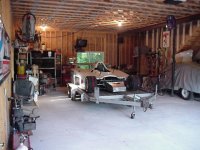
Currently, I have a flexible line suspended below the ceiling that runs from the compressor (behind some jun, er.....stuff) in the left rear to a 50' coil ceiling-mounted near the post on the right. That allows me to reach all points with air, but I want to make a multi-port system so I'm not reeling lots of hose out all the time. If I plumb a system using hard lines, is it better to surface mount them over the drywall, or is it safe to bury it within the walls and ceiling and terminate the ports at the surface? I would hate to have to fix a problem in a buried system, but wonder what the likelihood of a problem really is down the road?
I've seen both metal and plastic tubing used for this, but what is the best for a personal (probably never over 150psi) garage and why?

Many thanks in advance,
Brian
 

Attachments

  • SCA Home 1.JPG
    SCA Home 1.JPG
    52.1 KB · Views: 1,101
To avoid these ads, REGISTER NOW!

gb387

Well-known member
Joined
Jan 8, 2005
Messages
209
Location
Des Moines, Iowa
Well I am not to sure whats better but... My father used copper water line in his garage, in fact he is in the middle of installing it as I type this. He has yst to try it but a plumber told him it would be adequate and it all will be behind the dry wall or in the celling.

Now where I work we use black pipe to run air lines and I have worked for this company for 10 years and never seen a problem with that method.

I like the "clean" look in a garage so I like to keep things hidden behind dry wall this includes air lines. My thought is no plastic behind drywall, if you pound a nail in it or drive a screw in it to hand something you will have a leak.

Another thing not to for get is on the lowest parts of the pipe I would put a valve to drain water out that collects in the pipes.

I found this post has some good info in it, a big no to PVC a yes to copper or black pipe: Read this
 

dodgecharger-fan

Well-known member
Joined
Jan 10, 2005
Messages
87
Location
Niagara Region, ON Canada
Personal preference? Run it on the surface.
Stuff happens and it's so mouch easier to deal with if you can get at it.

I'm looking into something for my current garage. GaragePak seems interesting enough, but it's spendy.

One of the MOPARStyle members is a dealer or distributor. I'm sure he can set up a discount or group buy.. There was a post there I think - or it may have been a PM. I'll check later today...
 

ultgar

Well-known member
Joined
Jan 11, 2005
Messages
1,119
Location
New Jersey
The Garage-Pak piping system (made by Legris-Transair) is a thinwall aluminum tubing which goes together (and comes apart) with simple hand tools. It is a good product but can become a bit pricey plus the Garage-Pak folks cut the piping to 9' lengths (a pain for big jobs...too many couplings needed) for UPS shipping. You can get 20' sections direct from the manufacturer.

transair-a.jpg


To be honest, most of the professional jobs are done in "L" copper....3/4" loops and 1/2" drops are fine for most home workshops. If you're running big CFM's and multiple users, consider going with 1" or 1 1/4" feeds to your wall drops.

Do not use PVC. Threaded pipe is a bit of a pain with more leakage issues.
 

OI812

Well-known member
Joined
Jan 8, 2005
Messages
202
I would personally mount on the surface of the wall. When you want to add to it later it will be easier. Mounting behind the wall is cleaner, just less options. If you do it behind the wall, test it before dry-walling so that you don't have to worry about leaks.

I do commercial plumbing for a living, and I have run air in basically three different fashions.
1) Black Pipe, if you don't have access to threading equipment then it can be kind of a PITA
2) Copper Type L or K K is heavier walled but not necessary. This could be done with regular solder-soft solder
3) Copper Type L or K and silver solder. Silver solder is a much stronger joint, but you need a lot of heat. This will also make the copper soft.

I have run air lines for a couple of guys in there shops. When I did it we ran
1-1/4" copper tubing. We ran straight links all the way around the shop. Then they figured out where they wanted the stubs, and I pulled out my T-Drill and drilled them in. With a T-Drill you can actually pull a tee out of the straight pipe. I like doing this the best, but I have the drill. I know you can't rent these either.

I would also put a dirt leg at all stub outs unless you have a filter at the tank.
 
OP
S

sca037

Well-known member
Joined
Jan 10, 2005
Messages
250
Location
Metro Detroit Area- MI
Thanks for the superb responses guys!
One option that I figured someone would mention is to run the long feeder line(s) in air hose, similar to how I have it now. It's obviously cheap and flexible, and could then be plumbed down to hard ports in the walls. I can envision a large diameter hose for the long (50+ foot) horizontal runs through the ceiling trusses, then a transition to hard pipe for the vertical drops. I think that this scenario would keep the hose portion reasonably safe from puncture or other hazards, and I could easily make the run straight enough that if I ever had to service (or replace over time) the hose it could remain accessible.
Is the downside to this plan the limited availability of large diameter high pressure air hose, connection issues, or ???

Brian
 

jstbecauz

Well-known member
Joined
Jan 9, 2005
Messages
97
Location
Spring Hill
In my shop I used galvanized pipe. That is all I have ever used. I plumbed the complete shop where I am now and did it all with pipe. If you are going to use galvanized make sure that you put unions in, it will help when servicing the lines.
 

OI812

Well-known member
Joined
Jan 8, 2005
Messages
202
IMO I wouldn't run the hose, yeah safety is the main reason. Your going to spend all this money in your shop and you want to save 100 buck on copper pipe? There are some other issues with it, but IMO you would never notice in a system that small.
 

gb387

Well-known member
Joined
Jan 8, 2005
Messages
209
Location
Des Moines, Iowa
Satatic said:
I was wondering why PVC isn't a good idea.


There are many reasons listed on the site below... anything from the the constant changing pressure weakens the PVC to getting oil in the pipe softens the PVC to in cold climates it becomes very brittle and the list goes on all can cause the PVC to burst.... check it out below.

It is talked about here
 

SteveL

Well-known member
Joined
Jan 14, 2005
Messages
760
Location
St. Louis, MO
I am in the process of running a system in my new addition using 3/4" copper thick wall inside the drywall. I hate the look of everything exposed so I hope that I don't need to rip any drywall out some day. At least I pressurized the system to test for leaks prior to hanging the drywall so everything should be OK. I like the copper as I can come back and add or change things without a lot of work.

I also ran the system into my basement wood working shop at the same time so the compressor can be outside in the garage to cut down noise in the house. Makes the wife a lot happier that way! As soon as I get some pics I will try to post them. Good luck with your project!
 

OI812

Well-known member
Joined
Jan 8, 2005
Messages
202
PVC and air is a real bad idea--accident waiting to happen.

When you say thick walled copper I assume you mean type K. You really don't need K, L is less expensive and is fine for pressures under 200lbs. The weakest part of your system will be your soldered joints. Is your compressor installed in an area that will be cold? If you have air lines that go from cold to hot you can get moisture in the lines. You may need a moisture filter at your outlets.
 

carsguns&chics

New member
Joined
Jan 18, 2005
Messages
3
Location
North Highlands California
PVC and CPVC

I work everyday installing CPVC for fire sprinkler systems in homes, and like all the fittings say on the box "Not For Use with Compressed Gases or Compressed Air". I have asked one of our suppliers about this warning and he said it was due to pressure difference changes, or known as pressure cycles. So I figured from the ensuing conversation that as long as the pipe is not cycled rapidly over and over from 0 to max in quick succession that there should be negligable problems if the pipe is kept within these parameters. After viewing his setup at his residence I copied it but in a much smaller set-up. He had all of his piping in the walls and ceiling behind sheetrock. And he explained to me that he used the foam insulation wrap around the pipes in the trusses and walls using the proper straps to secure it. And he adapted the plastic to steel about a foot before each drop for a quick disconnect and another 6 inches of pipe below with a valve to drain water trapped. And another thing that I have yet to see other people install on their air line system is a safety release valve set just over the operating pressure of your tools. And Yes it is affected by temperature and by Sunlight, which causes embrittlement, which explains the insulation. :willy_nil

By the way I love the site.
 

OI812

Well-known member
Joined
Jan 8, 2005
Messages
202
I agree with carsguns&chics on this subject to a certain point. PVC in smaller diamters can take more pressure, larger diameter less pressure. I don't believe the pipe will burst or blow up due to pressure alone. What concerns me is that PVC does not like petroleum products and has a tendency to break down from some of them. Some of the glues are attacked by petroleum products. Yes sunlight does deteriorate PVC, but thats probably not much of a problem in a garage. However I certainly would be thinking about the fact that some of us live in cold climates and PVC becomes extremely brittle in these temps. It doesn't take much to break the pipe in these climates. If your going to use PVC and you have your mind made up then I would look at Sch 80 for it.

Now towards the air lines the Griots Garage, if I looked at it right the price on the pipe was roughly 1 dollar a foot. Copper is about half that price. One elbow was 3.99 one copper elbow is .39. If you notice the pressure was not to exceed 150 psi, copper in Type L is above a 1000 psi. It doesn't take much to solder a joint especially 1/2". Do what you want but if you use PVC be careful. Believe me when I say there are no commercial or industrial buildings putting in PVC for air lines, they either use copper or black. They are always looking to cut cost, and if they could use PVC they would.
 

52 M37

Member
Joined
Jan 17, 2005
Messages
13
Location
SOUTH JERSEY
Personally I would use either some type of steel (ie black iron, galvanized) or copper.

Using hose to run the air around to the drop downs won't give you much in the way of volume. I would run ¾" or 1" to the drop downs.

Also make sure in your drop downs to put a drain pet**** at the lowest point of each drop down. This way before each use you can drain the condensation out of the drop down.

I would also put the lines on top of the drywall. You never know what kind of problems might arise. If you want to paint it the same color as the drywall this will make it a little less obvious.

Of course this is just my 2¢
Hope this helps.
Good Luck with your project,
Rich
 

Hubjeep

New member
Joined
Jan 20, 2005
Messages
2
Location
NY
Hello all,
I used ½" PVC in the garage, which has been in place for the past 4 years with no problems. A mechanic I worked for who is very safety conscious, has been using PVC for a very long time. I keep constant pressure on the lines at all times, turning the power off to the pressure switch when I am not using it (just incase). I used Oatey Pool and Spa cement (blue in color), which is suggested for “fast pressurization”.

Here are some pics below:
compressor.jpg

gauge.jpg

Feeding outside:
goingout.jpg


-John :cool:
 

OI812

Well-known member
Joined
Jan 8, 2005
Messages
202
There is no manufacture that recommends PVC for air piping. It is a compressable gas, and water is not. Gas can explode violantly. Plumbing systems although not recommended by the manufacture are sometimes tested with air at 10 feet of head or 4.34 psi. I just want you to look at a system that was tested that way and what happened. Think about it, do you want pvc in your body? Your not saving that much over copper or black iron is it worth the risk? There are plastics that are rated for compressed air, why not use them. Where willing to spend thousands of dollars on our garages and toys. Yet when it comes to a safety factor and our lives we want to save a buck, is it worth it?
 

Attachments

  • Air testing pipe.jpg
    Air testing pipe.jpg
    52.9 KB · Views: 469

OH-MAN

Well-known member
Joined
Jan 11, 2005
Messages
125
Location
sunny Az.
PVC bad . Do not use it !!!
L copper is what I recomend.
Do it one time and be done with it.
 
To avoid these ads, REGISTER NOW!

2fuzy

New member
Joined
Jan 22, 2005
Messages
4
Location
Wyoming
thought I would add this as no one has the iron pipe is a bad idea if you plan to do any painting a little bit of rust can ruin a whole lot of time and money when it gets in your HoK paint job
 

OI812

Well-known member
Joined
Jan 8, 2005
Messages
202
Painting shouldn't be a problem if it is preped correctly. The biggest thing with black or threaded pipe is removing the oil, which is usually done with a alcohol or xylol(?) product. Prime the pipe and then paint.
 

Big6Dad

Member
Joined
Jan 22, 2005
Messages
13
Location
New Jersey
I think 2fuzy was refering to a speck of rust comming out of the line and contaminating the paint that then is applied to the surface being painted....
 

js73751

Well-known member
Joined
Jan 9, 2005
Messages
64
Location
New York
Please stay away from PVC. Why take the chance? I have witnessed the damage from a pipe that was hit while under pressure. Plastic Shrapnel(sp?)... There are far more cons than pros. I ran all my 3/4 copper lines through the walls. Gives a nice clean look. Don't forget the drains at the lowest points of the runs.
Joe
 

OI812

Well-known member
Joined
Jan 8, 2005
Messages
202
Big6Dad said:
I think 2fuzy was refering to a speck of rust comming out of the line and contaminating the paint that then is applied to the surface being painted....
I have my reading spectacles on now:lol_hitti I should have take more time to read it. Any way put on an air filter, I believe the one I have is a 5 Micron filter. It is installed along with a moisture filter just before the hose.
 

funnone

Member
Joined
Jan 22, 2005
Messages
12
Location
Toledo,Ohio
I used 1/2 copper easy to install been 6 yrs. No problems just check all of your joints for leaks before you drywall.
 

wlhump

New member
Joined
Jan 27, 2005
Messages
1
Location
Laredo, TX
One last word of caution on using PVC for compressed air...NO! I worked in a lumber mill that ran some temp air lines in PVC. After a week, one had a catastrophic failure at ~80 psi. Plastic fragments went everywhere and a large now unsupported end of a run whipped violently about the shop. A very memorable example to not do this.
wlhump
 

gb387

Well-known member
Joined
Jan 8, 2005
Messages
209
Location
Des Moines, Iowa
wlhump said:
One last word of caution on using PVC for compressed air...NO! I worked in a lumber mill that ran some temp air lines in PVC. After a week, one had a catastrophic failure at ~80 psi. Plastic fragments went everywhere and a large now unsupported end of a run whipped violently about the shop. A very memorable example to not do this.
wlhump

I agree! Even on the box at the home Improvement store the PVC comes in say NOT FOR gas or air lines!
 

OI812

Well-known member
Joined
Jan 8, 2005
Messages
202
If the pictures of plastic pipe exploded don't discourage you, then by all means please use plastic. If your still alive after using it, an it explodes on you please put up a post and tell us all how great pvc is for air.

By the way many local plumbing codes require DWV(drain, waste and vent) systems to be tested to 10 feet of head. 1 foot of water column is equal to .434 lbs of pressure. 10 time .434 = 4.34 psi. That system that I posted, probably had less then 10 lbs of pressure on it. Think about it.
 

OH-MAN

Well-known member
Joined
Jan 11, 2005
Messages
125
Location
sunny Az.
Hydrocarbons (oil ) and PVC do not mix. If you read the ASTM ratings on the side of the PVC I think sch. 40 is 480 psi at 72 degrees. As the temp goes up the psi rating drops very quickly.
The air temps coming out of a compressor are very high.
I do not have the tables here to show the psi drop with the temp increase but it is like a lead zepplin.
If you are using pvc ( I have seen many systems installed with it), you are pushing the luck envelope very hard.
Please do not do it.
 

Rex Ruby

Well-known member
Joined
Feb 4, 2005
Messages
59
Location
Phila SUburbs
Double Venom said:
PVC is not, "will it burst?", but WHEN!
DV

This is great :eek: I used PVC when I set up my garage. My compressor is in the shed on the side of the garage, the PVC runs under the concrete floor, where it subs up about 2.5' I transistion to galvanized pipe. Should I rerun, which would **** as it would have to be surface or would I be OK with cutting the PVC at the floor and installing a coupling to transition to galvanized? I could even put a metal sleeve over the coupling for protection.

What do you guys recommend?
 

OI812

Well-known member
Joined
Jan 8, 2005
Messages
202
Gee that is a tough one. HMMMMMMMMMMMMMMMM- At a minimum I would protect the pvc that is exposed. The stuff under the concrete will probably not harm anyone if it fails. Stuff coming through the floor? You don't want to bury galv. or black under ground. Concrete can attack both forms of pipe and eat it up. You also have to think about the moisture at the floor level and what that will do to the iron pipe.

Just curious as to why you ran the air line under the garage floor. You will get temp differentials in the air, which will create moisture in the line. Sooner or later that will fill up your air line. The compressed air will blow it out, but you are blowing moist air through your equipment for whatever.
 

Rex Ruby

Well-known member
Joined
Feb 4, 2005
Messages
59
Location
Phila SUburbs
OI812 said:
Gee that is a tough one. HMMMMMMMMMMMMMMMM- At a minimum I would protect the pvc that is exposed. The stuff under the concrete will probably not harm anyone if it fails. Stuff coming through the floor? You don't want to bury galv. or black under ground. Concrete can attack both forms of pipe and eat it up. You also have to think about the moisture at the floor level and what that will do to the iron pipe.

Just curious as to why you ran the air line under the garage floor. You will get temp differentials in the air, which will create moisture in the line. Sooner or later that will fill up your air line. The compressed air will blow it out, but you are blowing moist air through your equipment for whatever.

It was easy to rough the line in before concrete. Looks like I didn't get the right answers when I researched this 3 years ago. I do have a water separater at the end of the line.
 

GearHead_1

Well-known member
Joined
Jan 9, 2005
Messages
544
Location
Utah
I just installed overhead copper with 3/4" supply and 1/2" drops in my new project. It's going to be behind the sheet rock. I'm hoping this set up proves durable.
 

OI812

Well-known member
Joined
Jan 8, 2005
Messages
202
GearHead_1 said:
I just installed overhead copper with 3/4" supply, with 1/2" drops in my new project. It's going to be behind the sheet rock. I'm hoping this set up proves durable.


You should have no problems, provided you don't run a screw through the pipe during the sheet rock phase.
 

GearHead_1

Well-known member
Joined
Jan 9, 2005
Messages
544
Location
Utah
OI812 said:
You should have no problems, provided you don't run a screw through the pipe during the sheet rock phase.

I ran these down the center of the studs and block mounted the elbows where they come through the sheet rock. The places where screws might be a problem I covered with metal plate.
 
To avoid these ads, REGISTER NOW!
Top Bottom