To avoid these ads, REGISTER NOW!

Plumbing Liquid Propane

OverkillYJ

Well-known member
Joined
Aug 7, 2013
Messages
262
Location
Harleysville, PA
I moved from the city to the country and bought a 10k Generac generator. I need to add a line on the LP system to run the generator since it uses propane. Problem I have is that I went to Home Depot and a plumbing supply place and neither had the stuff I need.

In the pics are the fittings I am working with. I have a 1/2" galvanized line coming in from the tank. I am told the 1/2" copper fittings I have are flare fittings, but the guys at the plumbing supply were not sure if they were interchangeable with the different brands, and they did not have a flare T that would fit 1/2" copper anyway. I want to put a T where the union is to run the line to my generator back out through the exterior wall.

I am hoping someone here can point me to an online store where I can get a T, a shut off valve, and the pieces to connect it to the 1/2 galvanized I will run back out through the wall to the generator with a flex line since the stores near me dont have these parts on the shelves. I have done Natural Gas, and lots of automotive and hydraulic lines, but this is my first time doing LP. Whatever info you can point me to is a big help.

Thanks for the help
 

Attachments

  • 20221209_123358.jpg
    20221209_123358.jpg
    607.8 KB · Views: 71
  • 20221209_123511.jpg
    20221209_123511.jpg
    374.4 KB · Views: 69
To avoid these ads, REGISTER NOW!

rmanrman

Well-known member
Joined
Nov 2, 2012
Messages
385
What you have is 1/2 inch soft copper with 1/2 inch flare fittings. Very common in propane installs. You’re going to need a good tubing cutter and flare tool. Practice with the flare tool before new run to generator. You only get one chance for a good flare joint.
I purchased a lot from supply.com. Quick delivery and in stock
I’m surprised that a plumbing supply house was not helpful
 
OP
O

OverkillYJ

Well-known member
Joined
Aug 7, 2013
Messages
262
Location
Harleysville, PA
What you have is 1/2 inch soft copper with 1/2 inch flare fittings. Very common in propane installs. You’re going to need a good tubing cutter and flare tool. Practice with the flare tool before new run to generator. You only get one chance for a good flare joint.
I purchased a lot from supply.com. Quick delivery and in stock
I’m surprised that a plumbing supply house was not helpful
Thank you. Are all 1/2" soft copper flare fittings interchangeable? I ask because I am not sure If I can reuse those union ends to add a T there. I was also surprised the guy at the plumbing supply did not know more. I know flare threads are unique, so I would assume they are interchangeable, but I am not sure if I can reuse the ends from the union or if I should plan on reflaring the ends when I put in the T.
 
Last edited:

DennisK59

Well-known member
Joined
May 21, 2021
Messages
205
I think you need to attach a line from the 1st stage regulator at the tank, then that will feed to your 2nd stage regulator at the genset. Your volume from that 1/2 in. copper won't supply your genset enough from inside your house.
You might need 3/4 Blackpipe for the gas load. Vapor is whats coming from the tank, not liquid.
 

bob15

Well-known member
Joined
Dec 8, 2011
Messages
6,863
Location
Northeasten, CT
Lose the galv pipe. You want plain black pipe.

Also make sure your pipe sealant is LP approved as many are not.

Example:
Good for LP: https://www.oatey.com/products/hercules-megaloc--1330684393
Bad for LP: https://www.oatey.com/products/hercules-pro-dope-1185446064

Not to sound bad, but I think you should have your propane dealer hook this generator up. I think you are over your head, which could result in something bad happening.

Do you know how to pressure test the piping and at what pressure? Have you pulled a permit for this?
 

Firebrick43

Well-known member
Joined
May 12, 2015
Messages
14,162
Location
West central Indiana
I think you need to attach a line from the 1st stage regulator at the tank, then that will feed to your 2nd stage regulator at the genset. Your volume from that 1/2 in. copper won't supply your genset enough from inside your house.
You might need 3/4 Blackpipe for the gas load. Vapor is whats coming from the tank, not liquid.
OP, Please listen to this. You are not dealing with a "liquid propane" I have seen lots of grain dryers with liquid LPG but I have not seen any residential systems yet with liquid, at all. There are two valves on a Propane tank, one looks like this which should have a short POL pig tail and first stage regulator out of it.
2478793_usn.jpg

This is the vapor service valve, and everything should be hooked to it.

There is a liquid withdrawl valve,

236202_usn.jpg

You should not mess with this one, even to take the cap off unless you have proper PPE and know what you are doing or things can go badly. You only use it if filling DOT bottles or extremely high BTU systems like grain dryers any way.

You Should try to TEE directly after the regulator at the tank, or before the second stage regulator on the house, not after like your photos show. Some generators and houses have high enough loads its only suitable to do it directly after the first stage regulator as the BTU load just cant be handled with smaller diameter tubing/longer runs. There are BTU pipe sizing calculators online.

Show a picture on the outside of the regulator on the house and the one under the hood of the tank.

Thank you. Are all 1/2" soft copper flare fittings interchangeable? I ask because I am not sure If I can reuse those union ends to add a T there. I was also surprised the guy at the plumbing supply did not know more. I know flare threads are unique, so I would assume they are interchangeable, but I am not sure if I can reuse the ends from the union or if I should plan on reflaring the ends when I put in the T.
No, they are not all interchangeable. They should have a 45 degree flare. There are 37 degree JIC fittings out there that should not be used. You need a 45 degree flaring tool such as a ridgid 345 or imperial 195 fc. I would suggest getting your fittings at supplyhouse.com.

They have a good selection of Usa made malleable iron pipe fittings(cast iron is forbidden), flare fittings, and gas *****.


Lose the galv pipe. You want plain black pipe.

Also make sure your pipe sealant is LP approved as many are not.

Example:
Good for LP: https://www.oatey.com/products/hercules-megaloc--1330684393
Bad for LP: https://www.oatey.com/products/hercules-pro-dope-1185446064

Not to sound bad, but I think you should have your propane dealer hook this generator up. I think you are over your head, which could result in something bad happening.

Do you know how to pressure test the piping and at what pressure? Have you pulled a permit for this?
Galvanized pipe, while not allowed for NG in some areas due to corrosion, Propane is non corrosive so galvanized is ok. I don't have the current NFPA 58 fuel code book right now as my truck is in the shop getting tires and a PM this weekend. I looked galvanized pipe up just last week for some HVAC guys installing heaters in hog barns.

But I found an online 1998 version.

"2-4.2 Pipe. Pipe shall be wrought iron or steel (black or galvanized), brass, copper, or polyethylene (see 3-2.10.8) and shall comply with the following:

(a) Wrought-iron pipe — ASME B36.10M, Welded and Seamless Wrought Steel Pipe
(b) Steel pipe — ASTM A53, Specification for Pipe, Steel, Black and Hot-Dipped, Zinc-Coated Welded and Seamless
(c) Steel pipe — ASTM A106, Specification for Seamless Carbon Steel Pipe for High-Temperature Service
(d) Brass pipe — ASTM B43, Specification for Seamless Red Brass Pipe, Standard Sizes
(e) Copper pipe — ASTM B42, Specification for Seamless Copper Pipe, Standard Sizes
(f) Polyethylene pipe — ASTM D2513, Specification for Thermoplastic Gas Pressure Pipe, Tubing and Fittings. Pipe shall be recommended by the manufacturer for use with LPGas. Polyethylene pipe shall be marked in full compliance with the product marking requirements of ASTM D2513, and shall include the manufacturer’s name or trademark, the standard dimensional ratio of the pipe, the size of the pipe, the designation polyethylene (PE), the date manufactured, and the designation ASTM"

NFPA 58

I do agree that the OP asking the questions is probably not equipped with the proper knowledge and gauges for pressure test and surely not a leak test. Most LPG companies consider taking the tank out of service(shutting it off at the service valve) and turning it back on without them doing a leak test a violation of the service agreement, and therefore cause for termination of service. Pressure testing incorrectly can damage appliances and blow out regulators
 
Last edited:

Wheelingit

Well-known member
Joined
Jul 28, 2020
Messages
330
Location
Maryland USA
I have designed and installed many gas systems in my career. Gas is not to be messed with if you don't know exactly what you are doing. Protect yourself and your home. Get a pro and have him get a permit.
 
To avoid these ads, REGISTER NOW!

PoorUB

Well-known member
Joined
Mar 29, 2021
Messages
11,692
Location
Fargo, ND
I moved from the city to the country and bought a 10k Generac generator.

One more thing, nobody has mentioned pipe sizing. To the OP, you are not going to just "T" in a gas line from your existing system and feed a generator.
You need to find the BTU the generator consumes at full load and size the pipe from the tank to the generator for the load. If you don't and just guess, I can pretty much tell you it will not work.

I used to sell, install and service Generac generators and I can honestly tell you we always had to replace the pipe from the tank to the generator with larger pipe.

I can not tell you how many times people called us that had done their own install an wanted "warranty" work because their generator would not run. It was so bad that we warned people before we came out that calls were rarely warranty and typically we found something wrong with the gas supply.

You will not be running low pressure 11" water column to your generator and have it work, unless you run large pipe 3/4" ot 1" ID!

Yours looks like 1/2" OD or 3/8" ID, it will not run that generator.
 
Last edited:
OP
O

OverkillYJ

Well-known member
Joined
Aug 7, 2013
Messages
262
Location
Harleysville, PA
This is a great response, thank you so much. I am going to do this either way, so people who say I should not mess with it should just give me good info like you did since I am going to anyway.

I understand if I have 1/2" pipe in the house it limits the length of my runs more than if I had 3/4". I thought I could get away with it just because I read someone online saying they run a 20k Generac on a 1/2" line that's over 30ft long. do you have a link to length to volume charts so I can see what I need compared to the specs of my generator?

Its funny you say to toss the galv because I was telling my brother who installs gas mains that I normally run black 3/4" for natural gas and he was saying they run galv for the gas company.

Here is the issue with why I am doing it the way I am. My propane supplier doesnt deal with tanks hooked to generators. If the generator is hooked to the house I am good. I own a tank right now, and they do a rental 125 Gallon for free. So I spoke to them and was going to tie the generator to the house and schedule it so that when I finish they are coming to add the tank they offer for free so that I will have two tanks. When they do that they have to pressure test the system so before anything runs I know it will be good. I currently have a 125 gallon that I own. If I hook that to the generator as a stand by tank, I will actually have less fuel than if they daisy chain the two together and I run it off the house since I get a delivery every month to top the tank off and currently never have less than 50 gallons on hand. Since the generator runs a 50A panel, the extra fuel will be good to have if a bad storm hits. It will put me at 150 gallons reserved for the generator.

Also, thank you for the tip on the 45° flare. I have done a ton of automotive hard lines and own those flaring tools. I will buy the tools you recommend for doing these flares.


OP, Please listen to this. You are not dealing with a "liquid propane" I have seen lots of grain dryers with liquid LPG but I have not seen any residential systems yet with liquid, at all. There are two valves on a Propane tank, one looks like this which should have a short POL pig tail and first stage regulator out of it.
2478793_usn.jpg

This is the vapor service valve, and everything should be hooked to it.

There is a liquid withdrawl valve,

236202_usn.jpg

You should not mess with this one, even to take the cap off unless you have proper PPE and know what you are doing or things can go badly. You only use it if filling DOT bottles or extremely high BTU systems like grain dryers any way.

You Should try to TEE directly after the regulator at the tank, or before the second stage regulator on the house, not after like your photos show. Some generators and houses have high enough loads its only suitable to do it directly after the first stage regulator as the BTU load just cant be handled with smaller diameter tubing/longer runs. There are BTU pipe sizing calculators online.

Show a picture on the outside of the regulator on the house and the one under the hood of the tank.


No, they are not all interchangeable. They should have a 45 degree flare. There are 37 degree JIC fittings out there that should not be used. You need a 45 degree flaring tool such as a ridgid 345 or imperial 195 fc. I would suggest getting your fittings at supplyhouse.com.

They have a good selection of Usa made malleable iron pipe fittings(cast iron is forbidden), flare fittings, and gas *****.


Galvanized pipe, while not allowed for NG in some areas due to corrosion, Propane is non corrosive. I don't have the current NFPA 58 fuel code book right now as my truck is in the shop getting tires and a PM this weekend. I looked galvanized pipe up just last week for some HVAC guys installing heaters in hog barns.

But I found an online 1998 version.

"2-4.2 Pipe. Pipe shall be wrought iron or steel (black or galvanized), brass, copper, or polyethylene (see 3-2.10.8) and shall comply with the following:

(a) Wrought-iron pipe — ASME B36.10M, Welded and Seamless Wrought Steel Pipe
(b) Steel pipe — ASTM A53, Specification for Pipe, Steel, Black and Hot-Dipped, Zinc-Coated Welded and Seamless
(c) Steel pipe — ASTM A106, Specification for Seamless Carbon Steel Pipe for High-Temperature Service
(d) Brass pipe — ASTM B43, Specification for Seamless Red Brass Pipe, Standard Sizes
(e) Copper pipe — ASTM B42, Specification for Seamless Copper Pipe, Standard Sizes
(f) Polyethylene pipe — ASTM D2513, Specification for Thermoplastic Gas Pressure Pipe, Tubing and Fittings. Pipe shall be recommended by the manufacturer for use with LPGas. Polyethylene pipe shall be marked in full compliance with the product marking requirements of ASTM D2513, and shall include the manufacturer’s name or trademark, the standard dimensional ratio of the pipe, the size of the pipe, the designation polyethylene (PE), the date manufactured, and the designation ASTM"

NFPA 58

I do agree that the OP asking the questions is probably not equipped with the proper knowledge and gauges for pressure test and surely not a leak test. Most LPG companies consider taking the tank out of service(shutting it off at the service valve) and turning it back on without them doing a leak test a violation of the service agreement, and therefore cause for termination of service. Pressure testing incorrectly can damage appliances and blow out regulators
 

PoorUB

Well-known member
Joined
Mar 29, 2021
Messages
11,692
Location
Fargo, ND
I understand if I have 1/2" pipe in the house it limits the length of my runs more than if I had 3/4". I thought I could get away with it just because I read someone online saying they run a 20k Generac on a 1/2" line that's over 30ft long. do you have a link to length to volume charts so I can see what I need compared to the specs of my generator?
https://www.regoproducts.com/wp-content/uploads/2022/02/Table3-1536x1530.png

This will give you low pressure pipe sizing. Your 10KW should need around 200,000 BTU, perhaps you have the spec. you can see that 30 feet of low pressure LP will fall very short. Are you certain they were not running 30 feet at 10 PSI?

You can see on this chart 10 PSI will run it just fine.

https://www.regoproducts.com/wp-content/uploads/2022/02/Table1-1372x1536.png

Now, you can not run 10 PSI inside a house, but you can bury 1/2" line from the tank to the generator and have a second stage regulator at the the generator to knock the 10 PSI down to 11 inches.

Or you can run three regulators. A 10 PSI at the tank, a 2 PSI at the house, (You can run 2 PSI inside a house in most jurisdictions), and then a 11 inch regulator at the generator. Keep in mind you will have to put in multiple regulators for other appliances.

Depending on the situation I often left the house plumbing alone and ran gas pipe all the way from the tank to the generator.

Do you have a regulator on the wall of the house now?
 

Firebrick43

Well-known member
Joined
May 12, 2015
Messages
14,162
Location
West central Indiana
This is a great response, thank you so much. I am going to do this either way, so people who say I should not mess with it should just give me good info like you did since I am going to anyway.

I understand if I have 1/2" pipe in the house it limits the length of my runs more than if I had 3/4". I thought I could get away with it just because I read someone online saying they run a 20k Generac on a 1/2" line that's over 30ft long. do you have a link to length to volume charts so I can see what I need compared to the specs of my generator?

Its funny you say to toss the galv because I was telling my brother who installs gas mains that I normally run black 3/4" for natural gas and he was saying they run galv for the gas company.

Here is the issue with why I am doing it the way I am. My propane supplier doesnt deal with tanks hooked to generators. If the generator is hooked to the house I am good. I own a tank right now, and they do a rental 125 Gallon for free. So I spoke to them and was going to tie the generator to the house and schedule it so that when I finish they are coming to add the tank they offer for free so that I will have two tanks. When they do that they have to pressure test the system so before anything runs I know it will be good. I currently have a 125 gallon that I own. If I hook that to the generator as a stand by tank, I will actually have less fuel than if they daisy chain the two together and I run it off the house since I get a delivery every month to top the tank off and currently never have less than 50 gallons on hand. Since the generator runs a 50A panel, the extra fuel will be good to have if a bad storm hits. It will put me at 150 gallons reserved for the generator.

Also, thank you for the tip on the 45° flare. I have done a ton of automotive hard lines and own those flaring tools. I will buy the tools you recommend for doing these flares
I didn't say to get rid of galvanized pipe, i was responding to someone else who did. Galvanized pipe as long as it meets ASTM 53 standards, just like black steel pipe, is fine for a propane system. As sited in NFPA 58 above

I use most rego so I will give you a link to their charts.

REGO btu pipe charts.

Note, there is 10 psi charts, that is from the first stage regulator to the second stage regulator, completely outside the house/structure.

a 10kw generator is going to burn 180,000 to 200,000 btu an hour. Its in the owners manual.

Its easy to see by the charts that 1/2 copper on the 10 psi first stage side is more than sufficient to run the generator and the house with no issues even out 50 or 60 feet. This is typical, I have only seen issues with a combined 10 psi line when they are very long runs, but then on longer/larger setups we use 5/8 copper or 3/4 or 1" HDPE.

If we go down to the low side with is 11" of Water column (about 0.4 psi) , 1/2 copper cant even support 93000 btus at a short 10 feet long. As long as you keep it normal length 3/4 pipe is sufficient. Even 3/4 can be overloaded with a generator and a good size furnace running at the same time in longer lengths.

This is why we are telling you that you cant tap off the inside 1/2 copper tubing. In fact, what appliances do you have using propane now? Normally 1/2 copper for the 11"w.c side is for small gas logs and stoves. Most houses are plumbed in 3/4 pipe. I despise and refuse to use CSST. My personal house is in 1" black pipe so every appliance can come on at once and not have issues.

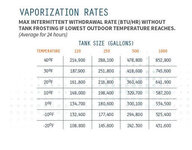
I didn't realize your using 120 gallon bottles as a tank. Tanks that small can have issues with vaporizing the liquid to vapor in colder temps.

IE at 0 they can only vaporize 135000 btu per hour, not enough if your using the generator, hell it can barely run just the generator on one tank at 40 degrees.
vaporization-table.jpg

Even two 120 gallon bottles is going to be pushing it depending on your heating appliances. We wont put any thing smaller than a 500 gallon on a generator, and many are on 1000 but those are typically large homes.
 
Last edited:

PoorUB

Well-known member
Joined
Mar 29, 2021
Messages
11,692
Location
Fargo, ND
Even two 120 gallon bottles is going to be pushing it depending on your heating appliances. We wont put any thing smaller than a 500 gallon on a generator, and many are on 1000 but those are typically large homes.
I would not bother with the two 125# tanks either. They probably will run the generator, but keep in mind they fill them to 80%, so 100 gallons each. That generator will take roughly 2 GPH at full load, a bit less at half load, so 100 hours of run time, maybe, not knowing the rest of the LP load on full tanks. 50 gallons might run you a bit better than a day! I would want a 500.
 

Lassen Forge

Well-known member
Joined
Apr 26, 2014
Messages
15,380
Location
The romantic hills of central Umbria, Italy,
Propane is known as "Liquid Petroleum Gas"... it doesn't mean what my hot water heater is using is liquid propane, it's how it's stored in the tank. The gas is drawn off the top of the tank, through a primary regulator, through the line to the house, through the secondary regulator to the house "spider" where it's all split off to whatever appliance uses it.

I ALSO have a "wet tap" which draws the still liquid LPG (or GPL in Italy) off the BOTTOM of the storage tank, which I use to fill my "service" (or "BBQ") bottles and my big 10 gallon portable tank behind the shop. Separate valve and outlet on the tank.

Out in the rural back 40 wet taps are pretty common, nothing to be skeeeeered of. I've even hosed myself once or twice (side note - have dedicated coveralls for propane as that Methyl Mercaptin smell ain't NEVER coming out of your jeans!). The 2 issues are flammability of the evaporated gas (evaporates at like -47F give or take depending on atmospheric pressure) and the cyrogenic damage it can do (not as bad as dry ice, but still nothing to sneeze at). You DEFINITELY NEED eye protection (imagine a frozen eyeball!!) and gloves - I use old welding gloves because they insulate better -

I almost bought a forge/foundary system that DID have a wet tap feed - but I realized for what I do it was kind of overkill. The only time you need something like that is if you're pulling SO much LPG you freeze out your regulator (BTDT, BTW) - I ended up splitting my burner feeds and feeding each off its own bottle instead - Occasionally I was pushing the limits (frosty tank syndrome), but cheaper than a LPG evaporator system.

LPG is nothing to be chicken little over, you just have to understand the medium and how to use it safely.
 

Lassen Forge

Well-known member
Joined
Apr 26, 2014
Messages
15,380
Location
The romantic hills of central Umbria, Italy,
I didn't say to get rid of galvanized pipe, i was responding to someone else who did. Galvanized pipe as long as it meets ASTM 53 standards, just like black steel pipe, is fine for a propane system. As sited in NFPA 58 above

- - - - -

Even two 120 gallon bottles is going to be pushing it depending on your heating appliances. We wont put any thing smaller than a 500 gallon on a generator, and many are on 1000 but those are typically large homes.

Sorry for the back to back posts...

We had 3 325 gallon tanks that were fine for our genset, one was kept full and closed as a backup, and the other 2 fed both the house and the genset. One tank would run our genset for about a month (thanks to PGE for lettting us confirm that :mad:) running the house, so we had some idea of our "ZSP" (zombie survival potential) of our system...

You definitely want some capacity, because otherwise you're going to have the propane truck out there weekly to refill - not good.
The one thing I wish I HAD done was have a separate 500 for the shop to run its own heat and run the forge. I was pulling off 10 gallon service tanks, but that gets old pretty quick. Especially when you frost out that 10 gallon tank and it's output drops to pissant levels...
 

pvanderlugt

Well-known member
Joined
Nov 14, 2010
Messages
334
This is a great response, thank you so much. I am going to do this either way, so people who say I should not mess with it should just give me good info like you did since I am going to anyway.
WOW…. , Just WOW….

what else is on that line? What else is that 1/2 copper line supplying? Have you run all the calculations to make sure that your 1/2 line can supply all those appliances as full load? I am sure Nothing bad can happen when those appliances can not run properly because the do not get the proper gas pressure:rolleyes:
I am sure you calculated the max draw/evaporation on that 125 gallon tank right? especially in cold weather?

But the good news is, no matter what anyone says, experts, professionals or not, you are going to do it anyway…. because you read somewhere on the internet that you could, Glad i am not your neighbor..
 
Last edited:

tester19

Well-known member
Joined
Apr 25, 2021
Messages
225
Location
chigago
Might look at Generac's suggested piping for that unit?
I run NG but the generator will draw a lot of volume and a normal whole house gas regulator will be too small.

I also have a pool heater plus a generator and the gas company had several bigger meter's depending on what you had at your house.
.
.
.
 
To avoid these ads, REGISTER NOW!
Top Bottom