To avoid these ads, REGISTER NOW!

Plumbing question

bluedog225

Well-known member
Joined
Jan 31, 2012
Messages
3,302
Location
Texas
I’ll need to commit to the materials on my water service line to my shop soon and I wanted to check in with the experts.

It’s about 1000 feet and I’ve decided 1” inch or 1.25” black poly.

I’ve taken a deep dive into poly pipe installation. I don’t want to have issues down the road. Most people seem to get whatever the farm supply sells and put barbs and clamps on it. Maybe that works fine.

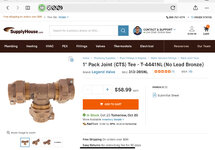
Looks like the best practice from both a service life and flow standpoint would be Ford couplings (aka pack joints) with stainless inserts. A little pricier (about $60 each) but not a deal breaker. And I think I’ll need to order/specify copper tube size (CTS) poly pipe that has a standard inside diameter ratio (SIDR). Pardon if I get some of this wrong, I’m like a parrot learning new words at this point.

All that said, I want to stub this up every 200’ or so for a hose bib. Depends on the roll length.

The only Ford coupling tees I’ve found are 1” in each direction so that may limit me to 1” pipe. And I think that will be fine.

Does anyone see flaws with this plan?

The only other issue I can think of is freeze protection. We do occasionally get temps in the teens. I’ll put the hose bibs in vaults and that may be enough. I’ve seen those tall faucet handles they have in some of the national parks I’ve visited that seem to put the ball valve or gate valve down in the earth away from the cold but I don’t know what they are called.

Thanks in advance.

edit-pic
IMG_0021.jpeg
 
To avoid these ads, REGISTER NOW!

RPH

Well-known member
Joined
Dec 17, 2006
Messages
4,190
Location
Michigan Thumb
Frost free spigot is what it’s called here. Different lengths for freeze protection. They need to have an area at the bottom that allows the spigot to drain. The water shuts off at the attachment the tee. See if the ford coupling comes with an npt connection on it.
 

HoosierBuddy

Well-known member
Joined
May 9, 2006
Messages
2,931
Location
Southern Indiana
When faced with the same project 27 years ago, I went with 1" Poly and used those barb and clamp fittings everyone complains about.

I have yet to have a leak. I would use the improved fittings you have suggested where possible, but don't be deathly afraid of the old school barb fittings. IIRC I used 2 clamps on each barb.

On the hydrant, I only installed one, but it is one of the "frost proof" ones. The actual valve is down at the base of the hydrant, well underground. The handle on top has a rod which goes down the hydrant tube and opens the valve. 27 years. No issues yet.


30-30remchester

Well-known member
Joined
Aug 20, 2011
Messages
251
Having been in the underground water business for 50 plus years, I have some experience. While your plan seems sound, the pipe size seems awfully small for the distance to be traveled. Friction loss from the pipe itself and all the fittings greatly reduce the flow at the tail end. I would definitely visit with a qualified pipe supplier and discuss your plans and let him help with sizing if you have not already. This year alone I was witness to 2 such systems that were buried that were too small and had to be dug up and larger pipe installed.
 
OP
B

bluedog225

Well-known member
Joined
Jan 31, 2012
Messages
3,302
Location
Texas
I appreciate you perspective. In another thread, I tested the flow with the current set up.

If you care to have a look. https://www.garagejournal.com/forum/threads/gallons-per-minute.523097/#post-10357391

Summary-It’s mostly 5/8 craftsman rubber hose. Though there is a 150’ stretch of 1.25 pvc with a 90 degree turn and a ball valve. Some gently uphill and mostly gently downhill.

My measured flow rate was a little over 6 gallons in 53 seconds (6.8 gallons per minute) and folks thought this was plenty for a one bathroom/one kitchen sink shop.

Given that actual flow, would you still be concerned? I can easily bump the pipe up but may have problems finding ford coupling tees.
 

pcmeiners

Well-known member
Joined
Aug 13, 2009
Messages
7,948
Location
In the only town in Pennsylvania, Bloomsburg.
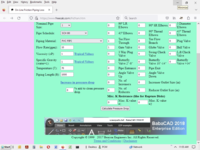
Friction loss calculator.....

Agree with 3030, 1000ft with 1" is asking for disappointment. Run the flow calculator for 1", 1 1/4", 1 1/2", and 2" . Even going to 1.25" cuts the pressure (thus volume) loss by 4 times. Fittings are out there, you need to do more searching . Use sch80, PVC pipe, flow rate 10?, pipe length 1000, one tee, one valve.
Ps ...I am single, have 7 gallons a minutes.... not enough for a family unless you have an additional storage tank.
Excuse me but why are you so fired up with Ford couplings? From what I see they are a source of turbulence/ friction loss. Get barbed stainless fittings with adjustable quality stainless bands (not the cheap hardware store $1.00 bands), full flow tees and valves. Figured 10 gallons flow from the source. As to bands, tees, valve etc if city chlorinated water, 316 stainless, if well water 304 stainless. (Ebay is your best pricing)


1697730965222.png
 
Last edited:

jack stand

Well-known member
Joined
Feb 29, 2012
Messages
3,346
Location
Lakes Region Maine
I like to plan ahead myself, but a hydrant every 200'? Are you going by a bunch of greenhouses or cattle watering trough? Joints that you DON'T have with never have a problem. Good call that 30-30 mentioned about your 1000' run and friction losses.👍
 

The Cobbler

Super Moderator
Staff member
Joined
Oct 24, 2013
Messages
25,954
Location
Niagara Region, Ontario, Canada
another option to get around friction loss, run a smaller service to a holding tank, say a 1,000 liter ( sized depending on your usage ) food grade tank. fit it with a float system and a pressure pump .
the tank is a reservoir to collect water at a slower rate and be a storage container to supply your higher flow pressure system .
perhaps you may find actual cost savings with the cost saved in your service line
 

Innovate1

Well-known member
Joined
Jul 28, 2014
Messages
4,291
Location
Illinois near St. Louis, Missouri
If it is and always will be just a shop then maybe 1.25 or 1.5 would be plenty but if there is any doubt I would go to AT LEAST 1.5" and maybe 2". It isn't that much more and you will never have to worry about it. We ran 2" the 500' from the street for our house - overkill but I haven't had any issues with flow. I used 20' sections of bell end pipe with seals that was available from a local commercial supplier. If I was doing it again I would probably go with heavy wall CTS poly. That's what I used on the tap from the 2" line for our shop. You should have no problem getting compression fittings from a real plumbing supply not the big box store. I got mine from Menards but I don't think they are in Texas. The place you posted has 1.5" and 2" fittings. For example:
https://www.supplyhouse.com/Legend-...t-CTS-x-MNPT-Coupling-T-4300NL-No-Lead-Bronze
No way I would be using barb fittings on pipe that has constant pressure. I have used them on sprinklers and other things where a blowout isn't going to continuously shoot water until I show up to turn it off.
 
OP
B

bluedog225

Well-known member
Joined
Jan 31, 2012
Messages
3,302
Location
Texas
I appreciate the advice.

Does it make any difference that the meter feed seems to look like it’s 5/8 or 3/4?

Seems like that’s going to be a constraining factor.
 
To avoid these ads, REGISTER NOW!
OP
B

bluedog225

Well-known member
Joined
Jan 31, 2012
Messages
3,302
Location
Texas
I like to plan ahead myself, but a hydrant every 200'? Are you going by a bunch of greenhouses or cattle watering trough? Joints that you DON'T have with never have a problem. Good call that 30-30 mentioned about your 1000' run and friction losses.👍
I‘m thinking ahead for irrigation of some fruit and pecan trees.

Otherwise, I’ll have to back run a hose from the shop. Seems like a good idea to put in some hose bibs along the way.
 

mike93lx

ALLIANCE MEMBER
Joined
Dec 9, 2013
Messages
37,816
Location
Richmond, VA
I appreciate the advice.

Does it make any difference that the meter feed seems to look like it’s 5/8 or 3/4?

Seems like that’s going to be a constraining factor.
I bet the piping in the street is a lot larger. The stretch of the section at the meter doesn't negate benefit downstream.

I'd also wonder about that many hydrants. Do you really need those feeds?

I'd be tempted to run a single piece to the house and then back out to the hydrants where needed. Unless you want to prioritize flow and pressure on the hydrants over the house
 

Innovate1

Well-known member
Joined
Jul 28, 2014
Messages
4,291
Location
Illinois near St. Louis, Missouri
The meter does cause some drop but it is a very short section of pipe so doesn't make as much drop as you might think. 1000' of pipe of 1" will still cause more drop at significant flow rates than the meter. Similar to voltage drop in long feed wires. If the wires are too big for the breaker a smaller wire can be spliced on to fit the breaker as long as it is big enough for the breaker rating and it is so short it doesn't introduce much voltage drop. I would be running the hydrants off a separate line with a shutoff - put the shutoff at the shop or somewhere in the main line to shorten the distance. And put an in ground valve for the hydrants. Then when you have any issues with the hydrants you can shut them off to repair without shutting off the shop.

Even a 1" pipe can't run many sprinklers at that distance. Figure out the flow rate for the sprinklers and how many you want to run at a time to get the total flow rate. Then size the pipe for minimal pressure drop for the distance and flow rate. If you typically have high water pressure you can put up with more pressure drop. Might want to put in some irrigation valves and a sprinkler timer like for lawn irrigation while you are making ditches and installing pipe. I haven't ever used one but depending on you soil conditions you might be able to use a plow to pull in the pipe without ditching. That's how they do sprinkler systems here.
 

stingry

Well-known member
Joined
Oct 14, 2006
Messages
732
Location
Western Nebraska
Summary-It’s mostly 5/8 craftsman rubber hose. Though there is a 150’ stretch of 1.25 pvc with a 90 degree turn and a ball valve. Some gently uphill and mostly gently downhill.

My measured flow rate was a little over 6 gallons in 53 seconds (6.8 gallons per minute) and folks thought this was plenty for a one bathroom/one kitchen sink shop.
your assumption is flawed. You are measuring flow to atmosphere. Put a pressure Gauge and valve on the end of the hose and then close the valve until you get 40 or so psi. This will give you the actual flow at system pressure.
 

KenC

Well-known member
Joined
Dec 20, 2009
Messages
2,592
Location
oklahoma
Clamps, the key to barbed fittings lifetime. Most of the geared clamps available locally are stainless band only the screw is not. So it will rust away when buried for years. Depending on soil type and moisture content it could be a few or many.

Poly with barbs is fine IF one sources 100% stainless hardware.
 

rlitman

Well-known member
Joined
Oct 18, 2010
Messages
24,642
Location
Long Island
Clamps, the key to barbed fittings lifetime. Most of the geared clamps available locally are stainless band only the screw is not. So it will rust away when buried for years. Depending on soil type and moisture content it could be a few or many.

Poly with barbs is fine IF one sources 100% stainless hardware.
True. Or if you want even better, just find the correct size range Oetiker stepless clamp. On a line this size, you can usually get two or three on the barb.
 

sjvicker

Well-known member
Joined
Aug 9, 2014
Messages
605
Location
SW Washington
I did a 700ish ft run of 160PSI 1-1/4" poly pipe and I started off with some of the fancy compression fittings and fought those more than I expected. At the end, plastic barbs and hose clamps are what I went with. If you're between 1" and 1.25" then go bigger for the piece of mind.

I'd stay away from the 100PSI stuff since its thinner and I'm assuming the 200psi would be a pain to work with. Also, I'd try to do the install on a warm sunny day so you can get a bit more flex out of the pipe.
 
OP
B

bluedog225

Well-known member
Joined
Jan 31, 2012
Messages
3,302
Location
Texas
"No way I would be using barb fittings on pipe that has constant pressure."

BS, there is nothing wrong with barbed fitting if used with the correct clamps. Done >100 wells, never a blowout. Agree if you use 5 & Dime quality bands
I appreciate the advice. But I don’t understand. Isn’t water in the shop always flowing to atmosphere?
 
To avoid these ads, REGISTER NOW!
Top Bottom