RegeSullivan
Well-known member
The last time I bought a 10' stick of 3" no hub ci it was $125... What does it cost today?


My current house has a pvc stack for the 2nd and 3rd floor that runs through a wall in the kitchen. It's really great knowing someone just used the ******* while cooking. If I ever had the walls open, I'd at least insulate, if not replace itExcellent point! Never thought about that, sounds like a good reason to use cast iron.
My current house has a pvc stack for the 2nd and 3rd floor that runs through a wall in the kitchen. It's really great knowing someone just used the ******* while cooking. If I ever had the walls open, I'd at least insulate, if not replace it
Great point. Wish I could tell if they washed their handsAt least you know the flush was successful
Not much for pricing online, but a quick Google shows a supplier in NJ at $115The last time I bought a 10' stick of 3" no hub ci it was $125... What does it cost today?
That seems alarmingly affordable.For reference, a 4’ piece of 3”pvc and two pvc couplers (one regular and one for repair with no stop) cost me $21.00 today.
What I can’t find is Oates Heavy Body Slow Set cement, at any of the big box stores. I’ll try Fastenal tomorrow. Where do you guys normally find it?
A big price difference for sure, and I wouldn't use CI in that spot anyway, but in the grand scheme of things, does the extra c note matter in the scope of a full build?For reference, a 4’ piece of 3”pvc and two pvc couplers (one regular and one for repair with no stop) cost me $21.00 today.
What I can’t find is Oates Heavy Body Slow Set cement, at any of the big box stores. I’ll try Fastenal tomorrow. Where do you guys normally find it?
The insurance claim I mentioned above was for a 4" horizontal run in my house that ran past a dining room. When it failed, I replaced it with PVC and wrapped it in MLV held in place with stainless tie wraps. I bought a bag of stainless ties, because I've had too many nylon zip ties snap over time on their own, and I wanted to be sure this stayed in place permanently after I sealed it up. The 1lb MLV easily quiets the pipe better than the CI was beforehand. You could barely hear a flush with the wall open, and once I put up the safe-n-sound and taped the sheetrock closed, there's absolutely not a whisper to hear.My current house has a pvc stack for the 2nd and 3rd floor that runs through a wall in the kitchen. It's really great knowing someone just used the ******* while cooking. If I ever had the walls open, I'd at least insulate, if not replace it
I'd ask for the slowest setting stuff from the counter at a plumbing supply house....What I can’t find is Oates Heavy Body Slow Set cement, at any of the big box stores. I’ll try Fastenal tomorrow. Where do you guys normally find it?
I am pretty sure it’s solid core but I’ll confirm in the morning. To be honest, I was happy that I found shorter sections and didn’t need to buy an entire 10’ stick, so I didn’t look closely.
Just curious.
I looked at a 10' a few months back for some reason and about crapped myself with how expensive it was

 www.classaction.org
Jeez, what a surprise. NOT. We listened to all the BS excuses for increased prices during covid but that has been over for 2+ years now. I notice a LOT of prices haven't changed back though.“Since at least January 2021, the Converter Defendants have used OPIS to facilitate an agreement to fix the price of PVC pipe sold in the United States,” the lawsuit summarizes, relaying that between January 2021 and mid-2022, the price of PVC pipes rose by nearly 250 percent compared to the 50-percent price increase for PVC resin. Per the suit, while resin prices have decreased since late 2022, PVC pipe prices “remain elevated to this day.”Major Manufacturers Have Illegally Fixed PVC Pipe Prices Nationwide, Antitrust Class Action Alleges
A class action alleges several companies have conspired to artificially inflate, fix or manipulate the price of finished PVC pipes sold in the U.S.
So... this keeps becoming a bigger rabbit hole.
After being asked if I purchased solid core or foam replacement pipe (I purchased solid core, fwiw), I decided to check and see what was originally installed. Turns out, its cellular (foam) 3" pipe labelled "not for pressure". Okay... I am guessing its not an ideal situation, but its what was originally installed when the house was built back in 2006, and near as I can tell, its been getting the job done aside from the damage I uncovered when I was taking down sheetrock.
I have no intention of replacing the entire stack in a finished, existing house. So at this point, I am going to just get a piece of cellular core pipe, use a standard coupler on one end and a Fernco to finish the connection. If I could find slow set cement (I tried 8 different places today, no one had any in stock), I'd use a NHC but my guess is the Fernco is liable to be stronger/last longer than the foam pipe anyway, so why sweat it at this point?
I realize this is Garage Journal and someone will probably advise that I should burn the house down and start over... lol If anyone feels like I am making a bad mistake here, by all means say so but I am pretty confident that overkilling it isn't going to be any real benefit.
I'll post a picture of the repair once I finish it.
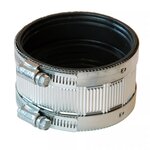
Nothing wrong with the pipe you have there, I wouldn’t lose sleep over it. Whether the coupling you select is a fernco or other brand, it should be one with a stainless steel shield all the way around it. These are commonly called “no hub couplings”. If using a no hub coupling makes you uneasy (it shouldn’t), they are available as “heavy duty or wide body” with a little deeper “hub” and 4 screw clamps in lieu of two.So... this keeps becoming a bigger rabbit hole.
After being asked if I purchased solid core or foam replacement pipe (I purchased solid core, fwiw), I decided to check and see what was originally installed. Turns out, its cellular (foam) 3" pipe labelled "not for pressure". Okay... I am guessing its not an ideal situation, but its what was originally installed when the house was built back in 2006, and near as I can tell, its been getting the job done aside from the damage I uncovered when I was taking down sheetrock.
I have no intention of replacing the entire stack in a finished, existing house. So at this point, I am going to just get a piece of cellular core pipe, use a standard coupler on one end and a Fernco to finish the connection. If I could find slow set cement (I tried 8 different places today, no one had any in stock), I'd use a NHC but my guess is the Fernco is liable to be stronger/last longer than the foam pipe anyway, so why sweat it at this point?
I realize this is Garage Journal and someone will probably advise that I should burn the house down and start over... lol If anyone feels like I am making a bad mistake here, by all means say so but I am pretty confident that overkilling it isn't going to be any real benefit.
I'll post a picture of the repair once I finish it.
The unshielded are for underground outside the building use. Most commonly at a sewer connection to the main where you may be required to connect two pipes running into one another.I read somewhere that the shielded coupler like in the picture above is required by residential plumbing code. The unshielded wider one seems to also work fine — I have seen them in use.
I recently had a crack in a vertical section of cast iron pipe. I cut it out and put in a section of 4” pvc. The outer diameters of the cast iron and pvc differed by about 1/4 inch. I found shielded couplers that had slightly different diameters on each side and used those to install the pvc to cast iron.
My local Home Depot had no short sections of 4” PVC and their 10’ sections cost more than Lowe’s, which had 5’ sections for $35 and 10’ sections for $40. I bought the 10’ section so I will have a spare for some future project.
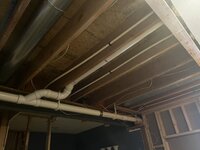
As long as that's not a belly on the left that should work fine!Repair done!

You can also stuff a "test plug" in that clean out, fill the pipes and let them sit for 24 hours to make sure there are no leaks.If you are fixing it, make sure it's pitched correctly
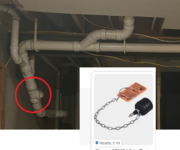
Question for the team: why not cut some slip couplings in half and glue them over the crack?
The proper repair is replacement, but I’m hesitant to put a Fernco in a waste line because it might snag something and cause a clog (I guess the same is true for a slip couplings, but to a lesser degree).
It's almost like they're made for this...After looking at the inside of the Fernco I was installing, I can't see that being any worse than a regular coupling in terms of snagging or clogging. The pipes seat up to the Fernco well enough that I can't see it causing any more obstruction that anything else you might use.
I would add another pipe hanger - closer to the repair coupling. My $0.02Repair done!