To avoid these ads, REGISTER NOW!

Plvmb Open End Wrench with 'War Finish'?

DuroChrome

Well-known member
Joined
Apr 24, 2015
Messages
323
Location
Oregon
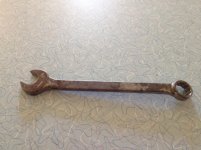
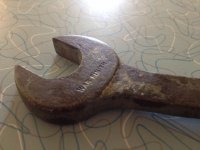
I have been going through my grandfather's tools and I found a roll up of older wrenches, most dating from the 40s as best I can tell. They were stuffed behind a bunch of rusty junk and I had never noticed them before. The roll up contained several Plvmb and Plvmb/Proto as well as SK, Snap On and a Thorsen. This particular wrench stood out to me as it was not chromed, it almost looks lightly galvanized. It is stamped 'war finish' on the open end...I haven't seen anything about that in the searches I've done so far, just that the era for the 1224 3/4" might be during the war years if it isn't chromed.

My source was a link woody posted for me...thanks again! http://home.comcast.net/~alloy-artifacts/plomb-gallery-p2.html#combo

Any info is appreciated. I am going to start using these wrenches...:thumbup:
 

Attachments

  • image.jpg
    image.jpg
    141.1 KB · Views: 66
Last edited:
To avoid these ads, REGISTER NOW!
OP
D

DuroChrome

Well-known member
Joined
Apr 24, 2015
Messages
323
Location
Oregon
Wow! Thanks for the information, I just put a little WD on them to keep them from rusting. The plating is odd for sure. I think I have three wrenches from that era, an 11/16" and a little 3/8", neither say war finish on them.

More of the collection...
 

Attachments

  • image.jpg
    image.jpg
    144.5 KB · Views: 38
Last edited:

DocsMachine

Well-known member
Joined
Sep 16, 2006
Messages
1,867
I can't say on the hand tools, but "War Finish" was used extensively on machine tools of the day.

Prior to the war, machine tool manufacturers took quite a bit of pride in their machines, with some parts getting chromed, castings being filled, sanded smooth and the paint polished, even adding pinstriping.

However, during the war, the US was short on manpower, so having people fill and sand and prime was seen as a waste of time, and using vital materials, like chromium, on merely-decorative uses was declared unnecessary.

The War Production Board was formed, and given almost unlimited authority to control things like that- who got what vital materials, what operations and services were allowed or deemed wasteful, etc.

Long story short, the manufacturers either couldn't (for lack of materials) or weren't allowed to do a lot of the final finishing. Rather than fillers and sanded & polished finishes, a simple coat of paint worked just as well. The lathes and mills were just as accurate, just didn't look as good.

The manufacturers had a reputation to think about, however, and so put the various "War Finish" tags, labels or stamps on their products- not only as a bit of partriotism ("We're helping the effort by complying with..." etc. etc.) but also as a way of telling the users, in effect, "this machine does not reflect our usual standards of appearance".

Doc.
 

Plombob

Well-known member
Joined
Oct 19, 2008
Messages
4,133
Location
Tennessee
"War Finish" marked Plomb tools were made during World War II for the civilian market. The designation implied that the finishes on the tools were not up to normal Plomb standards due to wartime strategic materials shortages. Plomb also made wartime tools for military contracts but these had different markings (WF = Wright Field contracts with the US Army Air Corps, USN = United States Navy, etc.). "War Finish" Plomb tools are typically plated with cadmium (a carcinogen), so don't sand, wire brush or wire wheel them. The cadmium finish is relatively is stable as a plating, but if you absolutley do not want to be breathing cadmium dust in any form, so use caution. I've also heard that vinegar de-rusting of cadmium plated tools produces toxic fumes so use caution there as well.

Don't soak Cad in Evaporust or solvents. MEK will strip Cad plating given some time.
 
To avoid these ads, REGISTER NOW!
Top Bottom