Looking for some insight to possibly help solve the condensation issue in my newly built pole barn. I recently built a 32x48x12 pole barn in Northern West Michigan this spring. I had it stay foamed in early November with Closed cell spray foam. They laid 1.5” foam board against the steel and then sprayed 1.5” of closed cell foam over top on all my wall. Since then I’ve insulated my ceiling with R’38 kraft faced insulation and studded my walls with preparation of sheathing the walls. I picked up some new R-13 unfaced batts on a forsale page that were cheap that I could Throw in between studs before sheatimg went up. I’m noticing that my windows and garage doors are soaking wet in the morning and between the spray foam and batts is always sweaty. I’m worried if I sheet the walls I will have a mold issue down the road. The temp is about 20-mid 30’s right now. I only have a torpedo heater in the barn right now and only run it for about 20min before it gets up to temp and it’s usually warm enough for the rest of the time I’m in the shop. I plan on putting a propane heater in the shop once I finish my ceiling with metal. Can anyone give any input what’s causing my condensation build up? Thanks!


You are using an out of date browser. It may not display this or other websites correctly.
You should upgrade or use an alternative browser.
You should upgrade or use an alternative browser.
Pole Barn Condensation problem
- Thread starter Lewit12
- Start date
Kerosene heaters will put off a lot of moisture that would show up on the windows like you described. I would expect the kerosene heater to run much longer for that much condensation however. 20 min of use shouldnt generate that much moisture. Is there a vapor barrier under your concrete slab?
Sent from my iPhone using Garage Journal
Sent from my iPhone using Garage Journal
Kerosene heaters will put off a lot of moisture that would show up on the windows like you described. I would expect the kerosene heater to run much longer for that much condensation however. 20 min of use shouldnt generate that much moisture. Is there a vapor barrier under your concrete slab?
Sent from my iPhone using Garage Journal
I heat my pole building with Kerosene heaters exclusively, no condensation at all.
Does condensation only occur after heat is run? I'd suspect the torpedo heater is causing issue but as above post says 20 minutes doesn't seem long enough for that to be problem. If the torpedo heater is causing issue it should resolve itself after you change heater. I would use an outside vent heater when you replace it. If torpedo isn't source I'm sorry have no suggestions. Good luck.
I did not put down a vapor barrier under my slab. I have scissor trusses on my barn, 4/12 pitch with 3/12 inside. 2ft vented soffit on the eves and 1ft vented on the gable ends with a ridge vent. Should be plenty of ventilation in the Ceiling.
I can walk in the shop first thing in the morning and the windows are sweating and it hasnt been heated since the previous morning. 20 degrees outside still around 40-45 in the garage I’d suppose. The condensation on the windows does seem to get a little better as it comes to temp. But still damp, I’m wondering If it’s the heating and cooling that’s causing the moisture. When I have a hot dawg heater on the ceiling I will keep the barn at a set temp. I will also be installing a ceiling fan once the ceiling metal is up
Last edited:
I did not put down a vapor barrier under my slab. I have scissor trusses on my barn, 4/12 pitch with 3/12 inside. 2ft vented soffit on the eves and 1ft vented on the gable ends with a ridge vent. Should be plenty of ventilation in the Ceiling.
I agree, should be plenty as long as the vents aren't blocked with insulation.
I can walk in the shop first thing in the morning and the windows are sweating and it hasnt been heated since the previous morning. 20 degrees outside still around 40-45 in the garage I’d suppose. The condensation on the windows does seem to get a little better as it comes to temp. But still damp, I’m wondering If it’s the heating and cooling that’s causing the moisture. When I have a hot dawg heater on the ceiling I will keep the barn at a set temp. I will also be installing a ceiling fan once the ceiling metal is up
Mine is about 45 degrees when it's 20 outside. I only heat when I'm working in it, I use two 23,800 BTU Kerosene space heaters. I also have a propane heater that clamps on top of a grill tank if I need to bring the temp up quicker. With the Kerosene heaters running it will even out at 65-70 degrees. No condensation at all, so I don't know if it's from heating and cooling.
How fresh is your concrete? Mine was poured in August of 2018. It has a vapor barrier underneath but no foam.

astroracer
Well-known member
To really rid the building of moisture you need to keep it at a stable temperature. The heating and cooling cycles will do exactly what you are seeing. The warm moist air in the building condenses on the cold glass and steel. Just "warming it up" does nothing to burn off the moisture and, with your building being new, it generates a lot of moisture as the materials are drying out.
My shop is warm 24/7 during the winter. I keep the temp at 52 or so degrees. It's warm enough to ward off the condensation blues and keep the lathes and mills from rusting. If I am going to be in the shop all day I will kick it up to 58 or 60. Plenty warm to work in shirt sleeves. I never see any moisture problems when I drop it back to 52 for the night.
Mark
My shop is warm 24/7 during the winter. I keep the temp at 52 or so degrees. It's warm enough to ward off the condensation blues and keep the lathes and mills from rusting. If I am going to be in the shop all day I will kick it up to 58 or 60. Plenty warm to work in shirt sleeves. I never see any moisture problems when I drop it back to 52 for the night.
Mark
Would anyone be leery with going forward with closing up the walls with the codensation issue? I’m installing pine tounge and groove on my walls walls with a galvanized corrugated steel wainscot. I have pine already on one of the walls. Once the walls are finished then I will start working on my ceiling, which then leads to the propane ceiling heater and ceiling fan. I’m hoping when everything is sealed up Up and I can get some air circulating it will knock down the moisture
buzzworth
Well-known member
Whatever you use to heat with needs to be vented. I tried to use a natural gas radiant tube unit in my 30 x 60 pole building and being unvented, it produced much moisture. It collected along the upper edge of the walls and then the mold formed.
I had to go to a standard type forced air furnace.
I had to go to a standard type forced air furnace.
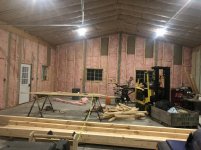
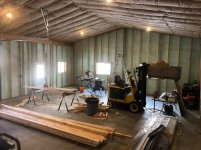
I have attached some pictures of interior and how sweaty my door is when I come into the garage
That's a nice space you have.
That's a nice space you have.
Thanks! It’s been a lot of work, looking forward to getting it all buttoned up on the inside. I just want to make sure I’m not walling in a mold box.
Attachments

Would anyone be leery with going forward with closing up the walls with the codensation issue? I’m installing pine tounge and groove on my walls walls with a galvanized corrugated steel wainscot. I have pine already on one of the walls. Once the walls are finished then I will start working on my ceiling, which then leads to the propane ceiling heater and ceiling fan. I’m hoping when everything is sealed up Up and I can get some air circulating it will knock down the moisture
What else would you try to do at this point? This is how my building is...inside plywood wall covering, 6 mil vapor barrier, Rockwool R23 insulation, outside steel. I do know you don't want to sandwich insulation between two vapor barriers, if the moisture can't escape it will lead to mold.
What else would you try to do at this point? This is how my building is...inside plywood wall covering, 6 mil vapor barrier, Rockwool R23 insulation, outside steel. I do know you don't want to sandwich insulation between two vapor barriers, if the moisture can't escape it will lead to mold.
I could pull the unfaced batts out of the wall if that is part of the problem. I’ve heard if the spray foam isn’t thick enough that can cause issues too. I thought 1.5” was sufficient.
Referencing your point on sandwiching insulation between 2 vapor barriers, I wanted to put black plastic up on the studs before installing the knotty tounge and grove. Due to the fact there are knots missing and knots will eventually fall out as they dry. Hoping with the black plastic in the back it wouldn’t be as noticeable. But that would be a second vapor barrier correct?
matt_i
Well-known member
Whatever you use to heat with needs to be vented. I tried to use a natural gas radiant tube unit in my 30 x 60 pole building and being unvented, it produced much moisture. It collected along the upper edge of the walls and then the mold formed.
I had to go to a standard type forced air furnace.
I would put my eggs in this basket. Everything seems fine when its warm and the air is holding the moisture. But, let it all free float back down to a low temp and then every surface in there becomes a receptor for "dew" --- condensing the moisture back out of the air which has a diminishing ability to hold it as the temp drops.
Go with some type of vented (e.g. with a chimney which penetrates the wall or roof) heater. Then you will not be pushing the combustion moisture into the air.
The propane forklift does the same thing although I doubt you are running it long enough to be nearly as much effect. (EDIT...I see its an electric so scratch that comment!)
Last edited:
I could pull the unfaced batts out of the wall if that is part of the problem. I’ve heard if the spray foam isn’t thick enough that can cause issues too. I thought 1.5” was sufficient.
Referencing your point on sandwiching insulation between 2 vapor barriers, I wanted to put black plastic up on the studs before installing the knotty tounge and grove. Due to the fact there are knots missing and knots will eventually fall out as they dry. Hoping with the black plastic in the back it wouldn’t be as noticeable. But that would be a second vapor barrier correct?
I would think black plastic on the inside would be a second vapor barrier. Wish I could give you more advice but I never had anything spray foamed. Living in the northeast we always put the vapor barrier on the inside, but spray foam would count as a vapor barrier.
finn
Well-known member
The condensation is caused by the cumulative run time of the torpedo heater. You have a tight building with the closed cell spray foam, so the building has no opportunity to breathe, and if your climate is anything like ours, the relative humidity has been high all winter, especially if you are close to the Great Lakes.
Also, the closed cell foam is your vapor barrier. Don’t add another one. Open cell would have probably been a better option for your build, then you could have a vapor barrier on the heated, rather than the cold side of the wall.
I would recommend modifying your build schedule to at least partially finishing the ceiling and then installing the hanging ceiling before doing the walls. That will let you confirm that the torpedo heater is, in fact, the source of the excess humidity.
One other thing to consider: forego the concentric vent that seems popular these days and use inside air for combustion. That will force some fresh air exchange in an overly tight building.
Also, the closed cell foam is your vapor barrier. Don’t add another one. Open cell would have probably been a better option for your build, then you could have a vapor barrier on the heated, rather than the cold side of the wall.
I would recommend modifying your build schedule to at least partially finishing the ceiling and then installing the hanging ceiling before doing the walls. That will let you confirm that the torpedo heater is, in fact, the source of the excess humidity.
One other thing to consider: forego the concentric vent that seems popular these days and use inside air for combustion. That will force some fresh air exchange in an overly tight building.
Last edited:
Scotto
Well-known member
I could pull the unfaced batts out of the wall if that is part of the problem. I’ve heard if the spray foam isn’t thick enough that can cause issues too. I thought 1.5” was sufficient.
Referencing your point on sandwiching insulation between 2 vapor barriers, I wanted to put black plastic up on the studs before installing the knotty tounge and grove. Due to the fact there are knots missing and knots will eventually fall out as they dry. Hoping with the black plastic in the back it wouldn’t be as noticeable. But that would be a second vapor barrier correct?
I would not install plastic behind the tongue and groove because you would definitely be creating a second vapor barrier.
"Since 2007, the IECC has required (in section 402.5) that walls and ceilings in climate zones 5, 6, 7, 8, and marine zone 4 -- a range of zones that includes Minnesota -- have a Class I or Class II vapor retarder — in other words, kraft facing, vapor retarder paint, or polyethylene -- on the interior side of the assembly."
With the closed cell foam, that's your vapor barrier so I would even be hesitant to having the unfaced batts in there. Then again the wood won't be sealed tight so you should be OK for it to breathe.
What layers of insulation do you have in the roof? Did you spray foam the roof metal?