Hey all, I’m planning my pole barn build and I have some questions about my foundation, I’ll be pouring concrete piers to set my columns on then pour my concrete pad, to bring the pad up to grade I have a 6’ difference from front to back, I was wondering if I could just use say 2B stone to bring my pad up to grade instead of having trucks deliver fill dirt then spreading stone ontop? Any info is helpful as this is my first pole barn build, thanks!


You are using an out of date browser. It may not display this or other websites correctly.
You should upgrade or use an alternative browser.
You should upgrade or use an alternative browser.
Pole barn foundation
- Thread starter brianc33
- Start date
Nope.Questions are about the Pad under the concrete is that not a form of a foundation
Your pole building is built, and then the slab is poured.
A foundation would be poured and then have the structure built on top.
6' (6 Feet) is a massive difference in grade and may require some engineering. For a pole barn, I'd want to get the grade situated, compacted (in lifts) and then drill for the poles.
If you're filling 6 feet you need to ensure that the area has proper fill material and that it is compacted, in lifts, using the proper equipment.Got ya, I just worded my thoughts wrong my bad, I understand the building gets built then the pad is poured, I guess I was trying to ask if there was any benefits of using gravel to bring the grade up to level instead of using fill dirt?
IMHO that's not DIY territory.
billconner
Well-known member
Yes it could be all gravel IMHO. I'd think fill dirt would be much less expensive. Whichever, as others stated, very compacted.
Not clear how deep your piers and footers are in relation to fill.
Not clear how deep your piers and footers are in relation to fill.
I will be drilling 5’ deep with 18” auger for my piers, which in the front they will set in the ground about 4’ with approx 1’ of gravel ontop but in the back the posts will be set in completely compacted gravel with approx 1’ of gravel below before I hit dirt
theoldwizard1
Well-known member
What ever you use as fill MUST be compacted in "lifts". Not sure how high a lift can be before it needs to be compacted.
billconner
Well-known member
I guess it doesn't matter because your posts aren't embedded so all lateral bracing is added above grade in the framing. Great opportunity to do a shallow frost protected foundation - just gravel to frost depth and some drains to daylight and just build on top.I will be drilling 5’ deep with 18” auger for my piers, which in the front they will set in the ground about 4’ with approx 1’ of gravel ontop but in the back the posts will be set in completely compacted gravel with approx 1’ of gravel below before I hit dirt
4 FN 27
ALLIANCE MEMBER
Pole barns don't have foundations, they have poles.
Interesting. Ours has an ICF Foundation and Poles?
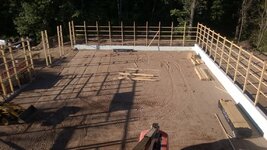

racecougar
Well-known member
That is very similar to the panel frame method that I went with for my build, though your girts are on the outside rather than bookshelf/commercial style.Interesting. Ours has an ICF Foundation and Poles?
vs
racecougar
Well-known member
Are you scraping the 4" stone off? If not, how far below grade will it remain on your high end (the end that doesn't need as much base)?Right now there’s a layer of 4’s (4” stone) ontop of the ground, would compacted gravel such as 2b be considered proper fill material? Not worried about compacting as I have a IR rt vibratory roller I will be using to compact the fill
billconner
Well-known member
Post frame and pole barn imply for me that the lateral bracing is a result of embedded posts or poles. On top of a foundation requires lateral bracing being added. Yes it can be done but you loose some of the advantage of embedded poles.
I will be compacting the 2b or whatever gravel I get ontop of the 4” stone it will probably sit 6”-8” ontop of the 4” stone on the high side of the gradeAre you scraping the 4" stone off? If not, how far below grade will it remain on your high end (the end that doesn't need as much base)?
gsmith22
Well-known member
this is what everyone gets wrong. its not just a difference in name, there is a functional difference too. The difference between the two structures are in how they are laterally stabilized for wind (as well as earthquakes and anything that could impart a horizontal load).Post frame and pole barn imply for me that the lateral bracing is a result of embedded posts or poles. On top of a foundation requires lateral bracing being added. Yes it can be done but you loose some of the advantage of embedded poles.
A 'pole barn' uses the vertical posts embedded into the ground functioning as cantilevers - the post is restrained from rotating at its base through the ground embedment. This is a very simple system (which is a benefit) with the problem of post bases eventually rotting from the ground/water contact, loosing your rotational restraint, and the structure then leans sideways eventually falling down (downside to the simplicity).
A 'post frame" has vertical posts that are "hinged" at their base connection with (usually) some type of concrete foundation. There is no restraint to rotation at the post bases. Rather, the post frame uses its above grade structure through member arrangement, sizing and connections between members (ie creating a "frame") to laterally stabilize the building. This is largely how steel and concrete buildings are structrually designed and constructed as well.
It is hard for a lot of engineers to understand lateral structural systems in buildings so I get that the non-engineer crowd mixes this up too but there is a reason for the difference in nomenclature.
For the OP, if you have to build up your base with fill, it will be very hard to create the embedment needed to satisfy the rotational restraint required of a pole barn. Post frame is the most logical choice.
gsmith22
Well-known member
perfect example of a post frame. this is not a pole barnInteresting. Ours has an ICF Foundation and Poles?
billconner
Well-known member
That may be how the terms are used in your area but googling post frame companies, the first 5 or 6 show post frames with embedded posts. The common explanation is round poles versus square - laminated - posts. It does seem to be the case that round posts are rarely set atop a foundation or pier, probably because of not many if any hardware for that.A 'post frame" has vertical posts that are "hinged" at their base connection with (usually) some type of concrete foundation.
gsmith22
Well-known member
its not a regional naming thing. the naming is based on the function. the vertical columns don't care if they are round or square only how they are attached at their bottom and top. if you embed a square column and create base fixity and don't provide the above grade framing components it will be a 'pole' structure. If you set round coumns on a foundation, don't create base fixity, and provde the column-to-roof construction rigidity need to create a frame, it will be a 'post frame' structure.That may be how the terms are used in your area but googling post frame companies, the first 5 or 6 show post frames with embedded posts. The common explanation is round poles versus square - laminated - posts. It does seem to be the case that round posts are rarely set atop a foundation or pier, probably because of not many if any hardware for that.
billconner
Well-known member
Many more post frame companies disagree with you than agree. I know I'm not going to change your mind but hope others will research for themselves.its not a regional naming thing. the naming is based on the function. the vertical columns don't care if they are round or square only how they are attached at their bottom and top. if you embed a square column and create base fixity and don't provide the above grade framing components it will be a 'pole' structure. If you set round coumns on a foundation, don't create base fixity, and provde the column-to-roof construction rigidity need to create a frame, it will be a 'post frame' structure.
4 FN 27
ALLIANCE MEMBER
perfect example of a post frame. this is not a pole barn
I still call it a Pole Barn!!! Sounds better than Post Frame.
"Park the Tractor in the Post Frame" just doesn't sound right.
