To avoid these ads, REGISTER NOW!

Pole Barn insulation

12voltsguy

Member
Joined
Sep 9, 2021
Messages
5
I recently had an uninsulated pole barn constructed. The roof has double bubble installed on the underside of roof sheet metal. I'd like to install a 1.5" foam insulation between the roof purlins then add a 6" vinyl faced blanket insulation to fill the top truss area. I was told the double bubble and vinyl face would create a dual vapor barrier and could possibly create moisture between the two. Does anyone have any experience with this? Should I remove the double bubble before installing the foam and faced blanket insulation?
 
To avoid these ads, REGISTER NOW!

billconner

Well-known member
Joined
Jul 20, 2021
Messages
6,928
Location
Thousand Islands NYS
I don't know your climate. If a heating climate and if a house with normal house activity, certainly a potential problem.

If moisture - air - gets past vinyl and past to the foam, it's likely to condense on the bubble wrap. Seems that the vinyl will be leaky. The rigid foam however - at least XPS or polyiso - might be enough to prevent condensation. Ideally, you might spray foam the purlins and foam.

And how warm and how consistently will you heat this space? Do you have a vapour barrier under slab? Do you store firewood in this space? Other moisture producers?

Probably safer to remove bubble but hard for me to be sure.
 
OP
1

12voltsguy

Member
Joined
Sep 9, 2021
Messages
5
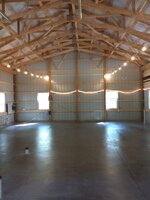
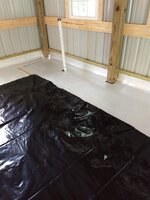
Thank you for the reply. I'm located in mid state PA. We have fairly cold winters 20's - 30's but can fluctuate lower. I have 8 mil plastic sheeting covering under concrete with 4' foil bubble around perimeter folded up the entire 5" edge of concrete. There is 2" XPS foam on top of plastic and bubble foil. The concrete pad is 30'x40' with 4 sections of pex for future radiant heat. The building is not a full time residence, but have been using as 3 season getaway. Hopefull for winter use after insulating. I do not store wood, but do have indoor plumbing. A few pictures of floor attached.
 

Attachments

  • IMG_20200711_104044096.jpg
    IMG_20200711_104044096.jpg
    249.7 KB · Views: 128
  • IMG_20210702_095840140.jpg
    IMG_20210702_095840140.jpg
    215.6 KB · Views: 129
  • IMG_20200715_113951927.jpg
    IMG_20200715_113951927.jpg
    397.3 KB · Views: 128

lkempf

Well-known member
Joined
Dec 19, 2015
Messages
71
Location
Indiana
Can't answer your question, but i like your building. The trusses being built like that really make it seem more open.
 

billconner

Well-known member
Joined
Jul 20, 2021
Messages
6,928
Location
Thousand Islands NYS
I'm not sure. I think the foam against the deck makes that a vapor barrier - with or without the bubble wrap. Or, the foam makes removing the bubble wrap unnecessary. So is there a problem with foam against exterior an vinyl against interior, and I believe there is. Some of the most touted wall systems use continuous foam on exterior but no vapor barrier inside - cellulose or fibreglass with just drywall and latex inside so wall moisture can dry to the inside.

No solutions, but I think you could could have a problem with foam and vinyl.
 
OP
1

12voltsguy

Member
Joined
Sep 9, 2021
Messages
5
Are the soffits vented and do you have a roof ridge vent?
There is a ridge vent and a cupula. Soffits are not vented. My original plan was to just use the vinyl faced blanket insulation without foam, but was told that could leave air gaps. I'm guessing near the purlins
 
To avoid these ads, REGISTER NOW!

kj_mustang

Well-known member
Joined
Feb 9, 2011
Messages
1,212
Location
Harrisonburg, VA
You have a couple decisions to make. If you put in a ceiling, then you created a space that will need to be considered. You have a ridge vent with no soffit venting so that newly created attic space can not vent well and moisture in the attic air becomes a concern. If you block off the ridge vent and insulate at the roof line, then you need to condition the inside air to control moisture levels.
 

billconner

Well-known member
Joined
Jul 20, 2021
Messages
6,928
Location
Thousand Islands NYS
I don't know how good or complete of a vapor barrier the vinyl is, but the bubble wrap and or foam on cold side and vinyl on warm side seems like a problem. If the yinyl is the priority, then remove bubble and do not add rigid foam.

It seems the best strategy is foam on exterior side, well sealed (like if not all spray, than rigid and spray seams, over purlins, around upper chords) and then fiber glass with a vapor permeable covering - like drywall with latex, but maybe fabric would work.

Not appealing but what I've learned from experience and more important listening to the best.

 
OP
1

12voltsguy

Member
Joined
Sep 9, 2021
Messages
5
I don't know how good or complete of a vapor barrier the vinyl is, but the bubble wrap and or foam on cold side and vinyl on warm side seems like a problem. If the yinyl is the priority, then remove bubble and do not add rigid foam.

It seems the best strategy is foam on exterior side, well sealed (like if not all spray, than rigid and spray seams, over purlins, around upper chords) and then fiber glass with a vapor permeable covering - like drywall with latex, but maybe fabric would work.

Not appealing but what I've learned from experience and more important listening to the best.

Thank you for all of the suggestions. I've heard many varying suggestions and it seems hard to know what the best approach is. I have lots to consider here.
 
To avoid these ads, REGISTER NOW!
Top Bottom