To avoid these ads, REGISTER NOW!

Pole Barn vs Stick Built

WordMan

ALLIANCE MEMBER
Joined
Jul 4, 2018
Messages
3,769
Location
Harriman, Tennessee
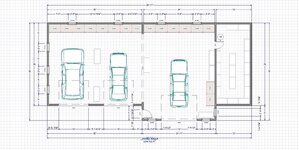
In a year or two I hope to begin building my "ultimate" garage. What are the pros and cons of going with a pole barn vs stick built?

Garage.jpg
 
To avoid these ads, REGISTER NOW!

jack stand

Well-known member
Joined
Feb 29, 2012
Messages
3,317
Location
Lakes Region Maine
If you're finishing the interior and heating, cooling and insulating the space, post framing loses its cost advantage unless you get into a traditional frost wall type foundation.
 
Last edited:

sz0k30

Well-known member
Joined
Feb 12, 2014
Messages
883
Location
SE Michigan
Can't help with your original question, but your 25' with is too narrow. You can barely put a short box crew cab pickup in there without any benches, much less have any room to walk around it.
 

Jakemedic

Well-known member
Joined
Jul 26, 2013
Messages
721
Location
Cornfields of SE Iowa
My post frame is insulated better than a traditional stick built. I used 8’ wide rolls of R19 and then applied vapor barrier. Thermal break every 8’ versus every 16” really made a world of difference. I also did full foundation and had the Amish construct the shell. The rest was up to me. I hope for your sake building material prices drop from where they are at. I am impressed with your plans, although I agree with other poster, 25 is an odd depth. My builder said increments of 4 was most cost effective. Have fun!
 

speed bump

Well-known member
Joined
May 28, 2008
Messages
6,317
Location
Butte Montana
This has been covered dozens of times but some quick highlights that stick with me.

Pole barn pros:
Less concrete work.
Typically less lumber
Typically faster to build
Can be cheaper
I would argue its easier to add doors and windows down the road

Pole Barn Cons:
Depending on where you are and your pole treatment they can/eventually will rot and you will need to replace them
Due to the nature of how they are built you need to be more conscious of high winds because you don't have as robust of an outer layer
Generally you have a higher chance of leaks. because you are putting metal on purlins and don't have a second layer of protection (IE roofing underlayment or vapor barrier.

Stick framing pros:
Typically much stiffer
Traditionally opens you up to more finish options
Typically considered easier to finish the inside

Stick Framing Cons:
Requires more foundation, either a monolithic slab or stem walls
A lot more quality lumber is required (more expensive).
Time to construct is often longer

Personally I like the pole building construction theory but when I build mine it will integrate some other pieces.
Pour sono tubes and use brackets. This gets the poles out of the ground (which right now is roughly the same price due to lumber cost) and lets me tilt up the walls like you do in traditional framing.
Tyvek the outside before sheeting. This makes the structure slightly more air tight.
 
OP
W

WordMan

ALLIANCE MEMBER
Joined
Jul 4, 2018
Messages
3,769
Location
Harriman, Tennessee
Can't help with your original question, but your 25' with is too narrow. You can barely put a short box crew cab pickup in there without any benches, much less have any room to walk around it.

I am impressed with your plans, although I agree with other poster, 25 is an odd depth. My builder said increments of 4 was most cost effective. Have fun!

Hmmm... my current garage is 20' deep and I have enough room for a lift with a small bench in front of it. The two bays that are 25' deep are really only for parking, not working. The working bay will be 12' high so I can use my lift.

Good info though. Thanks!
 
OP
W

WordMan

ALLIANCE MEMBER
Joined
Jul 4, 2018
Messages
3,769
Location
Harriman, Tennessee
I should also mention, I plan on paying someone to put up the pole barn or, if stick built, the shell, with roof.

If I have the pole barn built, I'll be building the walls, finishing the inside, outside, doing the electric, etc.
 

rburke65

Well-known member
Joined
Nov 10, 2007
Messages
12,349
Location
Canfield, Ohio
Can't help with your original question, but your 25' with is too narrow. You can barely put a short box crew cab pickup in there without any benches, much less have any room to walk around it.ues...25’ is REALLY shallow. You WILL hate yourself.
 

MikeinKy

Member
Joined
Nov 26, 2017
Messages
14
Location
North central Ky.
I have built several personal use shops. My current one is 40 ft deep and 44 ft wide. I have room for my crew cab dually and have room to work around it. I also have room for a couple of cars on the side. My lift is to the left side of the 16 ft door.. Speed bump has the right ideas. I think 30 ft deep would be a minimum. My last one was 36 x 48 with the door on the end, which was a mistake.
 
To avoid these ads, REGISTER NOW!

Jakemedic

Well-known member
Joined
Jul 26, 2013
Messages
721
Location
Cornfields of SE Iowa
You will save thousands of dollars by completing the inside yourself, including electric. I had a quote for 3600 just to run my feed and sub panel from a nice electrician with overhead and employee costs Which I understand. I did the entire wiring project for around 1200.00, and it passed inspection.
 

NUTTSGT

Super Moderator
Staff member
Joined
Sep 14, 2009
Messages
50,891
Location
Northern Central Ohio
Serious question here. Is the floor plan like that for practical purposes or or a design feature. If it's for practical purpose, you may find it's not much more to make it all the same dimension as the bump out.

I see that bump out using (I'm no post frame guy) two more posts for the outside corners, two additional inside & outside corners for trim. More labor to erect that detail, dump 2 window (front and side) and replace one with the man door. The cost sayings of those windows will pay for the extra concrete (5'x44' @4"=2.72yds/ 5"=3.4yds) that you'll need.
 
OP
W

WordMan

ALLIANCE MEMBER
Joined
Jul 4, 2018
Messages
3,769
Location
Harriman, Tennessee
Those dimensions are so small that they are really hard to read. You must really like odd dimensions. Looks like you changed the 25' to 26' that's good, but the 30' to 33'? Make it 32' or 34'.

Good point on the bump out.

If you click on the image, it gets larger and the dimensions are easier to read.
 
OP
W

WordMan

ALLIANCE MEMBER
Joined
Jul 4, 2018
Messages
3,769
Location
Harriman, Tennessee
Serious question here. Is the floor plan like that for practical purposes or or a design feature. If it's for practical purpose, you may find it's not much more to make it all the same dimension as the bump out.

I see that bump out using (I'm no post frame guy) two more posts for the outside corners, two additional inside & outside corners for trim. More labor to erect that detail, dump 2 window (front and side) and replace one with the man door. The cost sayings of those windows will pay for the extra concrete (5'x44' @4"=2.72yds/ 5"=3.4yds) that you'll need.

A bit of design and a bit of practicality.

That section is taller than the rest (12' high ceiling while the rest of the building will be 8' to 10' (haven't decided, yet)) to clear the lift.

The main door is already 12' wide.
 

NUTTSGT

Super Moderator
Staff member
Joined
Sep 14, 2009
Messages
50,891
Location
Northern Central Ohio
Don't do 8' ceilings, you'll be stuck with 7' tall doors. Go with atleast 10" sidewalls. It allows you to put in an 8' tall doors.

The other down side with 8' ceilings if you do anything with a sheet of plywood, drywall or something similar, you're going to be hitting you ceiling lights unless you go with recessed lighting.

So then you get to the point of an extra 2" between roof lines, might as well go 12' across the entire thing, less roof seems and it'll bring labor costs down. Probably break even on material cost. Extra 2' on side wall for entire building versus shorter section with angle cuts for those short walls between roof lines.

Again, if you want it for design, completely different story.

Whatever you do, you've put some thought & design into what you have.
 
OP
W

WordMan

ALLIANCE MEMBER
Joined
Jul 4, 2018
Messages
3,769
Location
Harriman, Tennessee
Don't do 8' ceilings, you'll be stuck with 7' tall doors. Go with at least 10" sidewalls. It allows you to put in an 8' tall doors.

The other down side with 8' ceilings if you do anything with a sheet of plywood, drywall or something similar, you're going to be hitting you ceiling lights unless you go with recessed lighting.

So then you get to the point of an extra 2" between roof lines, might as well go 12' across the entire thing, less roof seems and it'll bring labor costs down. Probably break even on material cost. Extra 2' on side wall for entire building versus shorter section with angle cuts for those short walls between roof lines.

Again, if you want it for design, completely different story.

Whatever you do, you've put some thought & design into what you have.
Good thoughts.

I think 12' ceilings all across will look too industrial. 10' ceilings so I can use 8' doors makes sense, though. Spending a little more to have it look nice, too, is okay. I already planed on running the peak on the tall section front to back with the peak on the other sections side to side, so the money is already spent, there.
 

Pike2350

Active member
Joined
Sep 27, 2020
Messages
44
Location
backyard
If you go with stick frame you would end up with a foundation pour. You could do a 12" stem wall and build in standard 8' on top of that in the lower portion. This will give you approx. 9' ceilings and will allow an 8' door and allow normal dimensional lumber and sheets which, in today's world may pay for the stem wall cost.

I did stems walls on the foundation and stick build because around here, pole barn building isn't really done. It seems to be a more common in more rural areas....but I like the stem wall for not having to worry about the framing touching the concrete where water may be.
 

racecougar

Well-known member
Joined
Jan 26, 2021
Messages
5,011
Location
Missouri
I went with what I'd consider a "blend" of the two when I had my shop framed. This utilizes a stem wall with a full foundation, and it nets you 6" thick walls with girts placed in the commercial orientation. This makes insulating a snap, as it's as simple as sticking R-19 batts straight into the cavities (batts are the same size as the cavities, so no cutting necessary except for around the windows/doors). Installing the interior sheeting is simple as well. Thanks to the commercial girt orientation, no additional girting/framing is needed; just slap up the sheets. Another plus side, the panels are pre-made off-site/near-site. This has two big "pros" attached to it: higher quality assurance and quick/simple erection of the building.

Panel frame design: https://bblusa.net/wp-content/uploads/2018/08/BBL_PanelFrame.pdf

R-19 batts: https://www.homedepot.com/p/Owens-C...s-Insulation-Batt-23-in-x-93-in-E54/303690817


You can see the design and insulation process in the photos below as well:

IMG_0856.JPG
49753674_10100369123232093_2504584503347904512_o.jpg
49815633_10100370519124713_7847168617186590720_o.jpg
 
To avoid these ads, REGISTER NOW!
Top Bottom