

I've got about 3,000 sq ft of space that I had a contractor come and put an epoxy chip floor coating on, and initially a polyaspartic clear on top -- however, the polyaspartic top coat delaminated and started flaking off in sheets, so the crew came back and scraped all of that coating of and then sanded the chip coating, followed by putting a urethane sealer on.
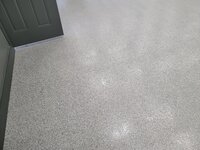
Now that the urethane is on all of it, it looks really blotchy and streaky -- almost like areas are on thicker while others are really thin, but it does seem to have adhered really well to the flake coating.
Initial polyaspartic coating:


More below...
Post urethane coating:


More below...
The crew that did the install definitely put a ton of effort into both installs, and has been extremely professional about the situation.
On the initial epoxy coats, they spent quite a bit of time with a diamond grinder and filling joints to get to the proper profile -- the epoxy coats and flakes seem very solid.
Not entirely sure what happened on the polyaspartic coating, but it did get really humid the day after the install, and I believe the coating was within the recoat time of the epoxy -- but they believe the chemical bond just didn't happen.
They spent about a whole week on their hands and knees peeling up all the small pieces of the polyaspartic before sanding for a mechanical bond and installing the urethane. Some of the polyaspartic came up in big sheets.
The urethane was poured as one coat, and then spread out by a squeegee and back rolled in one direction.
I honestly feel a bit bad by continuing to go back to them with the concerns, given all of the effort they've put in so far.
I've also got zero clue on how to install this type of floor coating system, but that seems to be consistent with what I've read and seen in videos -- with the exception of a few videos I've seen where they pour in one direction followed by rolling, and then seem to immediately or shortly thereafter poor in a different direction followed by rolling; a sort of crosshatch pattern.
Now that the urethane is on all of it, it looks really blotchy and streaky -- almost like areas are on thicker while others are really thin, but it does seem to have adhered really well to the flake coating.
- Any ideas what could have caused the blotchy and streaking effect?
- What could be done to make it all look smooth and glossy?
Initial polyaspartic coating:
More below...
Post urethane coating:
More below...
The crew that did the install definitely put a ton of effort into both installs, and has been extremely professional about the situation.
On the initial epoxy coats, they spent quite a bit of time with a diamond grinder and filling joints to get to the proper profile -- the epoxy coats and flakes seem very solid.
Not entirely sure what happened on the polyaspartic coating, but it did get really humid the day after the install, and I believe the coating was within the recoat time of the epoxy -- but they believe the chemical bond just didn't happen.
They spent about a whole week on their hands and knees peeling up all the small pieces of the polyaspartic before sanding for a mechanical bond and installing the urethane. Some of the polyaspartic came up in big sheets.
The urethane was poured as one coat, and then spread out by a squeegee and back rolled in one direction.
I honestly feel a bit bad by continuing to go back to them with the concerns, given all of the effort they've put in so far.
I've also got zero clue on how to install this type of floor coating system, but that seems to be consistent with what I've read and seen in videos -- with the exception of a few videos I've seen where they pour in one direction followed by rolling, and then seem to immediately or shortly thereafter poor in a different direction followed by rolling; a sort of crosshatch pattern.


