To avoid these ads, REGISTER NOW!

Popcorn Rewire Challenge

Ramper

Well-known member
Joined
Nov 30, 2010
Messages
1,484
Location
Southern MN
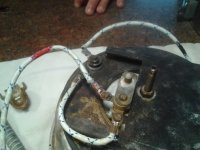
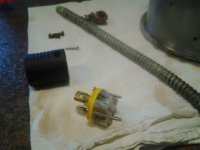
I would like to CHALLENGE someone on GJ to rewire my popcorn kettle.
Here are the details:
  • Heating element has continuity
  • Heating element has 14.8 ohms (1000 Watt)
  • Thermostat has continuity
  • The GFCI blows every time I plug the unit in

Here is the challenge:
  • I will send the kettle, wire, etc to you
  • I will send some money for return postage and some extra money for some beer
  • You will be "the man" and easily fix the unit
  • You will send the unit back to me
  • I will be "the best dad" as my kids will have movie night with popcorn

I will take any additional pictures or measurements that might be helpful. The unit is 120 and currently has a twist-lock plug. I will send a regular plug two if that is easier (I can (I think) switch the plugs).
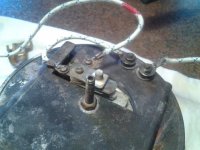
 

Attachments

  • Kettle #1.jpg
    Kettle #1.jpg
    51.2 KB · Views: 65
  • Kettle #2.jpg
    Kettle #2.jpg
    45.7 KB · Views: 59
  • Kettle #3.jpg
    Kettle #3.jpg
    30.8 KB · Views: 57
To avoid these ads, REGISTER NOW!

astroracer

Well-known member
Joined
Jun 22, 2005
Messages
3,001
Location
Mid_Michigan
Let me ask some questions...
1). How old is the GFCI? They do get weaker with age...
2). What rating is on the GFCI? It's possible the popcorn maker draws to much current. Does it need a dedicated circuit?
3). How many other appliances are on the circuit you keep popping?
Just some of the basic stuff I would be looking at if this where "my" problem... :)
Mark
 
OP
R

Ramper

Well-known member
Joined
Nov 30, 2010
Messages
1,484
Location
Southern MN
The house is only 3 years old. I do not know the GFCI rating. No other appliances on the circuit.
 

mayday0017

Well-known member
Joined
Oct 20, 2010
Messages
1,715
Location
Houston Texas
I am willing to bet the circuit can't handle the pop corn popper... Even more so since the house is only 3 years old. We have problems with houses built in the last 8-10 years in houston not being able to run a vacuum cleaner because they tie as many circuits together as possible.

Go try plugging it into a dedicated circuit on the house somewhere... maybe you have one in the laundry room or kitchen for something. If the house is only 3 years old I bet it is labeled quite well and you can find one. If not maybe you have a generator you could try plugging it into.

Other than that why would it need to be rewired if it use to work and suddenly doesn't? The wires and the connections look solid...
 

astroracer

Well-known member
Joined
Jun 22, 2005
Messages
3,001
Location
Mid_Michigan
Try plugging it into a "microwave" circuit. Most homes should have one of those wired into the kitchen. That will be a dedicated line...
Mark
 

dbonne

Well-known member
Joined
Apr 18, 2013
Messages
305
Location
Southern Idaho
Test both leads of the kettle heater to the kettle itself. You should have very high ohms to ground (>500K) The heater element may be shorted to ground.
 
OP
R

Ramper

Well-known member
Joined
Nov 30, 2010
Messages
1,484
Location
Southern MN
Well, I have been working on it and it now "works" to a point. The seemed to an issue with the grounding. It just worked for about 5 minutes and then tripped the GFCI. I will try in on its own circuit once it cools down.

Maybe I actually do know something.

To test if the heating element is grounding the unit would I check the ohms between the prongs on the plug or do I need to open up the unit?
 
OP
R

Ramper

Well-known member
Joined
Nov 30, 2010
Messages
1,484
Location
Southern MN
Well it just popped a batch from start to finish without an issue (not a GFCI). Now the only issue is the heating wire for the hopper. Is there any way to test this?
 

malibu101

Well-known member
Joined
Jul 1, 2005
Messages
3,908
Location
Walnutport PA
Just asking.......
Are you sure the ground and neutral are not touching in any way?
If ground and neutral touch they will trip a gfi too.
 

Gary S

Well-known member
Joined
Dec 27, 2008
Messages
2,972
Location
Bismarck, ND
If it works without a GFCI, but not with a GFCI, that tells you that you have current leakage to ground inside the device. Run it at your own risk. If it leaks enough, you die. I'd toss it and get a new one. That's better than injuring or killing someone.
 
OP
R

Ramper

Well-known member
Joined
Nov 30, 2010
Messages
1,484
Location
Southern MN
So is anyone still up for the challenge? I will send it to you, you fix it and send it back. Take the extra $$$ and buy some beer/soda.
 

wyliesdiesels

Well-known member
Joined
Aug 14, 2012
Messages
19,994
Location
Modesto, CA
Well, I have been working on it and it now "works" to a point. The seemed to an issue with the grounding. It just worked for about 5 minutes and then tripped the GFCI. I will try in on its own circuit once it cools down.

Maybe I actually do know something.

To test if the heating element is grounding the unit would I check the ohms between the prongs on the plug or do I need to open up the unit?

To check if there is a leak to ground, connect your meter between the ground prong and each end of the element. FYI- Some meters have a continuity beep function(beeps when there is continuity) which makes it a little easier when testing because u dont have to look at the screen! See if your meter has this function!
 

Kevin C

Well-known member
Joined
Aug 4, 2011
Messages
1,653
Location
Portland OR
GFIC trigger at 4 - 6 ma. At 120 volts that's about 30,000 ohms of resistance to get that current ( 4 ma).

The other factor can be breakdown voltage. You may not see 20-30 K ohms on your meter, but at 120 volts some bad insulation starts to break down. That could even be old popcorn residue that's carboned up a bit.. Moisture from popping corn would make it worse.
 

DesertSparky57

Well-known member
Joined
Apr 12, 2013
Messages
92
Location
Las Vegas
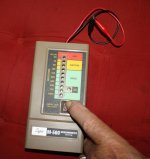
What you need, brave tamer of the tripping popcorn maker, is called a Megger. Your ohms to ground is probably way off the scale your meter can read. The Megger cranks voltage way way way up and meters leakage to ground. These are used to test insulation efficiency. Pretty sweet little units actually, but hardly something a non-sparky would have in their garage.

Two styles, a hand crank operated, and a rechargeable.
null-87.jpg


A closer shot.
null-86.jpg


You would put the red lead on your element and the black lead on your ground, on the popcorn popper with the unit unplugged. Turn the dial to 1kV/Mohm and crank. Ohms or MegOhms shows how easily or hard it is for electricity to cross the boundary created by insulation within your popcorn maker. From hot to ground ideally you would want to be in the 25-30 Mohm range at a 1kV pulse.

Yeah we just made a popcorn maker all kinds of high tech. :)
 
OP
R

Ramper

Well-known member
Joined
Nov 30, 2010
Messages
1,484
Location
Southern MN
So DesertSparky57, just PM me and I will send the kettle unit your way and you can conduct the test. I will send BEER MONEY!!!
 
To avoid these ads, REGISTER NOW!

Kevin C

Well-known member
Joined
Aug 4, 2011
Messages
1,653
Location
Portland OR
Megger is a new one to me..... We usually run a hipot test. I'm thinking megger is a brand name for a similar tool. Vitrex V74 is in my new test equipment list. It does hippy and insulation resistance.
 
Last edited:

rlitman

Well-known member
Joined
Oct 18, 2010
Messages
24,584
Location
Long Island
Yes, a Megger is a brand name of a high voltage insulation tester. But like many other brands, the name has become so ubiquitous as to become the device (Murphy Bed, Marrette, Bandaid, etc.).
 
OP
R

Ramper

Well-known member
Joined
Nov 30, 2010
Messages
1,484
Location
Southern MN
Is anybody willing to take on this challenge? My wife and children want popcorn and I want them to be safe. (I know playing the sympathy card, but it might work)
 

larry_g

Well-known member
Joined
Apr 28, 2007
Messages
16,872
Location
oregon
Megger is a new one to me..... We usually run a hipot test. I'm thinking megger is a brand name for a similar tool. Vitrex V74 is in my new test equipment list. It does hippy and insulation resistance.

You will usually find the hipot test in labs and manufacturing. Meggers are in the tool kit of the maint guy.

lg
no neat sig line
 

DesertSparky57

Well-known member
Joined
Apr 12, 2013
Messages
92
Location
Las Vegas
Megger is a brand name, but the hi pot is usually a much larger machine and usually it is a plug in device that requires steady 120v, some have the ability to place a simulated variable load across the circuit being tested as well. They can zap the holy hell out of you if you dont discharge the lines properly. The megger will do the same but takes much much longer to build the same charge. I have acces to a rather large hi-pot as well, we use it to test 15kV extension cords that supply 13,200v wye/480v delta step down transformers.

The main difference in the two similar but slang named devices is that a Megger is usually for a split second or several second test while the "hi-potential" device is for measuring leakage over a longer duration, some wire requires hours on the hi-pot to be "certified". Leakage at hi voltage is inevitable, but there are strict limitations as to the difference between cooked insulation and effective insulation.

Now on topic of the "leaky" popcorn popper :) someone already pointed out a very important wiring rule with GFCI's, no crossing of nuetral and ground anywhere. Check this first :) then check the GFCI. There are two sensitivity levels available, at least from Siemens in breaker style there is, one has a white test button and one has a red test button. One is for people one is for equipment, basically. If you have a dedicated spot for your popper you could change to the equipment only type, GFCI's are notorious for not playing well with heaters and certain types of small, electrically noisy motors. It's the price paid for sensitive personnel protection that actually works. Also worth noting, if the GFCI is tripping... It's doing its job. A new element may be in your near future...

Long ways to ship a popper sir!! Cheaper to just send me the beer money!! LoL! Heater elements are usually quite cheap compared to shipping :)
 
OP
R

Ramper

Well-known member
Joined
Nov 30, 2010
Messages
1,484
Location
Southern MN
I would only be shipping the kettle (it plugs into the main part). The popper worked fine on a non-gfci circuit. I will test again on a GFCI circuit. If it still pops the GFCI then I will have someone else look at it (my offer to you still stands)

The heating element runs about $100. The unit has free so maybe I should just bite the bullet and get a new heater.
 

DesertSparky57

Well-known member
Joined
Apr 12, 2013
Messages
92
Location
Las Vegas
I can't speak for all electricians, but I have come across quite a few devices that simply will not work on a GFCI circuit. A de-icing unit on a huge industrial air conditioner is the newest one I've dealt with that just will not work on a GFCI. It also has a heating element much like your popper does in it, just larger.
 

Kevin C

Well-known member
Joined
Aug 4, 2011
Messages
1,653
Location
Portland OR
You will usually find the hipot test in labs and manufacturing. Meggers are in the tool kit of the maint guy.

lg
no neat sig line

I come from the test lab side of things, so it was interesting to see a field test instrument.

Besides the HiPot test, my favorites for product testing has to running IEC 61000-4-4 test.

A long set of parallel plates are connected to a high voltage generator. The plates couple into the line cord of the DUT. Once you heard arcing inside the device it was usually all over.

Good show to watch... Kind of makes me want to have some popcorn!
 
Last edited:

Kevin C

Well-known member
Joined
Aug 4, 2011
Messages
1,653
Location
Portland OR
I can't speak for all electricians, but I have come across quite a few devices that simply will not work on a GFCI circuit. A de-icing unit on a huge industrial air conditioner is the newest one I've dealt with that just will not work on a GFCI. It also has a heating element much like your popper does in it, just larger.

My guess is you wont find a UL / NRTL label on them.
 

DesertSparky57

Well-known member
Joined
Apr 12, 2013
Messages
92
Location
Las Vegas
That's what I was thinking as well Kevin C. I joked to one of the techs that came to test the unit when it would not hold on a GFCI like it was spec'd to... I called it the harbor freight de-icer... Hell I thought it was funny!

He didn't.

To the OP, sorry to entirely derail your thread :) if the popper was free, then an element is a fair trade right? Still say just get one and swap it in, no need to ship it. If it is safely made and wired it should work on your GFCI.
 
OP
R

Ramper

Well-known member
Joined
Nov 30, 2010
Messages
1,484
Location
Southern MN
This is getting complicated :eyecrazy:

I plan to plug it into a GFCI today and if it works I feel comfortable using it. Well I felt comfortable before I read all of the potential ways it can kill me.

If it does not, nehog has accepted the challenge and I will send the kettle to the "expert".

As far as a new heater, why would it leak to the ground? Basically it is a metal ring that heats up. The heater has these specs:
RING HEATER, FULL SHEATH.
[ 120V 1000W 1PH ] [ 6-1/8" OD X 3" ID ]
[TERMINALS {STUD 10-32 }
http://www.allpointsfps.com/product_info.php?cPath=21&products_id=341130

341130.jpg
 

Alchymist

Well-known member
Joined
Mar 1, 2009
Messages
4,423
Location
Central PA
What you need, brave tamer of the tripping popcorn maker, is called a Megger. Your ohms to ground is probably way off the scale your meter can read. The Megger cranks voltage way way way up and meters leakage to ground. These are used to test insulation efficiency. Pretty sweet little units actually, but hardly something a non-sparky would have in their garage.

Two styles, a hand crank operated, and a rechargeable.

Third style - runs off 2 C cells. And here I thought every well equipped GJ garage had something similar!

Farcical expressions aside, one thing many people miss in the GFIC world is capacitance. When the hot wire runs close to the ground for a distance, intentionally or not, a minute current will develop. Really long extension cords can cause this. In the case of motors, or the popcorn heating element, it can cause a GFIC trip if the heating element itself happens to run really close to the grounded outer shell, or in the case of motors, windings too close to the case. Not common, but does happen. In refrigeration units, some motor windings are submerged in oil, and if there is any moisture present in the oil it will trip the GFIC.

Interesting read:
http://www.supco.com/images/pdfs/Manuals-Instructions/Microsoft Word - M500 Instuction Sheet.pdf
 

Attachments

  • MEGGER2.jpg
    MEGGER2.jpg
    139.4 KB · Views: 4
Last edited:
OP
R

Ramper

Well-known member
Joined
Nov 30, 2010
Messages
1,484
Location
Southern MN
Well, yesterday I plugged the popper into a GFCI and starting warming it up for the required 8 minutes. After 7.5 minutes the GFCI blew. I reset it and it blew again almost immediately. There were other devices on the circuit and the GFCI is a 3 year old in-house model.

I plan to plug the popper into a GFCI circuit in my garage that will have nothing else on the circuit.

SO the popper works on a non GFCI circuit just fine. It works on a GFCI circuit for 7.5 minutes.

I want the unit to be safe and I really do not know when I will be satisfied that the unit is safe for the wife and kids.
 

jerryd68

Well-known member
Joined
May 3, 2013
Messages
274
Location
Idaho
There are many different brand names of MegaOhm meters, I have tested 100's of 3 phase electric motors with them, I have one in my toolbox all the time. They will show you if the insulation on the motor winding is leaking to ground where a normal VOM will not.
 

nehog

Well-known member
Joined
Jan 2, 2010
Messages
7,935
Location
Jaffrey, NH
Well, yesterday I plugged the popper into a GFCI and starting warming it up for the required 8 minutes. After 7.5 minutes the GFCI blew. I reset it and it blew again almost immediately. ...

Classic symptoms of a heat related current leakage condition. As the temperature goes up, expansion causes things to change (move typically) leading to leakage to ground.
 
To avoid these ads, REGISTER NOW!
Top Bottom