To avoid these ads, REGISTER NOW!

Portable Generator Grounding

uconn9

Well-known member
Joined
Nov 22, 2009
Messages
83
Location
Tolland, CT
Hi again,

I'm a little confused regarding grounding.

My setup:
- 7500w Generac, neutral bonded to frame (I need to confirm this later today)
- L14-30 disconnect, wired to a transfer panel with 10/4
- Transfer panel neutral and ground connected to ground bus in service panel

Do I need to drive an additional 8' ground rod to ground the generator?

Thanks again for sharing your expertise.
 
To avoid these ads, REGISTER NOW!

KinzeMech

Well-known member
Joined
Jul 15, 2012
Messages
1,164
subbed. I don't have an answer, but it's a good question, I look forward to someone elses.
 

Burtonrider10022

Well-known member
Joined
Oct 20, 2012
Messages
695
Location
Chicago, IL
There was a thread about this a few days ago. Generator is grounded to itself and the earth through the frame. If you are hooking up to a home, do to the house having a separate grounding point, you need to add a ground rod to the generator. They posted the OSHA regulations and it had all the reasons why. Search for that thread, I know my answer is correct, but that other thread has the proof and the technical info that may or may not apply to your specific case.
 

Burtonrider10022

Well-known member
Joined
Oct 20, 2012
Messages
695
Location
Chicago, IL
You do not need a separate ground rod. You can connect it to the home's ground rod.

OSHA said:
If the portable generator is providing electric
power to a structure by connection via a
transfer switch to a structure (home, office,
shop, trailer, or similar) it must be connected
to a grounding electrode system, such as a
driven ground rod. The transfer switch must
be approved for the use and installed in
accordance with the manufacturer’s installation
instructions by a qualified electrician.

Yes, but it has to be from the frame of the generator to the home ground rod, from what I interpreted from the OSHA links in that other thread. Just plugging it in alone is not enough.
 

mrb

Well-known member
Joined
Dec 31, 2008
Messages
3,734
you can only have one neutral / ground bond. 99% of the time in this situation you need to remove the N-G bond on the generator, since you have the N-G bond on the house.
 

pattenp

Well-known member
Joined
Jun 4, 2008
Messages
10,175
Location
Virginia - USA
My understanding is portable generators that have a bonded neutral will need the neutral bond removed when the neutral is not switched at the panel and the frame does not need to be connected to a separate earth ground in this situation. If the neutral is switched at the panel then the neutral is to remain bonded in the generator plus the generator frame is to have its own ground to earth. The issue with removing the generator neutral bond is that it makes the portable generator non OSHA compliant as being used as a standalone portable generator. You can make up a neutral/ground jumper plug to re-bond the neutral when using the generator as a standalone to return the safty feature of the bonded neutral.
 
Last edited:

Alchymist

Well-known member
Joined
Mar 1, 2009
Messages
4,423
Location
Central PA
All depends. (Naturally). Point that most people miss - is your neutral switched? If no - generator does NOT bond neutral & EGC. If yes, Neutral and EGC are bonded, and requires a ground rod at generator.

Pattenp beat me to it!
 
Last edited:

theoldwizard1

Well-known member
Joined
Feb 22, 2011
Messages
43,116
Location
SE MI
All depends. (Naturally)!

Older generators with 3 prong 240V outlets typically have their ground just connected to the frame.

If you convert the outlet to a 4 wire outlet, you need to lift the ground connection from the frame and connect it to the appropriate ground connection on the outlet. This will maintain the one bonding point (inside the panel) in the system.
 
OP
U

uconn9

Well-known member
Joined
Nov 22, 2009
Messages
83
Location
Tolland, CT
Thanks for the great information.

I have an email into the switch manufacturer (Reliance) to confirm if the transfer panel is indeed neutral switched. I'll post their reply.
 

Alchymist

Well-known member
Joined
Mar 1, 2009
Messages
4,423
Location
Central PA
Older generators with 3 prong 240V outlets typically have their ground just connected to the frame.

If you convert the outlet to a 4 wire outlet, you need to lift the ground connection from the frame and connect it to the appropriate ground connection on the outlet. This will maintain the one bonding point (inside the panel) in the system.

Not sure what you are saying here....
The ground (EGC) lead must always be connected to the frame. The neutral depends on weather or not the transfer switch switches it or not. If the neutral is switched, then the neutral/EGC bond in the panel is lost, hence it must be bonded at the generator. The ground electrode is needed in this case to replace the one switched out by the transfer switch. If it is not switched, the bond in the main panel is still in circuit, and the bond at the generator must be removed.
 

Alchymist

Well-known member
Joined
Mar 1, 2009
Messages
4,423
Location
Central PA
Thanks for the great information.

I have an email into the switch manufacturer (Reliance) to confirm if the transfer panel is indeed neutral switched. I'll post their reply.

Just open the box and look - are there two sets of switched contacts (no neutral switched), or 3 (neutral switched)?
 

KinzeMech

Well-known member
Joined
Jul 15, 2012
Messages
1,164
you can only have one neutral / ground bond. 99% of the time in this situation you need to remove the N-G bond on the generator, since you have the N-G bond on the house.

Why is that? I don't mean for that to sound like snark, I would like to learn why.
 

Alchymist

Well-known member
Joined
Mar 1, 2009
Messages
4,423
Location
Central PA
you can only have one neutral / ground bond. 99% of the time in this situation you need to remove the N-G bond on the generator, since you have the N-G bond on the house.

Why is that? I don't mean for that to sound like snark, I would like to learn why.

#1) Because the NEC says so.

#2) Has to do with fault clearing in overload or short circuit situations.
 
OP
U

uconn9

Well-known member
Joined
Nov 22, 2009
Messages
83
Location
Tolland, CT
Just open the box and look - are there two sets of switched contacts (no neutral switched), or 3 (neutral switched)?

That would be too easy.

As suggested by Alchymist, I pulled the panel and it is indeed NOT neutral switched. Specifically, it is the wired per Fig 2 in the IMSA document he had posted in a previous thread:

http://www.imsasafety.org/journal/ma03/ma5.htm

So, based on the advice from Alchymist, Pattenp and MRB:

- Remove the N-G bond at the generator (if there indeed is one) when it's connected to the transfer switch.
- No additional grounding rod is required.
- If I ever use the generator as a stand alone device (i.e. for power tools), I'll need to reconnect the N-G bond at the generator.

Please fire away if I've got this screwed up.
 
To avoid these ads, REGISTER NOW!
OP
U

uconn9

Well-known member
Joined
Nov 22, 2009
Messages
83
Location
Tolland, CT
^^^Brilliant.

I might make up a bonded L14-30 instead because it's a twist-lock and I'm much more like to need the 110V in a portable situation.
 
Last edited:
OP
U

uconn9

Well-known member
Joined
Nov 22, 2009
Messages
83
Location
Tolland, CT
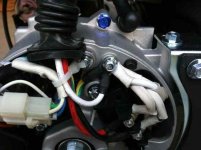
So, here's my next dilemma. Unlike the link that pattenp posted, my N-G bond is at the alternator housing, with 3 neutrals and the ground tied to a stud on the housing.


ImageUploadedByTapatalk1351977095.318223.jpg

What's the best way to isolate these neutrals? I was thinking I could just disconnect the three neutral lugs from the housing, then connect them together with a nut and bolt, covered with heat shrink. Is this Mickey Mouse?

I've also confirmed on the schematic that this is the only bond(as expected).
 

RCStocker

Well-known member
Joined
Aug 12, 2012
Messages
1,266
Location
Indiana, California, Australia
Do not gorund it to the house unless you are using it as an automatic back up generator.

That is a whole different instulation and generator.

I know this will turn heads but it is very safe.

I now have a back up generator installed at the farm but before I did I had a portable generator.

When the power went out I would pull the main breaker switch or fip the man service breaker. This way there is no power goin to the house if the power comes back on.

I made up havey extention cords with a male plug on each end. I used top grade comercial ends rated for high amps. I have outside plugs and I pluged into them and ran the electictiy through the house wiring. I did that for 30 years and never had a problem.
It ran the freezor and refer. I had lights, radio and the TV That is all I needed. I did not need power in every room.

Then I added an out let on the well pump I could plug into.

Don't not start the generator then pug in the cords. they will really spark. Plug in the cords fierst and keep your fingers off the prongs. You will be fine if you have short runs from the generator to the wall out let. I have run them through windows when I did not have an outside out let.

I have never had a problems. Turn off your generator and then un-pung the cords and flip the beraker. Don't be a dummy and unpug the cord when the generator is running. You might touch the plug and wake up.

I know it is not safe but it works.

After doing that for years I put in a sub pannel and hooked up a generator to the sub pannel directly. It had a main breaker in the sub box as well as a lever switch. I had to flip both to make it work. One inside and the other outside with the generator. for years I would turn the power off at the main and then start up the generator and run it through the entire house. There were no plugs to deal with, just the bereaker and switch. It was not automatic but it worked well. Years ago when the entire west coast went out Costo had some generators for under $2500. I picked up 2 and installed one on the farm house and the other here in california.

Things to need to be grounded to code.


Just know the amps you are drawing so things don't over heat and my stupid method will work just fine.

If you try to use your house ground and the power lines get crossed the hot wires could cross with thier gorund and power feed back through your ground and crate a mess. Blow out your generator and kill you at worst. If you are not going to intall an automatic switch over don't connect anyting to any wires in pannel. The ground will get you The breaker does not disconnect the ground only the hot lines.

My way works very well. I am sure soneone woud do it my way and burn thier house down or kill themselves. Nothing is fool proof but I have never had a problem in the 40 years or more I have been doing it.

I have been lucky and not had the house ground go hot in a storm. There is always a first time. It would only blow out my generator and damage the appliances.

I have run the generators on and off for as many as 5 days. The freezser and refer will stay cool over night. I don't run it when I go to sleep.

Try it at your own rick. LOL
 

Alchymist

Well-known member
Joined
Mar 1, 2009
Messages
4,423
Location
Central PA
Do not gorund it to the house unless you are using it as an automatic back up generator.

That is a whole different instulation and generator.

I know this will turn heads but it is very safe.

I now have a back up generator installed at the farm but before I did I had a portable generator.

When the power went out I would pull the main breaker switch or fip the man service breaker. This way there is no power goin to the house if the power comes back on.

I made up havey extention cords with a male plug on each end. I used top grade comercial ends rated for high amps. I have outside plugs and I pluged into them and ran the electictiy through the house wiring. I did that for 30 years and never had a problem.
It ran the freezor and refer. I had lights, radio and the TV That is all I needed. I did not need power in every room.

Then I added an out let on the well pump I could plug into.

Don't not start the generator then pug in the cords. they will really spark. Plug in the cords fierst and keep your fingers off the prongs. You will be fine if you have short runs from the generator to the wall out let. I have run them through windows when I did not have an outside out let.

I have never had a problems. Turn off your generator and then un-pung the cords and flip the beraker. Don't be a dummy and unpug the cord when the generator is running. You might touch the plug and wake up.

I know it is not safe but it works.

After doing that for years I put in a sub pannel and hooked up a generator to the sub pannel directly. It had a main breaker in the sub box as well as a lever switch. I had to flip both to make it work. One inside and the other outside with the generator. for years I would turn the power off at the main and then start up the generator and run it through the entire house. There were no plugs to deal with, just the bereaker and switch. It was not automatic but it worked well. Years ago when the entire west coast went out Costo had some generators for under $2500. I picked up 2 and installed one on the farm house and the other here in california.

Things to need to be grounded to code.


Just know the amps you are drawing so things don't over heat and my stupid method will work just fine.

If you try to use your house ground and the power lines get crossed the hot wires could cross with thier gorund and power feed back through your ground and crate a mess. Blow out your generator and kill you at worst. If you are not going to intall an automatic switch over don't connect anyting to any wires in pannel. The ground will get you The breaker does not disconnect the ground only the hot lines.

My way works very well. I am sure soneone woud do it my way and burn thier house down or kill themselves. Nothing is fool proof but I have never had a problem in the 40 years or more I have been doing it.

I have been lucky and not had the house ground go hot in a storm. There is always a first time. It would only blow out my generator and damage the appliances.

I have run the generators on and off for as many as 5 days. The freezser and refer will stay cool over night. I don't run it when I go to sleep.

Try it at your own rick. LOL

So much wrong with this I won't even attempt an explanation. :eek: :wtf:
 
OP
U

uconn9

Well-known member
Joined
Nov 22, 2009
Messages
83
Location
Tolland, CT
Well, that was entertaining.....

I could still use some advice on isolating my neutrals from my ground from some of the gurus.
 

pattenp

Well-known member
Joined
Jun 4, 2008
Messages
10,175
Location
Virginia - USA
So, here's my next dilemma. Unlike the link that pattenp posted, my N-G bond is at the alternator housing, with 3 neutrals and the ground tied to a stud on the housing.


ImageUploadedByTapatalk1351977095.318223.jpg

What's the best way to isolate these neutrals? I was thinking I could just disconnect the three neutral lugs from the housing, then connect them together with a nut and bolt, covered with heat shrink. Is this Mickey Mouse?

I've also confirmed on the schematic that this is the only bond(as expected).

Some may consider it Mickey Mouse, but if it were mine I'd probably do the the same thing. I'd use a brass bolt, but it probably doesn't make any difference.
 
Last edited:

Alchymist

Well-known member
Joined
Mar 1, 2009
Messages
4,423
Location
Central PA
Well, that was entertaining.....

I could still use some advice on isolating my neutrals from my ground from some of the gurus.

Were it me, I'd get some **** splices big enough to take 2 of those wires on a side. 2 wires in one side, and the remaining wire in the other along with a 4th wire. Crimp well, and insulate with a good hot melt shrink tubing. Attach the 4th wire to an insulating binding post. Then if you wanted to use the genset as a stand alone, just jumper the binding post to the frame.
 

wyliesdiesels

Well-known member
Joined
Aug 14, 2012
Messages
19,994
Location
Modesto, CA
So much wrong with this I won't even attempt an explanation. :eek: :wtf:

Yeah, usually I will dissect bad advice like that but that post is so wrong and mumbo jumbo, I'm not gonna attempt it. :eyecrazy: :wtf: All I can say is, to those who are looking for advice on this particular topic- PLEASE DON'T FOLLOW THE ADVICE IN POST #21!
 
Last edited:

Burtonrider10022

Well-known member
Joined
Oct 20, 2012
Messages
695
Location
Chicago, IL
Yeah, usually I will dissect bad advice like that but that post is so wrong and mumbo jumbo, I'm not gonna attempt it. :eyecrazy: :wtf: All I can say is, to those who are looking for advice on this particular topic- PLEASE DON'T FOLLOW THE ADVICE IN POST #!

And for those of us who don't speak symbols, I think he means 21
 
OP
U

uconn9

Well-known member
Joined
Nov 22, 2009
Messages
83
Location
Tolland, CT
I think I've got a better solution for removing the bond. Upon closed inspection, I noticed that there is a terminal block that has two unused spaces. I suspect this is a remnant from a previous design were the bond was located at the receptacles.

I plan on just moving the three neutral lugs to the open space using a M5 fastener, thereby isolating them from the alternator chassis and eliminating the N-G bond.

Here the picture again for reference:
pynagata.jpg

It's tough to see, but the space I plan on using on the TB is just above the black and red hot line.

Alchymist, you you still recommend a brass bolt?

This would give the neutrals a mechanical anchor, as well as giving me the option to rebond if needed.
 
Last edited:
To avoid these ads, REGISTER NOW!
Top Bottom