To avoid these ads, REGISTER NOW!

Portable power distribution

rick carpenter

Well-known member
Joined
Jan 20, 2011
Messages
3,785
Location
Huntsville, East Texas
I do a bit of volunteer work for "regular" church mission projects and disaster recovery work, and I need to upgrade my portable on-site power distribution system. I wish I could afford a spider but I can't :(

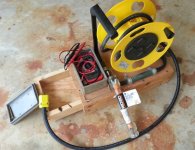
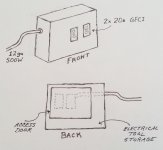
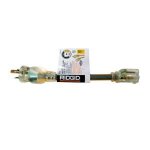
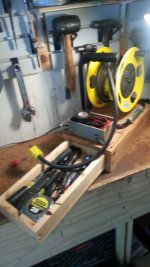
I want to replace my current setup, the first and second pic. It has about 12' of 12/3 SOOW going into a 15a 125v four outlet reel with circuit breaker. Though it has served me well for a few years, I kinda don't trust it with others. I want to build a plywood box like the drawing with two two-receptacle outlets with GFCI protection. Power in will be through the SOOW either directly from a 5-15 125v source or from a L5-30 125v source via the Ridgid adapter. Box will have feet to stabilize, etc. People possibly using this will have from none to considerable experience, so I want a power distribution box that is foolproof for the average user, i.e., overbuilt if possible.

Can I wire in a circuit breaker, or do I need one with the gfci outlets? Should I buy 15a or 20a gfci outlets? Should the outlets be "outdoor" outlets? I want this to be the link from the power source to the tools that will never be a problem. Typical big draws will be a circ saw (15a), chop saw (up to 13a), or portable compressor (up to 12a?). I'll make sure they're one one at a time. What other possibilities should I consider?
 

Attachments

  • 20131026_113229 (576x1024).jpg
    20131026_113229 (576x1024).jpg
    65.4 KB · Views: 81
  • 20140601_122859 (933x719).jpg
    20140601_122859 (933x719).jpg
    85.9 KB · Views: 73
  • 20140601_115327 (758x700).jpg
    20140601_115327 (758x700).jpg
    90.3 KB · Views: 55
  • adapter.jpg
    adapter.jpg
    4.4 KB · Views: 47
To avoid these ads, REGISTER NOW!

Mustang51js

Well-known member
Joined
Jan 24, 2014
Messages
1,734
Location
Haskell nj
It couldn't hurt to put a breaker on there but I would do each outlet a separate gfi instead of the breaker, this way only that outlet trips and not everything else.
 

Mustang51js

Well-known member
Joined
Jan 24, 2014
Messages
1,734
Location
Haskell nj
I would also look into running a 10/4 rubber cord and have an adaptor for 120 volts, this way if there happens to be a 30 amp twist lock like on a generator you can have 220 and a couple 120 volt circuits
 

offroadsteve

Well-known member
Joined
Apr 28, 2011
Messages
173
Location
Hampton, VA
I would use 15 amp "weather resistant" GFCI outlets. I don't see any need to go with 20 amp outlets given your expected loads. I do not believe the GFCI outlets provide any over-current protection, so you should include a circuit breaker for each circuit.

I'd use an inlet on the side for a L5-30 or possbly a L14-30 (240V) if you ever expect to have a 240V source. Then you can have multiple cords with L14-30 connectors for the distribution box end and whichever connector you like on the other end to plug into your power source.

In the event something happens to the cord, it can be unplugged and replaced with a spare. With your current configuration, as i'm sure you know, if something were to happen to the cord, the box is out of comission until repairs can be made. This does increase cost, not sure of your budget.

If your going to build something like this, i'd also add more outlets for a total of 8 plugs, wired in two circuits. That way you have plenty of outlets for things like battery chargers, radio, whatver, in addition to the tools. The extra outlets can be normal outlets and be wired to the "load" side of the GFCI outlets.
 
Last edited:

offroadsteve

Well-known member
Joined
Apr 28, 2011
Messages
173
Location
Hampton, VA
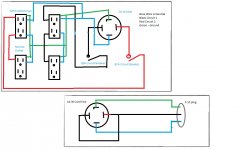
Here's a quick sketch of what I was thinking and what Mustang51 described. You could then use a commercially avaliable 30A 240V power cord if an appropriate outlet is avaliable, or have the adapter to plug the box into a standard outlet. You'd only be limited by your power source.
 

Attachments

  • plugbox wiring.jpg
    plugbox wiring.jpg
    113.9 KB · Views: 44

sberry

Banned
Joined
Jun 18, 2005
Messages
35,747
Location
Brethren, Michigan
You want to plug in common 120V outlets,,, correct? no need for 2 gfci. You are sposed to be plugged in to gfci anyway but they make those simple ready made. Buy a 12 cord and a 3 way.
 
To avoid these ads, REGISTER NOW!

theoldwizard1

Well-known member
Joined
Feb 22, 2011
Messages
43,218
Location
SE MI
Related ... Is there such a thing as a combination wall switch/circuit breaker or something similar that could be used in this application ? The only thing I have ever seen are to little push button breakers that are sometimes difficult to tell if they are tripped.
 

theoldwizard1

Well-known member
Joined
Feb 22, 2011
Messages
43,218
Location
SE MI
I like offroadsteve's wiring. Most portable generators over about 3,500 watts have an L14-30 receptacle. The wiring he shows split the loads across both halves of the 240V supply.

20A outlet are probably overkill, but buy the best quality 15A receptacles you can find !
 

sberry

Banned
Joined
Jun 18, 2005
Messages
35,747
Location
Brethren, Michigan
This thread didn't sound like it started from a genset but as a feed from an existing circuit????????? Didn't sound like multi voltage.
it has served me well for a few years, I kinda don't trust it with others.
Whats wrong with it? I cant see much advantage in trying to re invent a deal vs this UL listed device. Multiple gfci and now some added breaker scheme.
 
Last edited:

justsam

Well-known member
Joined
Aug 20, 2010
Messages
1,268
Location
Penngrove, California
I too serve on mission and recovery work and often get tagged as the electrician however that has never been my profession.

My experience is that you do not know what you will get in terms of generator power or local power, or how reliable it will be. I would rig some sort of visible if not audible alarm when there is loss of power, lest you have other well meaning team members jerking out cords and pushing breakers, etc.

I also would provide some type of charging box. Seems like many volunteers bring their own cordless tools and there seems to always be a shortage of low current outlets for tool charging stations.

If you are in an area where there is cell phone coverage, phone batteries will need to be charged. Another need for multiple outlets and not a lot of power demand. You might even consider a couple outlets with the built in USB charge ports, however they may not be too rugged.
 
OP
R

rick carpenter

Well-known member
Joined
Jan 20, 2011
Messages
3,785
Location
Huntsville, East Texas
I too serve on mission and recovery work and often get tagged as the electrician however that has never been my profession.

My experience is that you do not know what you will get in terms of generator power or local power, or how reliable it will be. I would rig some sort of visible if not audible alarm when there is loss of power, lest you have other well meaning team members jerking out cords and pushing breakers, etc.

I also would provide some type of charging box. Seems like many volunteers bring their own cordless tools and there seems to always be a shortage of low current outlets for tool charging stations.

If you are in an area where there is cell phone coverage, phone batteries will need to be charged. Another need for multiple outlets and not a lot of power demand. You might even consider a couple outlets with the built in USB charge ports, however they may not be too rugged.

JustSam, I don't know how you and OffRoadSteve read my mind but y'all did. A GJ-er from very close by PM-ed me on this thread and we've been conversing. One thing I asked about as a side issue was a separate cell phone charging system. But back to the box now... we've talked about going to 10ga, some solution for purposefully tapping 30a power, and other ideas. The variables will be the local power and the practices of the volunteers. I want this to be the one as foolproof as possible link between the two.

After I get back from my trip next week to OK for tornado rebuilding, I hope to get on this. Every better idea (thanks everyone!) I see here co$t$ more so I may have to go at it slowly.

Thanks all y'all!
 

theoldwizard1

Well-known member
Joined
Feb 22, 2011
Messages
43,218
Location
SE MI
I also would provide some type of charging box. Seems like many volunteers bring their own cordless tools and there seems to always be a shortage of low current outlets for tool charging stations.

If you are in an area where there is cell phone coverage, phone batteries will need to be charged. Another need for multiple outlets and not a lot of power demand.

The best solution for this situation (connecting a number of "wall warts" to 120V) is called a power "squid". A bunch of short (1'-3') female extension cord ends with one common male end.
 
To avoid these ads, REGISTER NOW!
Top Bottom