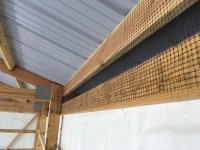
I'm confused what insulation and baffles have to do with soffits? the soffit is outside - which you dont show (the underside of the eave). Are they enclosed now? External vents should probably be on the bottom face..
You may choose to vent them into your "attic" if you're going to finish the attic.
You can use vented closure strips between the roof metal and the wood (these have meshy vents in the ribs) - but those were best installed as the root was installed. If you're going to close the attic, and soffit the eaves, I'd just let the attic get its vent from the ribs themselves.
If you really feel the need for more eave > attic connection than the ribs provide, you could drill holes in that top of wall purlin and screen over them. the only structure it supports is that section of roof sitting on top of it. There are even "standards" out there for drilling purlin for venting out there somewhere if you dig a bit.
Note that you -can- just finish the ceiling at the roof purlins if you want, and insulate it above that ceiling. (make sure you maintain vent - which the ribs provide across the purlins through to the peak vent)
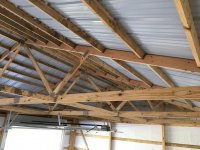
If you want to enclose the attic space and put a flat ceiling at the bottom chord of the truss, I'd probably do hang 2x 24" OC with joist hangers....probably 2x6 or 2x8 depending. If you're using metal, it depends which way you run the ribs - if you want to run the ribs long way, I'd treat it closer to how I would for drywall: I'd then run 1x3 strapping across those 24" to provide a flat surface with a drywall friendly spacing. or metal friendly (so 24" would probably be OK - even 48 if the ribs are working in your favor, depending on the metal)
It's worth noting that the ceiling supports are not purlins.

purlins support roof. girt support walls. in post frame terms, I dont think there's a name for the ceiling structure.
I'd remove that open mesh at the top of the wall and close that with metal outside - if your soffits are already enclosed, I'm assuming that connects to them?? No idea what someone was thinking there.
As for the other construction details - those are typical trusses for post frame (1 truss, or a pair of trusses, per post). because of the need for purlins (even if you ran trusses at 24 or 16 OC you'd still have to strap or purlin the top) with rib metal, you're really wasting trusses doing it that way (and you have to beef up your supports between posts to carry them..)
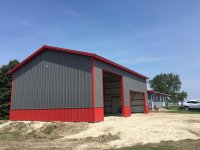
It's good that there's a fair amount of diagonal bracing in the walls, since those posts are NOT posts - and they are not in the ground, but bolted to the floor. You lose all of the structural sheer strength advantages without embedment.