To avoid these ads, REGISTER NOW!

Post hole depth and spacing?

SALIV8

Well-known member
Joined
Dec 11, 2008
Messages
2,114
Location
chicago and s/w michigan
My posts are set 46"-48" deep (frost line-iirc), on a concrete puck, in bobcat augered holes, in very sandy soil in Michigan. The soil is then packed/tamped around the poles and that's it. Nothing allows the water to stay in the wood posts or contact the wood other than natural ground moisture events.
 
To avoid these ads, REGISTER NOW!
OP
C

Cuda416

Well-known member
Joined
Mar 18, 2012
Messages
289
Location
TX
Here's a question for the gang. The proposed building is 36x48, which will require just about 22 yards of concrete to build a 4" slab. I got a "rough quote" from someone today for $8,600 which read....

Job Description: Site prep to be done by others and that site will be relatively level. No excavation of beams, but will dig below grade a few inches around perimeter so bottom of concrete pour will be below grade. Form, backfill with #2 road base, place #3 rebar on 18” OC each way for strength and integrity, pour and place minimum of 4” of 4000psi concrete provided by Ingram Redimix Concrete Co. to a light broom finish, remove forms, and clean up. Will excavate 4-5 inches in area where future car lift will be placed in order to thicken slab up to 8” to 10”.


It might be me, and who am I to judge, but it seems although this company has a good reputation for doing more involved work, maybe they know nothing about pole buildings and maybe I should politely walk away....:dunno:

I informed him already that the forms were not needed. I don't know about the thickening part, but he also kept mentioned adding posts and beams. I've not seen anyone do those for a pole building, not that it couldn't be done. Not sure what rebar costs, but I believe the concrete should be around $2400 which means the compacting, rebar and managing the pour will cost $6400? Does that seem reasonable? I know folks who got the concrete done in a 30x50 for 4k all in, though rebar was not used, he used that mesh that looks like cattle fencing.

Thoughts?
 

Marctrees

Well-known member
Joined
Mar 5, 2015
Messages
6,265
Location
TX/LA border - Toledo Bend
Not sure what "Light broom" is, I know just"Broom"

I think it's pretty rare to have that inside a private shop... You sure you want that??

Seems would be verryy difficult to sweep. Marc
 
OP
C

Cuda416

Well-known member
Joined
Mar 18, 2012
Messages
289
Location
TX
Not sure what "Light broom" is, I know just"Broom"

I think it's pretty rare to have that inside a private shop... You sure you want that??

Seems would be verryy difficult to sweep. Marc

I didn't spec it that way, just asked him for a WAG at to get me in the ballpark. I'll probably have him out once I get close to needing the concrete poured, unless I get someone to do the whole thing for me.
 
Last edited:

lakeroadster

Well-known member
Joined
Jan 19, 2015
Messages
5,166
Location
Central Colorado
Light broom means it has some surface roughness... but not deep rough gouges.

Your best bet is to be on site when they are finishing the concrete. If they are using a power trowel you can tell them when the surface meets your requirements.

For a working shop some surface roughness is a good thing.
 
OP
C

Cuda416

Well-known member
Joined
Mar 18, 2012
Messages
289
Location
TX
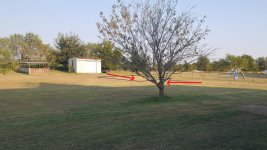
On the subject of post placement etc, I've been learning up on grading etc. I've attached a picture of my pack yard and generally where the building will go (not to perfect scale).

It appears the grade slopes down from the back and the front slightly. I'll be borrowing a neighbors laser transom level to determine the exact slope of the yard. I figure I'll take measurements on a 10' grid and plot it out.

Question is, and I think I know the answer, when setting the level of the skirt board height (grade?), do i simply find the highest point in the yard and that's "grade", or do I find some other high spot within a certain radius of the building? Obviously I don't want water to drain into the building but what's a reasonable starting point?
 

Attachments

  • 20170910_183300.jpg
    20170910_183300.jpg
    136.2 KB · Views: 13
Last edited:

LB-1911

ALLIANCE MEMBER
Joined
Sep 24, 2011
Messages
5,742
Location
Northwestern Il.
Question is, and I think I know the answer, when setting the level of the skirt board height (grade?), do i simply find the highest point in the yard and that's "grade", or do I find some other high spot within a certain radius of the building? Obviously I don't want water to drain into the building but what's a reasonable starting point?

Here you go.

Batter Boards are your friend.

Site Preparation
The first thing to do after locating the site and determining the placement of the building is to lay out building lines and batter boards.


Install Skirt Board

Find the corner post with the highest grade.

Set the building grade here by setting a nail in the corner post.

Place a nail in each post around the building maintaining a perfectly level string line or laser.

Source of above and additional information @
http://www.pole-barn.info/squaring-building-lines.html

Are you on a Septic system?
 
Last edited:
OP
C

Cuda416

Well-known member
Joined
Mar 18, 2012
Messages
289
Location
TX
Here you go.


Are you on a Septic system?

Thanks, I should have refereed to that site as it's been pointed out to me before. We are on a septic system and the building will be more than the county required 10' away from the drain field. Is there something else to consider with respect to the septic? I'm not well versed in them, never had on until now.
 
OP
C

Cuda416

Well-known member
Joined
Mar 18, 2012
Messages
289
Location
TX
Here you go.

So, just to be clear, it says

Find the corner post with the highest grade. Set the building grade here by setting a nail in the corner post. Place a nail in each post around the building maintaining a perfectly level string line or laser.

At what height is the nail set. Seems they are just saying "don't be a dolt and start from the low spot" which of course make sense, but is that nail placed at grade or some height above?
 

D94R

Well-known member
Joined
Nov 30, 2014
Messages
55
You set it where the top of your base will be, which will be your grade level. Bottom of the skirt board is level with the nails then.
 
OP
C

Cuda416

Well-known member
Joined
Mar 18, 2012
Messages
289
Location
TX
You set it where the top of your base will be, which will be your grade level. Bottom of the skirt board is level with the nails then.

Ok, I had to reread that a couple of times. I think what i am reading is...

  • Clear the site.
  • Plant poles
  • find the pole with the highest original grade
  • Set a nail at that height, find same point on all poles.
  • Install skirt boards to that height, bottom of boards level with the mark/nail. This height could result in a gap around the bottom of the skirt board and the dirt pad.
  • Add fill to raise the pad to the "base/grade" height so both are the same "grade"
  • Pour concrete inside the building, which puts the top of the "floor", the "concrete thickness", lets call that 4 inches, above "grade".

Am I getting close?
 

D94R

Well-known member
Joined
Nov 30, 2014
Messages
55
Bingo. Here's an example of mine. The grade change is exaggerated to make the point more clear.

Red is the nails.
Gray is the fill for base.
Green is original grade.

View media item 74514
 
To avoid these ads, REGISTER NOW!
OP
C

Cuda416

Well-known member
Joined
Mar 18, 2012
Messages
289
Location
TX

Tell us what he wins Johnny!

Ok I'll stop with that.....

Anyway, thanks for clearing it up. Though to be absolutely clear, why do I not care so much about surrounding grade that might be higher than that of what's at the posts? I've read countless times that I need to bring the slope of the "grade' surrounding the building up to the skirt board. This is what has always tripped me up. If I plant the skirt board at grade, then there nothing to "slope" otherwize the skirt board would be in the dirt and I thought that was bad.
 
Last edited:

lakeroadster

Well-known member
Joined
Jan 19, 2015
Messages
5,166
Location
Central Colorado
A barn that has the slab a little too high isn't a problem.

A barn that has the slab a little to low is a big problem.

I take exception with the above diagram. As drawn, water can get under the slab.

I had my barn set up so the bottom of the slab was 6" above grade. I don't want water running up to the building and going under the slab... and neither do you.

You want to back fill around the barn about 2 feet minimum... 4 feet is better. And you want to slope the back fill away from the barn.

This also helps dramatically to keep water away from the barn support columns (poles) as we discussed previously.

Your builder may not like the barn that high as it means more fill material. Just make sure you address this up front.
 
OP
C

Cuda416

Well-known member
Joined
Mar 18, 2012
Messages
289
Location
TX
A barn that has the slab a little too high isn't a problem.

A barn that has the slab a little to low is a big problem.

I take exception with the above diagram. As drawn, water can get under the slab.

I had my barn set up so the bottom of the slab was 6" above grade. I don't want water running up to the building and going under the slab... and neither do you.

You want to back fill around the barn about 2 feet minimum... 4 feet is better. And you want to slope the back fill away from the barn.

This also helps dramatically to keep water away from the barn support columns (poles) as we discussed previously.

Your builder may not like the barn that high as it means more fill material. Just make sure you address this up front.
I hear what you're saying and I agree with every word. I wouldn't say I take any exception to the drawing though, it helped illustrate some very important points for me and I appreciated that. Obviously I am very new to all of this and some of the terminology tends to blend and blur. Some people use the words correctly, some people use them interchangeably with other ideas. Sometimes it's hard to sit through it all and having people take the time to set up a little drawing for me helps loads. I've learned a lot from listening to everyone so far and I hope to continue to do so.

Eventually, I'm going to have to pull the trigger and either pay someone to build one for me, or buy a kit. I don't mind doing the work but I don't have any experience doing excavation. It's one of those things that doesn't look very hard, until you try and do it yourself. Hence all of the seemingly simple questions.

Sent from my SM-G920T using Tapatalk
 

D94R

Well-known member
Joined
Nov 30, 2014
Messages
55
You have to excavate a swale around the barn.
As drawn it is ONLY showing the immediate structure and does not account for exterior drainage. If you're taking exception to an elevation drawing with hand drawn and exaggerated ground slope then you're hitting above your weight class.
 
Last edited:
OP
C

Cuda416

Well-known member
Joined
Mar 18, 2012
Messages
289
Location
TX
You have to excavate a swale around the barn.
As drawn it is ONLY showing the immediate structure and does not account for exterior drainage. If you're taking exception to an elevation drawing with hand drawn and exaggerated ground slope then you're hitting above your weight class.

Well as I said, I appreciated the clarification on terms, and that's what I was after so thanks.
 

D94R

Well-known member
Joined
Nov 30, 2014
Messages
55
Aye, yah, you replied as I was typing that to address the post above yours.

In order to address the continuing slope and drainage you'd dig a swale into that slope. It's been done since man learned how to divert water. No need to build the base higher to match a point ** feet away on that slope and build the base up to it in order to achieve the proper drainage.

I intended to build my barn in a different location, but I absolutely would have had to build a base that would have gone from 6" deep on one corner to over 24" deep to the opposite corner. That would have cost me over $6,000 in fill and prep. The alternative was to move my barn and do grade work for a swale instead at the price of a couple hundred dollars. Or in my case, for the cost of 10 gallons of diesel for my brothers tractor.
They both achieved the drainage required and both are correct ways to do it.

Which ever you decide is between you and your check book ultimately.
 
OP
C

Cuda416

Well-known member
Joined
Mar 18, 2012
Messages
289
Location
TX
Got it, thanks. In my case, I'll probably build "UP" since I don't have much slope going away from the building. Thanks for your input.
 
OP
C

Cuda416

Well-known member
Joined
Mar 18, 2012
Messages
289
Location
TX
Another subject that will probably result in great contention is that the bid i received called for #2 Road Base, which is contradictory to what I've read. As I recall, the dust in it can settle after a time causing the base to weaken?
 

lakeroadster

Well-known member
Joined
Jan 19, 2015
Messages
5,166
Location
Central Colorado
Another subject that will probably result in great contention is that the bid i received called for #2 Road Base, which is contradictory to what I've read. As I recall, the dust in it can settle after a time causing the base to weaken?

Science and Testing is your friend.

Use a product that has known Proctor density data... call the local aggregate place and talk to them. If they don't know what "Proctor density data" is.. call another place.

More here:
Proctor Compaction Testing of Sub-Grade Material
 
Last edited:
OP
C

Cuda416

Well-known member
Joined
Mar 18, 2012
Messages
289
Location
TX
Are you in caliche or black dirt?

Sorry, didn't see this part until just now. The dirt is soft with a lot of small(ish) rocks. Someone else asked if it was caliche and I wasn't familiar with the term. Searched for it here and found this.

is that caliche?

Update: a coworker told be it might be caliche a couple of feet down based on the area. so at this point, I'm not sure.

Update: It looks as though the stuff out in the back yard might be what is known as 'Texas Black, Houston Black, or Black Clay'. One great use for it, as it is a very limited use soil, is cotton... Guess what, there's a ton of cotton farms, one next door, literally... It's across the fence from me. This is nasty stuff.... ugh
 
Last edited:

Trey T

Well-known member
Joined
Aug 3, 2011
Messages
3,749
Location
Houston, TX
Don't put them in concrete. Put a concrete pad in the bottom of the hole and after it cures put the pole one it. If you put concrete around the pole, the pole will shrink and a pocket for water will form. Then over time the pole will deteriorate. I have replaced poles where that happened.
Very good point, always cover your pole/post on all five sides that's below-ground-surface, whether you're building a garage or fence.
 
To avoid these ads, REGISTER NOW!
Top Bottom