To avoid these ads, REGISTER NOW!

Potential first time larger electrical run (workshop/garage)

fakka

Member
Joined
Jun 4, 2024
Messages
11
Hi all

Looking to build a workshop to house a 57 chevy. Washington State.
Thinking of pulling permit myself. Everyone is backed up out here ..... and also tbh - like to put the extra $$ to insulation.
So my plan as of right now ...... but some questions.
200ft run.
Build it as 90A to match wire - but reality is the largest load will be 240v at <30AMP for welder compressor. The compressor will be the biggest startup draw. 3.7HP 60 gallon - recommended 25A breaker per sheet.

So assuming 200ft for main AL wire and 40ft for internal wiring of shed

2-2-2-4 AL wire rated at 90A - $400
1.5" UL schedule 40 (grey). $250
Square D 12 circuit 6 slot panel - $60
Square D home 290 breaker for main feed panel - $60
Square 2 2 pole 40A gfci for welder/comrpessor - $100
1x QO2020 - 2 circuit - 20 AMPS - dedicated circuits for 4 working wall outlets plus around shed - $100
1 x 15A square d gfci breaker for garage door - $50
1 x 15A square d gfci breaker for lights (LED) - $50
12/2 romex - 250ft - $120
14/2 romex - 50ft - $40
LB box at shed end - $50
Outlets(20A and 40A) - $100
Conduit Lube and adapters/separate ground/neutral bar / miscellaneous...... $100

Anything Im missing ??

Install questions.

I have both an outside service disconnect panel and and inside service disconnect panel. I assume I can just wire directly into the outside panel - its has free space. Its fed from the utility transformer on the ground (square box) about 40 feet away.

Does the panel at the shed have to also have service disconnect or is it good enough its at the main 200A outside house panel. Each circuit then just protected by gfci breakers.

thx
 
To avoid these ads, REGISTER NOW!

75gmck25

Well-known member
Joined
Jul 21, 2014
Messages
1,317
Location
Alexandria, VA
Good plan overall, but I can suggest some modifications.

- Instead of just saying 2-2-2-4 AL, look for 2-2-2-4 AL dual rated mobile home feeder. The dual rating allows its use when buried in conduit, or in conduit inside your building. This means you can usually make a single run of wire from the main panel right to the sub panel.

- I would use 2" conduit to make the pull easier, and keep track of which way the joints are facing. You don't want to pull up against the lip of the larger "bell" end at the joints.

- You might buy a bigger sub-panel so you have more breakers. The increased cost will be minimal, and it gives you more flexibility in the future. For example, you may sometime want 240 volt EV chargers added, and each one takes two breaker spaces.

- You are buying a lot of 12/2 Romex for a small number of circuits. But maybe I misunderstand the layout.

- How do you plan to protect your Romex in areas where it's subject to damage? You can run it inside a regular 2x4 wall, or down the side of a vertical 2x4, or in metal conduit, but it needs some type of protection in areas below about 6 feet (not sure of the exact code).

- Someone else may know if a GFCI is required for the welder. 120 volt circuits have needed a GFCI for quite some time, but older versions of the code did not require it for 240 volt circuits. I also didn't see any wire big enough for the welder circuit.
 
OP
F

fakka

Member
Joined
Jun 4, 2024
Messages
11
Good plan overall, but I can suggest some modifications.

- Instead of just saying 2-2-2-4 AL, look for 2-2-2-4 AL dual rated mobile home feeder. The dual rating allows its use when buried in conduit, or in conduit inside your building. This means you can usually make a single run of wire from the main panel right to the sub panel.

- I would use 2" conduit to make the pull easier, and keep track of which way the joints are facing. You don't want to pull up against the lip of the larger "bell" end at the joints.

- You might buy a bigger sub-panel so you have more breakers. The increased cost will be minimal, and it gives you more flexibility in the future. For example, you may sometime want 240 volt EV chargers added, and each one takes two breaker spaces.

- You are buying a lot of 12/2 Romex for a small number of circuits. But maybe I misunderstand the layout.

- How do you plan to protect your Romex in areas where it's subject to damage? You can run it inside a regular 2x4 wall, or down the side of a vertical 2x4, or in metal conduit, but it needs some type of protection in areas below about 6 feet (not sure of the exact code).

- Someone else may know if a GFCI is required for the welder. 120 volt circuits have needed a GFCI for quite some time, but older versions of the code did not require it for 240 volt circuits. I also didn't see any wire big enough for the welder circuit.

Thanks 75gmck75
Good year btw - year I was born ;)
Yes sorry its 2-2-2-4 AL MHF wire I will be using

Ok will go with 2" conduit. The pull does have me a little worried to be honest. Is ther e NEC code around volume that is mean to be adhered to based on size of wire - or is it just a cost thing.

Noted on the larger panel.

12/2 was just I might have 3-4 dedicated runs of up to 36 ft feet each ........ so yes probably don't need that much but just in case.
I actually hadn't thought about the wiring in the shed from a protection perspective. Not sure what's typically done for that in metal sheds. Guessing pvc conduit.

Thx yes I missed the big wire.
Any tips on pulling the wire asides lots of lube ? (she said) ........ I've seen some guys just slide the 10ft sticks on 1 by one and PVC glue it ..... but apparently thats not code.
 

brewchief

Well-known member
Joined
Sep 20, 2008
Messages
2,370
Location
Michigan
You'll need a larger subpanel, a 100 amp with main breaker and at least as many spaces as circuits, remember 2 pole breakers use two spaces. Many panels will have twice as many circuits as spaces available but that just means they can accommodate tandem breakers, I don't think Afci are available in tandom and if they are there will be a price premium.

You will use more 14-2 and 12-2 then you think, don't buy the 50 ft rolls, buy 250 ft rolls as the price per foot is much better.
 

99MPower

Active member
Joined
Jan 4, 2007
Messages
33
Location
Chesapeake, VA
as someone who just wired a detached garage, I highly recommend just wiring ALL outlets with 12-2, for 20A rated outlets. If you even THINK you need high draw outlets (compressor, welder, vacuums, heat guns, etc), run individual 12-2 runs per outlet. I have (6) dedicated 20A outlets, all fed by 12-2, plus a few daisy chained outlets fed by 12-2.

Once you insulate/drywall, or whatever else you are doing, you will be angry you didnt add more wiring.

Try to think of ANY future add ons you might want. Id run the wiring, and put them an electrical box, and just close it off. Then in the future, you've always got what you need/want.

Id run a 30/50A run on each side of the garage, dedicated 20A on each side of the garage door, for hose reels/retracting outlets/etc. Dedicated 20A in the center of the ceiling for any retracting reels you want to hang, etc, etc.
 

sparky 1971

Well-known member
Joined
Oct 9, 2018
Messages
7,967
Location
Central Iowa
Hi all

Looking to build a workshop to house a 57 chevy. Washington State.
Thinking of pulling permit myself. Everyone is backed up out here ..... and also tbh - like to put the extra $$ to insulation.
So my plan as of right now ...... but some questions.
200ft run.
Build it as 90A to match wire - but reality is the largest load will be 240v at <30AMP for welder compressor. The compressor will be the biggest startup draw. 3.7HP 60 gallon - recommended 25A breaker per sheet.

So assuming 200ft for main AL wire and 40ft for internal wiring of shed

2-2-2-4 AL wire rated at 90A - $400
1.5" UL schedule 40 (grey). $250
Square D 12 circuit 6 slot panel - $60
Get a larger panel, at least a 20 space, it's only going to be a few $ more
Square D home 290 breaker for main feed panel - $60
Square 2 2 pole 40A gfci for welder/comrpessor - $100
1x QO2020 - 2 circuit - 20 AMPS - dedicated circuits for 4 working wall outlets plus around shed - $100
If you get a larger panel, you can use regular breakers instead of the tandem and still be money ahead
1 x 15A square d gfci breaker for garage door - $50
The door doesn't have to have a dedicated circuit, you could feed it from a wall receptacle and save more money
1 x 15A square d gfci breaker for lights (LED) - $50
The lights don't have to be GFCI protected unless you get the cheap plug in kind
12/2 romex - 250ft - $120
14/2 romex - 50ft - $40
LB box at shed end - $50
Outlets(20A and 40A) - $100
Conduit Lube and adapters/separate ground/neutral bar / miscellaneous...... $100

Anything Im missing ??
Two ground rods, clamps, and #6 bare wire
Install questions.

I have both an outside service disconnect panel and and inside service disconnect panel. I assume I can just wire directly into the outside panel - its has free space. Its fed from the utility transformer on the ground (square box) about 40 feet away.
yes
Does the panel at the shed have to also have service disconnect or is it good enough its at the main 200A outside house panel. Each circuit then just protected by gfci breakers.
You need a disconnect at the shed unless you can keep the breakers limited to six throws or less, when you get the larger panel, get one with a 100 amp main breaker and all will be well.

You'll need a larger subpanel, a 100 amp with main breaker and at least as many spaces as circuits, remember 2 pole breakers use two spaces. Many panels will have twice as many circuits as spaces available but that just means they can accommodate tandem breakers, I don't think Afci are available in tandom and if they are there will be a price premium.
Nothing in a garage requires AFCI protection
You will use more 14-2 and 12-2 then you think, don't buy the 50 ft rolls, buy 250 ft rolls as the price per foot is much better.
 
OP
F

fakka

Member
Joined
Jun 4, 2024
Messages
11
awesome tips spark 1971 and all - thx

Any tips on pulling the wire ?
I saw this as a backup plan ......


Also I think the inspection is a 2 part process - meaning I think I pull the permit ...... they come out and inspect 1 stage - then a final stage ?
But cant remember what they are looking for on the 1st stage ..... is it just the hole is more than 18" ?
Plan to go dedicated circuts as much as possible (thx 99MPower).

Finally ... I thikn theres a NEC code for conduit size for wire ...... but not sure if its a lower and and upper size ....... or just lower. Read somewhere no more than 53% or something. Go 1.5" or 2" ? Is mostly a straight shot ...... will have 2x 45 degree sweeps in it until I hit the ends and then have to turn 90 to get up to panel.

Quote I read on this forum actually .... "MHF is not considered a cable when sizing conduit, it's not jacketed, it's an assembly of individual conductors and 2-2-2-4 MHF is okay in 1.5" conduit. "

But if its just a cost thing I'll do 2" .... not much diff over 1.5" ...... but yeah how hard is this going to be :) I've only ever pulled heavy cable about 70ft through smurf tube ...... sucked.
 

Innovate1

Well-known member
Joined
Jul 28, 2014
Messages
4,281
Location
Illinois near St. Louis, Missouri
Get a larger panel with a 100A main. Buying them together will be the cheapest. You can also get packages that include a few smaller breakers that is often a good deal. Get at least twice the spaces you think you will need. It's only a couple bucks more and gives lots of flexibility in adding things later.

I see the word "home" in the OP and and also QO. Square D makes Homeline panels and also QO. The breakers are not interchangeable. I consider Homeline fine for residential use and that's what I put in my shop but but some have strong opinions on this similar to Ford vs. Chevy and other contentious ones.

Use long sweeps for the bends and keep the bends to a minimum and the pull will go fine. Knock the inside edge off the ends and you shouldn't have an issue pulling either way. You can get 24" radius bends in 2" PVC from electrical supply places or bend your own. Do you really need the 45s? Conduit can be bent some - can you do a long sweep just bending the conduit? 2" is really overkill for the wire you are putting in. I put #1 feed into 1-1/2" conduit for a similar run and it was no problem although it was single strands of THWN and the twists of MHF will make it slightly harder. The long sweeps will help more than the jump to 2". But long sweeps in under 2" are hard to find. On fill you can check out the Southwire fill calculator. The minimum allowed is going to be a hard pull so go up at least one size.
https://www.southwire.com/calculator-conduit

They also have a voltage drop calculator which should be considered for long runs like this.
https://www.southwire.com/calculator-vdrop
Select commercial and 75C for the end lugs.
Many here run their shops on 60A. A 90A breaker for the house end is going to be a bit harder to find that other sizes. I would drop to 80A or a smaller size just because it's easier to find and probably a bit cheaper. It doesn't have to match the main in the garage - the garage main is just a shutoff in this setup and doesn't protect anything from overload.

As far as what inspections you have you need to ask your local AHJ. It varies.
 

mike93lx

ALLIANCE MEMBER
Joined
Dec 9, 2013
Messages
37,407
Location
Richmond, VA
#2mhf will fly through 2" if you don't do anything dumb with bends. If you need adjust the run from straight, try to curve the pipe instead of adding fittings and use sweeps for the 90's.

One guy pushing, one guy pulling, and lube
 

PCustoms

Well-known member
Joined
Jul 23, 2011
Messages
22,383
Location
VT
I wouldn't think twice pulling 2-2-2-4 MHF through 1.5"

I solo pulled, 4/0, 4/0, 2/0, 4 in 2", that would be way overkill for a bunch of #2.
 

sparky 1971

Well-known member
Joined
Oct 9, 2018
Messages
7,967
Location
Central Iowa
You don't need 2", 1-1/2" is fine. If you want run 2" then go for it. You also don't need to get long sweeps. In 30 years of doing electrical work, I have used long sweeps a grand total of 0 times. To be honest, if your project were for me, I would direct bury the wire and use PVC as risers at the end and be done with it, that's what I did for my own shop and house.
If you do use conduit, use a vacuum cleaner to **** a string through it and then use the string to pull a rope through. 1/4 rope would probably be fine, but since I already have it, 3/8 would be what I use. Use Ideal Yellow 77 for lube, it's the best, hands down. It's also the messiest and hardest to clean up.
 

PCustoms

Well-known member
Joined
Jul 23, 2011
Messages
22,383
Location
VT
If you do use conduit, use a vacuum cleaner to **** a string through it and then use the string to pull a rope through.

This works, very well

1/4 rope would probably be fine, but since I already have it, 3/8 would be what I use. Use Ideal Yellow 77 for lube, it's the best, hands down. It's also the messiest and hardest to clean up.

Amazon sells cheap mule tape knockoff, the flat woven material is supposed to reduce the potential of rope cutting in. Since I didn't have rope I bought some.
 

acer66

Well-known member
Joined
Dec 4, 2010
Messages
4,418
Location
Western North Carolina
as someone who just wired a detached garage, I highly recommend just wiring ALL outlets with 12-2, for 20A rated outlets. If you even THINK you need high draw outlets (compressor, welder, vacuums, heat guns, etc), run individual 12-2 runs per outlet. I have (6) dedicated 20A outlets, all fed by 12-2, plus a few daisy chained outlets fed by 12-2.

Once you insulate/drywall, or whatever else you are doing, you will be angry you didnt add more wiring.

Try to think of ANY future add ons you might want. Id run the wiring, and put them an electrical box, and just close it off. Then in the future, you've always got what you need/want.

Id run a 30/50A run on each side of the garage, dedicated 20A on each side of the garage door, for hose reels/retracting outlets/etc. Dedicated 20A in the center of the ceiling for any retracting reels you want to hang, etc, etc.
Solid advice just that I personally would not bother with 20A rated receptacles unless I really have a tool with a 20A plug.
 

sparky 1971

Well-known member
Joined
Oct 9, 2018
Messages
7,967
Location
Central Iowa
This works, very well


Amazon sells cheap mule tape knockoff, the flat woven material is supposed to reduce the potential of rope cutting in. Since I didn't have rope I bought some.
I'm not a fan of mule tape, the one and only time I tried to use to pull wire, it broke and it was only four #10's through 200' of 1" with three 90°s. I've never had trouble with rope digging in. String, yes but never with a real rope and the bigger the better. That's easy for me to say though since I have 1/4, 3/8, and 1/2" all of which are 600' long. I think a good 1/4"rope would do this with no issue but if it were minethere wouldn't be any underground conduit unless the soil was rocky.
 
OP
F

fakka

Member
Joined
Jun 4, 2024
Messages
11
ok thx all.

Im sure I'll have more questions in a month or so when I actually get to start ...... still working on getting permits for the shed and waiting drawings .......
I'll bury it in conduit as yes its quite rocky area where I am at on side of a hill.

oh - does the romex wire in the metal shed need to be protected with pvc or with metal emt.
 

mike93lx

ALLIANCE MEMBER
Joined
Dec 9, 2013
Messages
37,407
Location
Richmond, VA
ok thx all.

Im sure I'll have more questions in a month or so when I actually get to start ...... still working on getting permits for the shed and waiting drawings .......
I'll bury it in conduit as yes its quite rocky area where I am at on side of a hill.

oh - does the romex wire in the metal shed need to be protected with pvc or with metal emt.
Romex needs protection when subject to damage. If it is in a spot where that can happen, conduit is one way to protect it, and either pvc or emt would work
 
To avoid these ads, REGISTER NOW!
OP
F

fakka

Member
Joined
Jun 4, 2024
Messages
11
hard to go on inside as have drainage tile and landscaping all by house now
 

Innovate1

Well-known member
Joined
Jul 28, 2014
Messages
4,281
Location
Illinois near St. Louis, Missouri
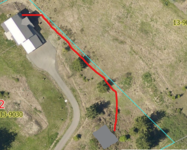
At that length it would be good to breaker it at less than 90A due to voltage drop. Doesn't sound like it should impact your use. Looks like you could just bend the conduit some instead of the 45s. I drew in two possible routes on the garage end (a little shaky - you don't have to do the tight loop near the garage :) ). I did a quick look for allowed bend for this sort of thing but didn't find anything. I had found some guidelines years ago but it may have been for PVC pipe (which would be the same thing as far as bending). You could just take some lengths and lay them out and see how much spring they have - I think with 1-1/2 you could easily make the needed bends and probably 2" too.
GJWIRI~1.jpg
 
Last edited:

sparky 1971

Well-known member
Joined
Oct 9, 2018
Messages
7,967
Location
Central Iowa
Romex needs protection when subject to damage. If it is in a spot where that can happen, conduit is one way to protect it, and either pvc or emt would work
The problem with that is there is no effing definition of subject to damage. Some places I work say it has to be in conduit if the walls and ceiling aren't covered. Others are ok if it's not run through the walls horizontally and stapled to the sides of the studs and across the tops of the trusses, while another place wants it within 12" of the wall if on top of the trusses or through holes drilled in the joists but sleeved in some kind of conduit below the ceiling. I just run EMT if it's not going to be finished and avoid the hassle of Romex altogether.
 
OP
F

fakka

Member
Joined
Jun 4, 2024
Messages
11
At that length it would be good to breaker it at less than 90A due to voltage drop. Doesn't sound like it should impact your use. Looks like you could just bend the conduit some instead of the 45s. I drew in two possible routes on the garage end (a little shaky - you don't have to do the tight loop near the garage :) ). I did a quick look for allowed bend for this sort of thing but didn't find anything. I had found some guidelines years ago but it may have been for PVC pipe (which would be the same thing as far as bending). You could just take some lengths and lay them out and see how much spring they have - I think with 1-1/2 you could easily make the needed bends and probably 2" too.

Thanks ......
 

Sumboodie

Well-known member
Joined
Mar 20, 2021
Messages
10,660
Location
AK
200' of #2 can only support a 25A load to stay under the recommended voltage drop figure 3%
About 60 amps at 3% is what my math works to.

I suppose if a guy is welding with the air compressor going while baking muffins and drying some rags that might be an issue.
 

Sumboodie

Well-known member
Joined
Mar 20, 2021
Messages
10,660
Location
AK
Rule of thumb I was taught was length of run under the voltage wasn't usually an issue.

Ie... 120ft for 120v, 240ft for 240v.
 

Joemctag

Well-known member
Joined
Aug 11, 2017
Messages
813
Location
Outside raleigh nc
Couple of related suggestions:
Don’t put outlets low, like in a bedroom or living room. Think higher, like 4’-6”.
Surface-mounted conduit and boxes on your OSB or gyp-board walls look good and can be easily modified-extended.
Wires in conduit can be individual, solid of stranded.
Don’t use PVC conduit. It’ll never look straight.
 
To avoid these ads, REGISTER NOW!
Top Bottom