To avoid these ads, REGISTER NOW!

Power strip or switch for 20 amp motor load

makemake

Active member
Joined
Dec 13, 2021
Messages
37
Hello,
typically in my shop I tend to turn on all of my lights and loads by turning on A surge protector When I enter and leave. I'm looking for a simple switch that can handle a motor load up to 20 A. I suppose ideally it would be a power bar, or a single switchbut the only thing I foundWas something that is difficult to get in Canada.

do you have any alternative Methods or cheaper ones for switching up to 20 amp loads

 
To avoid these ads, REGISTER NOW!

RTM

Well-known member
Joined
May 13, 2019
Messages
13,189
Location
SF Bay Area
I would not use a power strip for a 20a load, that is rated for 20a across the entire power strip.

I’m not a fan of power strips for rotating loads bigger than a fan. I consider them for lightweight stuff, not power hungry tools.

A 20a load should have the sideways 2nd prong (¿NEMA 6-20P?), which may be hard to find switched unless you do something like this


GeoBruin

Well-known member
Joined
May 5, 2018
Messages
3,740
You could make your own pretty easily. Choose an outlet box with as many gangs as you need, buy a 20 amp switch to install in one gang and outlets to fill the rest. Wire them all just like you would in a wall. Buy a 12 gauge extension cord of desired length, cut the head off, and wire it to your switch. Get a faceplate to cover/enclose everything and Bob's your uncle.

All that said, if your shopping at Home Depot or equivalent, you'll probably spend as much as you would on that nice, tidy Southwire power strip you linked, but availability shouldn't be an issue.

Keep in mind though, if you have one appliance pulling close to 20 amps, you won't have any overhead in your wire or your switch for more current.
 
OP
M

makemake

Active member
Joined
Dec 13, 2021
Messages
37
I would not use a power strip for a 20a load, that is rated for 20a across the entire power strip.

I’m not a fan of power strips for rotating loads bigger than a fan. I consider them for lightweight stuff, not power hungry tools.

A 20a load should have the sideways 2nd prong (¿NEMA 6-20P?), which may be hard to find switched unless you do something like this

For clarification, I'm talking about a 20 amp circuit. My mistake the load itself is a 14.5 ampMotor. But I'm using a 20 amp circuit. I usually don't run anything else at the same time with such a load
You could make your own pretty easily. Choose an outlet box with as many gangs as you need, buy a 20 amp switch to install in one gang and outlets to fill the rest. Wire them all just like you would in a wall. Buy a 12 gauge extension cord of desired length, cut the head off, and wire it to your switch. Get a faceplate to cover/enclose everything and Bob's your uncle.

All that said, if your shopping at Home Depot or equivalent, you'll probably spend as much as you would on that nice, tidy Southwire power strip you linked, but availability shouldn't be an issue.

Keep in mind though, if you have one appliance pulling close to 20 amps, you won't have any overhead in your wire or your switch for more current.
I kind of like this, but at the same time it would be nice to have something that was just plug-and-play. Do yu know where I can find a wiring diagram on the Internet?
 

Shiftless

Well-known member
Joined
Mar 9, 2014
Messages
14,551
Location
East Bay SFO
“I tend to turn on all of my lights and loads by turning on A surge protector”

By that do you mean you have a few receptacles and some light fixtures all connected with extension cords and all plugged in to a surge protector strip?
 

GeoBruin

Well-known member
Joined
May 5, 2018
Messages
3,740
I agree, plug and play would be nice (see my comment above regarding the linked power strip). That said, if availability of something off the shelf is non-existant, it could be an opportunity to customize to your liking. The wiring is pretty straightforward, and you should be able to find instructions on wiring an analogous circuit for a typical home application, but if you decide on the switch and outlets you want to use, I can draw a quick sketch and post it here.
 

RTM

Well-known member
Joined
May 13, 2019
Messages
13,189
Location
SF Bay Area
For clarification, I'm talking about a 20 amp circuit. My mistake the load itself is a 14.5 ampMotor. But I'm using a 20 amp circuit. I usually don't run anything else at the same time with such a load
but, I still wouldn’t do this on a regular power strip. Years ago a fried a power strip running a Milwaukee 1/2” drill off one, unloaded. Was just testing the drill, and the strip popped off. Not the breaker, fried the switch internals, I found out later.
 
OP
M

makemake

Active member
Joined
Dec 13, 2021
Messages
37
This.

OP, what are you actually plugging in?
Electric motor slightly under 15 A
“I tend to turn on all of my lights and loads by turning on A surge protector”

By that do you mean you have a few receptacles and some light fixtures all connected with extension cords and all plugged in to a surge protector strip?
no. That's not what I meant. Overhead shop lights is on its own light switch standard. The surge protector just allows for Any machines to be ready to use. I only use one machine at a time on any circuit.anyLED task lights that are attached to the tools to be turned on Which is a nice bonus. It turns on a small radio. every machine has its own separate power switch On the tool the way it's supposed to be.
I agree, plug and play would be nice (see my comment above regarding the linked power strip). That said, if availability of something off the shelf is non-existant, it could be an opportunity to customize to your liking. The wiring is pretty straightforward, and you should be able to find instructions on wiring an analogous circuit for a typical home application, but if you decide on the switch and outlets you want to use, I can draw a quick sketch and post it here.
That would be nice, but I don't want to ask too much
 

Gozo

Well-known member
Joined
Oct 10, 2013
Messages
250
Location
Central VA
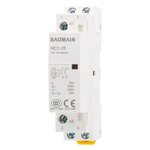
How about the power strip energizes a contactor relay? Very low load on the switch as the inrush current and arc on break are easily handled by the contactor. 15 amps is nothing for them.
 

jeepxj

Well-known member
Joined
Mar 2, 2008
Messages
17,863
just stick the motor wires into the power strip. then kick them out when you're leaving
 
To avoid these ads, REGISTER NOW!
OP
M

makemake

Active member
Joined
Dec 13, 2021
Messages
37
How about the power strip energizes a contactor relay? Very low load on the switch as the inrush current and arc on break are easily handled by the contactor. 15 amps is nothing for them.
What does this mean exactly?
 

RTM

Well-known member
Joined
May 13, 2019
Messages
13,189
Location
SF Bay Area
What does this mean exactly?
Using this image, stolen off the internet, edit in your mind as you read. (You only have a 2 wire plus ground motor, ignore that Third leg) Think of L1 and L2 wired directly to your motor, or plugged straight to the wall, always hot, except that relay K contacts stop it from running. L3 and N feed your power strip, and relay K coil. When you switch on your power strip, relay K coil energizes, drawing approximately 0.5amps, the contacts close, and your motor starts, drawing its 14.5 amps from the wall.


1685990700947.png
 
Last edited:

rlitman

Well-known member
Joined
Oct 18, 2010
Messages
24,613
Location
Long Island
You could make your own pretty easily. Choose an outlet box with as many gangs as you need, buy a 20 amp switch to install in one gang and outlets to fill the rest. Wire them all just like you would in a wall. ...
Don't do this. A regular switch is not rated for switching motor current. You need a switch made to disconnect motor horsepower, or you will fry your light switch. Really, the contactor idea is the best one here. That can be switched with any old light switch, since it only need to control power to the electromagnet in the contactor, and the contactor itself handles the current.

There's a wiring diagram right on this one:
51eA24tkgDL._SL1200_.jpg
 

GeoBruin

Well-known member
Joined
May 5, 2018
Messages
3,740
Don't do this. A regular switch is not rated for switching motor current. You need a switch made to disconnect motor horsepower, or you will fry your light switch. Really, the contactor idea is the best one here. That can be switched with any old light switch, since it only need to control power to the electromagnet in the contactor, and the contactor itself handles the current.

There's a wiring diagram right on this one:
51eA24tkgDL._SL1200_.jpg
He's not switching the motor on with this switch. He's just energizing the circuit. He says up above each machine has its own switch.
 

rlitman

Well-known member
Joined
Oct 18, 2010
Messages
24,613
Location
Long Island
He's not switching the motor on with this switch. He's just energizing the circuit. He says up above each machine has its own switch.
..."When I enter and leave. I'm looking for a simple switch that can handle a motor load up to 20 A"...
Any switch that has the capability of energizing the motor load needs the horsepower rating.
 

GeoBruin

Well-known member
Joined
May 5, 2018
Messages
3,740
You're right. Ideally, they ideally use a contactor. But really, ideally, they plug their motor into a socket in the wall with sufficient rating for his application. But for some reason that's not clear, they came here looking for something like a power strip. I can't possibly guess why that might be the case, but here we are.

Can we compromise on a widely available switch rated for controlling motors that still fits in a box so they can make their "power strip"?


It's rated for 2 HP at 120 volts. According to their post history, this is probably for a bandsaw with a 1ish HP motor.
 

darkzero

Well-known member
Joined
Oct 20, 2011
Messages
3,326
Location
SoCal
Manual motor starter, basically a glorified light switch. I use them to cut the power to my lathe & mill instead of electrical disconnects or flipping the breakers.

They're kinda of expensive (depending on power rating) but I found mine on ebay new for $10-20 ea. Mine are SquareD but others make em too, Leviton, Eaton, GE, Dayton, etc. There's also push button & slide lever types.

20230605_163511.jpg
 
Last edited:

darkzero

Well-known member
Joined
Oct 20, 2011
Messages
3,326
Location
SoCal
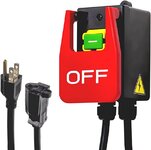
For plug-n-play, there's these. Seen em at woodworking stores for use with tablesaws, router tables, etc.

515tfKjqO9L._AC_UF894,1000_QL80_.jpg
 
OP
M

makemake

Active member
Joined
Dec 13, 2021
Messages
37
I don't like the cost of the plug-and-play solutions. As far as switches go, I understand the issue at the power strip side. On the machine side I have used 20 amp motor switches made by Leviton. What's the difference between a manual motor starter and a Leviton 20 amp motor switch? https://www.leviton.com/en/products/1221-2w
 

GeoBruin

Well-known member
Joined
May 5, 2018
Messages
3,740
One has an established HP rating for use as a motor disconnect and the other does not. Specifically, manual motor controllers are UL 508 Listed as "Suitable as Motor Disconnect". The leviton switch I linked above is UL 508 listed. I swear I caught a glimpse at the data sheet for the 20 amp switch you linked and it said it can switch small motor loads. I thought I even saw it said 1HP at 120 volts, but I can't find it now.

Technically, UL 508 switches can be used only to start, stop, regulate, control, or protect electric motors, while UL 98 components must be used for a branch circuit, feeder, or motor-circuit disconnect. In other words, you use a UL 508 switch on the machine itself, and you use a UL 98 device for the circuit.

All that said, NEC/CEC compliance isn't exactly in the spirit of your post. The switch I linked is just a little more expensive than the Leviton Heavy Duty switches, should be almost as widely available, and will still fit in a box.
 
To avoid these ads, REGISTER NOW!
Top Bottom