To avoid these ads, REGISTER NOW!

Power to new garage

Isdpcman

Member
Joined
Nov 26, 2025
Messages
11
We live in a rural area. We're getting a steel garage installed and I want to run a 100 Amp line to the new garage. I would like to tap into the existing house meter. The service is 250 amps, with the house having a 150 Amp box inside. So I have load capacity, now.

How can I add this 2nd connection to my meter? I'll have a 3 inch underground Raceway to the new garage and wiring a panel is nothing new for me. But I've never added a tap to a meter. And finding electrical workers in this area is early impossible. It's something I need to do myself.

I don't need 100 amps (just running LED lights and half a dozen outlets for battery chargers and two garage door motors.
 
To avoid these ads, REGISTER NOW!

mm08822

Well-known member
Joined
Jan 13, 2012
Messages
6,061
Location
NJ
Need pics of tie-in location and with covers off.

You won't need 3" conduit.

250A is an oddball size....how did you come to that value?
 

wyliesdiesels

Well-known member
Joined
Aug 14, 2012
Messages
20,089
Location
Modesto, CA
We live in a rural area. We're getting a steel garage installed and I want to run a 100 Amp line to the new garage. I would like to tap into the existing house meter. The service is 250 amps, with the house having a 150 Amp box inside. So I have load capacity, now. How can I add this 2nd connection to my meter?

unless you have a dual lug meter, not gonna happen. and 250a is a weird service size ive never seen. typically it goes 100, 125, 200, 400 (320 continuous)

how about some pics of what you have? nobody can guess without seeing what you got.

:needpics:

I'll have a 3 inch underground Raceway to the new garage and wiring a panel is nothing new for me. But I've never added a tap to a meter. And finding electrical workers in this area is nearly impossible. It's something I need to do myself.

I don't need 100 amps (just running LED lights and half a dozen outlets for battery chargers and two garage door motors.

3" is overkill for a feeder to a garage
 
OP
I

Isdpcman

Member
Joined
Nov 26, 2025
Messages
11
Need pics of tie-in location and with covers off.

You won't need 3" conduit.

250A is an oddball size....how did you come to that value?
Need pics of tie-in location and with covers off.

You won't need 3" conduit.

250A is an oddball size....how did you come to that value?
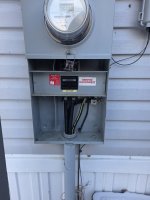
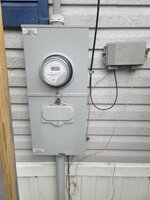
I can't open the box without cutting the seal. As fir the 250,i recall reading that on a label on or near the meter. All I can provide is this photo of the existing meter box. Feed voltage comes from above. The bottom chase is going into the house.

What size conduit do you recommend?
 

Attachments

  • 20200830_143048.jpg
    20200830_143048.jpg
    695.9 KB · Views: 110

PCustoms

Well-known member
Joined
Jul 23, 2011
Messages
23,561
Location
VT
I can't open the box without cutting the seal.

No offense, you may be in over your head.

1764245666082.jpeg

The bottom half is not sealed, and contains the breaker you need to look at, as that is likely where you will tie in

What size conduit do you recommend?

Let's backup

How far to garage?

Why 100a?

These will back into wire size. If you don't need 100a, it will overall be cheaper/easier. You won't need over 2" IMHO
 
OP
I

Isdpcman

Member
Joined
Nov 26, 2025
Messages
11
Garage has not been erected yet. Best estimate is, the feed will run between 60 and 90 feet.

Thanks on the conduit. What gauge for 50 amps, then?
 

mm08822

Well-known member
Joined
Jan 13, 2012
Messages
6,061
Location
NJ
It's a 200 amp meter, SE cable looks no bigger than 4/0-4/0-2/0, so I'd say 200amp service.

Take the cover off the bottom half so we can see what connection options there may be. There might be none and coming out of the house panel might be easier.

What are your loads going to be in the future? Heater, ac, minisplit, welder, evse?? THINK! Now is the time to do it once.

You went from 100A to 50A feeder at the drop of a dime. Really need to lock in on this. It determines conduit and wire size.
 

PCustoms

Well-known member
Joined
Jul 23, 2011
Messages
23,561
Location
VT
Garage has not been erected yet. Best estimate is, the feed will run between 60 and 90 feet.

Thanks on the conduit. What gauge for 50 amps, then?

Probably 1", I can't get the calcs to load but I think #6 wire.

You really need to nail down current demand. I'm thinking 2/2/4/6 xhhw in 1.5" will be your best bang for buck for a shop.

I don't think you have 200A service, maybe 150A max
 
OP
I

Isdpcman

Member
Joined
Nov 26, 2025
Messages
11
Probably 1", I can't get the calcs to load but I think #6 wire.

You really need to nail down current demand. I'm thinking 2/2/4/6 xhhw in 1.5" will be your best bang for buck for a shop.

I don't think you have 200A service, maybe 150A max
Thanks. The demands are light... Just some LED lights and a half dozen or so power outlets for low voltage battery trickle chargers and power tool battery chargers. That's it. The garage will be used for "toy" storage (ATVs, snowmobiles, a lawn tractor and small farm tractor). I know the inside panel is 100 Amp (it's a double-wide mobile home). I can't come off the panel in the house.
 
OP
I

Isdpcman

Member
Joined
Nov 26, 2025
Messages
11
I can take some photos of the lower panel on the meter when I get up to the house, in a couple of weeks. I'll share them then.
 

75gmck25

Well-known member
Joined
Jul 21, 2014
Messages
1,328
Location
Alexandria, VA
Many folks use 2/2/2/4 aluminum Mobile Home Feeder (MHF) with a breaker up to 90 amps, since it's a lot cheaper than copper wire. It will pull fine through a 2" conduit, or maybe even 1 1/2". Get the type that is dual rated for both direct bury and in conduit (very easy product to find), and make sure you have it in conduit wherever it's inside a building (that is required). I just checked online and Nassau Cable has it for $2.10/foot.

You can use a breaker up to 90 amps for 2/2/2/4 MHF. I started out with a 60 amp (much easier to find in stores) and have never found a need to upgrade.
 

kngelv

Well-known member
Joined
May 25, 2011
Messages
2,235
Location
Detroit, MI
If you have to come off the meter can then you will need taps which likely won't fit the current lugs. You'll have some additional work because of code updates if tapping off the meter can. You'll need a disconnect on the outside garage wall and a surge suppressor in the garage panel. If you have to trench anyway then I'd just run #2 with a #6 ground in 1 1/2" pipe. You'll also need two ground rods.

James
 

mm08822

Well-known member
Joined
Jan 13, 2012
Messages
6,061
Location
NJ
If you have to come off the meter can then you will need taps which likely won't fit the current lugs. You'll have some additional work because of code updates if tapping off the meter can. You'll need a disconnect on the outside garage wall and a surge suppressor in the garage panel. If you have to trench anyway then I'd just run #2 with a #6 ground in 1 1/2" pipe. You'll also need two ground rods.

James
The exterior disconnect requirement is only for 1 & 2 family dwelling units.
I personally would prefer a disconnect at the meter to eliminate unprotected conductors running through the property.

A panel inside the garage with a main cb (or fewer than 6 throws of hand cbs) would meet code.
 

JohnX14

Well-known member
Joined
Jun 2, 2014
Messages
614
Location
Boston 'burbs
I agree with most of what has been said here. I'd go 2" PVC to the detached structure, not enough difference between that and 1 1/2" to matter. I don't think you'll be able to tap into meter. May be easiest to put another meter with a separate service entrance riser next to the meter/ main that is there and do a 100 amp service to garage, with meter attached to house. If POCO allows it. If you are very rural, and no licenses are required, it's really not that difficult. I'd say a new service is easier than tieing into existing. (Without knowing where the indoor panel is in relation to everything already posted.)
 

kngelv

Well-known member
Joined
May 25, 2011
Messages
2,235
Location
Detroit, MI
The exterior disconnect requirement is only for 1 & 2 family dwelling units.
I personally would prefer a disconnect at the meter to eliminate unprotected conductors running through the property.

A panel inside the garage with a main cb (or fewer than 6 throws of hand cbs) would meet code.
some inspectors are kind of funny about that stuff though. I’d probably do what you said and just go ahead and put a breaker right next to that meter can that covers both the house and the garage?

James
 
OP
I

Isdpcman

Member
Joined
Nov 26, 2025
Messages
11
some inspectors are kind of funny about that stuff though. I’d probably do what you said and just go ahead and put a breaker right next to that meter can that covers both the house and the garage?

James
Inspectors? They don't know what those are in our area. 🙄
 
To avoid these ads, REGISTER NOW!
OP
I

Isdpcman

Member
Joined
Nov 26, 2025
Messages
11
for the meter pan section that is correct. but we are asking to see the disconnect section at the bottom half which does not and should not have a seal. take the cover off and take a pic
Will do! I'll be back to the house in 2 weeks. Will post photos when I get up there.

I appreciate all the input!
 

mike93lx

ALLIANCE MEMBER
Joined
Dec 9, 2013
Messages
37,960
Location
Richmond, VA
Get the type that is dual rated for both direct bury and in conduit (very easy product to find), and make sure you have it in conduit wherever it's inside a building (that is required)
Getting this a little mixed up.

All wire can be in conduit. The wire you are referring to is rated for direct burial and indoor use. URD is often does not meet the latter, so people recommend MHF, which does.

Individual conductors must be in conduit any time they are not in the ground. So not just in a building, but outdoors above grade requires conduit.

Personally, I would run conduit end to end to skip the direct burial shenanigans, and use xhhw instead of MHF.

1.5" will be fine. A second conduit for an internet line may be prudent.
 
OP
I

Isdpcman

Member
Joined
Nov 26, 2025
Messages
11
Getting this a little mixed up.

All wire can be in conduit. The wire you are referring to is rated for direct burial and indoor use. URD is often does not meet the latter, so people recommend MHF, which does.

Individual conductors must be in conduit any time they are not in the ground. So not just in a building, but outdoors above grade requires conduit.

Personally, I would run conduit end to end to skip the direct burial shenanigans, and use xhhw instead of MHF.

1.5" will be fine. A second conduit for an internet line may be prudent.
I have dozens of sections of 2" conduit I can use. I don't want to direct bury anything up there.
 

beltfeed

Well-known member
Joined
Jan 22, 2006
Messages
226
Location
USA
2" works good but 3" sure is easy for pulling wire.

I did 3" for a shared service between my house and the shop. Pulled very easy. Meter is gone from the house now and a Tap box replaced it.

1765134608169.jpeg

1765134684925.jpeg
 

75gmck25

Well-known member
Joined
Jul 21, 2014
Messages
1,328
Location
Alexandria, VA
Once again I need to make sure I am correct.

This is my understanding about the use of MHF.
- approved direct bury wire, including URD and RHH-RHW-2/USE-2 rated MHF can be either buried or run in conduit for an underground run. Many folks choose to use conduit.
- The dual rated MHF can also be run indoors, but inside the building it must be run in conduit to provide physical protection. I think this makes a lot of sense, since the MHF I bought was four wires (2-2-2-4) that had no outer jacket to keep them together.
 

mike93lx

ALLIANCE MEMBER
Joined
Dec 9, 2013
Messages
37,960
Location
Richmond, VA
Once again I need to make sure I am correct.

This is my understanding about the use of MHF.
- approved direct bury wire, including URD and RHH-RHW-2/USE-2 rated MHF can be either buried or run in conduit for an underground run. Many folks choose to use conduit.
- The dual rated MHF can also be run indoors, but inside the building it must be run in conduit to provide physical protection. I think this makes a lot of sense, since the MHF I bought was four wires (2-2-2-4) that had no outer jacket to keep them together.
You have it correct
 

Norcal

Well-known member
Joined
Mar 16, 2008
Messages
13,770
Once again I need to make sure I am correct.

This is my understanding about the use of MHF.
- approved direct bury wire, including URD and RHH-RHW-2/USE-2 rated MHF can be either buried or run in conduit for an underground run. Many folks choose to use conduit.
- The dual rated MHF can also be run indoors, but inside the building it must be run in conduit to provide physical protection. I think this makes a lot of sense, since the MHF I bought was four wires (2-2-2-4) that had no outer jacket to keep them together.
URD is made for electrical utilities, the aluminum alloy is is not what is speced in the NEC.
 

PCustoms

Well-known member
Joined
Jul 23, 2011
Messages
23,561
Location
VT
URD is made for electrical utilities, the aluminum alloy is is not what is speced in the NEC.

I've seen this listed twice in the past week (from you both times?) but never before.

Can you cite anything?

All I've ever seen posted here is issues with the jacket and how it can't go indoors.
 
Last edited:

sparky 1971

Well-known member
Joined
Oct 9, 2018
Messages
8,027
Location
Central Iowa
I've seen this listed twice in the past week (from you both times?) but never before.

Can you cite anything?

All I've ever seen here is issues with the jacket and how it can't go indoors.
This doesn't answer the question, and I obviously can't speak for everywhere, but I can't get regular URD locally, nor do I want to, because everyone stocks dual rated. The same with THHN and THWN. I can buy all of the TWHN-2 or THHN/THWN I want. Why have two or three things eating up shelf space when one thong will work for everything?
 
OP
I

Isdpcman

Member
Joined
Nov 26, 2025
Messages
11
Finally, here's the picture that was asked for.
 

Attachments

  • 20251220_094820.jpg
    20251220_094820.jpg
    500.5 KB · Views: 55

wyliesdiesels

Well-known member
Joined
Aug 14, 2012
Messages
20,089
Location
Modesto, CA
that is a 200a service not 250a (not sure where you got 250a as the breaker is clearly labeled)

looks like someone ran quadruplex URD inside the house which is not to code.

there are no dual lugs off that breaker. only option would be a tap but you wont have separate disconnect for the garage unless you add one in a separate panel off to the side.

what loads do you have in the house?
 

Snap-on_rich

Active member
Joined
Dec 12, 2025
Messages
44
Location
NJ
Why not install a breaker in the panel in the house that will supply the garage... you only have 200 amps.. makes no difference to tap in a splice box adjacent to that or inside the home in the panel.
 

wyliesdiesels

Well-known member
Joined
Aug 14, 2012
Messages
20,089
Location
Modesto, CA
Why not install a breaker in the panel in the house that will supply the garage... you only have 200 amps.. makes no difference to tap in a splice box adjacent to that or inside the home in the panel.
may be harder to get a feeder from the panel inside the house to the garage
 

Snap-on_rich

Active member
Joined
Dec 12, 2025
Messages
44
Location
NJ
may be harder to get a feeder from the panel inside the house to the garage
I'd put money that the panel is probably in the basement right below that meter main combo. If i was doing this job id just add a breaker in the main panel and from the basement stub out into a box then down underground with an expansion fitting into the garage. I'd use a panel with a main.. and dont forget the uffer ground or ground rod or rods ... otherwise you would need to add a splice box next to the existing meter main and run from the load side of that exterior main breaker into the box and then down to the main panel and use the tap rule to tap and add fused disco or a small 2/4 3r panel with the appropriate breaker size within 10' of the tap. Sounds easier to just run the work from inside!
 

wyliesdiesels

Well-known member
Joined
Aug 14, 2012
Messages
20,089
Location
Modesto, CA
I'd put money that the panel is probably in the basement right below that meter main combo. If i was doing this job id just add a breaker in the main panel and from the basement stub out into a box then down underground with an expansion fitting into the garage. I'd use a panel with a main.. and dont forget the uffer ground or ground rod or rods ... otherwise you would need to add a splice box next to the existing meter main and run from the load side of that exterior main breaker into the box and then down to the main panel and use the tap rule to tap and add fused disco or a small 2/4 3r panel with the appropriate breaker size within 10' of the tap. Sounds easier to just run the work from inside!
the main panel is the one outside and cannot take any more breakers. the panel inside is a subpanel.

you could make the tap right inside the meter main, then feed it into a disco next to it....

and im not gonna assume where the inside panel is located....
 
To avoid these ads, REGISTER NOW!
Top Bottom