NOT FOR SALE: Given the time since the original post 2018), I took it upon myself to obtain the bicycle vise that
@chgans mentioned above. Thank you again, Chris, for your help!
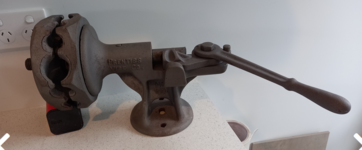
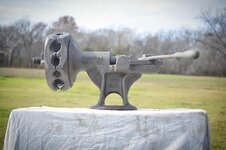
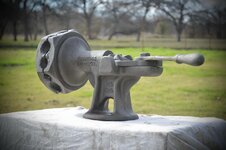
I’m beyond thrilled to be able to present the (to my knowledge) the only publicly recorded example of a Prentiss #100 Bicycle vise (not to be confused with the Holland’s Star Bicycle Vise). Given its rarity, I would love to be proven wrong if there are more out there.
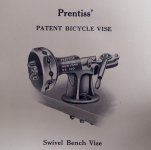
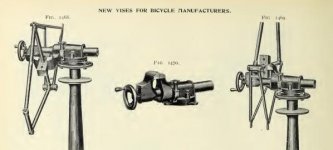
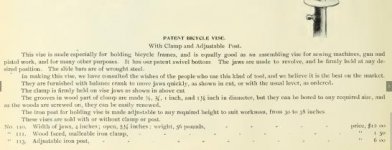
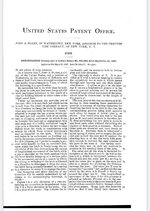
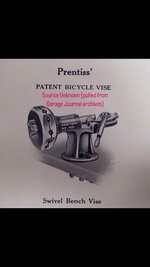
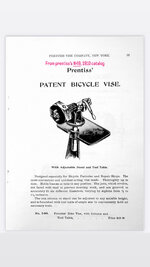
Patented on September 21, 1897, this vise was “designed especially for bicycle factories and repair shops” (Prentiss Catalog #49, published in 1910). The lead-faced jaws (offering a soft clamping grip) hold 6 sizes of pipe. Given the absence of screw threads in the holes of the base, it’s safe to assume that this vise was originally purchased in tandem with Prentiss’s “Adjustable Stand and Tool Table” option, depicted in their 1910 catalog (see pictures). In my estimation, this vise was made somewhere between 1897 and 1910 given the apparent absence of available references to the vise after about 1910. I’ve included a handful of notes for the sake of public documentation and future reference, and I’m open to correction from any of you with more knowledge.
I was lucky enough to purchase this vise from a gentleman in New Zealand. After discovering it “in a trailer load of steel rubbish going to the dump”, he saved it, sandblasted it, and displayed it in his home.
1) The weight of this vise (unrecorded in any advertisements I’ve found) is 44.6 lbs
2) The full travel distance of the dynamic jaw (from full extension of the handle to full flexion) is 1/4 inches
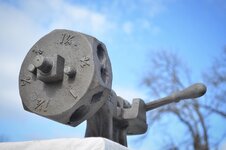
3) The vise jaws can accommodate six sizes of pipe - 5/8, 3/4, 7/8, 1, 1.25, and 1.5. The operator rotates the jaws until the desired pipe size numeral is at 12-o'clock. Then, the pipe is inserted horizontally between the jaws
4) Consistent with several 1897 and 1898 Iron Age advertisements, the jaws are lined with lead and show signs of wear/tear including clear impressions from gripping various items
5) Though there are light traces of red paint in-between the jaws, several areas untouched by the sandblaster (sandblasted by the previous owner) suggest an original coat of japanning
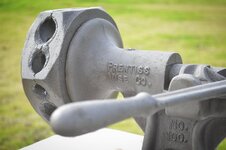
6) The only feature on the vise that may not be original is the large, square nut threaded onto the main screw on the face of the dynamic jaw. All advertisements of this vise depict it with a large wing nut. See pictures
7) The vise as depicted on the original patent (see pictures) is the only advertisement that I've found which seems to accurately show the design of the arched webbing between the columns of the base. Every other photograph I've found seems to show the vise with either no arch (aka. a solid wall) or with a very shallow arch (aka. very low to the base of the vise).
8)* Interestingly, out of the 185 vises that the 1910 Prentiss Vise Catalog No 49 advertises, the bicycle vise is among 22 of these vises that are NOT included in the price lists for extra parts (pg. 68-71). These 22 vises include the bicycle vise, all 9 styles of Prentiss's "Handy Vises", all 5 sizes of the stationary-base "New Blake Pipe Vise", all 3 sizes of the stationary "Monarch Combination Pipe Vise", and all 4 sizes of the stationary "Combination Pipe Vise 'Rex'". My un-proven, un-researched theory is that Prentiss was easing these vises out of production and in so doing had ceased production of replacement parts.