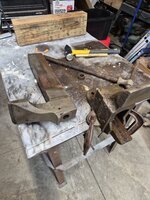
-It actually looks pretty good for having lived underground for part of its life, you did a good job of bringing it back to the current state. Not knowing what you have for bringing it back to service life I'll just mention what I did as a suggestion, take what you want from it. I have a #10 that was the "coachbuilder" model with a swivel back jaw, it came to me unintentionally and I had no idea what it was. There wasn't even any cast lettering on the sides to determine the brand, that was done much later. After disassembly and thorough cleaning, mine was supposedly used as a boat anchor in a New York lake at some point. Due to the age (100 years?) and my intention to put it back into service I went with a somewhat minimal metal removal approach. I have some fondness for old iron (machine shop career) and antiques so I felt that even the dings and imperfections were part of the history of the previous owners so who was I to remove blemishes?
-Brass brushes (BBQ brush) and bristle brushes where what I used as brass/bristle can remove rust but not solid metal. Use WD-40 in between washings with water & Dawn (dish soap) to avoid flash rust. Red rust is active, black rust is fairly stabilized. Next I went for all the flat sliding/rotating surfaces with a carborundum stone soaked in oil to remove dings that interfered with the function. Stoning won't be to remove metal so much as just to smooth the contact surfaces. That lead screw will want a good scrubbing with a brass brush, same for the internal nut. If the gap between the lead screw and vise body allows it you could drop in a couple of thin washers made from plastic containers, should reduce the friction vs. metal to metal. What appears to be weld on your moving jaw I'd just leave alone with a minimum of metal removal.
-For finishing that's up to you. I had some small patches of rather durable paint on mine and I wanted to perhaps duplicate the original. In my reading I believe that Japanning was used for some of the earlier models. I've encountered Japanning on older tooling before so I read up on it. It's a fairly durable surface treatment that looks great (to me) but it's a messy, multi-step process that smokes/stinks up the area so I went with a brand of rattle can paint another member here had favored. If I had to do it all over again I'd probably go with the BLO, the rattle can doesn't begin to compare to Jappaning other than color (black).