To avoid these ads, REGISTER NOW!

Preparation for MaxJax

Gabriel J

Well-known member
Joined
Mar 5, 2008
Messages
155
Location
Cape Cod, MA
I read the original post by Jeff (JSK) regarding the MaxJax lift literally minutes after he posted and basically decided that moment it was the lift that I wanted. Since that day, I have been waiting for the chance to have a lift in my 9' ceiling garage. Now that the group buy has come and gone, it was time to get serious about preparing the garage for the MaxJax that will hopefully be arriving in a matter of weeks.

I am not one to skimp when it comes to safety so I carefully read and re-read the installation requirements and instructions. A few things stood out to me: The PSI and Depth requirements for the concrete anchors. My house was built in 1977, and to say that my garage was a low budget afterthought is no lie. The house blueprint did not include a garage at all, it was added at some point during it's haphazard construction.. Long story short, I felt that ichances were my concrete slab did not meet minimum anchor depth or PSI requirement.

Once I had learned that I would be one of the first MaxJax recipients, I went out to the garage and broke out the hammer drill. I started drilling the concrete in the hopes that the drill bit would not be through the base until at least the 4" mark...I should have known. I broke through and took out my ruler..sure enough 3 3/4". That was enough for me, I knew that there was little to no chance that anywhere in the slab would meet the 4" minimum.

I spent a couple days trying to decide how I wanted to go about meeting the requirements and not tearing out my whole garage floor. I designed a floor plan using 3 4'x4' slabs that will allow me to have the lift in 3 positions total using my two bays. Saturday I finally found the time to start my work. I first used a cardboard template to visually test how my paper drawn layout would work. I was happy with my setup so I measured out and chalk lined my layout. I then spray painted the lines so that the concrete saw's water would not wash them out. I rented a diamond-bladed gas concrete saw and went to work. I wish I could have had taken some pictures of the process..It was loud, and fun. Unfortunately it was also too messy for me to run into the house and grab the camera.

Tonight I moved my car and motorcycle over to my gracious neighbor's garage where they will be stored until the garage is ready to be driven on. I took out the pry bars and lifted out the sections....Sure enough I found sections that were not even 3" in areas where I would have been drilling for the concrete anchors...Here are the photos I took tonight. I plan on updating this thread as each step progresses from today until the MaxJax is bolted down! -Gabe

*notice in the first photo the gladiator cabinets scored for $27 thanks to the thread from a few weeks back.......

img1966n.jpg

img1967.jpg

img1970k.jpg
 
To avoid these ads, REGISTER NOW!

35mastr

Well-known member
Joined
Dec 6, 2007
Messages
2,534
Location
Norcal
Gabe,Now that was using your head to get what you need done.But Why did you make the holes soooo big.You could of gotten away with half of that in each hole.
 
OP
G

Gabriel J

Well-known member
Joined
Mar 5, 2008
Messages
155
Location
Cape Cod, MA
I decided on the size of the cutouts based on the layout I needed for multiple column positions. Right in the directions it states that if the anchors will not hold the proper torque of 100ft.lbs to replace the area with a 4'x4' 6" deep section of concrete. That's basically what I am doing, except I will be potentially laying down a much deeper depth. Also it states that the anchors need to be a minimum of 4 1/2" from any edge. The size allows me a nice safety margin. If I didn't lose it, I would post a scale layout I made on the computer...-Gabe
 

fomocoforrester

Well-known member
Joined
Jun 13, 2008
Messages
3,061
I would think there must be quite a few of us who would like to have a MaxJax lift, but are concerned that the concrete spec. of the floor may be inadequate or at best marginal.

So it occurs to me that there might be an alternative mounting method.

Would it not be possible to weld the mounting studs to the back of a 10' length of standard 15" rolled steel channel. The sides of the channel could be reccessed into two grooves 15" apart by 3.5" deep in the floor, then there would be no stress on the floor, other than the straight compressive load of the lift plus vehicle weight.

It would also be neccessary to weld two plate extensions to the RSC at the base of each column to resist any out of balance tilting forces.

If an almost flush installation was required the mounting bolts could be threaded into captive nuts inside the channel section.

Standard C15 section 15" X 3.5" RSC weighs approximately 35lbs per ft. so the total weight of the beam would be about 360 to 370 lbs which is not much more than a single MaxJax column.

Just an idea - what do you guys think?
 

krooser

Well-known member
Joined
Jun 3, 2005
Messages
2,377
Location
Waupaca, Wisconsin
I think you guys are a little too worried... I have my lift bolted to my 4" floor... I had my floor poured but I'm sure there are spots where the floor is more than 4" and some where it's less than 4".

I've had a Ford E350 on my lift loaded with 3,000 lbs. of freight... the truck's empty weight is over 6600 lbs. With the weight of the lift that's over 10,000 lbs.... never a problem then... never a problem now.

Just my humble opinion...
 

35mastr

Well-known member
Joined
Dec 6, 2007
Messages
2,534
Location
Norcal
I have worked in some real old shops,I mean like 100 years old when I started out as a mechanic in New England.

When the old hydralic post lifts would blow.We would replace them with new electric lifts.I know now that that concrete was only abut 4 inches or less thick.

The lifts never had any issues and I would put F450 Superduty tow trucks up on those racks,pull engines and do clutches and never had an issue.

So I would not be all that concerned if the floors are not exactly the perfect thickness.

All that weight should be pushing down on the columns and not pulling up at the bolts.
 

tatra

Well-known member
Joined
Dec 2, 2007
Messages
4,785
Location
pirate contest city
myself , i think will be pouring piers and then boxing in cap a of appropriate size..........i have the equipment to fit inside my garage [ 10 ft in my case but will fit 8 ft as well]...........i will also be doing the same on a patch of gravel outside in a different configuration as well.............gotaa break down and buy a digital camera for this project............
 
OP
G

Gabriel J

Well-known member
Joined
Mar 5, 2008
Messages
155
Location
Cape Cod, MA
35mastr said:
All that weight should be pushing down on the columns and not pulling up at the bolts.


I'm far from an engineer, this is my idea of how forced is applied to the anchors:

liftexample.jpg


The back anchors are the ones that bear the most tension, and on the MaxJax there are no front fasteners used. I'm not taking the risk with some sections as shallow as 2" in my garage to try a wedge anchor that is meant for a minimum of 4". It would be my life at stake if there were some sort of failure.

-Gabe
 

Junkman

Well-known member
Joined
Dec 18, 2006
Messages
6,626
Location
Northeastern CT
I would under cut the gravel under the existing floor around the sides of the holes that you cut out, so the new concrete will flow under the cuts a few inches. Also, put 6 mil plastic over the gravel, so the dry gravel doesn't pull the moisture out of the new concrete. When you order the concrete, specify 5000 PSI fiber reinforced concrete, and don't water it down. Once you have the patches poured, keep them wet with a burlap coverings for 14 days, and it will be plenty strong.
 

fomocoforrester

Well-known member
Joined
Jun 13, 2008
Messages
3,061
I'm far from an engineer, this is my idea of how forced is applied to the anchors:

liftexample.jpg


The back anchors are the ones that bear the most tension, and on the MaxJax there are no front fasteners used. I'm not taking the risk with some sections as shallow as 2" in my garage to try a wedge anchor that is meant for a minimum of 4". It would be my life at stake if there were some sort of failure.

-Gabe

Exactly - and if you assume a distance ratio of 3:1 between the vertical forces and the pivot point, (the front edge of the baseplate), a 1000lb downward load on the arms results in a 3000lb upward force on the anchor bolts.

Incidentally, the compressive load resulting from the above two forces acting on the front edge of the baseplate becomes 4000lb.
 

tatra

Well-known member
Joined
Dec 2, 2007
Messages
4,785
Location
pirate contest city
i want to mix my own crete as i have the equipment and time...........what would be a good recipie for the mix?.............as for ordering the mix, not gonna happen as i do this on the side for a contracter.........they specify a 4 to 1 mix of portland to gravel for their needs..........any suggestions?.......as for the piers i can go 6, 8 or 10 inch by seven feet...................
 
OP
G

Gabriel J

Well-known member
Joined
Mar 5, 2008
Messages
155
Location
Cape Cod, MA
I called the local ready mix yesterday and they were able to come today at 8:30 to deliver the concrete. Last night after work I finished the prep work. My wife snapped a couple photos of me removing the sand down to a depth just shy of 12". There is now a nice pile of sand on the side of my house I'll have to find a new use for.

dsc01958i.jpg


In that shot, you can see the far hole is down to 12" against the wall. Shot with a steel ruler to confirm the depth:

dsc01951l.jpg


I didn't get pictures of when I was done though...I removed about 2-3 inches under the old floor around the perimeter so that the new slabs will resist any type of movement. Of course with one slab weighing in at somewhere near 1100lbs at this depth, I don't believe that movement will be a problem.

The truck arrived at 8:30, and I went to work with the help of the driver. We filled the three areas and he helped me out to get started with the finish work. I have never finished concrete, I have just used it to fill small cracks. I borrowed a couple trowels from a more experienced co-worker (He was also kind enough to call the ready mix company on my behalf..he was a driver for many years and they really helped me out) and using his instructions went to work. I would give myself a B- as far as smooth and level finish goes. There were some chips to the older areas when I was removing the blocks, so that's why you see what appears to be crooked lines..They are actually filling the chipped areas.

img1975o.jpg

img1977p.jpg


Now that the surface has hardened enough I put a level on it to see how well it turned out..Not bad at all, and the surface nearly matches what was in my garage already. Once it hardens over night, I will give a good cleanup to the area.

-Gabe
 

goodfellow

Well-known member
Joined
Dec 17, 2006
Messages
2,288
Location
NoVA
Good job Gabe!! and a special thanks for documenting this process. It'll be of help to others that are contemplating a lift purchase. That 4'x4'x12" base concept will definitely allow for a variety of anchor points. Good thinking!!!

Junk -- that undercutting idea is excellent!!
 

Tarheelgarage

Well-known member
Joined
Dec 14, 2008
Messages
3,865
Location
NC
Gabe, great job. I believe you are doing the right thing to ensure a slab that meets the requirements for the Maxjack.

BTW, is there anyway to ensure that the concrete you ordered met the 5000psi spec? What's to keep them from delivering 1500psi and saying it is 5000psi?
 
OP
G

Gabriel J

Well-known member
Joined
Mar 5, 2008
Messages
155
Location
Cape Cod, MA
Thanks guys!

The instruction from the Maxjax site mentioned to "key" replacement slabs under the existing floor so I made sure to follow that. Junkman was definitely on point with his tips.

I trust the the ready mix company that delivered my concrete because they have an excellent reputation and my co-worker worked for them quite a while. They don't skimp on their orders. He told me that their concrete when tested commonly exceeds the PSI rating at 28 days by up to 20%. The mix I got was a "winter" mix that has a higher early yield strength. I'm expecting that by the end of the month when the MaxJax should be arriving that it will easily beat the 3000psi minimum for installation.
 

wachuko

Well-known member
Joined
May 15, 2008
Messages
690
Location
Ocala, FL
Gabriel, better safe than sorry. Good job in getting a good foundation for the lift.

Is the concrete fiber reinforced? Re-bars used? Just curious.

Be sure to let it cure before putting the anchors... concrete sets in 24 hours, reaches spec in 28 days, and fully cures like in 30+ years... Don't ruin all this work by drilling that puppy too early...
 

Tarheelgarage

Well-known member
Joined
Dec 14, 2008
Messages
3,865
Location
NC
Just courious as to how rebar or reinforcement can be placed in concrete to ensure it will not interfer with a hole and bolt location for something like the Maxjack?
 
OP
G

Gabriel J

Well-known member
Joined
Mar 5, 2008
Messages
155
Location
Cape Cod, MA
I didn't go with fiber-reinforced or rebar..It would have been great to add those as well as having a depth 3x the minimum, but I felt comfortable with a normal mix of concrete and a 12" depth.

The mix has an accelerator to help it cure faster, and my garage is climate controlled so it won't be too hot/too cold or too dry during the process. I don't expect the lift to come for two weeks based on the original ship date and I am not in a rush that I'm willing to push my luck.

Honestly, I'm more anxious to be able to park cars back in the garage, my car is in my neighbors garage and I don't want to leave it there for too long. That and the wife gets cranky when her car is out in the snow/rain in the morning....
 
OP
G

Gabriel J

Well-known member
Joined
Mar 5, 2008
Messages
155
Location
Cape Cod, MA
Just courious as to how rebar or reinforcement can be placed in concrete to ensure it will not interfer with a hole and bolt location for something like the Maxjack?

Drilling through rebar is possible, however you don't want to be using a concrete bit to do so...I didn't want to chance ruining a nice new masonry bit when the first hole I drill is directly into rebar..If you are going with the minimum 6" depth that is required, I would consider doing the rebar or reinforced fibers.
 
To avoid these ads, REGISTER NOW!

Junkman

Well-known member
Joined
Dec 18, 2006
Messages
6,626
Location
Northeastern CT
Keep the fresh concrete wet at all times. If concrete dries too fast, then it looses its strength. That is why I said to cover with wet burlap. If you don't have burlap, then old sheets or towels will do. Then cover them with plastic to keep the moisture in. Concrete cures by chemical reaction, and moisture is important to keep the chemical reaction going. You could actually tape the plastic to the floor to keep the moisture from escaping, and re-moisten it every couple of days.
 

PurdueSD

Well-known member
Joined
Mar 25, 2006
Messages
1,577
Location
Indiana
I'm far from an engineer, this is my idea of how forced is applied to the anchors:

liftexample.jpg


The back anchors are the ones that bear the most tension, and on the MaxJax there are no front fasteners used. I'm not taking the risk with some sections as shallow as 2" in my garage to try a wedge anchor that is meant for a minimum of 4". It would be my life at stake if there were some sort of failure.

-Gabe

Gabe youve got the right idea and you are smart to not risk your life over a couple days prep.

Exactly - and if you assume a distance ratio of 3:1 between the vertical forces and the pivot point, (the front edge of the baseplate), a 1000lb downward load on the arms results in a 3000lb upward force on the anchor bolts.

Incidentally, the compressive load resulting from the above two forces acting on the front edge of the baseplate becomes 4000lb.

You are correct about the length compounding the load where the moment occours, however you cant look at each side individually when figuring mechanics. Think of it this way. When the weight on one side tries to pull up on the outside anchors, the weight applied to the other tries to do the same thing. The two forces meet and apply outward force on the base of the columns and thus the anchors.

Probably two much info, but hey, just putting my college mechanics course to some practical use... hah
 

Junkman

Well-known member
Joined
Dec 18, 2006
Messages
6,626
Location
Northeastern CT
I'm wondering if the anchors are fine thread or coarse? Fine threads are much stronger.. assuming that they are not going to be shipping the anchors in a metric thread. Then all bets are off, since there are so many variables that I can't begin to count the ways....
One of the things that I am going to be doing, is to get some of the same type of bolts that will be coming with the anchors, and cutting the heads off, and then cutting across the top of the remaining threaded portion to create screws. When the lift isn't attached to the floor, the "screws" will be in the anchors to keep any contaminants out of the anchors. With my method, there will be no bolt heads sticking up to trip over. I will also be drilling all the way through the concrete, so if an anchor is damaged, then it will be a simple matter of beating it below the floor and inserting another.
 
OP
G

Gabriel J

Well-known member
Joined
Mar 5, 2008
Messages
155
Location
Cape Cod, MA
Interesting idea...When it's bolted down it will look more like a traditional mounting setup, nuts and washer. You might even be able to get some high strength threaded rod for your idea depending on the thread pitch of the supplied bolts.

I plan on drilling through as well and was planning on getting plastic plugs for the anchors so that I don't end up losing a small non-magnetic part someday down the hole.
 

fomocoforrester

Well-known member
Joined
Jun 13, 2008
Messages
3,061
You are correct about the length compounding the load where the moment occours, however you cant look at each side individually when figuring mechanics. Think of it this way. When the weight on one side tries to pull up on the outside anchors, the weight applied to the other tries to do the same thing. The two forces meet and apply outward force on the base of the columns and thus the anchors.


I agree with you if you had a ridgid link joining the arms, however in reality you have a vehicle resting on mounting pads. In the best case scenario the pads could be dry with a coeficient of friction approaching one.

However I think you have to consider the worst case scenario when the pads could be covered in oil and grease acting on a smooth part of the underbody with a very low coefficient of friction. In this situation the columns of the lift would provide very little mutual support to each other.

Another situation to consider, is when using one collumn by itself, for example, as a motor cycle lift.
 

slicktoptt

Well-known member
Joined
Nov 26, 2007
Messages
228
Location
North Florida
Not sure how the max jax mounts exactly but I'm guessing you've already looked into the availability of 13" or 14" anchor bolts? On my lift install the concrete was between 5" and 6" and they drilled all the way through the slab for the expanding anchors. I would assume that the max jax anchors would need to go all the way through the slab. If that's the case you are going to need some long anchor bolts.
 

wachuko

Well-known member
Joined
May 15, 2008
Messages
690
Location
Ocala, FL
Read the manual... Anchors go 5/8" in from surface...so when you thigthen it the first time, they sit flush with the surface...

Not sure how the max jax mounts exactly but I'm guessing you've already looked into the availability of 13" or 14" anchor bolts? On my lift install the concrete was between 5" and 6" and they drilled all the way through the slab for the expanding anchors. I would assume that the max jax anchors would need to go all the way through the slab. If that's the case you are going to need some long anchor bolts.
 

427HISS

Well-known member
Joined
Aug 15, 2005
Messages
746
Have a small problem.

The armature of the hammer drill I bought, hits the post (on the two side plate holes) so, I can't get drill bit to 90 degrees. Have any of you had this problem ?

I guess on the these two holes, I can just mark the center of the hole, move the post out of the way, and use like a 1/4" bit to start a pilot hole, then the 5/8" bit to the 7/8" bit. Move the post back, and do the rest as the instructions say.

Thanks,
Kevin
 

wachuko

Well-known member
Joined
May 15, 2008
Messages
690
Location
Ocala, FL
Kevin, get a smaller drill to do the 1/4" starter hole.

First you drill that first hole, drop the anchor and bolt the tower and then make holes that are centered to the holes in the tower. A smaller drill that will allow you to do those... then remove the tower and use the radial drill for 5/8, 7/8 holes.

All you are going after is making holes that are centered to the holes in the base.
 

427HISS

Well-known member
Joined
Aug 15, 2005
Messages
746
Anchor problem ?

I don't know if this is a problem ?

My floor is 4" thick. I drilled the holes in the concrete with a 5/8 bit then the 7/8", as the instructions said, with the anchors down 5/8" below the surface. It says to then add the washer and tighten the bolt and it will bring the anchor up flush with the surface. Mine only came up to apx. 1/2".

I tightened the bolt with a 1/2" ratchet and I'm fairly strong. I will take one out and use my torque wrench to the 100 ft. lbs as the instructions indicate to make sure their at the correct specs.

Will this be a problem, or with as tight as the bolts are, and the anchor being only 1/2" from the surface, will I be ok ?

Thank you,
Kevin
 

wachuko

Well-known member
Joined
May 15, 2008
Messages
690
Location
Ocala, FL
Re: Anchor problem ?

I don't know if this is a problem ?

My floor is 4" thick. I drilled the holes in the concrete with a 5/8 bit then the 7/8", as the instructions said, with the anchors down 5/8" below the surface. It says to then add the washer and tighten the bolt and it will bring the anchor up flush with the surface. Mine only came up to apx. 1/2".

I tightened the bolt with a 1/2" ratchet and I'm fairly strong. I will take one out and use my torque wrench to the 100 ft. lbs as the instructions indicate to make sure their at the correct specs.

Will this be a problem, or with as tight as the bolts are, and the anchor being only 1/2" from the surface, will I be ok ?

Thank you,
Kevin


Kevin, the important part of all this is that the anchor is seated in place. If it is and it is 1/2" from the surface it is fine. Also, the first few times you use it make sure that the bolts are tight. The weight from the car will make loose the first few times. While installing I lifted the car just to tighten the bolts to make sure the anchors where seated correctly. Do the same.

Enjoy your new toy. :thumbup: I am :D
 

427HISS

Well-known member
Joined
Aug 15, 2005
Messages
746
I'm usually not like this but, raising my 427 cobra for the first time, it does raise the hair on my neck. :yikes:

Thanks for easing my mind. :thumbup:
 

wachuko

Well-known member
Joined
May 15, 2008
Messages
690
Location
Ocala, FL
I'm usually not like this but, raising my 427 cobra for the first time, it does raise the hair on my neck. :yikes:

Thanks for easing my mind. :thumbup:

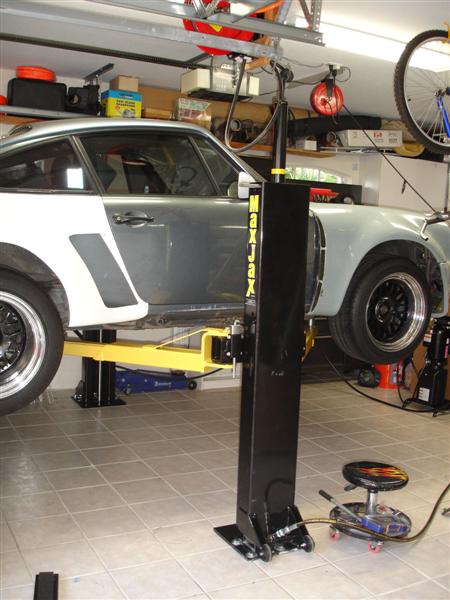
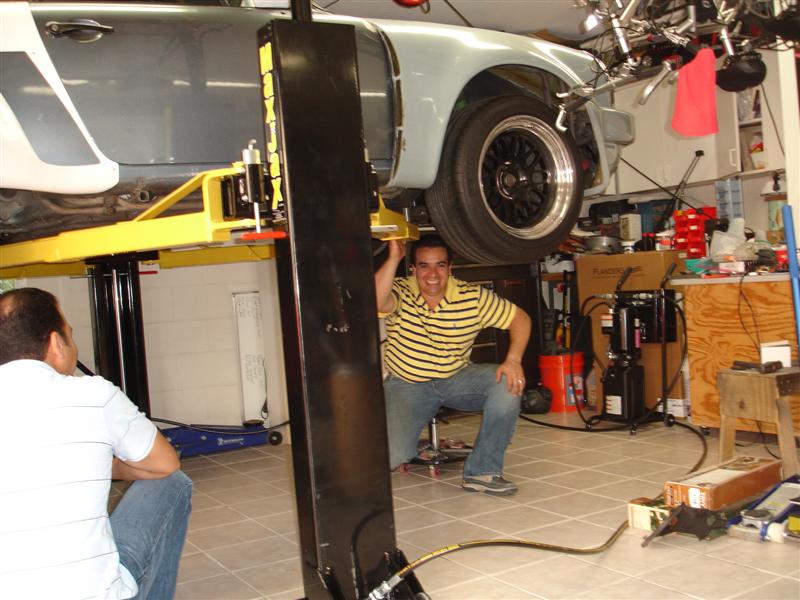
Understood... and can relate. I started with the bike, 996TT, 911 SC, and then my favorite one, the 964...

Just make sure you check the bolts as you raise the car. That first time lift will seat those anchors in place. And for those reading this that have not install their lift... get some concrete epoxy in there before droping the anchor. Just another safety precaution.

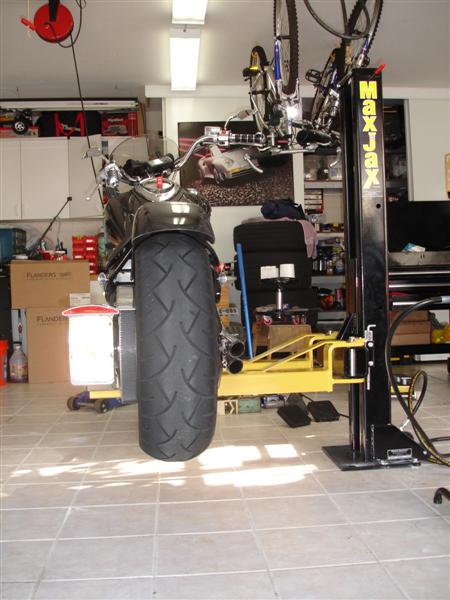
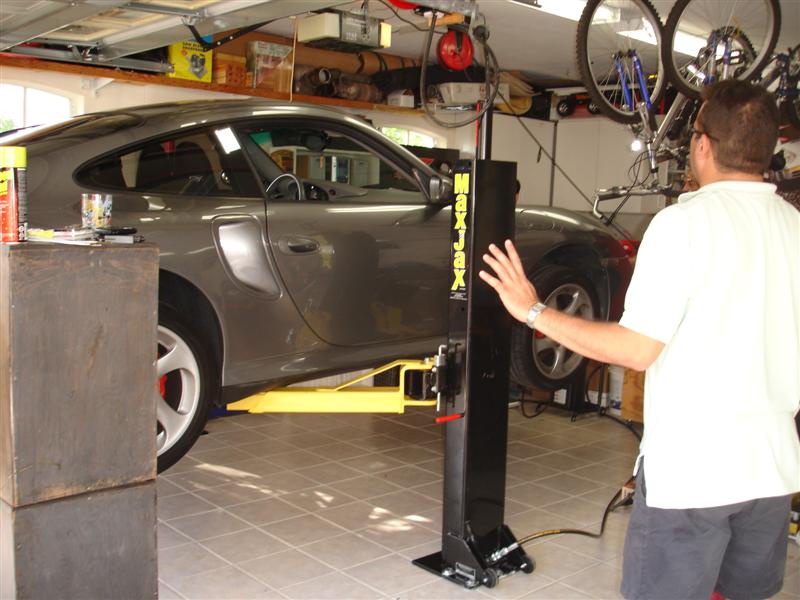
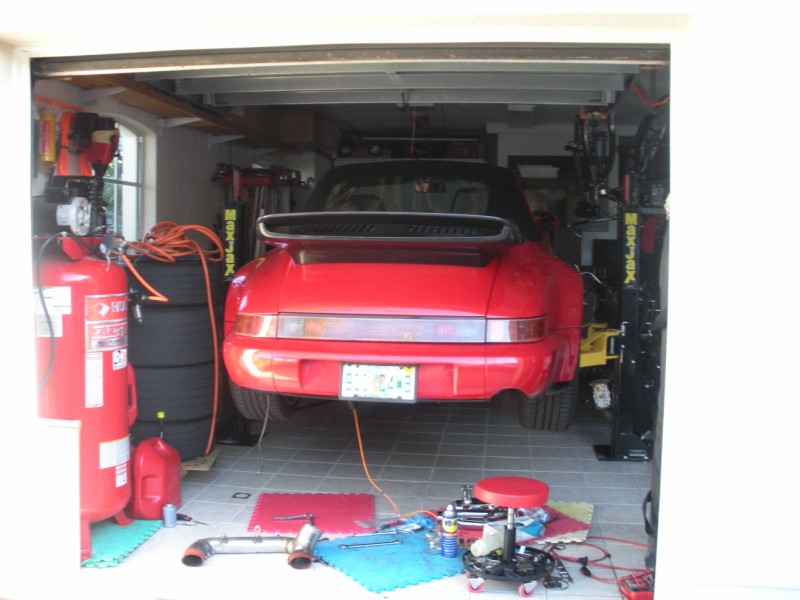
Photos:

dsc05165_medium.jpg


dsc05175_medium.jpg


dsc05179_medium.jpg


038_800x600.jpg
 

427HISS

Well-known member
Joined
Aug 15, 2005
Messages
746
I did buy two tubes of anchor epoxy but, did not use it because if I needed to tighten the bolts even further, there's no way with the epoxy bonded, that it would not be able to move up. On the second post, I'll now use it.

Great Porsche, is it the 911 Carrera ?
Do you race it ?

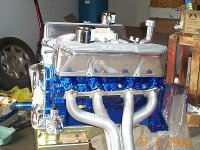
Here's me 427 Cobra.
 

Attachments

  • Rodfest 2007 008a3.jpg
    Rodfest 2007 008a3.jpg
    64.9 KB · Views: 277
  • Cobra at Speedway 05' 010.jpg
    Cobra at Speedway 05' 010.jpg
    96.9 KB · Views: 79
  • eng. painted and ready #13.jpg
    eng. painted and ready #13.jpg
    53.2 KB · Views: 88
  • Custom SS dash insert.jpg
    Custom SS dash insert.jpg
    113.6 KB · Views: 65
  • Interior 1.jpg
    Interior 1.jpg
    59.9 KB · Views: 71

nmk_61802

Well-known member
Joined
Mar 6, 2008
Messages
965
Location
Central IL
Something is wrong with your first picture though, I can see the picture but I'm having trouble making out a Cobra:drool:
 

wachuko

Well-known member
Joined
May 15, 2008
Messages
690
Location
Ocala, FL
I did buy two tubes of anchor epoxy but, did not use it because if I needed to tighten the bolts even further, there's no way with the epoxy bonded, that it would not be able to move up. On the second post, I'll now use it.

Great Porsche, is it the 911 Carrera ?
Do you race it ?

Here's me 427 Cobra.

Very nice!!! :thumbup: Always liked the Cobra. Look at that engine!! :bowdown:

Those are all different variations of the 911 Carrera ('02 Twin Turbo, '83 that I am modifying to look like a '74 RSR 3.0, and a '91 Cab). I have only taken the gray one to the track once for a Drivers Education event at Sebring. It was a blast! After a few sessions learning the ropes I was running as fast as my abilities allowed me to do. It was fun, fun, fun. Looking forward to doing it again when time and money permits.

n661467097_747342_9244.jpg
 

wachuko

Well-known member
Joined
May 15, 2008
Messages
690
Location
Ocala, FL
Seriously... being able to work without anything in the way under the car (like how I had to work when I had the mid-rise lift) is great! I can sit in my roller and do an exhaust swap, work on the brake system, bleed the clutch, drop the engine, swap sway bars, oil changes, etc.

And when you do not have the option to change the house or modify the height to accomodate a taller lift! This solution was something I had been waiting for a long time.

dsc05178_medium.jpg
 

///Mflossin

Active member
Joined
Feb 12, 2008
Messages
29
Wachuko,
Exactly.......FAR EASIER to work under a lift.

As far as the epoxy goes....how or why would you use it if the anchors pull up as part of the embedment process? If you epoxy the anchor...it will either not allow the seating (pull up) or the bond will break. Are you stating to expoxy the anchors in and set the anchor flush with the surface instead?
 
To avoid these ads, REGISTER NOW!
Top Bottom