To avoid these ads, REGISTER NOW!

Preparing for slab pour and sealer application

lyonkster

Well-known member
Joined
Nov 18, 2009
Messages
432
Location
Portland, OR
My builder is planning to have the garage slab poured next week. I plan to apply Densifier and Ghost Shield 8510 after the concrete cures. What (if anything) should I ask for in the finishing process - power vs hand troweling, water application during pour/cure, etc? I just want to avoid any oversight that will make the Ghost Shield application more difficult. Thanks!
 
To avoid these ads, REGISTER NOW!

ConCretin

Well-known member
Joined
Jan 20, 2011
Messages
3,378
Location
Central Maine
I'm sure the experts will chime in but one important point is to avoid chemical curing compounds. They will interfere with future sealer/densifier applications. My guess is that your weather conditions up there are probably conducive to curing but moist cure the slab if you do anything.

I'd keep the mix water low by using a mid range water reducer and I wouldn't want any water applied during finishing. It shouldn't be necessary especially this time of year and it will diminish your slab surface.

I'd definitely want my slab machine troweled. I'd be looking for a dense, smooth surface with no trowel marks or shine. The terminology varies but something akin to a 'smooth or flat troweled' finish and probably not a 'burnished or burnt' finish. A shiny floor is slippery and I suspect your sealer and densifier won't penetrate as well.

Give my Guide to Floor Slabs in the link below a read for some additional thoughts on the process. Congrats on the new garage and good luck with your floor.
 
Last edited:
OP
L

lyonkster

Well-known member
Joined
Nov 18, 2009
Messages
432
Location
Portland, OR
Thanks @ConCretin and @Rusted Nut! @ConCretin, I read your Guide to Floor Slabs a while back, but just went back to refresh myself.

So I think I'll ask for the following:

- #4 bars, 24" o.c. supported at 4';
- 5" slab, 4000 psi concrete with fibermesh;
- 3/4" aggregate;
- mid range water reducer;
- no chemical curing compounds;
- no water added during finishing;
- dense smooth finish, not hard trowel or burnished;
- saw cuts every 12' in one direction (37' width) and 9' in other direction (27' depth)

Do I have this right? Did I miss anything? I have to say that I'm not finding much information on the distinction between "smooth finish" and "hard trowel" finish - can you share a link or some pics?

I'm working through a GC, so I'm thinking that I should have this discussion with him rather than with the concrete sub, right? I always worry about coming across as a "know it all" which I'm sure no professional likes - then again, with concrete, I can't wait to see what he does only to discover that it's not what I wanted, right?
 

ConCretin

Well-known member
Joined
Jan 20, 2011
Messages
3,378
Location
Central Maine
So I think I'll ask for the following:

- #4 bars, 24" o.c. supported at 4';
- 5" slab, 4000 psi concrete with fibermesh;
- 3/4" aggregate;
- mid range water reducer;
- no chemical curing compounds;
- no water added during finishing;
- dense smooth finish, not hard trowel or burnished;
- saw cuts every 12' in one direction (37' width) and 9' in other direction (27' depth)

Do I have this right? Did I miss anything? I have to say that I'm not finding much information on the distinction between "smooth finish" and "hard trowel" finish - can you share a link or some pics?

I'm working through a GC, so I'm thinking that I should have this discussion with him rather than with the concrete sub, right? I always worry about coming across as a "know it all" which I'm sure no professional likes - then again, with concrete, I can't wait to see what he does only to discover that it's not what I wanted, right?
Assuming you have a fixed price contract, the first thing you should do is determine what that includes by talking to your GC. You can't go wrong with that formula if executed properly but frankly, I doubt that's what your GC intended to provide. One area where you could save a few bucks would be the reinforcing. Rebar has its advantages but that comes with a cost. Most slabs will perform just fine with welded wire fabric.
 
OP
L

lyonkster

Well-known member
Joined
Nov 18, 2009
Messages
432
Location
Portland, OR
Assuming you have a fixed price contract, the first thing you should do is determine what that includes by talking to your GC. You can't go wrong with that formula if executed properly but frankly, I doubt that's what your GC intended to provide. One area where you could save a few bucks would be the reinforcing. Rebar has its advantages but that comes with a cost. Most slabs will perform just fine with welded wire fabric.
We have a cost plus contract. The original estimate was 4" slab, #3 rebar. Would 5" slab and #4 rebar be significantly higher (I've asked the contractor but haven't heard back)? Are any of the other items significant cost drivers?
 

Rusted Nut

Well-known member
Joined
Dec 11, 2022
Messages
1,802
Location
PNW
Yes, 5” slab is 25% more concrete.

Personally I wouldn’t use fiber. I don’t think it works that well, and you’ll have to run a sander over it to get rid of the fuzzies. ConCretin has great info on minimizing cracking.
 
Last edited:
OP
L

lyonkster

Well-known member
Joined
Nov 18, 2009
Messages
432
Location
Portland, OR
Yes, 5” slab is 25% more concrete.

Personally I wouldn’t use fiber. I don’t think it works that well, and you’ll have to run a sander over it to get rid of the fuzzies. ConCretin has great info on minimizing cracking.

I think the slab thickness will be hard to change at this point, as the rock is already installed and compacted to a level assuming a 5" slab. I realize there'll be a 25% extra cost.

Thanks for the thought about fiber, I'll skip it!
 

Pompey

Well-known member
Joined
May 25, 2021
Messages
120
Don' forget to put a slope on the area in front of the doors to prevent water running back under the closed doors

I forgot and had to grind mine after the event...it was not fun

 
Last edited:
OP
L

lyonkster

Well-known member
Joined
Nov 18, 2009
Messages
432
Location
Portland, OR
Don' forget to put a slope on the area in front of the doors to prevent water running back under the closed doors

I forgot and had to grind mine after the event...it was not fun

Thanks for the tip @Pompey. I read about your fiasco, that definitely did not look like fun, so I'd rather avoid the same situation.

Was your slab completely flat? My slab is supposed to have 1/8"-1/4" slope per 12", so hopefully that will avoid the water intrusion issue? But I will mention the concern to the builder before they pour concrete next week, I definitely don't want to be grinding brand new concrete!
 

Garage Flooring

ALLIANCE MEMBER
Joined
May 21, 2011
Messages
5,288
Location
Grand Junction, CO
I will let the concrete experts deal with the concrete itself.

8510 can be installed over power-troweled or hand troweled concrete so long as no sealer or curing agent with sealer is used.

The methods do vary slightly.

Etch & Seal Polyurea is also a great option
 

Pompey

Well-known member
Joined
May 25, 2021
Messages
120
Yes my pad was completely flat which I prefer. It looks like I have finally cured my door leaks. Since most of the front side of the building is actually door openings with small door pillars (60 foot long wall with four 12 foot doors), I am glad that the area under the front walls are flat and the door openings are sloped now. So if you put a slope on the door opening make sure the other areas where the walls will sit are flat unless you want to shim the wall plate or cut the wall joist ends at an angle.

Last week I had to regrind a few door areas to fix some very minor water leaks but this time I did not have to do a lot of grinding and I did it wet to keep the dust down. I watched a YouTube video about floor sealing and the author mentioned getting water under his doors and yes he had made the same mistake as I did with a flat porch.

I now have to deal with all the tree pollen and grinding dust remnants and then start on sealing the floors with 4500 and 8510.

Good luck with your pour.

PS I went with a 6 inch thick floor which is the minimum quoted for a two post lift.
 
OP
L

lyonkster

Well-known member
Joined
Nov 18, 2009
Messages
432
Location
Portland, OR
Yes my pad was completely flat which I prefer. It looks like I have finally cured my door leaks. Since most of the front side of the building is actually door openings with small door pillars (60 foot long wall with four 12 foot doors), I am glad that the area under the front walls are flat and the door openings are sloped now. So if you put a slope on the door opening make sure the other areas where the walls will sit are flat unless you want to shim the wall plate or cut the wall joist ends at an angle.
...

Good luck with your pour.

PS I went with a 6 inch thick floor which is the minimum quoted for a two post lift.
Thanks, I'm crossing my fingers the pour will go well. I'm sure they know what they are doing, but I do want to confirm that they put the saw cuts where I want them (or tell me why that won't work and provide an alternative approach).

Since my slab is supposed to be slightly sloped, hopefully I won't have the same issue you had in front of the garage door, but I'll see if they can slope the 8" portion outside the garage door a little more than the rest of the slab.

In our case, the slab is being poured separately from the stem walls (which have already been poured and walls installed on top), so the slab slope will not affect the wall placement (but that's a good thing to keep in mind for anyone planning to build the walls directly on a sloped slab).

I'm going with a 5" slab - probably overkill since I'm planning on a four post lift, but whatever :).
 
OP
L

lyonkster

Well-known member
Joined
Nov 18, 2009
Messages
432
Location
Portland, OR
8510 can be installed over power-troweled or hand troweled concrete so long as no sealer or curing agent with sealer is used.

The methods do vary slightly.

Etch & Seal Polyurea is also a great option
Thanks @Garage Flooring , I'm glad you mentioned the polyurea. Since starting this thread, I've talked myself out of 8510, I think I'll be too worried about stains from oil and other fluids. So I'm now leaning towards coatings, looking at TS210 and single component polyurea. My primary considerations are stain resistance, next is application difficulty and slip resistance, and cost is less important (not that I'm not budget minded, but I'm in the "buy once cry once" mindset these days). What would be your recommendation?
 
To avoid these ads, REGISTER NOW!

dcg9381

Well-known member
Joined
Jun 20, 2018
Messages
11,627
Location
Austin, TX
Thanks @Garage Flooring , I'm glad you mentioned the polyurea. Since starting this thread, I've talked myself out of 8510, I think I'll be too worried about stains from oil and other fluids. So I'm now leaning towards coatings, looking at TS210 and single component polyurea. My primary considerations are stain resistance, next is application difficulty and slip resistance, and cost is less important (not that I'm not budget minded, but I'm in the "buy once cry once" mindset these days). What would be your recommendation?
Polyurea is my go to, I've done 4 floors with it. It may require additional prep though (ask vendors). It's excellent at resisting most fluids short of something like acetone/keytone... You can make it look like anything you want via a combination of solid colors and/or a base stain of the concrete when using a transparent application. The lower floor of my home is actually finished in polyurea. Easier to apply than epoxy (IMHO). Less expensive too.

It is slippery as **** when wet. You address this by adding an anti-slip agent on the final coat.
 

Garage Flooring

ALLIANCE MEMBER
Joined
May 21, 2011
Messages
5,288
Location
Grand Junction, CO
Polyurea is my go to, I've done 4 floors with it. It may require additional prep though (ask vendors). It's excellent at resisting most fluids short of something like acetone/keytone... You can make it look like anything you want via a combination of solid colors and/or a base stain of the concrete when using a transparent application. The lower floor of my home is actually finished in polyurea. Easier to apply than epoxy (IMHO). Less expensive too.

It is slippery as **** when wet. You address this by adding an anti-slip agent on the final coat.
It can definitely me slick! All
Of our kits include anti skid
 

Pompey

Well-known member
Joined
May 25, 2021
Messages
120
Since my slab is supposed to be slightly sloped, hopefully I won't have the same issue you had in front of the garage door, but I'll see if they can slope the 8" portion outside the garage door a little more than the rest of the slab.

My porch was about 7 3/4 inches deep I think and I dropped (ground down) the front by about 1/2 inch. It seems to have stopped pretty much all of the leaks now.
 
OP
L

lyonkster

Well-known member
Joined
Nov 18, 2009
Messages
432
Location
Portland, OR
Thanks @Garage Flooring and @dcg9381 ! I think polyurea is looking like a good option for me (I value stain resistance most).

For tomorrow's pour/finishing, would polyurea require anything different than if I went with Ghost Shield like I planned originally? I think they plan to power trowel (like I asked them to), would that be OK with a polyurea (I'll make sure to ask that they don't burnish it)?
 

Garage Flooring

ALLIANCE MEMBER
Joined
May 21, 2011
Messages
5,288
Location
Grand Junction, CO
Thanks @Garage Flooring and @dcg9381 ! I think polyurea is looking like a good option for me (I value stain resistance most).

For tomorrow's pour/finishing, would polyurea require anything different than if I went with Ghost Shield like I planned originally? I think they plan to power trowel (like I asked them to), would that be OK with a polyurea (I'll make sure to ask that they don't burnish it)?
Power trowel is fine. Just make sure no sealer is added. You may need a little more etching than what’s in the kit for a power troweled floor
 
OP
L

lyonkster

Well-known member
Joined
Nov 18, 2009
Messages
432
Location
Portland, OR
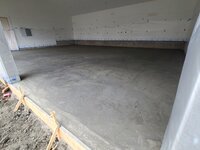
The slab is all done - light power trowel followed by hand troweling. Then the saw cuts were made the next day.

I have a question about the saw cuts - the edges of the cuts are fairly sharp (understandably) - would there be a benefit to trying to break the sharp cut edges somehow, to avoid future spalling? Or am I overthinking it?
 

theoldwizard1

Well-known member
Joined
Feb 22, 2011
Messages
43,106
Location
SE MI
IMHO ... every garage/shop floor should have the following ...
  • Vapor barrier between the concrete and the dirt. This will keep moisture out in the future.
  • Curbing (except in front of garage door). It won't 100% eliminate water ingress, but it will slow it down. This is required in some jurisdictions.
Something I would discuss with the concrete guys is "drainage". No slab is ever perfectly level. You would probably prefer to have it "drain" toward the main door.
 
OP
L

lyonkster

Well-known member
Joined
Nov 18, 2009
Messages
432
Location
Portland, OR
IMHO ... every garage/shop floor should have the following ...
  • Vapor barrier between the concrete and the dirt. This will keep moisture out in the future.
  • Curbing (except in front of garage door). It won't 100% eliminate water ingress, but it will slow it down. This is required in some jurisdictions.
Something I would discuss with the concrete guys is "drainage". No slab is ever perfectly level. You would probably prefer to have it "drain" toward the main door.

Thanks, I think we have these covered - 10 mil vapor barrier under slab, 1/8:12 slope towards the front. What is "curbing"?
 

Pompey

Well-known member
Joined
May 25, 2021
Messages
120
Looks good and I see that he sloped the door openings as well. You should be good there.
 

Pompey

Well-known member
Joined
May 25, 2021
Messages
120
Here's the finished job on my door openings...well I hope it's finished
 

Attachments

  • DSCN5887.JPG
    DSCN5887.JPG
    633.9 KB · Views: 8
  • DSCN5890.JPG
    DSCN5890.JPG
    680.9 KB · Views: 8

ConCretin

Well-known member
Joined
Jan 20, 2011
Messages
3,378
Location
Central Maine
I have a question about the saw cuts - the edges of the cuts are fairly sharp (understandably) - would there be a benefit to trying to break the sharp cut edges somehow, to avoid future spalling? Or am I overthinking it?
It's generally not a problem. The saw kerf is pretty narrow and not likely to spall from cross traffic. Plus it would be fairly difficult to ease the edges of the cut.
 
To avoid these ads, REGISTER NOW!
Top Bottom