To avoid these ads, REGISTER NOW!

Prepping garage doors for paint

stickshift

Well-known member
Joined
Nov 16, 2011
Messages
1,236
Location
northeastern US
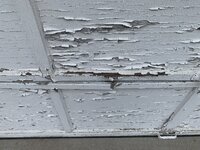
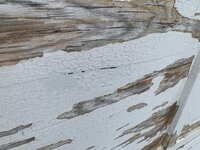
I'm going to paint these wood garage doors with an airless sprayer. I had some questions about prep, but first, some pics of what I'm dealing with.
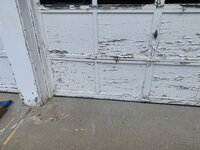
2024-09-28 10.54.05.jpg
2024-09-28 10.46.33.jpg
2024-09-28 10.46.19.jpg
2024-09-28 10.54.19.jpg

I'm thinking first step is remove all the gasketing. This includes the bottom rubber, as well as the trim holding the side and top gaskets. And then replace all the gasketing after painting.
2024-09-28 10.48.43.jpg

Then use wire brush to remove the loose paint. I can get a steel wire brush sawzall attachment to speed this up. Then use my RO sander to flatten out raised edges of paint. Could try to sand the raised ridges, but these have a profile and aren't flat, so maybe a quick hand sand (emphasis on quick because if I spend a lot of time on each, it will take forever) instead of using something powered like a die grinder. Fill in the rotted/missing pieces of wood with an exterior grade wood filler (maybe DAP Plastic Wood-X or Bondo wood filler?), then sand those flat. Wipe down doors with wet sponge to remove dust. Mask off windows and around doors. Spray.

Is this a good process? Any modifications/suggestions to get a better result, or to make it more efficient? Not looking for perfection (obviously, given the current state of these doors).

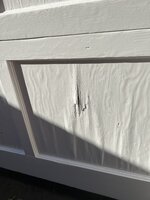
One troublesome spot - the wood here has broken apart.
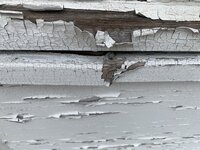
2024-09-28 10.47.57.jpg
2024-09-28 10.52.07.jpg
2024-09-28 10.48.07.jpg

Not sure how to deal with this. Maybe just use wood filler and call it good? Seems like it could get quite involved to really fix this, but I have no idea.
 
Last edited:
To avoid these ads, REGISTER NOW!

captain14

Well-known member
Joined
Dec 19, 2012
Messages
7,057
Location
Near College Park Maryland 20740
Here’s some pic of my single garage door I stripped down 5 years ago. I kept track of the time when I was doing it but don’t remember exactly- somewhere between 30-40 hours. I only worked for 2-3 hours at a time when it was in the shade.

Heat gun, putty knife, painters 5-one tool, Electric pad sander. I had to make a couple of patches out of an 1 inch oak dowel.

Can you get wood behind the broken piece to support it and fasten behind it? Simpson Ties Mending plates?

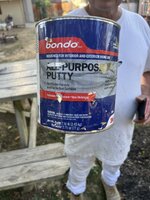
I have a couple of soft spots or bubbles in a couple of panels too. When I can get my neighbor to give me some info about patching it, I’ll post it. He did show me this product. He said that’s what he uses on jobs.
 

Attachments

  • IMG_0619.jpeg
    IMG_0619.jpeg
    603.9 KB · Views: 17
  • IMG_0614.jpeg
    IMG_0614.jpeg
    1.1 MB · Views: 17
  • IMG_0613.jpeg
    IMG_0613.jpeg
    1.1 MB · Views: 16
  • IMG_0609.jpeg
    IMG_0609.jpeg
    1.1 MB · Views: 16
  • IMG_0612.jpeg
    IMG_0612.jpeg
    946.3 KB · Views: 16
  • IMG_0610.jpeg
    IMG_0610.jpeg
    1 MB · Views: 15
  • IMG_1759.jpeg
    IMG_1759.jpeg
    614.4 KB · Views: 16
  • IMG_1750.jpeg
    IMG_1750.jpeg
    1,002.2 KB · Views: 18
  • IMG_1770.jpeg
    IMG_1770.jpeg
    613.1 KB · Views: 17
OP
S

stickshift

Well-known member
Joined
Nov 16, 2011
Messages
1,236
Location
northeastern US
What did you use the heat gun for?

Good idea - maybe I can use oscillating multitool to cut a little bit off the broken piece, then screw it down - the other side of the door panel has similar wood trimming, so drill a thru hole on the front side and screw that piece that's sticking out into the wood on the back side. Then fill in the gap with Bondo wood filler.
2024-09-28 14.01.18.jpg
 

The Cobbler

Super Moderator
Staff member
Joined
Oct 24, 2013
Messages
25,933
Location
Niagara Region, Ontario, Canada
That looks like tons of work to strip back to a smooth flat surface . I think you might have better luck with a chemical stripper to get back to all wood. anything else will be futile .
Auto Body filler( Bondo) works well for patching wood, you also need some wood replaced by the looks of it.
I also would question spraying it, a good brush & technique will do a nice job on wood .
The obvious unstated ... maybe time to think about replacing the doors?
good luck with your project, keep us posted .
 

captain14

Well-known member
Joined
Dec 19, 2012
Messages
7,057
Location
Near College Park Maryland 20740
Stickshit

I used the heat gun and heated up the width of the scraper and muck kept working straight up each panel. You have to be prepared because there is most likely lead paint underneath. I would fill up a grocery store plastic bag and it was 5-8 pounds each to toss in The trashcan.

Same with rails and styles. Work In Sections . If you can find a small triangle scaper to get into each corner it may help. Take your time, 3-4 hours max.

HF and HD have some similar but cheaper with interchangeable heads
 

Attachments

  • IMG_1797.jpeg
    IMG_1797.jpeg
    418.5 KB · Views: 15

toolmiser

Well-known member
Joined
Sep 1, 2009
Messages
1,657
Location
La Crosse, WI
Maybe someone already mentioned it (I didn't see it) but there is a chance that has lead paint on it, if that is a concern for you.
 
OP
S

stickshift

Well-known member
Joined
Nov 16, 2011
Messages
1,236
Location
northeastern US
Maybe someone already mentioned it (I didn't see it) but there is a chance that has lead paint on it, if that is a concern for you.
Not a concern. I'd be wearing a respirator, and paint chips collected, and any sanding would be done with attached shop vac with HEPA filter, regardless.
 
Last edited:

38 Dodge Coupe

ALLIANCE MEMBER
Joined
Mar 19, 2013
Messages
419
Location
Delaware Ohio
I agree with captain 14 that a heat gun to remove the old paint is a good recommendation. I have done it many times and while it is a slow process, it will leave you with a surface that can then be sanded, repaired and primed.
 
OP
S

stickshift

Well-known member
Joined
Nov 16, 2011
Messages
1,236
Location
northeastern US
I agree with captain 14 that a heat gun to remove the old paint is a good recommendation. I have done it many times and while it is a slow process, it will leave you with a surface that can then be sanded, repaired and primed.
What do you guys think about pressure washing? Someone (offline) suggested that, and I do have access to a pressure washer. My guess is that pressure washing won't take nearly as much of the loose paint off as scraping and wirebrushing will, and will only add a delay as I wait for the doors to dry. Plus, pressure washer will probably spray through the seams of the wood door panels and past the side gaskets.
 

captain14

Well-known member
Joined
Dec 19, 2012
Messages
7,057
Location
Near College Park Maryland 20740
First I tried my little Karcher electric pressure washer, just seemed to get everything wet, it did clean up my sheds when I prepped them for stain.

I watched a pro painter use his pressure washer during his prep work on a house down the street. I’m sure it was a much bigger machine but I don’t remember how big it was.
 

Fav Onefour

Well-known member
Joined
Jul 14, 2022
Messages
709
Location
MN cold and hot
Pressure washer method varies on paint you are trying to remove and the wood under the paint.
In this case, the pressure washer wouldn't be a good solution. Multiple layers of oil paint are like a hard shell. The pressure washer will need to cut wood before it peels that paint in the well covered sections.

The exposed bare wood areas are already soft compared to the covered sections. Pressure washer will cut soft wood faster. The end result would be a contrasting rough wood surface.

Not sure how long you want to keep the doors? If you are going long term, the bare wood really should be prepped and primed before final coat. If you don't mind taking some time, scraping and priming can be done in sections. When you are done with that step, it's not too bad masking and spraying the whole works in one shot.
 

bwringer

Well-known member
Joined
Jan 1, 2013
Messages
10,313
Location
Indianapolis
Um... hate to bring this up, but have you priced new doors? Might be worth skipping some the hours and hours of misery in front of you.


If you're determined to save these doors, and you have more time than money, then you have to figure out what level of "OK" you're aiming for. You could literally spend six months and hundreds of hours on these if you jump down that rabbit hole. But it's a garage door, not a historic sailing ship...

As stated above, scraping with a high quality heat gun (and of course you'll need access to power and a good extension cord) should get you a surprisingly long way without much expense or chemical exposure, or chemicals soaked into the wood you'll need to deal with later. Also, the first few square feet will give you a good idea of the amount of labor involved.

You're not going to get perfection here. Personally, I would not aim for stripping every picogram of old paint, just get to something that seems like a stable substrate. For example, I probably wouldn't bother with sanding much. Primer hides many, many sins, and besides, how many people inspect garage doors that closely?

The remaining wood, especially where it's exposed, is very soft, so a wire brush is not the right move here.

You'll also need to structurally stabilize some things, of course. You might end up finding it easier to replace some of the trim boards than salvage them intact, and door panels near the bottom are usually heavily water damaged and may need to be replaced.

You'll also face the decision as to whether the windows need to be stabilized. If they're a little loose, then you'll need to remove the trim, re-putty, etc.

And the inside will need to be repaired and painted as well.
 

Stelzer

Well-known member
Joined
Mar 14, 2022
Messages
448
Location
Portland, OR
It's interesting that as a professional painter here in Oregon, I can get fined $37,000 per occurrence for not completely containing lead, (which that garage almost certainly has), while the homeowner next door can blast lead-ridden chips all over creation without incident. Whether you have a respirator or not, do the responsible thing and contain the chips. It isn't just about your immediate safety.

Carbide scraper, 5-n-1 and lots of sanding. Airless may be the most efficient way to apply the paint but will do nothing to hide all the cracks which will remain, so you'll want to either back brush, back roll or both. You'll see after the paint is removed that the panels are delaminating, but back-rolling several times will help fill the voids. The alligatoring is indicative of old oil paint under the latex, since old oils never stop hardening, they continue to oxidize & crack, which means you'll want to ensure all of that is removed. I'd stay away from rigid wood fillers as much as possible, since most end up getting brittle and cracking out. Some painters like to float MH Ready Patch on wood projects like these or even Elmers. Bondo of any kind likely wouldn't hold up for long on a surface like yours. OSI Quad Max for the cracks. Give it at least 12hrs to dry before priming.

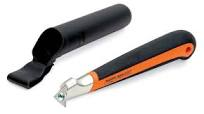
Best scrapers on the planet are the little Bahco triangle ones. They're scary sharp, can be rotated 3 times before need replacing, and actually capable of feathering the paint rather than just scraping off loose stuff. I've hand-scraped old oak floors with these on high spots before sanding them down. Don't let the small size fool you either. They're extremely efficient. They make

https://www.amazon.com/Bahco-Premium-Ergonomic-Carbide-Scraper/dp/B000288LOW?tag=atomicindus08-20

1727625681077.png
 

Stelzer

Well-known member
Joined
Mar 14, 2022
Messages
448
Location
Portland, OR
It's interesting that as a professional painter here in Oregon, I can get fined $37,000 per occurrence for not completely containing lead, (which that garage almost certainly has), while the homeowner next door can blast lead-ridden chips all over creation without incident. Whether you have a respirator or not, do the responsible thing and contain the chips. It isn't just about your immediate safety.

Carbide scraper, 5-n-1 and lots of sanding. Airless may be the most efficient way to apply the paint but will do nothing to hide all the cracks which will remain, so you'll want to either back brush, back roll or both. You'll see after the paint is removed that the panels are delaminating, but back-rolling several times will help fill the voids. The alligatoring is indicative of old oil paint under the latex, since old oils never stop hardening, they continue to oxidize & crack, which means you'll want to ensure all of that is removed. I'd stay away from rigid wood fillers as much as possible, since most end up getting brittle and cracking out. Some painters like to float MH Ready Patch on wood projects like these or even Elmers. Bondo of any kind likely wouldn't hold up for long on a surface like yours. OSI Quad Max for the cracks. Give it at least 12hrs to dry before priming.

Best scrapers on the planet are the little Bahco triangle ones. They're scary sharp, can be rotated 3 times before need replacing, and actually capable of feathering the paint rather than just scraping off loose stuff. I've hand-scraped old oak floors with these on high spots before sanding them down. Don't let the small size fool you either. They're extremely efficient. They make

https://www.amazon.com/Bahco-Premium-Ergonomic-Carbide-Scraper/dp/B000288LOW?tag=atomicindus08-20

1727625681077.png
They make a 2" & 2.5" straight blade scraper too, but there's nothing great about either of those. The triangle scrapers are what you want.
 
To avoid these ads, REGISTER NOW!
OP
S

stickshift

Well-known member
Joined
Nov 16, 2011
Messages
1,236
Location
northeastern US
I scraped one door with 5-in-1 tool and carbide scraper (just what I had, not the one Stelzer just recommended in post above).
Before and after on one section:
2024-09-28 10.54.19.jpg
2024-09-29 13.24.29.jpg

To @Fav Onefour's point, this paint is pretty hard and it's certainly harder than the bare wood. So I think pressure washing will create more problems than it solves.

Couple of other sections (upper panel has way more intact paint):
2024-09-29 13.24.53.jpg
2024-09-29 13.24.38.jpg

I have not used a heat gun yet, so I'll probably do another pass with heat gun and 5-in-1 tool to try and get under the thicker edges of paint. But there's no way I'm going to get all this paint off.

Where the paint is most difficult to remove is the non-flat areas, the angled raised areas of the 'picture frame' around every box - those edges has a non-flat profile, so I can't really scrape without gouging the wood. Any suggestions for those?

In terms of expectations, I realize that after painting, it will be obvious to anyone who looks closely that in some areas, existing paint was painted over. But to @bwringer's point, it's a garage door. If it looks good from the curb, that's good enough. I'm hoping that with a reasonable (i.e., not ridiculous) amount of prep, and a good primer (perhaps SW PrimeRx Peel Bonding Primer (https://www.sherwin-williams.com/homeowners/products/primerx-peel-bonding-primer)), and a couple of coats of paint, the paint job will last for 4-5 years, at which point I can pressure wash, lightly sand and paint (as opposed to scraping again). Is that an unrealistic expectation?

As mentioned, even after heat gun and scraper, I expect there will be quite a bit of old paint remaining. And it does have those alligator cracks. I'm hoping the primer can fill that in, but even if it doesn't, so long as it doesn't crack through the topcoat within a few years, I'd be satisfied. Per the PDS for SW PrimeRx Peel Bonding Primer:

PrimeRx Peel Bonding Primer is a high build, interior/exterior, waterborne, coating designed to improve the adhesion of topcoats to various surfaces.
Dependable Bonding — Formulated to bond tightly, making it ideal for application to marginally prepared, alligatored or peeling siding and trim.
Smoother Finish — Compared to applying a traditional primer over less-than-perfect surfaces, PrimeRx Peel Bonding Primer’s filling characteristics result in a more even finish after topcoating.
Saves Time — Less sanding and scraping of old paint. PrimeRx Peel Bonding Primer lets contractors finish the job in much less time without sacrificing good adhesion and appearance.

2024-09-29 13.25.05.jpg
2024-09-29 13.25.17.jpg
 

Stelzer

Well-known member
Joined
Mar 14, 2022
Messages
448
Location
Portland, OR
Prime RX is clear, just fyi. Also doesn't stop tannin, which could be an issue if you plan on painting it anything other than a darker color, so you may have to use some sort of sealing primer in addition to that if you painted that garage door a light color. Prime RX is decent stuff, but between that, a sealing primer & 2 topcoats, you'll be adding a lot of weight to an already compromised coating, which means it could actually pull off sooner because of it. I'd try to at least sand everything to a feathered edge til you can't chip anymore paint off with your nail. If all else fails and you can't achieve a feathered edge, float the abrupt edges with OSI Quadmax before you prime and it'll hold it down for years to come.
 
OP
S

stickshift

Well-known member
Joined
Nov 16, 2011
Messages
1,236
Location
northeastern US
My HF heat gun gave out before I did. Got one panel done, and heat gun is basically a bulky handwarmer at this point. Heat gun recommendations? Maybe the Wagner Furno 500? This job would be the extreme use case for me. My HF heat gun lasted ~10 years because most of my usage is short duration.

Noticed areas where the paint is thicker bubbled up from the heat more quickly. So while there are still some areas with a lot of paint coverage, it's much 'flatter', and will probably feather out much easier.
2024-09-29 16.32.38.jpg

Edit: Got the Wagner Furno 500. Easier to scrape long strips with this than with the cheap HF gun.
 
Last edited:
OP
S

stickshift

Well-known member
Joined
Nov 16, 2011
Messages
1,236
Location
northeastern US
Prime RX is clear, just fyi. Also doesn't stop tannin, which could be an issue if you plan on painting it anything other than a darker color, so you may have to use some sort of sealing primer in addition to that if you painted that garage door a light color. Prime RX is decent stuff, but between that, a sealing primer & 2 topcoats, you'll be adding a lot of weight to an already compromised coating, which means it could actually pull off sooner because of it. I'd try to at least sand everything to a feathered edge til you can't chip anymore paint off with your nail. If all else fails and you can't achieve a feathered edge, float the abrupt edges with OSI Quadmax before you prime and it'll hold it down for years to come.
Thanks for the info.

Now that I've got the heat gun going, I think I'll be able to scrape down to the point where it won't be possible to chip off paint using my nails. Should make for much less sanding to feather out what remains.
 
OP
S

stickshift

Well-known member
Joined
Nov 16, 2011
Messages
1,236
Location
northeastern US
That’s what I found using my heat gun. It would just peel off after heating and using the 5in one tool.
Yeah, the heat is a game changer. I went from thinking I got in way over my head (without the heat), to thinking I can probably git'er done (with the heat).

What's a quick method to get the scraper clean? I'm using another scraper to clean off the scraper, but hard to get it all off, so I just scrape off what I can in 5-10 seconds, then get back to scraping the door. I suppose I could use the heat gun to get it very hot, then clean, but that's inconvenient to do every time it builds up on the scraper.
 
Last edited:
OP
S

stickshift

Well-known member
Joined
Nov 16, 2011
Messages
1,236
Location
northeastern US
HF stocks this scraper with multiple heads. Maybe one of these profiles will help with the moulded areas.
I actually picked this up last night, but haven't opened it up yet. Now that I'm using heat, I can see one major problem - the plastic touches the blades, so this probably won't work well with heat. Hyde makes a heat safe version with a metal shaft.
 

Hank11

Well-known member
Joined
Aug 19, 2019
Messages
1,154
Location
Tennessee
If you have time, order the large size Bahcos. They were just as good as the small one and the one with the extra handle knob upfront lets you use two hands.

Any good exterior oil based primer is going to be your friend. You might thin it a little bit to help it penetrate. Don’t use Bondo get some marine epoxy. It’ll be much much better and actually make this structural repair possible.

Those doors are really rough. They don’t have that much life left in them so don’t kill yourself working on them.
 
Last edited:

captain14

Well-known member
Joined
Dec 19, 2012
Messages
7,057
Location
Near College Park Maryland 20740
Keep a spray bottle with water nearby. I did notice some charring and smoking at the beginning while using the heat gun. Keep on eye on it after you finish each time. Hate to see you have a fire after working on it.


I usually worked with a couple of scrapers. Never noticed the paint sticking to the tools while working.
 

captain14

Well-known member
Joined
Dec 19, 2012
Messages
7,057
Location
Near College Park Maryland 20740
Any good exterior oil based primer is going to be your friend. You might thin it a little bit to help it penetrate. Don’t use Bondo get some marine epoxy. It’ll be much much better and actually make this structural repair possible.


Hank11,

Can you name your choice of a marine to epoxy? I have a couple of areas of the bottoms panels that need some attention.
 

Hank11

Well-known member
Joined
Aug 19, 2019
Messages
1,154
Location
Tennessee
West System is my go to. Been using it for 30 40 years. Search the web for Epoxy Works. It’ll be on the West System website. They have articles going back decades and many of them are home repairs very much like what you’re doing. They have the best support and instructions on how to use their products of any company I can think of.
 

Stelzer

Well-known member
Joined
Mar 14, 2022
Messages
448
Location
Portland, OR
If you have time, order the large size Bahcos. They were just as good as the small one and the one with the extra handle knob upfront lets you use two hands.

Any good exterior oil based primer is going to be your friend. You might thin it a little bit to help it penetrate. Don’t use Bondo get some marine epoxy. It’ll be much much better and actually make this structural repair possible.

Those doors are really rough. They don’t have that much life left in them so don’t kill yourself working on them.
The big Bahcos aren't any better than the Hydes, Huskys, Purdys, Warners, etc. We've got at least 200 scrapers and have used them on thousands of homes. Not hundreds, thousands.
 
To avoid these ads, REGISTER NOW!
Top Bottom