To avoid these ads, REGISTER NOW!

Press brake build

f150skidoo

Well-known member
Joined
Dec 29, 2012
Messages
1,206
Location
Ontario, Canada
I have been wanting to improve my bending capability's in the shop for awhile. My 32" brake in my shop press and 4 foot box and pan brake ain't cutting it anymore, always need wider then the shop press and thicker then the box and pan brake. I've been looking at the classified's and auctions for over a year and haven't found one that fits my needs.

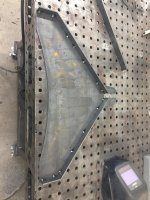
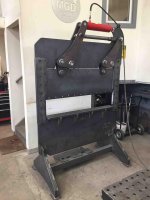
So I decided to just build one. My brake is going to based off of the DXF files from BESRK's build on Pirate4x4 but I significantly changed them to add more strength and to be more compact of a machine. After I figured out the basic design I constructed a 3D rendering then ran stress simulations to make sure the frame was up to the task. This style of brake uses mechanical advantage, so with the 3.81:1 ratio a 3.5" bore cylinder @3000psi will create 110,049 lbs of force. But I'm going to reduce the pumps psi to drop the machines tonnage to 44-45 tons. I outsourced the cutting of the 1" plate frame which was ready for pickup today and I also picked up a 3hp power unit.
 

Attachments

  • Main frame design 3 v30.jpg
    Main frame design 3 v30.jpg
    39.5 KB · Views: 786
  • IMG_0921.jpg
    IMG_0921.jpg
    98.1 KB · Views: 752
  • IMG_0922.jpg
    IMG_0922.jpg
    132.3 KB · Views: 641
To avoid these ads, REGISTER NOW!

bigguns69

Well-known member
Joined
Aug 23, 2011
Messages
411
Location
Iowa
Another nice project that I will probably have to copy. What are the spec's on the hydraulic pump you are planning on using?
 

MoonRise

Well-known member
Joined
Nov 5, 2010
Messages
4,028
Location
NJ
Interesting.

Too late now, but some of your holes (shaft/pin locations) seem a bit too close to the edge/wall. Usually want the wall thickness around a pin/shaft to be at least 1D.

50 tons of force is not a trivial amount. :lol_hitti And over-center linkages can REALLY increase the forces as they pivot.
I'd usually go for some bushings for the shafts/pins. Probably an oilite type, since you will be in the low-speed range of things. But run a check on the bearing pressures to see if porous bronze can even handle the expected loads plus a safety factor. Might have to go to a hardened steel bushing if bronze types can't handle the raw forces.

What do you think of the certiflat table?
 

jbfab

Well-known member
Joined
Jun 17, 2014
Messages
65
Interesting.

Too late now, but some of your holes (shaft/pin locations) seem a bit too close to the edge/wall. Usually want the wall thickness around a pin/shaft to be at least 1D.

Looks like the force will be applied in a direction opposite the edge, shouldn't be a problem.
 
OP
F

f150skidoo

Well-known member
Joined
Dec 29, 2012
Messages
1,206
Location
Ontario, Canada
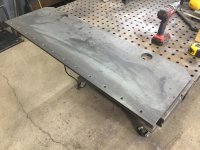
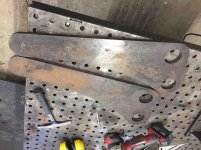
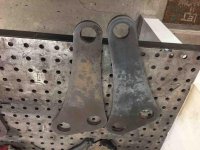
I had some time today to burn out the long and short levers out of 5/8” plate on my plasma table.
IMG_0924.jpg
IMG_0925.jpg
IMG_0926.jpg


Sent from my iPhone using Tapatalk
 
Last edited:
OP
F

f150skidoo

Well-known member
Joined
Dec 29, 2012
Messages
1,206
Location
Ontario, Canada
While the plate was still sitting in the flat position I mag drilled all the 5/8" bolt holes for the punch guides and the mounting points for the back gauge. I also welded in the 2.5" x .500" wall DOM pivot tubes. Next step was to make the legs. I cut them out of 3/16" material and stiffened them up by welding a flat bar between them. The 2 legs are connected by 3"x4" .188" tube that also has the power unit mount.
 

Attachments

  • IMG_0931.jpg
    IMG_0931.jpg
    77.2 KB · Views: 438
  • IMG_0930.jpg
    IMG_0930.jpg
    141.5 KB · Views: 334
  • IMG_0929.jpg
    IMG_0929.jpg
    140.7 KB · Views: 336
  • IMG_0928.jpg
    IMG_0928.jpg
    105.6 KB · Views: 336
  • IMG_0927.jpg
    IMG_0927.jpg
    151.5 KB · Views: 338
OP
F

f150skidoo

Well-known member
Joined
Dec 29, 2012
Messages
1,206
Location
Ontario, Canada
Interesting.

Too late now, but some of your holes (shaft/pin locations) seem a bit too close to the edge/wall. Usually want the wall thickness around a pin/shaft to be at least 1D.

50 tons of force is not a trivial amount. :lol_hitti And over-center linkages can REALLY increase the forces as they pivot.
I'd usually go for some bushings for the shafts/pins. Probably an oilite type, since you will be in the low-speed range of things. But run a check on the bearing pressures to see if porous bronze can even handle the expected loads plus a safety factor. Might have to go to a hardened steel bushing if bronze types can't handle the raw forces.

What do you think of the certiflat table?

I was originally also concerned about the meat around the pins but the stress simulation showed that it wasn't a issue since the force is pushing up. the most stressed part of the whole brake is the top of the arched notches. I love my certiflat table knock offs The table in the picture with power unit is 2'x4' that I cut out on my plasma table, I have a larger 4x6 table that was laser cut by a local fab shop. I like that I can clamp anywhere both horizontally and vertically and I can still use the 11R vise grip clamps around the edge. I did a few jobs this year when having a fixture table was a huge time saver.

Another nice project that I will probably have to copy. What are the spec's on the hydraulic pump you are planning on using?

The power unit is 3hp with a 2.75 gal reservoir, the pump is a 2 stage which is 5.6 GPM in low pressure and 1 GPM in high pressure. I also ordered a electrical DO3 valve which bolts to the power unit so I can control the press with foot pedals and also limit the stroke via limit switches.
 

theoldwizard1

Well-known member
Joined
Feb 22, 2011
Messages
43,106
Location
SE MI
I missed this the other day !

HOLY **** ! You have been watching the Fireball Tool Channel !! 1" frame ! I couldn't even afford the raw materials.

With the correct addons, that would make a great shear for heavy stock. Again, more addons and you would have an ironworker !
 

4 FN 27

ALLIANCE MEMBER
Joined
Oct 19, 2015
Messages
4,635
Location
Minnesnowta
This is cool stuff.

I have been around and running Press Brakes for 40+ years. From the simple to the complex and they amaze me.

What style Tooling do you plan on setting it up for?

We just invested in a Salvagnini P4L Panel Bender and seeing this build brings me back down to ground. I miss the simplicity at times.
 

matt_i

Well-known member
Joined
Mar 14, 2008
Messages
10,725
Location
SE Michigan
Very nice! I'm guessing some kind of threaded adjuster between the two arms to work on parallelism & account for any lost-motion?

My free advice is to pre-emptively put a drip pan under the hydraulic unit. Yes I know they are not supposed to leak but its just a matter of time :)....I have on my list to work on my Diacro, it slowly leaks from the tank to the point where the pump aerates the fluid...
 
OP
F

f150skidoo

Well-known member
Joined
Dec 29, 2012
Messages
1,206
Location
Ontario, Canada
Looks kind of like Iroquois Irons works press brake.

Yep your right its based off a Iroquois.

This is cool stuff.

I have been around and running Press Brakes for 40+ years. From the simple to the complex and they amaze me.

What style Tooling do you plan on setting it up for?

We just invested in a Salvagnini P4L Panel Bender and seeing this build brings me back down to ground. I miss the simplicity at times.

I'm using American style tooling, I'm currently looking to order a 4 way die.
 
OP
F

f150skidoo

Well-known member
Joined
Dec 29, 2012
Messages
1,206
Location
Ontario, Canada
Very nice! I'm guessing some kind of threaded adjuster between the two arms to work on parallelism & account for any lost-motion?

My free advice is to pre-emptively put a drip pan under the hydraulic unit. Yes I know they are not supposed to leak but its just a matter of time :)....I have on my list to work on my Diacro, it slowly leaks from the tank to the point where the pump aerates the fluid...

You are correct, One end will have a 1.25" heim joint with left hand threads connected to 2" 1/4" wall DOM, and the other end right hand threads so I can spin the DOM to give fine adjustments to keep punch and bed parallel.
 

4 FN 27

ALLIANCE MEMBER
Joined
Oct 19, 2015
Messages
4,635
Location
Minnesnowta
I'm using American style tooling, I'm currently looking to order a 4 way die.

Do you know what opening widths you are looking for on you 4-Way?

Typically we figure between 4 to 6 times material thickness for the opening. Add more opening for a bigger Inside Radii.

The bigger the opening the less tonnage required to bend. Something to note. But this also decreases the accuracy of your Bend Deductions as the Inside Bend Radius will measure bigger than the Punch tip in most case on the heavier gauge material unless you coin the snot out of the part using true 90° Punches and Dies...but then what is the point of trying to reduce tonnage?

Often 88° or 86° Tooling can be beneficial allowing for air bending thus over bending and letting the part spring back to the desired angle vs coining.

Can't wait to see this in action.
 
To avoid these ads, REGISTER NOW!
OP
F

f150skidoo

Well-known member
Joined
Dec 29, 2012
Messages
1,206
Location
Ontario, Canada
Do you know what opening widths you are looking for on you 4-Way?

Typically we figure between 4 to 6 times material thickness for the opening. Add more opening for a bigger Inside Radii.

The bigger the opening the less tonnage required to bend. Something to note. But this also decreases the accuracy of your Bend Deductions as the Inside Bend Radius will measure bigger than the Punch tip in most case on the heavier gauge material unless you coin the snot out of the part using true 90° Punches and Dies...but then what is the point of trying to reduce tonnage?

Often 88° or 86° Tooling can be beneficial allowing for air bending thus over bending and letting the part spring back to the desired angle vs coining.

Can't wait to see this in action.

I'm ideally looking for a 4 way die with .75",1",1.5", & 2" openings. I Bought a punch of tooling at a auction last year for basically nothing, So I already have .625", 2", and a 2.5" die and some shorter length of .500" & .875" dies. But I'm in need of a full width 1" and 1.5" die which would be my most used sizes. My auction purchase also came with a 18 gauge, 14 gauge and 10 gauge gooseneck punches varying between 2-3 feet wide and some short widths of straight 14 gauge and 11 gauge punches. I think I'm also going to look for a full width 11ga. punch.
 

4 FN 27

ALLIANCE MEMBER
Joined
Oct 19, 2015
Messages
4,635
Location
Minnesnowta
I'm ideally looking for a 4 way die with .75",1",1.5", & 2" openings. I Bought a punch of tooling at a auction last year for basically nothing, So I already have .625", 2", and a 2.5" die and some shorter length of .500" & .875" dies. But I'm in need of a full width 1" and 1.5" die which would be my most used sizes. My auction purchase also came with a 18 gauge, 14 gauge and 10 gauge gooseneck punches varying between 2-3 feet wide and some short widths of straight 14 gauge and 11 gauge punches. I think I'm also going to look for a full width 11ga. punch.

Very well rounded assortment.

Can you put a pic up of the "Gauge Punches"? I have not seen them go by Gauge before. Just tonnage per foot.

What range of material thickness do you work in typically?
 
OP
F

f150skidoo

Well-known member
Joined
Dec 29, 2012
Messages
1,206
Location
Ontario, Canada
Very well rounded assortment.

Can you put a pic up of the "Gauge Punches"? I have not seen them go by Gauge before. Just tonnage per foot.

What range of material thickness do you work in typically?

According to this website's link I have the 6B, 6C, and 7C gooseneck punches. For the straight punches I have the Number 1 and 1A punches. I typically work with 14 ga, 11 ga, & sometimes 3/16", I will also need to bend shorter lengths of 1/4" and occasionally make small bracket's out of 3/8". 98% of my bending needs are under 4 feet in width. The few times a year I need to bend something bigger I farm it out to a local guy with a 10' 150 tonne 6 axis CNC brake.


https://www.americanmachinetools.com/gooseneck_dies.htm
https://www.americanmachinetools.com/dies.htm
 

4 FN 27

ALLIANCE MEMBER
Joined
Oct 19, 2015
Messages
4,635
Location
Minnesnowta
According to this website's link I have the 6B, 6C, and 7C gooseneck punches. For the straight punches I have the Number 1 and 1A punches. I typically work with 14 ga, 11 ga, & sometimes 3/16", I will also need to bend shorter lengths of 1/4" and occasionally make small bracket's out of 3/8". 98% of my bending needs are under 4 feet in width. The few times a year I need to bend something bigger I farm it out to a local guy with a 10' 150 tonne 6 axis CNC brake.


https://www.americanmachinetools.com/gooseneck_dies.htm
https://www.americanmachinetools.com/dies.htm

Thank you...that clears it up. Their recommendation is "up to".

Our findings are best practice for:

14 Ga = 1/32 BR, .394 Bottom (3/8 or 7/16)
Bend Deduction @ 90.0° = -.120

11 Ga = 1/32 BR, .551 Bottom (5/8)
Bend Deduction @ 90.0° = -.198

3/16 = 1/32 BR, .984 Bottom (1.00)
Bend Deduction @ 90.0° = -.288
 
OP
F

f150skidoo

Well-known member
Joined
Dec 29, 2012
Messages
1,206
Location
Ontario, Canada
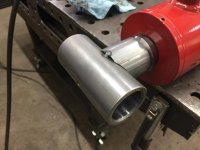
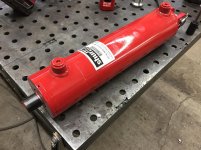
I have been busy lately so I haven't had as much time as I wanted to work on the brake as much as I would like. But I have gotten a bit done, First I cut out the side punch guides out of 3/8" plate. Next I cut out the main punch plate out of 1/2" plate and mag drilled all the bolt holes. I'm using a 3.5" x 12" clevis mounted cylinder but I needed a cross tube mount on the rod end to connect to the moving levers. I made the cross tube mount out of 2" x .25" wall DOM with a 1-1/4" x 12 bung welded onto the tube and coped to the cross tube to lengthen the cylinders center to center pin measurement to match my cad drawing.
 

Attachments

  • IMG_0944.jpg
    IMG_0944.jpg
    97.7 KB · Views: 240
  • IMG_0943.jpg
    IMG_0943.jpg
    101.9 KB · Views: 197
  • IMG_0942.jpg
    IMG_0942.jpg
    151.3 KB · Views: 180
  • IMG_0936.jpg
    IMG_0936.jpg
    150.3 KB · Views: 181
  • IMG_0935 v2.jpg
    IMG_0935 v2.jpg
    57 KB · Views: 182
OP
F

f150skidoo

Well-known member
Joined
Dec 29, 2012
Messages
1,206
Location
Ontario, Canada
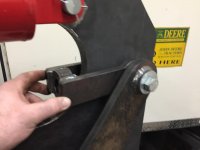
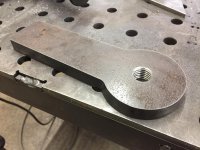
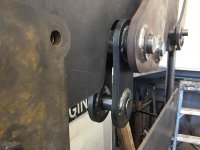
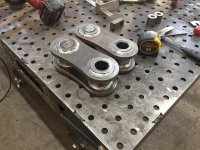
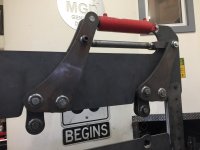
The next step in the build is to make the shackles that connect the levers to the punch, The shackle plates are 1/2" plate welded to the 2.5 x .500" DOM tubing. With the design of my frame if you had a single pin between the two rear arms the pin wood hit the frame reducing the usable stroke in half. I ended up making a large clevis so the arms can pass by the frame. The outer pieces of the clevis are 5/8" plate drilled and tapped for a 3/4"-10 bolt. I drilled out the center of the 1.5" pin material so I can bolt the pin to the 5/8" plate to essentially make a large shoulder bolt. The center part of my clevis is 1" plate where it will have a 1.25"-12 bolt that connects to a adjustable connecting rod between the pairs of levers.
 

Attachments

  • IMG_0952.jpg
    IMG_0952.jpg
    74.8 KB · Views: 174
  • IMG_0950.jpg
    IMG_0950.jpg
    154.1 KB · Views: 161
  • IMG_0948.jpg
    IMG_0948.jpg
    148.7 KB · Views: 146
  • IMG_0947.jpg
    IMG_0947.jpg
    116.2 KB · Views: 164
  • IMG_0946.jpg
    IMG_0946.jpg
    155.1 KB · Views: 166
  • IMG_0945.jpg
    IMG_0945.jpg
    141.1 KB · Views: 150
OP
F

f150skidoo

Well-known member
Joined
Dec 29, 2012
Messages
1,206
Location
Ontario, Canada
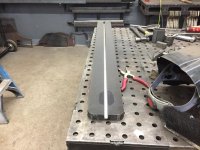
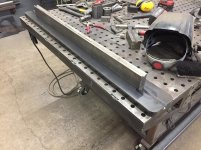
The next step was to make the lower die holder. I machined a 1/2" wide by 5/8" deep slot in 1" x 5" flat bar, my mill doesn't have enough travel so I had to cut the slot in two operations.
 

Attachments

  • IMG_0955.jpg
    IMG_0955.jpg
    152.7 KB · Views: 225
  • IMG_0957.jpg
    IMG_0957.jpg
    150.5 KB · Views: 222
  • IMG_0958.jpg
    IMG_0958.jpg
    152.8 KB · Views: 226

matt_i

Well-known member
Joined
Mar 14, 2008
Messages
10,725
Location
SE Michigan
Looking great there! Are you going to use snap rings to retain the larger pins, or just keeper washers with a small bolt on the centerpoint?
 

cmandp

Well-known member
Joined
Dec 22, 2011
Messages
1,272
Location
New Jersey
I like the aesthetics (not to mention technical part) of the design there OP.

One thing I'm wondering about the design. How are going to control the fit of the punch in the punch guides? Machine things or just use material thickness tolerance?
 
OP
F

f150skidoo

Well-known member
Joined
Dec 29, 2012
Messages
1,206
Location
Ontario, Canada
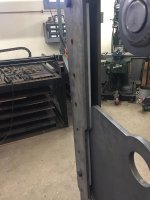
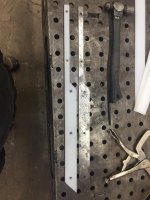
The next step in the build is to make the plastic wear strips that will guide the 1/2" punch. First I made a template to copy the shape and bolt pattern to the UHMW plastic then transfer the bolt holes to the 3/8" plate which had to be drilled and taped. Once I had all the plastic wear strips installed and bolted back to the main frame I sandwiched the 1/2" punch and used to to align the die holder. I spend A lot of time adjusting and shimming making sure the die holder was perfectly square to the punch and perfectly flat before welding it. I also finished the connecting rod. The tube is 2" .25" wall DOM, The clevis end I made has 1.25"-12 right and thread and the Heim joint end has 1.25"-12 left hand thread so I can fine tune to keep the punch parallel to the die.
 

Attachments

  • IMG_0967.jpg
    IMG_0967.jpg
    94.8 KB · Views: 189
  • IMG_0966.jpg
    IMG_0966.jpg
    116.6 KB · Views: 167
  • IMG_0965.jpg
    IMG_0965.jpg
    74.2 KB · Views: 208
  • IMG_0961.jpg
    IMG_0961.jpg
    75.9 KB · Views: 162
  • IMG_0962.jpg
    IMG_0962.jpg
    96.5 KB · Views: 155
  • IMG_0960.jpg
    IMG_0960.jpg
    98.9 KB · Views: 169
OP
F

f150skidoo

Well-known member
Joined
Dec 29, 2012
Messages
1,206
Location
Ontario, Canada
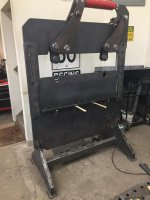
I got the punch installed and hooked up to the linkages. I then immediately had to try it out by using compressed air to actuate the cylinder. The brake has 3.188” of stroke.IMG_0969.jpg
IMG_0968.jpg


Sent from my iPhone using Tapatalk
 

lilscorpion

Well-known member
Joined
Mar 15, 2010
Messages
3,599
Location
Colorado
It’s turning out awesome. How much space will you have between the knife and die when the life is all the way retracted?
 
To avoid these ads, REGISTER NOW!
Top Bottom