To avoid these ads, REGISTER NOW!

Pressure testing a water line

AA7483

Well-known member
Joined
Dec 22, 2017
Messages
433
Location
South Jersey
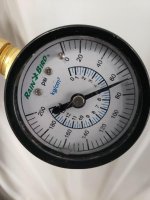
I hooked my water line for the shop into the house yesterday. Valved off the line inside the house after purging the air and filling the line with water. Had just over 60 psi on my gauge inside the shop. This morning, after about 15 hours my gauge reads 43. Obviously I know water pressure will drop with temperature but I imagine that it should be pretty consistent below ground. The shop temp has stayed the same as has the basement. No visible leaks above ground. Which has me fearing a leak below ground. Should I be concerned? Is this not an accurate way to test? Should I pressurize with air instead? Obviously I know air has the same fluctuations. Typically, in my trade we use nitrogen in refrigeration lines. Much more consistent.
 
To avoid these ads, REGISTER NOW!

jubilee

Well-known member
Joined
Nov 17, 2013
Messages
635
Location
Colorado
I’d let it set for a full 24 hrs., the do test again. Have you got a really good gauge? When I hydro test a line for my own purposes, I chart the pressure for first 4-5 hrs, then let it set for 24 hrs. Small pressure drop like you have so far would just be a few drops, low weather front combined with low quality bourdon tube gauge can effect extended test. Red neck fix for very small leak, add a little black pepper.
 
OP
A

AA7483

Well-known member
Joined
Dec 22, 2017
Messages
433
Location
South Jersey
Yea the gauge is nothing special. I cant imagine the hdpe poly is leaking underground but i guess anything is possible
 

couch67

Well-known member
Joined
Mar 18, 2016
Messages
1,401
Location
Ontario Canada
As jubilee says, it wont take much water loss to change the pressure in a sealed pipe. How much does your water pressure vary in the house (ie are you on a well)? Maybe the shutoff in the basement to the garage is not quite closing all the way, allowing the water pressure in the shop line to slowly equalize to what the house water pressure is at?

what do you have in the shop that is using water. maybe a toilet is leaking a bit?

If these dont pan out I would redo the test.
 

Radix2

Well-known member
Joined
May 28, 2014
Messages
1,853
Location
the thumb!, MI
As water is incompressible, it is extremely sensitive (too sensitive) to use as a pressure testing medium in a sealed volume. Your result doesn't mean anything IMO. Besides the obvious effects of temp, any relaxation in the stress in the plastic pipe, position, etc. can effect the effective volume and hence pressure.

If you want to test, fill with air and do your monitoring.

Compressed air is much much less sensive to the contained volume, and the pressure will follow the amount captured, giving you a proper test for leaks.
 
Last edited:

road_king

Well-known member
Joined
Dec 17, 2018
Messages
77
Location
Eastern USA
Give it more time and see if it holds the current pressure. Certainly air would have given a better reading in a shorter time frame.
Is the polyethylene pipe to shop one continuous line? If it is, then its is doubtful that it is leaking this soon. If a Tee was added or something like that, then that's a different story.
 
OP
A

AA7483

Well-known member
Joined
Dec 22, 2017
Messages
433
Location
South Jersey
No connected fixtures. This is a new water line. Pressure in the house should be the same or greater than what is in the shop. After 27 hours my gauge is reading 42. Maybe i should retest with air. Pipe is continuous underground. No fittings
 

ddawg16

Well-known member
Joined
Jul 11, 2008
Messages
21,005
Location
S. California
Really? How much pressure change should he expect with a non-compressible liquid and a few degrees?

https://www.engineeringtoolbox.com/expansion-tanks-d_885.html

running relatively warm water in, sealing, then having it cool to ground temp....

Using that graph, it would take at least a 15 deg temp change to make the pressure change the OP saw.

If the pipe is in the ground, I really doubt the temp change was more than 5 deg
 

benjamintmiller

Well-known member
Joined
Feb 8, 2011
Messages
284
Location
IA
If all the air has been purged, the tiniest of leaks would cause the pressure to go to 0. My guess is that the pipe expanded a slight amount as it adjusted to the pressure.
 

woodzy

Well-known member
Joined
Oct 16, 2011
Messages
248
Location
Se Michigan
We pressure test injection molds at work with air pressure at shop air 80-100 psi. We only watch the gage for about 15 minutes. We got some new type of water manifolds which a bunch of O-rings and when we pressure tested the system with these they leaked. The soapy bubble test really showed up these leaks. In talking to the manufacture, they said to pressure test them with water and they didn't leak at all. Since Air has smaller molecules, they tend to leak easier. I would seal the ends again, and raise the pressure to around 80psi and use the soapy water to look at all your joints.
 

flat350

Well-known member
Joined
Jan 1, 2009
Messages
1,006
Location
illinois
In a true hydrostatic test there is an allowable pressure loss based on pipe footage and fittings used.You don't have that long of a run and zero fittings.If you had it completely filled with water and lost 17-18 lbs something is leaking,when we did hydro tests on larger mains it was done at 250# for 2 hours with the gauge being allowed to drop X amount of pressure based on the calculations for the run.Are you sure it's not pushing any remaining air past a valve or your test equipment at either end?
 
OP
A

AA7483

Well-known member
Joined
Dec 22, 2017
Messages
433
Location
South Jersey
Its not my joints Im worried about. If the joints were leaking Id see water. Its the pipe underground. I know its highly unlikely its leaking as it is a brand new pipe with no joints. Just concerned with the pressure drop
 
To avoid these ads, REGISTER NOW!
OP
A

AA7483

Well-known member
Joined
Dec 22, 2017
Messages
433
Location
South Jersey
Well, on the other side of the shut off in the house there is water with a greater pressure than I have in the pipe so I don't think anything is being pushed past the valve and my test equipment is at the end of the line on the shop side. The run is less than 100 ft.
 
OP
A

AA7483

Well-known member
Joined
Dec 22, 2017
Messages
433
Location
South Jersey
New gauge. Recharged the water. 67 psi. After an hour and a half its reading. 65-66. I think i felt a small drop of water on the old gauge.
 

flat350

Well-known member
Joined
Jan 1, 2009
Messages
1,006
Location
illinois
You say there are no joints underground,what was the ditch backfilled with,possible for something in the backfill to make a small puncture in the line?
 
OP
A

AA7483

Well-known member
Joined
Dec 22, 2017
Messages
433
Location
South Jersey
It was backfilled with the dirt that came out of the trench. I was careful when backfilling but i suppose anything is possible
 

flat350

Well-known member
Joined
Jan 1, 2009
Messages
1,006
Location
illinois
I've hydro tested systems with thousands of feet of pipe and left pressure on for days,might go up and down a pound or so with temp. fluctuations but it won't drop unless there is some kind of leak.
 

ard

Well-known member
Joined
Feb 16, 2015
Messages
4,391
Location
Sierra Foothills... California
Using that graph, it would take at least a 15 deg temp change to make the pressure change the OP saw.

If the pipe is in the ground, I really doubt the temp change was more than 5 deg

15 degrees is an 80psi change. Using the graph.

OP when from 60psi to 43psi. In his post

That is a 17psi delta.

From the graph that is about 1/4 of the 80 psi, so about 4 degrees. Prolly 3.3 degrees if I used a calculator.....
 

johninct

Well-known member
Joined
Dec 21, 2010
Messages
2,595
Just for a rough estimate cursory test, after the water psi stabilized, if it is the same after say 24 hours, you are probably ok. If then you are low, re-check with air.
 

flat350

Well-known member
Joined
Jan 1, 2009
Messages
1,006
Location
illinois
Originally Posted by flat350 View Post
I've hydro tested systems with thousands of feet of pipe and left pressure on for days,might go up and down a pound or so with temp. fluctuations but it won't drop unless there is some kind of leak.


completely filled with water, no expansion tank, no air column anywhere?
ard is offline Report Post

Hydro tests are done with no air in the system if at all possible,the pump used introduces water into the system not air,even when using a hand pump it's only takes a few pumps of the lever to hit 200#.It's probably not possible to remove 100% of the air as even the water has some dissolved oxygen in it.
 

cderalow

Well-known member
Joined
Nov 13, 2011
Messages
1,326
Location
Potomac, MD
i will tell you that for every commercial hydro pressure test I've ever seen, they've used air and not water. schedule 40 cast iron pipe to 200psi for sprinkler lines typically.
 

forced induction

Active member
Joined
Aug 16, 2012
Messages
28
Location
NJ
Depending on the size and length of run, the HDPE will stretch. I routinely test large diameter, heavy wall HDPE and it take a long time for it to stretch before it will actually hydrotest well enough that the gauge doesn't drop. With the pressure drop you are showing it is questionable if there a leak. I would continue to keep the pressure in the pipe, then isolate it after a few hours, or just keep re-pressurizing it until the the pipe is done stretching. Each time you pump it back up the pressure degredation should be less and less. Do not pressurize with air, there is nothing to be gained there.
 

flat350

Well-known member
Joined
Jan 1, 2009
Messages
1,006
Location
illinois
i will tell you that for every commercial hydro pressure test I've ever seen, they've used air and not water. schedule 40 cast iron pipe to 200psi for sprinkler lines typically.

And a plumber was killed in Chicago a few years ago testing a 5" galv. main with air,a hydro test is done with water not air.I've installed a whole bunch of cast iron pipe and i would never never ever even consider doing an air test on it.
 

motorcycle79

Well-known member
Joined
Jun 26, 2011
Messages
471
Location
wisconsin
i will tell you that for every commercial hydro pressure test I've ever seen, they've used air and not water. schedule 40 cast iron pipe to 200psi for sprinkler lines typically.

Every hydro test uses water. Air test use air. A lot of miss information here. Any temperature change will play a huge roll as will air.. even a few air bubbles moving around Will cause fluctuations.. once filled with water even a few drops of water will b noticeable depending on the volume of water tested. Plastic pipe could expand and stretch also I supposed.. I just hydro steel valves and pipe. I will look at work for a chart paper to post..

I blew apart a 6 million dollar cold box in a natural gas facility last June. I was 2 or 3 hundred pounds under what they wanted me to test it to close to 1000psi. It was a big chunk of aluminum..
 
Last edited:

Radix2

Well-known member
Joined
May 28, 2014
Messages
1,853
Location
the thumb!, MI
And a plumber was killed in Chicago a few years ago testing a 5" galv. main with air,a hydro test is done with water not air.I've installed a whole bunch of cast iron pipe and i would never never ever even consider doing an air test on it.


Nobody is talking about doing a high pressure strength test here.

The idea of the air test is simply to fill the system to some nominal value and wait to see if it leaks out. Air is the better medium for this since it is much less sensitive to variations outside of the ability to see if the stuff leaks out or not.
 

Bob275

Well-known member
Joined
Nov 20, 2011
Messages
319
Location
RI
If you don't have ALL the air out, it will keep dropping. The air will eventually compress if you keep at it.

When testing a water line you want all the air out. You fill the line from the low point and release the air from the highest point. Then pump up the line (from the low point) with a water pump to a determined PSI (usually 1.5 times the working pressure) and wait. Any little leak will drop out that gauge on a short run, check all fittings and use pipe tape AND dope on any threaded fittings.
 
Last edited:
To avoid these ads, REGISTER NOW!
Top Bottom