To avoid these ads, REGISTER NOW!

Problem with drop in anchors and thin floor

Jaja

Well-known member
Joined
Oct 2, 2017
Messages
94
Location
Michigan
I ran into a snag while bolting down my 4 post lift.

I'm using drop in anchors and while drilling the holes for the anchors (which are 2.5" long) I learned that my floor is less than 3" in some spots. In three of the 12 holes holes I drilled the drill broke through the bottom of the slab. :mad:

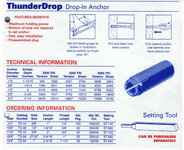
These strongtie anchors require you use a driver to set the anchor using this process:

Using the designated Drop-In setting tool, drive expander plug towards the bottom of the anchor until the shoulder of the setting tool makes contact with the top of the anchor. When properly set, four indentations will be visible on the top of the anchor indicating full expansion.

This step requires the anchor to bottom out so you can hammer the set tool. To address this I bought some Sikacryl ready-mix concrete patch and applied it in the holes. Although it's fast curing (2 hr) it didn't within 24 hrs. I later leaned that mis-applied it, it's only supposed to be applied 1/4 at a time and I'm guessing its over an inch thick in each of the holes. I'll remove it and use something else.

The question is what would be the best product? Maybe hydraulic cement? Whatever it is, it needs to cure quickly and be strong enough it can be hammered against without cracking or moving.

Thanks in advance.
 
Last edited:

To avoid these ads, REGISTER NOW!
OP
J

Jaja

Well-known member
Joined
Oct 2, 2017
Messages
94
Location
Michigan
I can assure you that the floor is strong enough to support the lift. It has for the last 5 years. It's only thin in some spots.

Its self standing, I'm bolting it down to level the columns.
 
OP
J

Jaja

Well-known member
Joined
Oct 2, 2017
Messages
94
Location
Michigan
@rockettauto I considered this for securing the3 problematic anchors within their holes. The anchors and grade 8 hardware weren't cheap. I'm not really open to changing direction at this point. Rather, I'm looking for a solution for the 3 holes.
 

nadogail

Well-known member
Joined
Jan 23, 2009
Messages
31,935
Location
Coronado, CA
I have become very fond of Hilti Kwick Bolts, even when I have drilled completely through the slab they have worked successfully.

Hilti products have been widely copied but IMHO have never been surpassed.
 

charbar

Well-known member
Joined
Feb 6, 2021
Messages
1,993
Location
Midwest
Must be a 4 post lift??? (I hope) If so you really don't need all the anchors on each post anyway, there are a lot of 4 post that arent bolted down. If you want all of them then drill the holes out bigger, get threaded rod and some epoxy and set the threaded rod in it.

If it's a 2 post lift you are trying to do this with then you are on borrowed time bud.
 
OP
J

Jaja

Well-known member
Joined
Oct 2, 2017
Messages
94
Location
Michigan
Must be a 4 post lift??? (I hope) If so you really don't need all the anchors on each post anyway, there are a lot of 4 post that arent bolted down. If you want all of them then drill the holes out bigger, get threaded rod and some epoxy and set the threaded rod in it.

If it's a 2 post lift you are trying to do this with then you are on borrowed time bud.
Yes, it's a 4 post, I should have said that in the beginning and have edited the first post.
 

Beemer

Well-known member
Joined
Jun 21, 2020
Messages
1,400
Location
Northeast
I can assure you that the floor is strong enough to support the lift. It has for the last 5 years. It's only thin in some spots.

Its self standing, I'm bolting it down to level the columns.
Assuming that you found the thin concrete where you are putting anchors, presumably at the columns where the slab loads are concentrated, how is that not an issue and not creating structural integrity concerns?

Anchors should be a secondary concern if you found thin concrete.
We can put a 2" diameter bolt in a piece of 1/4" plywood. The anchor is not the issue and there is no point in trying to improve it's anchorage.
 
Last edited:
OP
J

Jaja

Well-known member
Joined
Oct 2, 2017
Messages
94
Location
Michigan
Assuming that you found the thin concrete where you are putting anchors, presumably at the columns where the slab loads are concentrated, how is that not an issue and not creating structural integrity concerns?

Anchors should be a secondary concern if you found thin concrete.
We can put a 2" diameter bolt in a piece of 1/4" plywood. The anchor is not the issue and there is no point in trying to improve it's anchorage.
I'm not an engineer. My logic is if my slab has only 2500 psi (low grade) concrete and it's at least 2.5 inches thick. Thats 6250 psi. The entire lift and with a car loaded isn't focused on a single square inch. The pads are 10"x 12" (120 sq. inches) at the base which distribute the weight. 120 sq. in x 2500 psi is 300,000 pounds per column and there's 4 of them.
 
OP
J

Jaja

Well-known member
Joined
Oct 2, 2017
Messages
94
Location
Michigan
@Beemer - Another thing that comes to mind is that my existing anchors which are wedge type (mechanical) have sufficient surface area to be effective. They are 2.5" and my concrete is equally thick. They will be fully encapsulated. It's the setting process that's problematic.
 

Beemer

Well-known member
Joined
Jun 21, 2020
Messages
1,400
Location
Northeast
I'm not an engineer. My logic is if my slab has only 2500 psi (low grade) concrete and it's at least 2.5 inches thick. Thats 6250 psi. The entire lift and with a car loaded isn't focused on a single square inch. The pads are 10"x 12" (120 sq. inches) at the base which distribute the weight. 120 sq. in x 2500 psi is 300,000 pounds per column and there's 4 of them.
How many times have I heard "I'm not an Engineer but...."
I am a retired Structural Engineer who designed buildings for a lifetime.
To be polite I'll just warn that your logic of how the concrete works and is analyzed is all wrong.
Good luck.
 

jonesg

Well-known member
Joined
Mar 15, 2010
Messages
1,698
Location
northern Maine/
you're trying to prevent lateral movement, not tipping over or pulling the anchors out, these guys can't grasp that.
go ahead with your inclination, if anchors pull out you know what happens then.

absolutely nothing.
Just use your own common sense , don't look for much here.
 

jack stand

Well-known member
Joined
Feb 29, 2012
Messages
3,326
Location
Lakes Region Maine
I can assure you that the floor is strong enough to support the lift. It has for the last 5 years. It's only thin in some spots.

Its self standing, I'm bolting it down to level the columns.
So basically you only want to shim a couple of the post to get all 4 posts on the same plain?
 

Wiz02

Well-known member
Joined
Jul 13, 2007
Messages
2,399
Location
Southeastern PA
How many times have I heard "I'm not an Engineer but...."
I am a retired Structural Engineer who designed buildings for a lifetime.
To be polite I'll just warn that your logic of how the concrete works and is analyzed is all wrong.
Good luck.
I know that as a professional. it is dangerous to give advice over the internet but given all the usual caveats, what would you recommend as a solution?

Please don't leave us hanging.
 
OP
J

Jaja

Well-known member
Joined
Oct 2, 2017
Messages
94
Location
Michigan
So basically you only want to shim a couple of the post to get all 4 posts on the same plain?
My garage floor has a typical slope that pitches towards the opening. I'm shimming the columns/posts so that they are plumb and I can level the carriage.
 
To avoid these ads, REGISTER NOW!
OP
J

Jaja

Well-known member
Joined
Oct 2, 2017
Messages
94
Location
Michigan
Could you shim and tack weld them in place if for some reason gravity doesn't do the trick? 👍
I understand your concrete/fasteners frustration.
It's an interesting idea. A plate could be fabed with a hole slightly larger than the diameter of the anchor. The bead would need to be strong enough to withstand a few hammer blows yet be accessible to grind it away.
 

Rusted Nut

Well-known member
Joined
Dec 11, 2022
Messages
1,806
Location
PNW
My logic is if my slab has only 2500 psi (low grade) concrete and it's at least 2.5 inches thiThats 6250 psi. The entire lift and with a car loaded isn't focused on a single square inch. The pads are 10"x 12" (120 sq. inches) at the base which distribute the weight. 120 sq. in x 2500 psi is 300,000 pounds per column and there's 4 of them.
This is very false logic, you do not have 6250 psi.

However, with a four post lift, you are really only dealing with shear with regard to the anchors; assuming the lift is installed correctly. Epoxy and threaded rod would be your best solution. Clean out the holes and use epoxy.
 
Last edited:
OP
J

Jaja

Well-known member
Joined
Oct 2, 2017
Messages
94
Location
Michigan
This is very false logic, you do not have 6250 psi.

However, with a four post lift, you are really only dealing with shear with regard to the anchors; assuming the lift is installed correctly. Epoxy and threaded rod would be your best solution. Clean out the holes and use epoxy.

Help me understand the math then, so others can understand this point as well.
 

Zeke

Well-known member
Joined
Aug 13, 2009
Messages
17,176
Location
Long Beach CA, the sewer by the sea.
I understand the math and the point and I'm stupid with math. To hold shear you could drive nails into the concrete floor and have nearly as much holding power. We're not talking 2-post lifts here that might want to pull anchors out of the slab.
 
OP
J

Jaja

Well-known member
Joined
Oct 2, 2017
Messages
94
Location
Michigan
I appreciate all the replies and input provided.

I think the point that I didn't communicate effectively is the areas of the floor/slab that are thin are only a problem for a few of the anchors and the method they need to be set. These are Simpson Strong-Tie DIAB62 anchors and I provided the method to set them in my first post. Because the anchor didn't have a solid "floor" or bottom of the bored hole to **** up to (just the aggregate under the slab) when the anchor is set posed the problem, not the structural integrity of the concrete.

I purchased Quikrete Anchoring Cement to fill the voids in the 3 holes. I filled them with the cement and then drove in the anchor to compact the cement mixture in the void and repeated until the slurry filled the hole to the required height. This stuff cures in less than an hour. It's dry now and gives a solid sound when I tap on it with a metal rod. I'll likely set anchors tomorrow after a 24 hr cure and report back if this worked.
 

rockettauto

Well-known member
Joined
May 12, 2023
Messages
745
Help me understand the math then, so others can understand this point as well.
Disclaimer, this is all super rough estimation and not modeling actual forces involved so it's napkin estimate methods that aren't directly applicable;

Psi is literally pounds per square inch, you can't increase the psi by increasing the square inches.

Also it's square inches , not cubic. So again increasing the volume doesn't lead to an increase in psi strength.

With an anchor if you're looking at uplift or turnover leverage as with a two post you are looking at a conical area in an upward direction from the maximal friction point in the anchor. What is essentially a square inch or four becomes 40-50 square inches and isn't necessarily representative of anchor strength, it gets much more complicated and basically testing is needed to determine the real pullout strength.

That all said, with four post you are basically looking at shear. You will essentially be looking at some 70 percent of so of the surface area of one side of the bolt pressing against filler material. However ultimate strength still doesn't mean a lot in this application since the forces generated will mostly be collateral. Vibration, turnover due to flex that is shared with other posts etc.

There isn't simple way to do the math involved here, bottom line.

At the same time, as you've summized, it's self supporting so really not very critical.

We understand that you just need a bottom point to put force against so your chosen anchors can be expanded in the way they are designed but short of cutting the area out to pour a patch block there isn't a nominal solution besides abandoning the anchor design to use use what will work nominally.

If I were being creative and had to use your chosen anchors I would suggest water jetting some material out from below the hole and then vacuuming it out and filling the cavity with hydraulic cement....but why?.....epoxy and threaded rod will do the job, likely better with less than perfect installation conditions.

Lastly grade 8 is likely entirely unnecessary and even grade 5 exceeds the strength of the concrete and expanding anchors pullout strength as well as the shear available with the given depth vs compressive strength to such a degree as to be overkill. Really rough numbers;
Side load area available to the anchor= 6 in2
5ksi concrete= 30k
Grade 5 fastener = approximately 70ksi shear strength with about a square inch in shear applied area.

All in all an epoxy buffer that is closer in flex to steel vs a brittle filler will negate some of the wear involved from collateral forces.

Lastly , it's just simple. Hell, you could epoxy your chosen anchors with an oversized hole without expanding them and bolt into them and still have it do what you need.
 
Last edited:

Beemer

Well-known member
Joined
Jun 21, 2020
Messages
1,400
Location
Northeast
I know that as a professional. it is dangerous to give advice over the internet but given all the usual caveats, what would you recommend as a solution?

Please don't leave us hanging.
You are exactly right.
A key word in my answer was "retired". We are not allowed to practice without active licenses.
I offered a warning that his thoughts on a technical numerical approach are wrong.
Free advice solicited on the internet is going to only leave him holding the bag if things go bad.
 
Last edited:

Old tool guy

Well-known member
Joined
Apr 13, 2023
Messages
3,218
. It's dry now and gives a solid sound when I tap on it with a metal rod. .
Well now, that sounds like it’s rock solid. Able to hold a battleship. Be sure your life insurance is paid up when you have a car up on the lift and you’re looking up at the underside.
 

Rusted Nut

Well-known member
Joined
Dec 11, 2022
Messages
1,806
Location
PNW
Help me understand the math then, so others can understand this point as well.
Concrete psi is the same whether your slab is 2” or 10”. 2500# psi concrete is always 2500# regardless of depth.

With that said, 2500# slab on grade concrete is probably adequate to support the vertical load of a 4 post lift (check with manufacturer). Pinning down the feet of a four post just keeps it from sliding around.
 

Wiz02

Well-known member
Joined
Jul 13, 2007
Messages
2,399
Location
Southeastern PA
You are exactly right.
A key word in my answer was "retired". We are not allowed to practice without active licenses.
I offered a warning that his thoughts on a technical numerical approach are wrong.
Free advice solicited on the internet is going to only leave him holding the bag if things go bad.
I'm somewhat disappointed in your response, but I completely understand your position.
 

racecougar

Well-known member
Joined
Jan 26, 2021
Messages
5,025
Location
Missouri
Concrete psi is the same whether your slab is 2” or 10”. 2500# psi concrete is always 2500# regardless of depth.

With that said, 2500# slab on grade concrete is probably adequate to support the vertical load of a 4 post lift (check with manufacturer). Pinning down the feet of a four post just keeps it from sliding around.
Thickness matters. 6" of 2500# mix will support more weight per sq in than 1/4" of 2500# mix.

You'll find most 4-post lift suppliers recommend a minimum of 4-4.25" thickness.
 

sjvicker

Well-known member
Joined
Aug 9, 2014
Messages
602
Location
SW Washington
So you have a 4 post lift, are just shimming for level and 9 of 12 fasteners were in concrete that was thick enough. If I were you I'd pound those 3 loose ones into the dirt and put some standard wedge anchors in their place in the thin areas and be done with it. If it was a 2 post then this would be a completely different story and I'd be suggesting you cut your slab and repour to the correct thickness.


the pads on a 4 post lift are what, 8"x8"? If they're holding a 6k car and the lift weighs 2k then you have 31.25psi on the concrete. My tool box puts more of a point load on the slab than this lift would.
 
OP
J

Jaja

Well-known member
Joined
Oct 2, 2017
Messages
94
Location
Michigan
So you have a 4 post lift, are just shimming for level and 9 of 12 fasteners were in concrete that was thick enough. If I were you I'd pound those 3 loose ones into the dirt and put some standard wedge anchors in their place in the thin areas and be done with it. If it was a 2 post then this would be a completely different story and I'd be suggesting you cut your slab and repour to the correct thickness.


the pads on a 4 post lift are what, 8"x8"? If they're holding a 6k car and the lift weighs 2k then you have 31.25psi on the concrete. My tool box puts more of a point load on the slab than this lift would.
the pads are 10x12 which means even less load than you calculated. This was what I was trying to explain earlier. Others have made the point about shear and I agree it's at play, but I don't believe it's a significant issue here.
 

wssix99

Well-known member
Joined
Mar 2, 2011
Messages
5,159
Location
Chicago, IL
Help me understand the math then, so others can understand this point as well.

Don't worry about this. Your car, parked on your slab exerts a pressure equal to your tire pressure. (If your tires are 30 PSI, then the car puts 30 PSI down on the floor.)

If your 4 post lift pads are larger than your tire contact patch, then the pressure the loaded lift puts on the floor (assuming the extra weight of the lift is relatively small) is LESS than the vehicle puts on the floor when its just parked there. Easy.

The precise math is to take the total weight and divide it by the surface area of the lift posts. If the car is 4000 lbs and the lift weighs 1000 lbs and the lift post pads are 10" X 10", then the pressure is (4000lb + 1000lb) / (4 * (10in X 10in)) = 12.5 PSI.


Grouting the floor is going to be really difficult. I would abandon the anchors you bought and use something more forgiving like Titen Bolts, since you just need to pin the feet in place and don't need a structural hold.
 

Sumboodie

Well-known member
Joined
Mar 20, 2021
Messages
10,674
Location
AK
Those Simpson anchors are like $1 each. I’ve definitely trash binned more than $50 of parts after a screw up, redo, or changed plan.
 

Dig Doug

Well-known member
Joined
Apr 16, 2018
Messages
1,100
I can assure you that the floor is strong enough to support the lift. It has for the last 5 years. It's only thin in some spots.

Its self standing, I'm bolting it down to level the columns.
So what your saying is it hasn’t failed yet

Did you pour the floor? If not then you don’t really know, what concrete mix was used & if any rebar is in it. at 2.5 inch thick seems a bit shy…

half full or half empty

IMG_9049.jpeg

I would use a titan bolt before any drop in deals

titan bolt
IMG_9050.jpeg
 

sjvicker

Well-known member
Joined
Aug 9, 2014
Messages
602
Location
SW Washington
the pads are 10x12 which means even less load than you calculated. This was what I was trying to explain earlier. Others have made the point about shear and I agree it's at play, but I don't believe it's a significant issue here.

Dig Doug's idea for titan anchors seems like a solid idea for the thin spots in your slab. No doubt there is a shear element as well but you also aren't in an earthquake prone area and you probably aren't going to load at speed and slam on the brakes.
 
To avoid these ads, REGISTER NOW!
Top Bottom