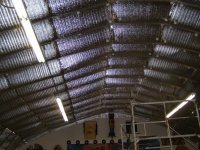
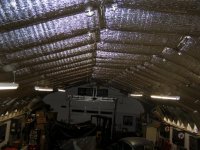
Okay, so I am actually a thermal engineer and infrared inspector. I would like to get some feedback on Prodex as well. I have to start by saying that it cannot possibly be an R 15.67 based on industry standard R-Value calculations. Closed cell foam at its best has an R-Value of 6.5 per inch. As such, the product itself cannot have an 15.67 unless it had a 2.41076923076 inch minimum. Clearly they **** with their calculations. Moving on from R-Value, however, there are three ways that heat flows from one spot to the other, and one I break into two sub parts.
1. Conduction - this is the part of heat transfer that R-Value addresses. Basically, it is a measure of how well heat transfers by direct contact of molecules within a substance. Metal has an R-Value of damned near zero. The best R-Value of any known substance is achieved with Aerogels which can approach R-10 per inch.
Aerogels:
http://www.americanbuildingtechnolo...insulation/nanogel-higest-R-Value-insulation/
http://www.jetsongreen.com/2010/02/aerogel-ultra-thin-super-insulation.html
http://www.aerogel.com/
Aerogels are super expensive and not a good choice for a garage. Basically though, to achieve R-15.67 in the Prodex line, at the thickness it has, it would have to be about 3 times better per inch than the best known product on the planet.
2 A. Convection - When air curculates, it improves heat transfer. Blocking its ability to convect makes the transfer from heat or liquids less effective.
2 B. Convection - air intrusion. If you have a hole in the wall and cold air can blow in and warm air can go out, your effectiveness of the insulation is reduced. You could have R-500 on 95% of your walls and a hole in 5% of your walls and your heat loss would be greater than having R-10 on all of your walls and zero holes.
My bet is that Prodex is pretty good for covering the holes and blocking intrusion when properly installed. The seams need to be 100% sealed.
3. Radiation - When matter is warmer than absolute zero, it will radiate heat via infrared spectrum waves. These will travel across a vacuum, but bounce back off a perfectly reflective substance 100%. The shiniest and most reflective materials in real world applications start off about 97% reflective, and...
ALL REFLECTIVE MATERIALS LOSE SOME OF THE REFLECTIVE PROPERTIES WHEN THEY GET DIRTY OR OXIDIZE.
Also, reflective products need to have a gap to reflect. If the reflective material is in direct contact with another material, it's conductive properties come into play and...
IT WILL LOSE 100% OF ITS REFLECTIVE PROPERTY.
Essentially, if you install a reflective over a 1/4 inch furring strip on the walls creating an air gap, you will be able to reflect infrared heat. If you put the reflective surface ON the wall, you have lost your reflective properties for the points in contact and it becomes a conductor with a very low R-value.
The GREATER the temperature difference between two spaces, the more important reflectivity becomes and the less R-value matters. Think gold on the lunar lander. Gold is damned near a 100% conductive substance, but reflects the sun's heat pretty close to 100%.
My best bet for insulating a garage is to use a reflective with the side that is usually warmer having the reflective surface facing it WITH AN AIR GAP. You also have to figure out how to keep it clean and kill all the air flow. You can get a big bang for your buck in either super hot or super cold climates, so long as the reflective side faces the hot side without coming into contact with another material.
R-15.67 for 5MM however.... I call ********!