To avoid these ads, REGISTER NOW!

Project Farm Digital Torque wrench test

neophyte

Well-known member
Joined
Apr 23, 2012
Messages
9,590
Location
Pennsylvannia
The alternative is to recognize that Project Farm is entertainment designed to sell ads, not to provide to consumers credible information about tools on the market.

ETA: If you don't see the difference between a complex machine like a car and a simple product like an L-key then there's nothing to talk about. And if you do understand the difference, then you know yours is a straw man argument.
Project Farm guy’s tests are probably at a similar level, plus or minus, as tests done by major magazines, including Consumer Reports, and industry specific magazines.
I really wouldn’t be surprised if his tests are sometimes better.
PF shows his methodology, and while possibly a bit less “scientific” than Torque Test Channel guy, his tests seem perfectly valid.
Since he shows his methodology, ignore individual criteria in his reviews if you disagree, or think the test was poor.
I would also not focus on minor result differences, like Icon beating Snap-On by 1%.
Icon beating Snap-On by 10% or more seems less like a margin of error difference.
 
To avoid these ads, REGISTER NOW!

neophyte

Well-known member
Joined
Apr 23, 2012
Messages
9,590
Location
Pennsylvannia
the problem with AA cells is that everyone is going to use regular alkaline cells in them. And modern alkaline cells are garbage that leak without any provocation.
Making a sealed “battery enclosure”, that can hold AA batteries, but be easily and affordably replaced in case of leakage, would probably be a better system, since it allows even crappy AA batteries that might leak, while not destroying an expensive piece of equipment, and allowing one of the most easily available battery types to be used.
Somy used to have separate battery holders for using AA batteries for Walkmans snd Discmans years ago, in case the user failed to recharge the rechargeable batteries.
 

neophyte

Well-known member
Joined
Apr 23, 2012
Messages
9,590
Location
Pennsylvannia
I'd be shocked if that was the case. If he approached an undergrad Physics lab with the same misguided procedures, he'd flunk.
Tool tests done in woodworking magazines routinely did not involve multiple tool samples, and were just as lax about procedure, or more so, than the Project Farm tests, and the magazines routinely requested the tools from the manufacturers rather than buying the tools on the open market.
Cknsumer Reports tested circular saws years ago, and just used the blades that came on the saws rather than buying s consistent batch of blades.

Torque Test Channel did at least one test, were multiple samples of the same size, from the same manufacturer were tested, and Snap-On if I recall correctly came out as more consistent, but the Harbor Freight tools actually did well, maybe beating Snap-On, but with the occasional sample that underperformed by maybe 20%.
That 20% lower tool world still be perfectly fine for years if use given the test ratings though.
 

Jaywalk3r

Well-known member
Joined
Mar 9, 2025
Messages
50
Location
PNW, USA
Tool tests done in woodworking magazines routinely did not involve multiple tool samples, and were just as lax about procedure, or more so, than the Project Farm tests, and the magazines routinely requested the tools from the manufacturers rather than buying the tools on the open market.
Woodworking magazines aren't Consumer Reports.
Cknsumer Reports tested circular saws years ago, and just used the blades that came on the saws rather than buying s consistent batch of blades.
So they tested the tools in the same manner they would typically be used by consumers? Shocker. If they aren't testing to failure, they don't need a new tool every time they perform a test. They just need to perform the test n-times for a n-sized sample of performance for each tool. PF has a test to failure fetish. For tests to failure, which are not typically relevant for real-world use, a new specimen of the tool being tested is required for each of n tests. If n isn't sufficiently large, results are meaningless. The more complicated the test, or the more potential for experimenter error, the larger n needs to be.
Torque Test Channel did at least one test, were multiple samples of the same size, from the same manufacturer were tested, and Snap-On if I recall correctly came out as more consistent, but the Harbor Freight tools actually did well, maybe beating Snap-On, but with the occasional sample that underperformed by maybe 20%.
That 20% lower tool world still be perfectly fine for years if use given the test ratings though.
20% variation is high. There's a reason HF doesn't command SO prices, and it isn't the warranties. Good on TTC for testing multiple samples and demonstrating higher-end tools having better specimen to specimen consistency. Such consistency increases production costs, hence the higher prices.
 

finn

Well-known member
Joined
Mar 27, 2005
Messages
16,227
Location
The UP, God's country
Project Farm guy’s tests are probably at a similar level, plus or minus, as tests done by major magazines, including Consumer Reports, and industry specific magazines.
I really wouldn’t be surprised if his tests are sometimes better.
PF shows his methodology, and while possibly a bit less “scientific” than Torque Test Channel guy, his tests seem perfectly valid.
Since he shows his methodology, ignore individual criteria in his reviews if you disagree, or think the test was poor.
I would also not focus on minor result differences, like Icon beating Snap-On by 1%.
Icon beating Snap-On by 10% or more seems less like a margin of error difference.
Consumer Reports has a fairly large staff of degreed engineers and professional lab facilities, last I checked.

The traditional magazines from the past decades, did not.

In fact, the Technical Writing Professor from the University I attended let it slip that he was a ghost writer for some of the West Coast car magazines, despite never have driven the vehicles. The editors would fly to Detroit, sppend the afternoon at the Proving Grounds of the respective manufacturers, take some cars around the track, shoot some photos and take some notes, then send the notes to this guy, who would generate the story.

I can’t confirm if it was true, but that was the line at the time, the late sixties and early seventies.

I can, however confirm that I was personally interviewed by writers for industry publications that followed that model. They were writers rather than hands on technical people. They mainly got some quotes, and fashioned stories around those quotes.

Project Farm, love him or hate him, seems to be a genuine hands on person.

It’s unfair to judge him because of his voice or presentation style. Those have nothing to do with what he’s doing, or his capabilities, and I find those attacks somewhat juvenile.
 
Last edited:

neophyte

Well-known member
Joined
Apr 23, 2012
Messages
9,590
Location
Pennsylvannia
Woodworking magazines aren't Consumer Reports.

So they tested the tools in the same manner they would typically be used by consumers? Shocker. If they aren't testing to failure, they don't need a new tool every time they perform a test. They just need to perform the test n-times for a n-sized sample of performance for each tool. PF has a test to failure fetish. For tests to failure, which are not typically relevant for real-world use, a new specimen of the tool being tested is required for each of n tests. If n isn't sufficiently large, results are meaningless. The more complicated the test, or the more potential for experimenter error, the larger n needs to be.

20% variation is high. There's a reason HF doesn't command SO prices, and it isn't the warranties. Good on TTC for testing multiple samples and demonstrating higher-end tools having better specimen to specimen consistency. Such consistency increases production costs, hence the higher prices.
Saw blades dull and need replacement, way before the saws typically die.
Using a consistent blade on all saws would actually test the performance of the saws, rather than whatever blade was on the saws, and would have cost about $10-$15 per saw at the time.
If consumer reports wanted to ALSO test the saws with the blades the saws came with, that would be a valid subcategory, not a valid way to actually test saws.
The only circular saw tests I’ve seen from an industry specific test that did not use consistent blades on all saws, did not do so only on tools like Festool tools, that came with blades that were not readily available in the USA at the time from other blade manufacturers.
Also, it should be pointed out, that the Consumer Reports tests were therefore no more valid, or less crappy, than the Project Farm tests.

As for the Icon items, occasional tests show the tools beating Snap-On on torque tests.
Pictures of Broken Snap-On tools, and poorly finished new Snap-On tools brand new out of the package have also turned up on GJ for a decade or longer.
Snap-On may be consistently very good, but they’re far from consistently perfect, or always “the best”.
 

liliysdad

Well-known member
Joined
Jul 18, 2008
Messages
5,384
It’s unfair to judge him because of his voice or presentation style. Those have nothing to do with what he’s doing, or his capabilities, and I find those attacks somewhat juvenile.


He’s producing entertainment, with the intention of generating revenue; of course his presentation is a metric by which he should be judged.
 

Jaywalk3r

Well-known member
Joined
Mar 9, 2025
Messages
50
Location
PNW, USA
Saw blades dull and need replacement, way before the saws typically die.
The original blade is part of the saw being tested. If the blade doesn't hold up well, that's important information for CR's target audience. It might make sense for a specialist magazine to also test the saws with 3rd-party blades, but it doesn't make sense for CR to do that. Their typical reader is going to use the blade that comes with the saw, so that's how CR tests.
As for the Icon items, occasional tests show the tools beating Snap-On on torque tests.
Occasionally doesn't suggest much consistency. Low consistency tends to be due to poor QC or loose production tolerances. Neither instills much confidence in the product.
Snap-On may be consistently very good, but they’re far from consistently perfect, or always “the best”.
Nothing is consistently perfect. Consistently very good is about the best we can hope for. Of course SO isn't always the best. They are, however, typically among the best options.
 

liliysdad

Well-known member
Joined
Jul 18, 2008
Messages
5,384
Sorry he doesn’t meet your standards for what a person’s voice must sound like.

Sort of sad…

I don’t care what he sounds like, I simply choose not to listen to or watch him.

No different than music…I don’t like what you like. Luckily there are plenty of folks on YouTube I do enjoy, and plenty you like.
 

neophyte

Well-known member
Joined
Apr 23, 2012
Messages
9,590
Location
Pennsylvannia
The original blade is part of the saw being tested. If the blade doesn't hold up well, that's important information for CR's target audience. It might make sense for a specialist magazine to also test the saws with 3rd-party blades, but it doesn't make sense for CR to do that. Their typical reader is going to use the blade that comes with the saw, so that's how CR tests.

Occasionally doesn't suggest much consistency. Low consistency tends to be due to poor QC or loose production tolerances. Neither instills much confidence in the product.

Nothing is consistently perfect. Consistently very good is about the best we can hope for. Of course SO isn't always the best. They are, however, typically among the best options.
If Consumer Reports tested the saws with the blades they came with, then they were mostly testing the blades, not the saws.
Consumer reports routinely makes recommendations about what options should be purchased, or not purchased, with various products, and even has tested things like audio cables.
The fact that CR didn’t bother with an industry standard procedure for testing circular saws was just CR being cheap and lazy.

Since this is regarding a Project Farm Torque Wrench test, where PF guy used bolts from the same batch, presumably made to the same specs, to test the wrenches, than this is mire consistent testing than CR did with the circular saws.
CR routinely provides less information on how tests were conducted than the videos do, whether PF or Torque Test Channel, who both show much of the testing in videos.

As for Fine Woodworking, or Fine Homebuilding, or numerous other magazines, they’re industry specific, and try to educate their readers both on what is usual, and what is recommended, when using tools.
The tests however are not always done evenly, or consistently, over numerous examples.
PF is no worse than this.
 

Jaywalk3r

Well-known member
Joined
Mar 9, 2025
Messages
50
Location
PNW, USA
If Consumer Reports tested the saws with the blades they came with, then they were mostly testing the blades, not the saws.
No. Just no. 3rd-party blades wouldn't make a bit of sense, given CR's purpose. That would be the same as making sure every car they tested had the exact same model tires installed. It would be great info for enthusiasts, but not very useful for the non-enthusiasts for whom they are comparing products.
 

neophyte

Well-known member
Joined
Apr 23, 2012
Messages
9,590
Location
Pennsylvannia
No. Just no. 3rd-party blades wouldn't make a bit of sense, given CR's purpose. That would be the same as making sure every car they tested had the exact same model tires installed. It would be great info for enthusiasts, but not very useful for the non-enthusiasts for whom they are comparing products.
If a saw didn’t come with a blade would they complain that the saw doesn’t work ?
How would they select a blade for the bladeless saw?
What if some of the saws come with thin kerf blades, and come with wider blades?
Is blade drift and straightness of cuts part of the tests, and if so, is this going to be consistent between thin kerf blades and regular wider kerf blades?
The Torque Test Channel guy, and the Project Farm guy, both try to account for possible variables, but both seem to be individuals doing tests in their free time, maybe to make a bit of ad revenue that may barely cover the cost of the tested tools.
Both were routinely doing mire tests and providing more information that the tests for certain products in CR.
Testing saws with whatever blades they came with, would be the equivalent of testing flashlights with the batteries they came with, with whatever charge was in the batteries if rechargeable.
It may be a valid test to include, but not as a performance test of the main product.
CR is the same magazine that mentioned in a lock test that buying longer screws to use instead of the short screws that came with the lock catch plates, could vastly increase the impact resistance of many of the locks.
Not all the testers at CR were lazy, but some were.
 

finn

Well-known member
Joined
Mar 27, 2005
Messages
16,227
Location
The UP, God's country
I don’t care what he sounds like, I simply choose not to listen to or watch him.

No different than music…I don’t like what you like. Luckily there are plenty of folks on YouTube I do enjoy, and plenty you like.
I understand, to a point.

I typically watch, or listen for content, personally. I go back to my working days. Our VP of Customer Satisfaction and Product Reliability had a shrill voice that some might take offense to, or find annoying, but he was a human dynamo that was well respected in the industry and loved by customers, who he went to bat for at every opportunity, and had a heart of gold. He had a yo-yo weight problem and there wasn’t a Taylor in the world that could fit a suit to him. He could talk to anyone, from a dirt farmer using our equipment, to a senator or Executive VP of Penske.

We had dozens, if not hundreds of technical battles, but remained good friends, with respect on both sides, until the day he passed away. He had a squeaky, shrill voice much like the Project Farm guy. I’m richer for having had the opportunity to work with him over a twenty year period.

My boss, who I generally considered open minded, had no love of him. I suspect that was more because it often took a lot of work to get him to understand technical issues, as he was more of a people person than technical.

That said, I quit watching Uncle Tony because he’s a technically illiterate buffoon, in my experience, with no understanding of how things work. I like the subject matter but mostly stay away for my own sanity’s sake.
 
Last edited:

Ohio Andy

Well-known member
Joined
Jul 31, 2024
Messages
2,267
Location
Columbus, Ohio
Making a sealed “battery enclosure”, that can hold AA batteries, but be easily and affordably replaced in case of leakage, would probably be a better system, since it allows even crappy AA batteries that might leak, while not destroying an expensive piece of equipment, and allowing one of the most easily available battery types to be used.
Somy used to have separate battery holders for using AA batteries for Walkmans snd Discmans years ago, in case the user failed to recharge the rechargeable batteries.
I use lithium batteries when I can. So the majority of my AA And AAA batteries are all lithium. Never had one leak and they last longer.
 

Farmall450

Well-known member
Joined
Dec 23, 2011
Messages
13,356
Location
Marengo, Illinois
Honestly, if the Craftsman was available in the flex head I'd buy one. Shocking to see how much worse the GW was - must be old tech - for them both being SBD products. If anything I would have expected the GW to be less budget/better performing.
 

Max

ALLIANCE MEMBER
Joined
Jun 16, 2018
Messages
3,326
Location
Georgia
No. Just no. 3rd-party blades wouldn't make a bit of sense, given CR's purpose. That would be the same as making sure every car they tested had the exact same model tires installed. It would be great info for enthusiasts, but not very useful for the non-enthusiasts for whom they are comparing products.
You don’t understand saws. Battery life, cut quality, cut speed, and cut width all depend on the blade. Unlike your tire analogy, using different blades on the tires is like giving track times on different tracks for different cars.
 

tak1313

Well-known member
Joined
Feb 4, 2018
Messages
651
Tools Tested does good reviews on torque wrenches - caveat for those believing multiple samples should be used, he also only uses one sample each. I commend him on going through the hassle of "exercising" EVERY wrench 1000 times and retesting for accuracy.

I would personally get REALLY annoyed at clicking every torque wrench 1000 times.
 
To avoid these ads, REGISTER NOW!

M635_Guy

Well-known member
Joined
Dec 5, 2019
Messages
4,334
Location
NC
Unacceptable rate is relative to expected rate. The cost to the manufacturer from expected warranty replacements are built into the initial price, spread out among all customers. A low-quality tool with a lifetime warranty is only a problem for the manufacturer (beyond reputation) if they don't realize it's a low-quality tool before they sell them and experience more warranty claims than were expected, by a substantial margin.

I would point out that Sears learned decades ago that offering a mid-tier tool with a top-tier, no-hassle warranty is a successful formula. Harbor Freight continues that tradition today.
I think the quality and consistency available in today's landscape is better (or at least more multi-tiered) than when Sears did the MiC switch in their retail Craftsman line.

Despite the great warranty, there is good reason that most professional mechanics don't rely on HF (or Sears) for the bulk of their tools.

You're right - it's marketing and the strange 'gotta-have-truck-tools' atmosphere in the tech world.

The differences in real-world performance are so small these days for just about every tool where there's a premium non-truck option that the next tier becomes about something else. You could quite easily have a backup (or multiples) for every tool that sees stress/abuse, use the lifetime warranty of whoever (GearWrench/HF/Sunex, etc) and get all your work done, so it's not about the easy warranty. I've recently had to replace products from Sunex and Matco, and both had the replacement in my mailbox in 2 days with zero fuss. So what's the next tier?

In my experience, manufacturer reputation is more important than product warranty.
I keep seeing comments about your company and your lab/shop, but I'm not familiar - what is your experience/job/whatever?


I prefer tools that are less likely to fail over less reliable tools with great warranties. I have plenty of second-hand tools (with non-transferrable warranties) for which I paid more than I would have paid for a similar new tool, with a lifetime warranty, from a less reputable manufacturer.
How are you benchmarking "less reliable"? Are you suggesting your experience is more valid (or statistically significant) than what we're seeing from TTC, Tools Tested and PF?

A poor-quality tool can have a great warranty just like a poor driver can have excellent insurance coverage.
No. A poor driver is going to pay a lot for excellent insurance coverage. And that goes sorta back to my point - the poor driver's rates are set based on an actuarial table that extrapolates that person's statistically-insignificant data set (driving record) with an actuarial set of data on which they're running their business.

It's really not that far off what like and Snap On and Harbor Freight absolutely have to do to set their pricing and make their profit. And that means what we're seeing is representative of their choices on how wide their tolerances are for warranty replacements. As I said, I spent a decade and a half working with teams focused on reducing warranty rates because the cost of each claim vastly exceeds the cost of the thing itself, so any smart business that has long/lifetime warranties is laser-focused on keeping those costs as low as possible. It's very clear that while HF might not have been living that fifteen years ago, they're doing it now. There is no data that says Icon tools are less reliable tools. The information we can glean from multiple sources who are earnestly attempting to offer valid, repeatable tests is useful. If the tolerances were wide or inconsistent, it would invariably show up in those tests and in these forums.[/QUOTE]
 

Jaywalk3r

Well-known member
Joined
Mar 9, 2025
Messages
50
Location
PNW, USA
I think the quality and consistency available in today's landscape is better (or at least more multi-tiered) than when Sears did the MiC switch in their retail Craftsman line.


You could quite easily have a backup (or multiples) for every tool that sees stress/abuse, use the lifetime warranty of whoever (GearWrench/HF/Sunex, etc) and get all your work done, so it's not about the easy warranty.
That's one approach, and a valid one. OTOH, some people prefer to not keep a lot of duplicate tools. For those folks, paying more for the better tool with the same warranty makes more sense. Different strokes.
I keep seeing comments about your company and your lab/shop, but I'm not familiar
Not in any of my comments, you haven't.
How are you benchmarking "less reliable"?
Example: I grew up using Snap-on. My dad inherited his professional mechanic grandfather's extensive collection of mechanics tools, along with having his own kit. I was taught to not abuse tools, and to use the right to for the job whenever possible. Nearly always had the right tool, at least when working on cars. Never broke a tool.

One side of my family were mechanics, from one region of the country. One side of my family were farmers, from a different region. The prevalent belief among both sides was that warranty quality was indicative of tool quality. One brand tool with a lifetime warranty was approximately as good as another brand of the same kind of tool with the same lifetime warranty.

As a young adult, I took that wisdom to heart and purchased a basic mechanics kit from Craftsman, with about a dozen socket rails (across 1/4-3/8-1/2, inch/metric, 6-/12-point, deep/shallow), along with ratchets and associated accessories, combination wrenches, screwdrivers, hex keys, ignition wrenches, etc. Despite my own kit getting less use and no abuse, I've broken some of the tools over the years. Overall, the Craftsman kit has been good, much better than buying junk tools from discount stores as they were needed. But the Craftsman haven't been as good as the Snap-on stuff that I used growing up.
A poor driver is going to pay a lot for excellent insurance coverage. And that goes sorta back to my point - the poor driver's rates are set based on an actuarial table that extrapolates that person's statistically-insignificant data set (driving record) with an actuarial set of data on which they're running their business.
That's how warranties are done, too. It isn't just the insurance industry that uses actuarial mathematics. Actuarial mathematics are probability, statistics, and financial mathematics. Every industry uses them to one extent or another.

The important point is the bad driver pays. Until the cost of insurance makes driving cost-prohibitive, the bad drivers will tend to pay their higher premiums instead of finding different transportation options. Similarly, as long as the cost of warranty replacements doesn't increase the price so much that the tools stop selling, everything is good for the manufacturer, no matter the quality of their tools. As in any other industry, costs are passed along to the consumer.
As I said, I spent a decade and a half working with teams focused on reducing warranty rates because the cost of each claim vastly exceeds the cost of the thing itself, so any smart business that has long/lifetime warranties is laser-focused on keeping those costs as low as possible.
Are you suggesting that insurance companies don't spend a lot of money reducing claims and claim sizes? They do, and they do it for exactly the same reasons that manufacturers are always trying to reduce their warranty costs. That doesn't mean that the current expected benefits paid aren't covered by premiums. Same with manufacturers: Warranties induce costs, the expected amount of which are included in the initial price.
 

Jaywalk3r

Well-known member
Joined
Mar 9, 2025
Messages
50
Location
PNW, USA
Battery life, cut quality, cut speed, and cut width all depend on the blade.
For the typical consumer, who happens to be CR's target audience, the blade is an inherent part of the saw. Therefore, it only makes sense to test each saw with the blade with which it comes. The folks who would be likely to buy a saw based on how it performs with a third-party blade are unlikely to be reading CR for product information.
 

Jaywalk3r

Well-known member
Joined
Mar 9, 2025
Messages
50
Location
PNW, USA
If a saw didn’t come with a blade would they complain that the saw doesn’t work ?
No, they wouldn't complain about it not coming with a blade. They would point out that a blade is required and sold separately. They would probably also link to a CR article comparing blades.

Of course, saws are typically sold with blades, so that's how CR tests them.

If they were testing multi-bit ratcheting screwdrivers, would you be similarly outraged if they performed their tests on each driver with the bits included with that driver?
 

neophyte

Well-known member
Joined
Apr 23, 2012
Messages
9,590
Location
Pennsylvannia
No, they wouldn't complain about it not coming with a blade. They would point out that a blade is required and sold separately. They would probably also link to a CR article comparing blades.

Of course, saws are typically sold with blades, so that's how CR tests them.

If they were testing multi-bit ratcheting screwdrivers, would you be similarly outraged if they performed their tests on each driver with the bits included with that driver?
The bit costs usually far exceed the costs of the driver, whereas the blade on a circular saw is usually 10% or less of the value.
Further, some tool tests actually do differentiate differences between bit quality and driver quality in tests.
 

tarbellb

Well-known member
Joined
Apr 17, 2011
Messages
5,750
Location
Oregon
Nearly always had the right tool, at least when working on cars. Never broke a tool.....

Despite my own kit getting less use and no abuse, I've broken some of the tools over the years. Overall, the Craftsman kit has been good...

So... which one is it?
" Never broken a tool or broken some tools"
...... If we're busting balls over technicalities
 

neophyte

Well-known member
Joined
Apr 23, 2012
Messages
9,590
Location
Pennsylvannia
For the typical consumer, who happens to be CR's target audience, the blade is an inherent part of the saw. Therefore, it only makes sense to test each saw with the blade with which it comes. The folks who would be likely to buy a saw based on how it performs with a third-party blade are unlikely to be reading CR for product information.
Or they read Consumer Reports because they know someone with a subscription, or have a subscription themselves, and then they read a test that makes them rethink the validity of Consumer Reports and the quality of their tests.

Cooks Illustrated magazine does tests of kitchen items.
In one test of mixing bowls, they specifically criticized mixing bowls that were too deep.
I couldn’t understand this.
Years later, Cooks Illustrated did a test of hand mixers.
Apparently, during this test, they realized that deep mixing bowls were needed when using a hand mixer, or food splattered all over the place.
Their initial mixing bowl tests were simply incomplete in thoroughness, which is a bit of an issue, when **** loads of home chefs use hand mixers.
 

neophyte

Well-known member
Joined
Apr 23, 2012
Messages
9,590
Location
Pennsylvannia
For the typical consumer, who happens to be CR's target audience, the blade is an inherent part of the saw. Therefore, it only makes sense to test each saw with the blade with which it comes. The folks who would be likely to buy a saw based on how it performs with a third-party blade are unlikely to be reading CR for product information.
My argument should probably be be augmented with this.
The type of person who simply rates a circular saw based on the single blade the saw comes with, and who does not realize, or know to realize that the performance if a circular saw may vary due to the blade, is the type of person that is not only not qualified to rate circular saws, but likely also the type of person, who should not be using a handheld circular saw.
The blade type and design can have signigicsnt consequences on saw performance, for attributes such as following a line, or blade drift and cut cleanliness, but also on attributes such as the likelihood of saw kickback, particularly when cutting lumber or other products that aren’t perfectly flat.
OSHA injury reports are full of incidents of people not only being injured with circular saws, (finger and hand injuries), but also deaths, usually from a saw kicking back and severing the carotid or femoral artery.
I believe their was also at least one report of a saw kicking back into the chest and killing someone.

Rating a circular saw based on the blade the saw comes with is like rating a car’s performance based on the color, despite the car model being available in other colors.
 

Steve_P

Well-known member
Joined
Sep 15, 2010
Messages
5,182
JFC. Enough about CR and circular saw blades 😆 they test thousands of items a year and somehow one test from 40 years ago makes them clueless because one manufacturer put a cheap POS blade on their saw and they were supposed to correct for that. Nope. Get over it.
 

M635_Guy

Well-known member
Joined
Dec 5, 2019
Messages
4,334
Location
NC
Not in any of my comments, you haven't.
Listen, I'm not trying to invade your privacy or asking you to disclose identifying personal information, and I am honestly not trying to be snarky, but you're making it sound like you have in the past or currently direct experience in this area, but it's hard to tell.

I do have experience here - three decades of work experience that involved product management, working deeply with development/engineering teams, and for the last decade and a half working directly in the area of engineering that had significant focus on minimizing warranty claims because (as you imply later in your post) we have done the math on how much less expensive it is to spend upfront to avoid warranty claims than pay to execute them - spend a nickel to save a quarter (or more) kind of thing.

My point is this - you're making some pretty sweeping statements. It sounds like you've just read about it and not lived it. It would be helpful to know so I can figure out how much effort I'm

Example: I grew up using Snap-on. My dad inherited his professional mechanic grandfather's extensive collection of mechanics tools, along with having his own kit. I was taught to not abuse tools, and to use the right to for the job whenever possible. Nearly always had the right tool, at least when working on cars. Never broke a tool.
That's a nice example. I have a different background, but a similar approach of not abusing tools and using the proper tool for the job. I've managed to break very few.

But neither of our life experiences are statistically significant.

On this one my point is you can't ride the "Statistically Significant" horse as aggressively as you have and then tell romantic stories of your upbringing as it relates to evaluating quality of tools. For me, having been on both sides ("Make" side vs. "Use" side, though not with tools but the logic still works), there are times when talking about sample size is justified. But you can't just use it as a shield whenever you want.

One side of my family were mechanics, from one region of the country. One side of my family were farmers, from a different region. The prevalent belief among both sides was that warranty quality was indicative of tool quality. One brand tool with a lifetime warranty was approximately as good as another brand of the same kind of tool with the same lifetime warranty.
I'm not sure that's a safe bet - lots of companies have promised attractive warranties and just made them very hard to use...

Unfortunately, in the pre-internet days it often took hard lessons to learn which was which.

As a young adult, I took that wisdom to heart and purchased a basic mechanics kit from Craftsman, with about a dozen socket rails (across 1/4-3/8-1/2, inch/metric, 6-/12-point, deep/shallow), along with ratchets and associated accessories, combination wrenches, screwdrivers, hex keys, ignition wrenches, etc. Despite my own kit getting less use and no abuse, I've broken some of the tools over the years. Overall, the Craftsman kit has been good, much better than buying junk tools from discount stores as they were needed. But the Craftsman haven't been as good as the Snap-on stuff that I used growing up.
Well sure. But as men of a certain age I'd hope we can agree that manufacturing as a whole (at least when it comes to tools) has taken a lot of leaps since we were young adults. It does not take buying a Snap On tool these days to get quality. Mainly it takes a company willing to pay attention to the details.

That's how warranties are done, too. It isn't just the insurance industry that uses actuarial mathematics. Actuarial mathematics are probability, statistics, and financial mathematics. Every industry uses them to one extent or another.

The important point is the bad driver pays. Until the cost of insurance makes driving cost-prohibitive, the bad drivers will tend to pay their higher premiums instead of finding different transportation options. Similarly, as long as the cost of warranty replacements doesn't increase the price so much that the tools stop selling, everything is good for the manufacturer, no matter the quality of their tools. As in any other industry, costs are passed along to the consumer.
These are not comparative examples, at least in my opinion. One is a statistical model based on a spectrum of human behavior, demographics, living location, automobile types, etc. and one is line and field failure rate. Or more simply, one is behavioral and is executional. Different math with very different spans of control.

Are you suggesting that insurance companies don't spend a lot of money reducing claims and claim sizes? They do, and they do it for exactly the same reasons that manufacturers are always trying to reduce their warranty costs. That doesn't mean that the current expected benefits paid aren't covered by premiums. Same with manufacturers: Warranties induce costs, the expected amount of which are included in the initial price.
That's an oversimplification. Beyond the difference stated above, the other big factor is the span of control an insurance company has on the customers they manage. To some extent they manage it by setting pricing to filter the customers to the most-beneficial price model (or to some other company), but the reason they're so maniacal about the math is it is constantly moving under them. They can't set a level and manage it the way a manufacturer of a tool can. And insurance companies have vastly more soft costs (which you're correct in saying they spend a lot of time and money managing to keep a lid on to as great an extent as possible). I used to have a buddy who worked at a fairly high level at a large insurance company, and he referred to it once as "battling the kraken of humanity with a glowing actuarial sword" but at some point said there was a lot of Hydra in that kraken (we'd had a few beverages that night...).

At the end of the day, the world of tool manufacturing (and more) has changed so vastly in the last 15 years it's incredible. The internet makes it easy to praise and shame companies, to find and provide support and to have communities like Garage Journal exist where knowledgeable people when it comes to tools exchange information and experiences.

It also serves as a democratizing force against companies talking a big game and then not delivering. Word gets out. It might be challenging to quantify, but the "when there's smoke there's fire" principle is pretty powerful.

I try not to have sacred cows or brand loyalty to any company in particular - I try to be brutally objective and as information-based as I can. We're all going to lack a definitive statistical answer. But I think we can have insight that comes from a variety of sources to get pretty close to the information if we had that data.
 

neophyte

Well-known member
Joined
Apr 23, 2012
Messages
9,590
Location
Pennsylvannia
JFC. Enough about CR and circular saw blades 😆 they test thousands of items a year and somehow one test from 40 years ago makes them clueless because one manufacturer put a cheap POS blade on their saw and they were supposed to correct for that. Nope. Get over it.
I had the same issue with a VCR purchased based on CR testing for “best picture” from a VCR.
The picture was annoying enough that the VCR actually hot returned to the store.
Later that month, I was in a Taxi Cab, and was talking to the cab driver, and apparently he had the same opinion of the VCRs from the same manufacturer. (Sony)I can only go by exoerience from years ago, (or I supposed decades), because I gave up on CR after a number of purchases based on their recommendations turned out to be ****, or way below expectations.
Appliances from brands with “high reliability” scores, lasted a couple years or less.

Nowadays, the extended warrantees offered by Best Buy are usually a better indicator of reliability.
If Best Buy offers a three year extended warrantee, then the product might actually last that.
If the extended warrantee offered is lower, or doesn’t exist, you know Best Buy has no desire to eat the cost of replacement, and the item will likely break.
 

Max

ALLIANCE MEMBER
Joined
Jun 16, 2018
Messages
3,326
Location
Georgia
, because I gave up on CR after a number of purchases based on their recommendations turned out to be ****, or way below expectations.
I subscribed to CR years ago. I dumped them when products they said were great were not, and when I read reviews of cameras, audio gear, and autos had nonsensical testing criteria. They may have “real” engineers working for them back then and now, but I sure couldn’t tell it.
 

Cruzan80

Well-known member
Joined
Jul 22, 2015
Messages
4,200
Location
Denver, CO
Nowadays, the extended warrantees offered by Best Buy are usually a better indicator of reliability.
If Best Buy offers a three year extended warrantee, then the product might actually last that.
If the extended warrantee offered is lower, or doesn’t exist, you know Best Buy has no desire to eat the cost of replacement, and the item will likely break.
You realize warranties are set up and done thru a separate company, right? And the price of the warranty is based on the purchase price of the item, not the brand?
 

neophyte

Well-known member
Joined
Apr 23, 2012
Messages
9,590
Location
Pennsylvannia
You realize warranties are set up and done thru a separate company, right? And the price of the warranty is based on the purchase price of the item, not the brand?
It’s not “the purchase price” that is the point.
Extended warrantees are only offered on certain products, and the length you can get for the warrantee varies by product, and model.
Kitchenaid hand mixers for instance last I checked could be purchased with a 3 year extended warrantee.
The more expensive 9 speed models with fancier electronics were only offered with a 1 or 2 year extended warrantee last I checked.
Reviews of the mixers seem to indicate the mire expensive “fancier” models are much more likely to die quickly.
The cheaper 5 speed hand mixers are considered fairly reliable.
Best Buy allows you to return items under warrantee to the store if they break, for replacement or credit. (It’s sort of the whole point of shopping in person at Best Buy).
Basically, Best Buy, or whoever backs the extended warrantees, has no desire to sell extended warrantees on products that will likely die quickly, so they limit the extended warrantee length on products that are less reliable.
 

Cruzan80

Well-known member
Joined
Jul 22, 2015
Messages
4,200
Location
Denver, CO
It’s not “the purchase price” that is the point.
Extended warrantees are only offered on certain products, and the length you can get for the warrantee varies by product, and model
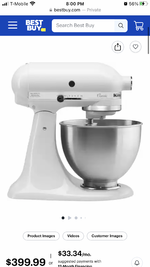
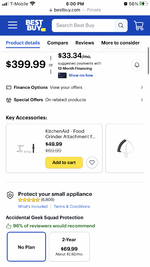
Funny how Best Buy's site says different. This is under "appliances". Scroll down to pricing structure, and you will see it is by sale price.

Just looked and both the stand mixer and hand mixer were 2yr warranty.
 

Attachments

  • Screenshot_2025-10-26-10-59-25-84_3aea4af51f236e4932235fdada7d1643.jpg
    Screenshot_2025-10-26-10-59-25-84_3aea4af51f236e4932235fdada7d1643.jpg
    440.8 KB · Views: 8
  • Screenshot_2025-10-26-10-57-31-42_3aea4af51f236e4932235fdada7d1643.jpg
    Screenshot_2025-10-26-10-57-31-42_3aea4af51f236e4932235fdada7d1643.jpg
    470.8 KB · Views: 7
Last edited:

neophyte

Well-known member
Joined
Apr 23, 2012
Messages
9,590
Location
Pennsylvannia
Funny how Best Buy's site says different. This is under "appliances". Scroll down to pricing structure, and you will see it is by sale price.

Just looked and both the stand mixer and hand mixer were 2yr warranty.
First off, you’re comparing a hand mixer to a stand mixer, which isn’t really the same thing.

Second, while that stand mixer has a 2 year extended warrantee offered, the Artisan 5 Quart stand mixer foes not offer an extended warrantee, so Best Buy or the insurance agency that underwires the policies may have decided against offering an extended warrantee on certain products.
 

Attachments

  • IMG_3781.png
    IMG_3781.png
    914.7 KB · Views: 3
  • IMG_3780.png
    IMG_3780.png
    348.2 KB · Views: 3
  • IMG_3779.png
    IMG_3779.png
    395 KB · Views: 4

neophyte

Well-known member
Joined
Apr 23, 2012
Messages
9,590
Location
Pennsylvannia
Funny how Best Buy's site says different. This is under "appliances". Scroll down to pricing structure, and you will see it is by sale price.

Just looked and both the stand mixer and hand mixer were 2yr warranty.
Also, Best Buy offers 2 or 5 year extended warrantees on TVs, while only offering 2 year extended warrantees, or no extended warrantee, on the mixers.
 

Cruzan80

Well-known member
Joined
Jul 22, 2015
Messages
4,200
Location
Denver, CO
Second, while that stand mixer has a 2 year extended warrantee offered, the Artisan 5 Quart stand mixer foes not offer an extended warrantee, so Best Buy or the insurance agency that underwires the policies may have decided against offering an extended warrantee on certain products.
Or the fact that the one you showed isn't sold by Best Buy, but rather Beach Camera. The "hint" is that it wasn't available for Store Pickup (from this seller)...

You were the one that mentioned hand mixers, so I was pointing out that both hand mixers and stand mixers SOLD By Best Buy (not another seller) have the same warranty. Both of which were driven by price.

They offer different lengths of warranties on different categories, hence my linking appliances. Selling a different length for TV vs mixers doesn't hhelp your initial argument, that "Within a category type, Best Buy sells different lengths of warranties (including none), based on the perceived level of quality of one product vs another." They sell warranties for a given time amount, based on category type and price when purchased. Nothing about quality of one vs another.
 
To avoid these ads, REGISTER NOW!
Top Bottom