To avoid these ads, REGISTER NOW!

Project Farm's Jack Stand round-up!

General Geoff

Well-known member
Joined
Jan 12, 2013
Messages
3,878
Location
Allentown, Pennsylvania


A little disappointed he didn't include the ESCO Tripod-style stands, but the clear winner of this comparison was the U.S. Jack garage stands, thanks to their very wide legs.

Note that even the cheapest Chineseum stand he tested, failed at a whopping 9235 lb downward load for a single stand. The safety factor on modern jack stands is immense.
 
To avoid these ads, REGISTER NOW!

Outahere

Well-known member
Joined
Mar 13, 2021
Messages
874
Location
Idaho
Brands tested: Husky, Arcan, Daytona, Pro-Lift, TCE, Apextreme, Pittsburgh, Big Red, Hein-Werner, and US Jack ranging in price from $31 to over $200. Jack stands compared for load stability, jack tip over, handle release and failure load. I purchased all of the jack stands to ensure an unbiased review. So, thank you for supporting the channel.
 
  • Like
Reactions: LSU

Luciferi

Well-known member
Joined
Mar 24, 2013
Messages
219
In 30+ years of working on cars, I have never supported a car by the rear axle. I definitely would not consider it with the stands so close together. I don’t think have I ever use a small stand at max height either, I go to bigger stand.
 

qqzj

Well-known member
Joined
Nov 28, 2017
Messages
3,747
Most of the jack stands are made in China. It just means that there's a lot of variation in Chinese products ...

The most obvious reason for US Jack to lead is due to design with a wide base. I wonder why others don't use this design?

One thing that he cannot test is the performance after many years of storage and rust. Here I suspect that aluminum ones are more reliable, at least for rusty places.
 

Jim greengo

Well-known member
Joined
Sep 3, 2018
Messages
7,415
Location
Behind my house
Why would anybody put the Jack stands that close together under a rear axle and expect to to be stable?
Atleast put them between the shocks and backing plates.
 
Last edited:

ike

Well-known member
Joined
Apr 9, 2009
Messages
332
The most obvious reason for US Jack to lead is due to design with a wide base. I wonder why others don't use this design?

I would assume that the models he tested are largely geared towards the homeowner/diy'er, and the wider stand would be viewed as taking up more room for storage. I don't think the average Husky/Pittsburgh jack stand buyer is putting a lot of thought into the design.
 

CallumRD1

Well-known member
Joined
Jul 7, 2017
Messages
339
Location
Colorado
Why would anybody put the Jack stands that close together under a rear axle and expect to to be stable?
Atleast put them between the shocks and axle plates.
When it comes to the failure mode he used in the testing, the separation of the stands doesn't matter. Spacing them wider wouldn't increase the amount of force necessary to tip the vehicle.
 

Jim greengo

Well-known member
Joined
Sep 3, 2018
Messages
7,415
Location
Behind my house
When it comes to the failure mode he used in the testing, the separation of the stands doesn't matter. Spacing them wider wouldn't increase the amount of force necessary to tip the vehicle.
I'd say spacing them wider apart would be more like real world conditions.
I say spacing them apart will make them much more stable,and increase the load required to make them tip.
 

CallumRD1

Well-known member
Joined
Jul 7, 2017
Messages
339
Location
Colorado
I'd say spacing them wider apart would be more like real world conditions.
I say spacing them apart will make them much more stable,and increase the load required to make them tip.
That's not how the physics works. If the load were applied up or down at the wheel (like torquing a lug nut with a breaker bar) then you'd be correct because of the increased length of the moment arm from your hand to the jack stand contact point. But for the failure mode tested in the video with a lateral force, the failure is caused by the stand tipping so the hypotenuse formed by it's base and height becomes the upright, lifting the entire vehicle a few inches. Once that hypotenuse passes vertical (the cradle of the stand pass over the edge of the base) the vehicle falls. This is completely independent of the spacing in-between the jack stands. More so, you'd actually get the exact same result if you only had one jack stand centered on the rear axle or ten jack stands evenly spaced across the axle. The lateral force you're applying is just lifting the vehicle so the number of rotation points doesn't matter.

The reason a wider stand has a larger force required to tip the vehicle is (to a first approximation, the trigonometry has a few subtleties that do matter) because the wider base (or shorter height) causes the hypotenuse to be longer than with a narrower base, meaning that the vehicle has to lift higher into the air before it falls over. Lifting the vehicle higher requires applying more force to reach failure which we experience as greater stability.
 
Last edited:

M6erfan

Well-known member
Joined
Dec 6, 2014
Messages
10,170
Location
'Merica!
Would have liked to see the Esco stands tested as well.

Years ago when shopping for new jack stands it was between the Hein Warner, Esco, and U.S. Jack. I went with U.S. Jack mainly due to recommendations here on GJ. This test makes me feel pretty good about my decision.

The $80 Big Red's are pretty impressive.

:beer:
 

Jim greengo

Well-known member
Joined
Sep 3, 2018
Messages
7,415
Location
Behind my house
That's not how the physics works. If the load were applied up or down at the wheel (like torquing a lug nut with a breaker bar) then you'd be correct because of the increased length of the moment arm from your hand to the jack stand contact point. But for the failure mode tested in the video with a lateral force, the failure is caused by the stand tipping so the hypotenuse formed by it's base and height becomes the upright, lifting the entire vehicle a few inches. Once that hypotenuse passes vertical (the cradle of the stand pass over the edge of the base) the vehicle falls. This is completely independent of the spacing in-between the jack stands. More so, you'd actually get the exact same result if you only had one jack stand centered on the rear axle or ten jack stands evenly spaced across the axle. The lateral force you're applying is just lifting the vehicle so the number of rotation points doesn't matter.

The reason a wider stand has a larger force required to tip the vehicle is (to a first approximation, the trigonometry has a few subtitles that do matter) because the wider base (or shorter height) causes the hypotenuse to be longer than with a narrower base, meaning that the vehicle has to lift higher into the air before it falls over. Lifting the vehicle higher requires applying more force to reach failure which we experience as greater stability.
Ok,put 175lbs of pressure against the side of a motorcycle on a kickstand and see what affect it has.
Now put the same amount pressure against a motorcycle with a side car and see what it does.
Same affect as a wider wheel base on a vehicle,it makes it's more stable.
I'm no engineer,but I've built enough things over the years to understand a few things about stability.
It's the same affect as the wider base on some of those jack stands.
You're spreading the load over a wider area making it more stable.
 
OP
G

General Geoff

Well-known member
Joined
Jan 12, 2013
Messages
3,878
Location
Allentown, Pennsylvania
I'm no engineer,but I've built enough things over the years to understand a few things about stability.
The lateral stability you are inferring is only attained when the wider support structure is fixed solidly to the mass it is supporting.

Stick a jug of water onto a 3 foot wide 2x4 and support it with two empty soda cans. First place the cans touching each other directly under the jug, and nudge the jug till it falls over. To be scientific, use a postage scale to measure how much force was needed to push it over.

Now repeat the experiment but with the two soda cans placed on the far ends of the 2x4. Nudge the jug again using the same scale. It will topple with roughly the same amount of force.
 

M6erfan

Well-known member
Joined
Dec 6, 2014
Messages
10,170
Location
'Merica!
Ok,put 175lbs of pressure against the side of a motorcycle on a kickstand and see what affect it has.
Now put the same amount pressure against a motorcycle with a side car and see what it does.
Same affect as a wider wheel base on a vehicle,it makes it's more stable.
I'm no engineer,but I've built enough things over the years to understand a few things about stability.
It's the same affect as the wider base on some of those jack stands.
You're spreading the load over a wider area making it more stable.

Sorry, but bad analogy. The sidecar has a wider footprint than the kickstand (not to mention several other variables that makes the comparison moot).

Weld kickstands, with the same angle and footprint of the original, to the front and real axles of the motorcycle. It should topple with the same 175 lb/ft of pressure (using your example).

I'm not an engineer.
 

Jim greengo

Well-known member
Joined
Sep 3, 2018
Messages
7,415
Location
Behind my house
Sorry, but bad analogy. The sidecar has a wider footprint than the kickstand (not to mention several other variables that makes the comparison moot).

Weld kickstands, with the same angle and footprint of the original, to the front and real axles of the motorcycle. It should topple with the same 175 lb/ft of pressure (using your example).

I'm not an engineer.
The side car is just a generalization of the affects of a wider wheelbase making things more stable is all.
It doesnt matter if you lengthen a wheel base from front to rear,or side to side.
It has the same affect of making things more stable.
Same affect as spreading your feet out versus keeping them together when some one pushes you from the side.
 

Jim greengo

Well-known member
Joined
Sep 3, 2018
Messages
7,415
Location
Behind my house
Sorry, but bad analogy. The sidecar has a wider footprint than the kickstand (not to mention several other variables that makes the comparison moot).

Weld kickstands, with the same angle and footprint of the original, to the front and real axles of the motorcycle. It should topple with the same 175 lb/ft of pressure (using your example).

I'm not an engineer.
Kickstands on the same side of a bike is only protecting it from falling in the direction that the bike is leaning to on the kickstand.
Putting a bike on a center stand or putting kickstands on both sides of a bike would work a lot better to stabilize it.
A side car on the other hand the same affect as a wider wheel base,its a whole hell of a lot harder to knock over.
I'm no engineer either,but I've spent a lot of years redoing their work for them.
 

Jim greengo

Well-known member
Joined
Sep 3, 2018
Messages
7,415
Location
Behind my house
The lateral stability you are inferring is only attained when the wider support structure is fixed solidly to the mass it is supporting.

Stick a jug of water onto a 3 foot wide 2x4 and support it with two empty soda cans. First place the cans touching each other directly under the jug, and nudge the jug till it falls over. To be scientific, use a postage scale to measure how much force was needed to push it over.

Now repeat the experiment but with the two soda cans placed on the far ends of the 2x4. Nudge the jug again using the same scale. It will topple with roughly the same amount of force.
How about using something a little bigger than empty pop cans,like empty coffee cans?
Or full pop cans?
That would be a little more realistic dont ya think?
 
To avoid these ads, REGISTER NOW!

M6erfan

Well-known member
Joined
Dec 6, 2014
Messages
10,170
Location
'Merica!
Kickstands on the same side of a bike is only protecting it from falling in the direction that the bike is leaning to on the kickstand.
Putting a bike on a center stand or putting kickstands on both sides of a bike would work a lot better to stabilize it.
A side car on the other hand the same affect as a wider wheel base,its a whole hell of a lot harder to knock over.
I'm no engineer either,but I've spent a lot of years redoing their work for them.

It's the stability of the jack stand that matters. Whether you put it inboard or at the furthest points allowable, the jack stand is still the same.

You have it right in at least one respect though, make a wider more stable jack stand and the force required to wobble increases. And that force to wobble will be pretty much the same no mater where it is placed on the axel.
 

Jim greengo

Well-known member
Joined
Sep 3, 2018
Messages
7,415
Location
Behind my house
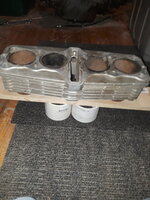
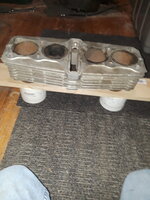
Here's a simple example of the affects of spacing on stability,not scientific of course.
Just and old kawasaki j motor cylinder sitting on a 1x4 and some 3" pvc couplings spaced ar differant centers for each video on my phone.
I have an old 1170 motor sitting there,but dont want to deadlift 175lbs on to a piece of wood and try to balance it right now.
Anyway let's see if my little non scientific videos will load! Hahaha
How the hell do you get a video to work on here,says wrong extension when I try to post it? Hahaha
 

Jim greengo

Well-known member
Joined
Sep 3, 2018
Messages
7,415
Location
Behind my house
Cant get the videos of my little experiment to work.
So I just took pictures of it being supported each way.
Which 1 do you think is going to be more stable?20221211_183820.jpg20221211_183837.jpg
 

dogdog

Well-known member
Joined
Nov 15, 2011
Messages
12,711
Lol finish watching PF videos feel like I just came back from OTB.
 

Jim greengo

Well-known member
Joined
Sep 3, 2018
Messages
7,415
Location
Behind my house
Just working with what I've got laying in the back room.
That old cylinder block and 1x4 moved pretty easy with the couplings sitting right next to each other,with little force at all.
It's a hell of a lot more stable with the couplings spread out even with outside sleeves.
Cant make it much simpler than that.
 

ATC

Well-known member
Joined
May 12, 2012
Messages
8,345
Location
VA
Why would anybody put the Jack stands that close together under a rear axle and expect to to be stable?
Atleast put them between the shocks and backing plates.

He put them where he did for the test because the tires wouldn't interfere with the stands too bad. You can see that when the truck partially crushed one of the jackstands, and a couple others hit the sidewall.

If he put the stands between the shocks and backing plates, the test he set up would not work.

Either way, the results are the same. Spacing them wider would not change the numbers. The test is showing how much force it takes to overcome the jackstands center of gravity. The COG of the stands don't change just because you move them farther apart.
 

dnschmidt

Well-known member
Joined
Oct 3, 2014
Messages
7,289
Location
Phoenix, AZ
In 30+ years of working on cars, I have never supported a car by the rear axle. I definitely would not consider it with the stands so close together. I don’t think have I ever use a small stand at max height either, I go to bigger stand.
Agreed, I've done it when I've had all four wheels are off the ground but never just the rear two and when I've done it they were as far apart as they could get. On most modern cars, which are front wheel drive for the most part, the rear axel isn't very stout as they don't have a differential and are meant to be lifted at the pinch welds. Clearly they were too close together and jack stands far too extended. If I was trying to lift something that high I'd use 6 ton stands rather than 3 ton. Project Farm tries hard but sometimes misses the mark and I think they did that this time. None of the stands were much better than the average with a couple of duds in the mix. To me the super wide base model was basically cheating as it obviously would have more resistance to tipping over and for the price of these you could get four of the Harbor Freight Daytona 6 ton models which are equally as wide. A swing and a miss on PF's part.
 
Last edited:

F-22

Well-known member
Joined
Jan 23, 2022
Messages
1,830
pf.PNG

While this does not really indicate their strength, it disturbed me that he repeated a few times on how the first cheapest stands got bent when it tipped over (because the tire crushed them), but does not mention it at all with the US made stands - but the left one clearly got bent. If he mentions it at the cheap one (whether it's relevant or not), it makes me think he's showing some bias when he does not mention it with the most expensive one.


I think it's common sense that a wider support won't tip over as easily. Not just spreading the stands - all the individual stands that withstood more sideways force, had a wider individual base/support too.
 

kettch

Member
Joined
Dec 7, 2016
Messages
16
That's not how the physics works. If the load were applied up or down at the wheel (like torquing a lug nut with a breaker bar) then you'd be correct because of the increased length of the moment arm from your hand to the jack stand contact point. But for the failure mode tested in the video with a lateral force, the failure is caused by the stand tipping so the hypotenuse formed by it's base and height becomes the upright, lifting the entire vehicle a few inches. Once that hypotenuse passes vertical (the cradle of the stand pass over the edge of the base) the vehicle falls. This is completely independent of the spacing in-between the jack stands. More so, you'd actually get the exact same result if you only had one jack stand centered on the rear axle or ten jack stands evenly spaced across the axle. The lateral force you're applying is just lifting the vehicle so the number of rotation points doesn't matter.

The reason a wider stand has a larger force required to tip the vehicle is (to a first approximation, the trigonometry has a few subtleties that do matter) because the wider base (or shorter height) causes the hypotenuse to be longer than with a narrower base, meaning that the vehicle has to lift higher into the air before it falls over. Lifting the vehicle higher requires applying more force to reach failure which we experience as greater stability.
I'd also add that he was probably also trying to not destroy the jacks. He damaged that one early on because the wheel came down on it. It seemed like they were a little narrower after that. Not really relevant to the tests, but more a limitation of the testing circumstances.

While this does not really indicate their strength, it disturbed me that he repeated a few times on how the first cheapest stands got bent when it tipped over (because the tire crushed them), but does not mention it at all with the US made stands - but the left one clearly got bent. If he mentions it at the cheap one (whether it's relevant or not), it makes me think he's showing some bias when he does not mention it with the most expensive one.

It's possible that it's just a quirk of editing, or he just forgot it. That happens sometimes just due to the sheer amount of data he includes. Either way, I don't think that I'd ever trust any jack stand, regardless of apparent damage, if it was involved in a tip-over. There are forces outside of the design spec that were applied, so it could be weakened in some way.
 
Last edited:

Lucid Moments

Well-known member
Joined
Aug 9, 2015
Messages
1,775
Location
Gainesville, Ga
A little disappointed he didn't include the ESCO Tripod-style stands, but the clear winner of this comparison was the U.S. Jack garage stands, thanks to their very wide legs.

Note that even the cheapest Chineseum stand he tested, failed at a whopping 9235 lb downward load for a single stand. The safety factor on modern jack stands is immense.
While I agree that the U.S. Jack garage stands were clearly the best quality I am not sure the quality is worth the price. 300% to 500% price premium is a lot to swallow.
 

WWheeler

Well-known member
Joined
Jun 23, 2015
Messages
4,105
Location
Middleofnowhere USA
I'm surprised the US Jack failed at "only" 9k.

I believe it broke one of the ears of the cradle because he was pressing on them and not the middle of the cradle where it would normally be holding a load. Never would there be a load out on the ends that I could imagine so I'm nnot sure why he set it up like that or what can actually be gleaned from testing it like that.

All that said, I wouldn't spend the extra coin on them. Sure wider is more stable but too often a jack stand winds up being in my way of where I need to be as it is and it's wider base just makes that more of an issue. All of them passed with a high enough force before tipping that it would never be a safety issue for me.
 

Steve_P

Well-known member
Joined
Sep 15, 2010
Messages
5,186
I thought this was a good test like most everything he does. Yes, the destruction stuff is typically somewhat pointless, but in the case of a jack stand, I think the ultimate strength is actually highly relevant- as opposed to putting 600 lbf on a pair of pliers in a hydraulic press - which no human could possibly do. Keep in mind that he's also going for an entertainment factor.

On a solid rear axle vehicle, I typically put the jack stands under the axle tubes and close to the wheels. The only time I don't do this is if I want the axle to hang down for access above it. I realize that there are always people here who find something to nitpick about in his tests (nitpicking is easier than actually doing), but I was surprised to see this pointed out as objectional- it's perfectly fine. Yes, he put them inboard, but that was for a reason, as pointed out.

As far as tipping, if you tested all the jack stands at the same support height, the one with the widest base in the direction of the applied force will have the highest required force to tip over. This is a simple summation of moments, and second year Statics class in Mechanical Engineering.
 

Cruzan80

Well-known member
Joined
Jul 22, 2015
Messages
4,308
Location
Denver, CO
Just working with what I've got laying in the back room.
That old cylinder block and 1x4 moved pretty easy with the couplings sitting right next to each other,with little force at all.
It's a hell of a lot more stable with the couplings spread out even with outside sleeves.
Cant make it much simpler than that.
Your "jack stands" dont narrow at the top, so they arent a triangle, and the CoG travels much further while staying over the base.
 
To avoid these ads, REGISTER NOW!
Top Bottom