To avoid these ads, REGISTER NOW!

Propane regulator - second stage indoors

traumadoc2b

Well-known member
Joined
Jun 17, 2014
Messages
104
Location
Indianapolis
Ongoing project, building new construction. I ran the utilities, which all enter the house below grade, except for the propane line. I have 3/4" poly underground from the tank/first stage to a riser, a union, then into the basement just above grade.

Question is, I had the propane company out today to set the tank and they wouldn't hook up because he didn't feel comfortable with the second stage regulator being indoors. Now, I can respect that, but I am trying to remember justification to disagree with him.

I cannot cite code or references (unfortunately), but I know I did a lot of research on this last year when installing the line. I feel pretty confident that everything meets or exceeds code and I'm fairly certain I reviewed the NFPA fuel code when making the final decision on where to locate the regulator. The relief vent/outlet from the second stage regulator is appropriately vented to the outside with proper clearances from the ground, building, ignition sources, and fenestrations/windows, etc.

Can anyone help me out with this? I'm not saying I want to argue with this guy - if he doesn't feel comfortable, like I said I can respect that. But if I ensure that I feel comfortable, I can look for someone else.
 
To avoid these ads, REGISTER NOW!

HoosierBuddy

Well-known member
Joined
May 9, 2006
Messages
2,915
Location
Southern Indiana
I have a copy of the 2009 national fuel code. NFPA® 54 ANSI Z223.1,
What you're discussing is a line pressure regulator by code. That's a regulator between the service regulator and the appliance regulator. They are allowed. They must be vented.

5.8.5 Venting.
5.8.5.1 Line Gas Pressure Regulators. Line gas pressure regulators
shall comply with the following:
(1) An independent vent to the exterior of the building, sized
in accordance with the regulator manufacturer’s instructions,
shall be provided where the location of a regulator
is such that a ruptured diaphragm will cause a hazard.
(a) Where more than one regulator is at a location, each
regulator shall have a separate vent to the outdoors
or, if approved by the authority having jurisdiction,
the vent lines shall be permitted to be manifolded in
accordance with accepted engineering practices to
minimize back pressure in the event of diaphragm
failure. (See 5.9.7 for information on properly locating the
vent.)
(b) Materials for vent piping shall be in accordance with
Section 5.6.
Exception: A regulator and vent limiting means combination listed
as complying with ANSI Z21.80/CSA 3.7, Line Pressure Regulators,
shall be permitted to be used without a vent to the outdoors.
(2) The vent shall be designed to prevent the entry of water,
insects, or other foreign materials that could cause blockage.
(3) The regulator vent shall terminate at least 3 ft (0.9 m)
from a source of ignition.
(4) At locations where regulators might be submerged during
floods, a special antiflood-type breather vent fitting shall
be installed, or the vent line shall be extended above the
height of the expected flood waters.
(5) A regulator shall not be vented to the appliance flue or
exhaust system.
5.8.5.2 Appliance Pressure Regulators. For venting of gas appliance
pressure regulators, see 9.1.19.
5.8.6 Bypass Piping. Valved and regulated bypasses shall be
permitted to be placed around gas line pressure regulators
where continuity of service is imperative.
5.8.7 Identification. Line pressure regulators at multiple
regulator installations shall be marked by a metal tag or other
permanent means designating the building or the part of the
building being supplied.

The Material section 5.6 is essentially just a list of what can be used for gas line materials. It's a pretty big section...but in summary it's saying the vent material has to be an approved gas line material.

5.9.7 describes vent requirments:

5.9.7 Vents.
5.9.7.1 The discharge stacks, vents, or outlet parts of all pressure
relieving and pressure limiting devices shall be located so
that gas is safely discharged to the outdoors. Discharge stacks
or vents shall be designed to prevent the entry of water, insects,
or other foreign material that could cause blockage.
5.9.7.2 The discharge stack or vent line shall be at least the
same size as the outlet of the pressure relieving device.

Phil
 

mcbane

Well-known member
Joined
Jul 23, 2017
Messages
794
Location
California
NFPA 58 allows indoor installation. But there be local codes related to this. Probably best to confirm that a local code doesn’t prohibit your install.
 
OP
T

traumadoc2b

Well-known member
Joined
Jun 17, 2014
Messages
104
Location
Indianapolis
Phil, thanks for refreshing my memory, particularly your reference to line regulators. That and your quote from the code led me to my reference, which was the Emerson/Fisher Installation materials for my regulator. They had a description of indoor installation and outdoor venting. I dug a little deeper and found additional info in a brochure from Fisher on regulator inspection.

Long story short, I am reassured that my installation meets code. I believe I can vaguely recall talking with the lead heating inspector about my planned install and was told that'd be fine - I know I asked him about the location of my shutoff for the fireplace.

With regard to the local AHJ question, my work was pressure tested, inspected, and signed off. Granted, they did not inspect the underground line, but the service stage/line regulator and vent were within the building and 'inside' the inspection sticker they placed on the riser, outside the house.

The propane company service tech mentioned concern for leaking regulators/rubber gaskets. Has anyone seen this as a real problem? If the diaphragm leaks, it should exit through the vent line to outside. Leaking at the gasket sounds like a freak thing for a regulator that's within its service life.
 

Attachments

  • Emerson Propane Regulator R600 - HSRL Series Instruction Manual.pdf
    580.7 KB · Views: 11
  • LP Gas Regulator Inspection Bulletin Emerson Fisher .pdf
    1.5 MB · Views: 4
  • Reg-O L-545_Servicemans_Manual.pdf
    966.8 KB · Views: 6
Last edited:

yeldogt

Well-known member
Joined
Jan 2, 2012
Messages
18,184
You may run into an issue when trying to do its ...... they do make a special regulator w/ a cover and copper tube (vent) that you extend out to daylight.

I assume this may be a regional thing ..... around me they want them outside and even hidden they get twitchy. I always place mine behind a door/ cabinet that hides the electric meter and other stuff and have had guys not want to do it w/o a vented regulator. My cabinets are vented and don't extend to the ground ... so, plenty of circulation
 
OP
T

traumadoc2b

Well-known member
Joined
Jun 17, 2014
Messages
104
Location
Indianapolis
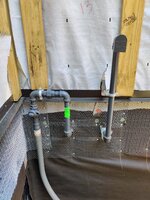
Not sure what special regulator to look for. The installation guide for this Emerson includes instructions specifically for indoor installation. You can see in the pics that the vent is piped outside, above grade, with the opening pointed downwards and covered with mesh.

The only thing I can think of on this install is that the vent opening on the regulator isn't pointing down - could possibly collect some condensation. However, it is indoors/conditioned (warm) and the underground poly run from the tank/first stage is well over 100', should allow for temperature change with the pressure drop and maybe decrease some of the potential for condensation in the second stage.
 

Attachments

  • vent.jpg
    vent.jpg
    530.9 KB · Views: 36
  • second stage.jpg
    second stage.jpg
    267.7 KB · Views: 41
To avoid these ads, REGISTER NOW!

yeldogt

Well-known member
Joined
Jan 2, 2012
Messages
18,184
That is a regulator with a piped vent .. that is different looking vs the ones I have outside. Obviously the ones outside don't need that threaded port on them.

In my area the best way to have new service piped is to have the propane company do it ... In my case they were there when the excavator was there and they did all the lines and the tank/ primary as well. You don't even need a permit -- the propane company does it and certifies the install and fills the tank. It's on them. They don't like those types of installs -- it's like .... why do you want to do that? Outside eliminates all the potential problems -- leaking etc.

Maybe if I wanted it inside I could get a plumber and pull permits -- I'm not saying it's not possible.

We get snow -- But -- I'm in the mid-atlantic. We don't get 10' of snow and 2 months of sun zero temps. They have a riser height for the regulator and that is it. In other areas putting them inside may be the norm for some reason -- snow or cold?
 
Last edited:

TractorJeff

Well-known member
Joined
Dec 8, 2013
Messages
3,309
Location
Elkhorn, WI
While true that all the research and inspections can be passed and signed off. The final decision on the Propane Tank fill is still the decision of the Supplier! I would just re-pipe it to satisfy the Supplier! Once they have you on the "Fill Schedule", then decide if you want to change it back to your original install as they do not typically (around here) inspect the piping at each Refill.
 
OP
T

traumadoc2b

Well-known member
Joined
Jun 17, 2014
Messages
104
Location
Indianapolis
A member of the family who owns the propane company came to fill the tank yesterday. He said he looked at his books, said it would be fine - just not something they typically see. He looked over my installation and again said OK. They will re-check and set the first stage regulator as needed to limit pressure to less than 10 psi, which the second stage/line regulator install manual lists as the inlet pressure limit.
 

PoorUB

Well-known member
Joined
Mar 29, 2021
Messages
11,621
Location
Fargo, ND
Most places will not allow over 2 PSI gas inside a residence. If your 1st stage is regulating down to 10 PSI it would not be allowed in my area. You could regulate down to 2 PSI at the tank and then the second stage regulator can be in the house. My area follows International Mechanical Code or International Fuel Gas Code which is fairly common in the USA.

Also the manufacturer's manual does not know what code is in your area. They can give you do's and don'ts for installation for their equipment, but that doesn't mean it meets code in your area.

So the pressure is the issue, not the regulator installation.
 
Last edited:

yeldogt

Well-known member
Joined
Jan 2, 2012
Messages
18,184
Most places will not allow over 2 PSI gas inside a residence. If your 1st stage is regulating down to 10 PSI it would not be allowed in my area. You could regulate down to 2 PSI at the tank and then the second stage regulator can be in the house. My area follows International Mechanical Code or International Fuel Gas Code which is fairly common in the USA.

Also the manufacturer's manual does not know what code is in your area. They can give you do's and don'ts for installation for their equipment, but that doesn't mean it meets code in your area.

So the pressure is the issue, not the regulator installation.
That's a logical reason ... I guess there are different primary regulators?

I was told the 1/4 line form the tank will do over 1m BTU -- kinda scary. From there it's always been 3/4 out to the buildings .... even a big house a good distance from the tank is covered w/ 3/4"
 
To avoid these ads, REGISTER NOW!
Top Bottom