To avoid these ads, REGISTER NOW!

Proper lathe stand

katit

Well-known member
Joined
May 5, 2006
Messages
862
Location
St. Louis, MO
I am thinking about getting lathe. I got rid of my 9x20, because of basement refinish and no space. Now that I am close to getting this done I am thinking which lathe to get.

Thinking this: https://www.precisionmatthews.com/shop/pm-1340gt/
BTW, if you have anything to say about it - please do. I really don't want to mess with "old american". And working envelope of this one should do all I need. Most importantly, it's size/weight will be possible to get into the basement.

Question is about getting it setup. I really dislike stands they sell. I'd rather get HF toolbox and set it on a floor (level of course). Much more storage for similar price. What other options for good lathe bench? And I couldn't find specs for bench height..

I am just not sure what else should I consider?
 
To avoid these ads, REGISTER NOW!

Jswain

Well-known member
Joined
Apr 26, 2013
Messages
2,457
Location
Calgary, AB
Lathes are something that benefit from a heavy, rigid stand. I don't think you will find that with a HF toolbox

To put it lightly the precision Matthews stand is built with 3/16" steel plate. So use nothing less
 

marinusdees

Well-known member
Joined
Oct 30, 2012
Messages
1,325
Location
Edgewood, Washington
I am thinking about getting lathe. I got rid of my 9x20, because of basement refinish and no space. Now that I am close to getting this done I am thinking which lathe to get.

Thinking this: https://www.precisionmatthews.com/shop/pm-1340gt/
BTW, if you have anything to say about it - please do. I really don't want to mess with "old american". And working envelope of this one should do all I need. Most importantly, it's size/weight will be possible to get into the basement.

Question is about getting it setup. I really dislike stands they sell. I'd rather get HF toolbox and set it on a floor (level of course). Much more storage for similar price. What other options for good lathe bench? And I couldn't find specs for bench height..

I am just not sure what else should I consider?
Bench height depends on how tall you are. Unless you plan to work sitting down.
 

BTL-A4

Well-known member
Joined
Feb 28, 2018
Messages
1,252
Location
Santa Clarita
You can also make a sturdy table out of wood, Use 4x4's for the legs, bolt it to the floor. Make the top out of plywood: laminate two 3/4" or thicker sheets together and top that with a piece of steel.

The other option is to fabricate one out of steel.
 
OP
K

katit

Well-known member
Joined
May 5, 2006
Messages
862
Location
St. Louis, MO
I am not necessary wanting to fabricate something. My main dilemma is space use. I'd rather have storage under lathe since I am not working sitting, and there is a lot of tooling/etc. Tool box under lathe makes sense to me.
 

Jswain

Well-known member
Joined
Apr 26, 2013
Messages
2,457
Location
Calgary, AB
I am not necessary wanting to fabricate something. My main dilemma is space use. I'd rather have storage under lathe since I am not working sitting, and there is a lot of tooling/etc. Tool box under lathe makes sense to me.
If you're stuck on the toolbox underneath I'd build a table overtop of the toolbox.(which then might be making the lathe pretty tall) or use a thick piece of plate steel between the lathe & the box, or thick wood.

That lathe ain't gonna be happy on top of a flimsy box, period
 

larry_g

Well-known member
Joined
Apr 28, 2007
Messages
16,874
Location
oregon
My experience:
When I was first getting into machining I ended up with two identical Logan lathes. One was mounted on a welded tube frame that was plenty rigid and stout for the job. The second was mounted on a custom made wooden desk that was hardwood and very well made. The lathe on steel would set up a chatter that could get the whole bench to move. The lathe on the wooded bench was solid and das not prone to chatter. I went so far as to swap the lathes on the stands and the chatter followed the stand. Bu my figuring the wood has a very low resonant frequency and would damp out the chatter while the steel has a high resonant frequency that accentuated the problems in the lathe design.

That said I would not mount that big of a lathe on a tool box. The lathes like your looking at somewhat depend on the base it's mounted on to add rigidity and strength to the lathe. Mass in what the lathe is mounted to is required in my mind.

lg
no neat sig line
 
Last edited:

whateg01

Well-known member
Joined
Mar 13, 2006
Messages
11,223
Location
doo dah, kansas, usa
If this was a smaller machine I would say the toolbox is just fine. Smaller machines don't benefit as much from a rock solid foundation. But this is a bit bigger than your old 9x20.
 
OP
K

katit

Well-known member
Joined
May 5, 2006
Messages
862
Location
St. Louis, MO
Then maybe some kind of metal frame (custom built) where I can pour 4-6in concrete top?
I am 6'1" tall, little taller is OK. I can just place toolbox under top which will be bolted to the floor.
 

alfazer

Well-known member
Joined
Nov 1, 2011
Messages
393
Location
N. Ireland
If you want your lathe to be really accurate you are best to have a bench with a heavy top to attach the lathe to. If you turn a test piece to check for parallel accuracy and you find it running off a few thou, then you can "level" the bed by adjusting these screws, ideally with an adjusting nut. This allows you adjust any twist in the bed ever so slightly to improve the accuracy, but you won't be able to do this if the bench top is not sturdy.
The word "level" doesn't mean level in the usual sense, but rather means than the bed is not twisted. (Apologies if you already know about this)
 
OP
K

katit

Well-known member
Joined
May 5, 2006
Messages
862
Location
St. Louis, MO
If you want your lathe to be really accurate you are best to have a bench with a heavy top to attach the lathe to. If you turn a test piece to check for parallel accuracy and you find it running off a few thou, then you can "level" the bed by adjusting these screws, ideally with an adjusting nut. This allows you adjust any twist in the bed ever so slightly to improve the accuracy, but you won't be able to do this if the bench top is not sturdy.
The word "level" doesn't mean level in the usual sense, but rather means than the bed is not twisted. (Apologies if you already know about this)
I understand what you mean. How do commercial lathe tables work? From what I can tell you only level by legs, not "top"
 

alfazer

Well-known member
Joined
Nov 1, 2011
Messages
393
Location
N. Ireland
I'm not sure, but in my head the table needs to be slightly more rigid than the lathe bed so the adjusting the screws will twist the bed.
A reason you might level the legs could be to help coolant drain, or just having the satisfaction of knowing it's level, even though it's not that important. For example, ships often have lathes and they cope okay.
 

Jswain

Well-known member
Joined
Apr 26, 2013
Messages
2,457
Location
Calgary, AB
That one definitely looks sturdy enough. Looks like a thick plate top with thick wall tube. Level the table as best you can then level the bed of the lathe with a test bar and feeler gauges/shims between the table and the tailstock and possibly the headstock base

If you don't do this do not expect it to maintain its cut for more than an inch or so
 
OP
K

katit

Well-known member
Joined
May 5, 2006
Messages
862
Location
St. Louis, MO
That one definitely looks sturdy enough. Looks like a thick plate top with thick wall tube. Level the table as best you can then level the bed of the lathe with a test bar and feeler gauges/shims between the table and the tailstock and possibly the headstock base

If you don't do this do not expect it to maintain its cut for more than an inch or so
Shims is what bothers me. I feel like once you start using shims - all rigidity you built in goes out of the window..
 

Duker

Well-known member
Joined
Sep 25, 2010
Messages
10,861
Location
Livingston, TX
That one definitely looks sturdy enough. Looks like a thick plate top with thick wall tube. Level the table as best you can then level the bed of the lathe with a test bar and feeler gauges/shims between the table and the tailstock and possibly the headstock base

If you don't do this do not expect it to maintain its cut for more than an inch or so
^^^^^^ This.... Structurally it has plenty of strength. You could always add more mass with filling the tube with sand/lead shot or even making a panel with weight at the bottom.
 

Jswain

Well-known member
Joined
Apr 26, 2013
Messages
2,457
Location
Calgary, AB
Shims is what bothers me. I feel like once you start using shims - all rigidity you built in goes out of the window..
On a table mounted lathe that's how it is done. It doesn't matter how level you get the table you still need to 'level' the bed of the lathe on top of the table by taking cuts on a test bar you make yourself or but a test bar and running an indicator down it.
 
To avoid these ads, REGISTER NOW!
OP
K

katit

Well-known member
Joined
May 5, 2006
Messages
862
Location
St. Louis, MO
Because I don't know that you have the tools or means to ensure it's back together correctly
I don't, I knew that, I heard that, I guess it's a triple-warning now.

On a side note - I need to move it to basement. "Depth" of the crate 30 inches, should fit vertically through the door.
I plan to hire safe movers, 1000lb should be no problem for those guys.

Any issues with getting lathe vertical (headstock down)? I wouldn't be able to re-use wooden crate, but I was thinking about welding temporary "cube" structure out of metal and bolt lathe to it.
 

LopezBart

Well-known member
Joined
Oct 13, 2023
Messages
2,533
Location
Lopez Island, WA
I'm not sure, but in my head the table needs to be slightly more rigid than the lathe bed so the adjusting the screws will twist the bed.
A reason you might level the legs could be to help coolant drain, or just having the satisfaction of knowing it's level, even though it's not that important. For example, ships often have lathes and they cope okay.
Yup... the cross section of the bed is much smaller than that of the table. What matters here is torsion, which is why leveling works well. If both headstock end and tailstock end are level, the bed isn't twisted. I've leveled a small lathe (Atlas 10") w/ shims; it's much easier with screws.
Any issues with getting lathe vertical (headstock down)? I wouldn't be able to re-use wooden crate, but I was thinking about welding temporary "cube" structure out of metal and bolt lathe to it.
I'd make a heavy wooden toboggan to go down the stairs. Metal works too, but a skid w/ 4x6 "runners" is more controllable and kinder to floors, stairs, etc. Ask your movers, too; they may have preferences.
 

Jswain

Well-known member
Joined
Apr 26, 2013
Messages
2,457
Location
Calgary, AB
A good example of why the lathe must be 'level'. Not just the table itself, but that's a good place to start. But the headstock vs tailstock


isb cornbinder

Well-known member
Joined
Nov 3, 2010
Messages
7,073
Location
Pacific South West, BC, Canada
I am thinking about getting lathe. I got rid of my 9x20, because of basement refinish and no space. Now that I am close to getting this done I am thinking which lathe to get.

Thinking this: https://www.precisionmatthews.com/shop/pm-1340gt/
BTW, if you have anything to say about it - please do. I really don't want to mess with "old american". And working envelope of this one should do all I need. Most importantly, it's size/weight will be possible to get into the basement.

Question is about getting it setup. I really dislike stands they sell. I'd rather get HF toolbox and set it on a floor (level of course). Much more storage for similar price. What other options for good lathe bench? And I couldn't find specs for bench height..

I am just not sure what else should I consider?
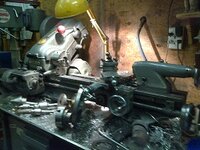
I built a proper base with a 3/8" top. I had a local fab shop fold a 1.5" flange at 45* on the long sides. I welded a matching lip on the ends. The support legs are 1.5" square tube and cross braced and welded. I added adjusters to the bottom of the legs. (aka 1/2" bolts in threaded plates.)
 

Attachments

  • myford 7 lathe.jpg
    myford 7 lathe.jpg
    29.4 KB · Views: 33
  • MYFORD TOOLBOX 1.jpg
    MYFORD TOOLBOX 1.jpg
    103.8 KB · Views: 29
  • MYFORD BERNERD 4 JAW 7 INCH.jpg
    MYFORD BERNERD 4 JAW 7 INCH.jpg
    71.1 KB · Views: 22
  • MYFORD COLLET HOLDER.jpg
    MYFORD COLLET HOLDER.jpg
    65.1 KB · Views: 40

larry_g

Well-known member
Joined
Apr 28, 2007
Messages
16,874
Location
oregon
Lets kill this level ******** right now. The lathebed does not have to be level but it has to all line up on the same plane. The level is the simplest tool to check this with. If the lathebed is level front to back at each end and left to right, that defines and proves it is all on the same plane. Now let's hope that the plane defined by the bottom of the feet is coplanar with the ways of the bed. If that is true and you mount it on a flat surface then it should cut straight. Reality is that the planes of the top and bottom may not be parallel. So you have to adjust, bend, or shim to get things straight. Once that happens then you start cutting bars and checking that the lathe makes a perfect cylinder that is the same diameter the length of the cut. From there you cut a test bar between centers to align the tailstock. This takes some time and understanding to do. Then after a month you go through the procedure again to make sure things haven't settled or moved.

Shimming is standard practice in getting tools aligned and level. I should have said above that in checking the cut is making sure that the centreline of the spindle is parallel to the plane of the ways. If the plane of the ways is twisted then the carriage/cutting tool does not travel in a straight line parallel to the c/l of the spindle. That is a must for cutting cylinders.

lg
no neat sig line
 

whateg01

Well-known member
Joined
Mar 13, 2006
Messages
11,223
Location
doo dah, kansas, usa
Maybe it comes from the fact that leveling the machine is the surest way or simplest way to ensure it's all coplanar. I don't know if that's why it has become the standard term for making sure that the that is not twisted. The same thing happens with 3D printers though. Everybody says level the bed but what they really mean is make sure the bed is flat and not twisted or high in one spot and low in another.
 

GeoBruin

Well-known member
Joined
May 5, 2018
Messages
3,735
This was for a 10 x 24 benchtop lathe. The cross members coincide with the location of the mounting bolts.
 

Attachments

  • 20240305_153953.jpg
    20240305_153953.jpg
    840.2 KB · Views: 41

Mallen

Well-known member
Joined
Aug 11, 2021
Messages
649
I am thinking about getting lathe. I got rid of my 9x20, because of basement refinish and no space. Now that I am close to getting this done I am thinking which lathe to get.

Thinking this: https://www.precisionmatthews.com/shop/pm-1340gt/
BTW, if you have anything to say about it - please do. I really don't want to mess with "old american". And working envelope of this one should do all I need. Most importantly, it's size/weight will be possible to get into the basement.

Question is about getting it setup. I really dislike stands they sell. I'd rather get HF toolbox and set it on a floor (level of course). Much more storage for similar price. What other options for good lathe bench? And I couldn't find specs for bench height..

I am just not sure what else should I consider?
Make a welded steel stand and top it with a 4" thick slab of countertop concrete. The concrete makes a massive difference.
 

Caa311

Well-known member
Joined
Jan 2, 2016
Messages
762
Location
Virginia
On a table mounted lathe that's how it is done. It doesn't matter how level you get the table you still need to 'level' the bed of the lathe on top of the table by taking cuts on a test bar you make yourself or but a test bar and running an indicator down it.
Shims are not a problem, you just want to make sure you don't have a soft foot.
 

haveissues

Well-known member
Joined
Feb 9, 2011
Messages
379
Location
Hudson Valley NY
I had a smaller PM lathe and it was fine. I ended up replacing it with a 5hp Romi and it is a night and day difference though. Give it some thought - you are going to be at 10k by the time you ship it, get a couple of chucks, toolpost with holders, etc. You can buy a really nice lathe for a lot less with a bunch of tooling if you look around.
 
OP
K

katit

Well-known member
Joined
May 5, 2006
Messages
862
Location
St. Louis, MO
I had a smaller PM lathe and it was fine. I ended up replacing it with a 5hp Romi and it is a night and day difference though. Give it some thought - you are going to be at 10k by the time you ship it, get a couple of chucks, toolpost with holders, etc. You can buy a really nice lathe for a lot less with a bunch of tooling if you look around.

Yeah. I know. It's a big dilemma. But I just want to use it and not be a "restorer". I have many other projects.

Hardinge HLV looks like a dream machine. But again, whatever I get have to go down stairs. I am limited to about 1000lb and 30 inch wide so safe movers can get it into the basement.

I am not pro machinist, even getting good used - I wouldn't know what to look for. I get and idea, but not like I know that stuff. Anybody from St Louis willing to shop with me for used lathe for a fee?? :) I am up for it. I know good one could be bought for less.

And then again, I don't have equipment to haul purchased lathe home. And my time worth some money so spending days buying also worth something.
 

NUTTSGT

Super Moderator
Staff member
Joined
Sep 14, 2009
Messages
50,900
Location
Northern Central Ohio
The Mathews stand is $100 less than the HF 56" box. A smaller lathe on a HF box, yeah maybe but the lathe you are looking at weighs 1100 pounds. I'm not sure the HF will handle that for an extended period especially with the vibrations of the machine running.

I think I would go with their stand, which ships free with the lathe shipping flat fee.

I would consider buying their stand and take the $100 saved and buy something like this from HF for tooling.


This could be moved to where you are working closer or farther away from the standing position at the lathe or back against the wall when not in use.
 

haveissues

Well-known member
Joined
Feb 9, 2011
Messages
379
Location
Hudson Valley NY
Yeah. I know. It's a big dilemma. But I just want to use it and not be a "restorer". I have many other projects.

Hardinge HLV looks like a dream machine. But again, whatever I get have to go down stairs. I am limited to about 1000lb and 30 inch wide so safe movers can get it into the basement.

I am not pro machinist, even getting good used - I wouldn't know what to look for. I get and idea, but not like I know that stuff. Anybody from St Louis willing to shop with me for used lathe for a fee?? :) I am up for it. I know good one could be bought for less.

And then again, I don't have equipment to haul purchased lathe home. And my time worth some money so spending days buying also worth something.
For anywhere near that kind of money you should be able to find a nice lathe ready to go, not something that needs work unless it is a 10ee or something. Light enough to get down the stairs presents a problem though.
 

OccupantRJ

Well-known member
Joined
May 15, 2009
Messages
11,004
Location
Eastern North Carolina
Lets kill this level ******** right now. The lathebed does not have to be level but it has to all line up on the same plane. The level is the simplest tool to check this with. If the lathebed is level front to back at each end and left to right, that defines and proves it is all on the same plane. Now let's hope that the plane defined by the bottom of the feet is coplanar with the ways of the bed. If that is true and you mount it on a flat surface then it should cut straight. Reality is that the planes of the top and bottom may not be parallel. So you have to adjust, bend, or shim to get things straight. Once that happens then you start cutting bars and checking that the lathe makes a perfect cylinder that is the same diameter the length of the cut. From there you cut a test bar between centers to align the tailstock. This takes some time and understanding to do. Then after a month you go through the procedure again to make sure things haven't settled or moved.

Shimming is standard practice in getting tools aligned and level. I should have said above that in checking the cut is making sure that the centreline of the spindle is parallel to the plane of the ways. If the plane of the ways is twisted then the carriage/cutting tool does not travel in a straight line parallel to the c/l of the spindle. That is a must for cutting cylinders.

lg
no neat sig line
What Larry states here is it in a nutshell. A PRECISION level just happens to be the most obtainable way to do it.
 

kmacht

Well-known member
Joined
Apr 12, 2010
Messages
2,769
Location
Connecticut
The toolbox idea is not a good one. That lathe isn’t some small bench top lathe. It’s 1100lbs and if you want to do any sort of precision work with you you are going to need more than a sheetmetal toolbox to hold it solid. The lathe itself is a decent one but for $7500 and no tooling I would be considering a tooled up used machine instead. For home use you are never going to wear it out and you can’t take a tax deduction on a depreciating value so there’s not much point in buying new. If your concern is weight down the stairs you could always disassemble the lathe and move it in pieces. Taking the headstock, tail stock, and carriage off will cut the weight significantly.
 
To avoid these ads, REGISTER NOW!
Top Bottom