To avoid these ads, REGISTER NOW!

Proper technique to enlarge a hole

manoweb

Well-known member
Joined
Oct 9, 2013
Messages
97
Location
California
I had to repair my tractor and needed to enlarge holes to make new threads using a hand help cordless drill. With a brand new, high quality drill of the correct size, it was a nightmare: it was catching on all the time. At the end of the fourth and last hole, it finally broke in half. This is not so uncommon apparently, a drill needs more material in order to be able to work correctly. So I wonder, what is the *proper* way to enlarge a hole slightly when drilling into thick steel?
 
To avoid these ads, REGISTER NOW!
OP
M

manoweb

Well-known member
Joined
Oct 9, 2013
Messages
97
Location
California
The depth of the hole (blind, into the (cast) transmission case) is about 1-1/2inch. As I was working with stripped threads I don't have an ultra precise measurement but it was more or less from 1/2" to 37/64"
The idea to "dull" the edges a bit might be actually pretty good, as counter-intuitive as it sounds...
 
OP
M

manoweb

Well-known member
Joined
Oct 9, 2013
Messages
97
Location
California
What lubricant/cutting oil were you using?
Some CRC cutting oil in a spray can. As the holes are vertical and I was going in from below, I sprayed in and the cut would stay nicely lubricated with the oil dripping down, but this did not prevent grabbing. Also, being this material a cast transmission case, I am not even 100% I should have used lubricant at all
 

Steve_P

Well-known member
Joined
Sep 15, 2010
Messages
5,185
As you said, this is about the worst thing for a drill bit as only a small portion of the bit, at the OD, is doing all the work. But sometimes you just have to do it this way. A few months ago, my neighbor brought me a steel part with a 7/16 hole that he wanted enlarged to 1/2, or similar, and I was like, "oh man...."
 

isb cornbinder

Well-known member
Joined
Nov 3, 2010
Messages
7,073
Location
Pacific South West, BC, Canada
I had to repair my tractor and needed to enlarge holes to make new threads using a hand help cordless drill. With a brand new, high quality drill of the correct size, it was a nightmare: it was catching on all the time. At the end of the fourth and last hole, it finally broke in half. This is not so uncommon apparently, a drill needs more material in order to be able to work correctly. So I wonder, what is the *proper* way to enlarge a hole slightly when drilling into thick steel?
The reason your drill was catching and kicking back was because you were not strong enough. There must be enough resistance/traction to hold the drill-motor firm. A twist drill will likely hook and stop cutting if there is too little metal to cut. Too much drill speed is another problem.
I bought a HOUGAN mag drill and annular cutters for a job much like you describe.
 

Attachments

  • HOUGAN MAG DRILL.jpg
    HOUGAN MAG DRILL.jpg
    44.8 KB · Views: 34

larry_g

Well-known member
Joined
Apr 28, 2007
Messages
16,879
Location
oregon
The depth of the hole (blind, into the (cast) transmission case) is about 1-1/2inch. As I was working with stripped threads I don't have an ultra precise measurement but it was more or less from 1/2" to 37/64"
The idea to "dull" the edges a bit might be actually pretty good, as counter-intuitive as it sounds...
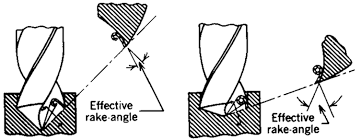
The idea is not to dull the cutting edge, lip, but to change the angle behind the lip that the spiral flute forms. Change this angle so that the bit does not tend to self feed and screw into the part. Change this angle to something like 7-12 degrees.

lg
no neat sig line
 
OP
M

manoweb

Well-known member
Joined
Oct 9, 2013
Messages
97
Location
California
The reason your drill was catching and kicking back was because you were not strong enough. There must be enough resistance/traction to hold the drill-motor firm. A twist drill will likely hook and stop cutting if there is too little metal to cut. Too much drill speed is another problem.
I bought a HOUGAN mag drill and annular cutters for a job much like you describe.
Maybe, but the drill (bit) broke in half at the last hole, so the problem is only in part due to lack of rigidity from my part. It is well documented that this kind of operation leads to breakages or chipping of the cutting edge, even in rigid setups. I would have loved to put this part on the Bridgeport, but it's the bottom of a tractor's transmission. Which by the way does not have machined surfaces and it's all curved, so it would be pretty difficult to fit a mag drill anyway to fit existing holes.
 
OP
M

manoweb

Well-known member
Joined
Oct 9, 2013
Messages
97
Location
California
The idea is not to dull the cutting edge, lip, but to change the angle behind the lip that the spiral flute forms. Change this angle so that the bit does not tend to self feed and screw into the part. Change this angle to something like 7-12 degrees.
Ohh this sounds so interesting but I am not 100% sure I understand. I will lookup drill geometries to try to understand
 

LopezBart

Well-known member
Joined
Oct 13, 2023
Messages
2,539
Location
Lopez Island, WA
I assume this was a cast-iron transmission casing? You can stone a small flat on the drill cutting lip to reducing the rake angle to as little as zero, as one does for drilling brass. Those machining a lot of brass often maintain a set of drills modified like this.


1701723868403.png1701723911709.png
 
OP
M

manoweb

Well-known member
Joined
Oct 9, 2013
Messages
97
Location
California
I assume this was a cast-iron transmission casing? You can stone a small flat on the drill cutting lip to reducing the rake angle to as little as zero, as one does for drilling brass.

1701723868403.png1701723911709.png
It's a ferrous cast part, it's an old Deere tractor, I cannot imagine they used any advanced process, but at the same time I don't have the elements to be more precise as I am not really an expert of this brand or tractors in general. It started as "I need to tighten those bolts as the front loader seems to wobble" and quickly becoame "I need to extract two broken bolts, rethread two more because they are completely stripped"
 

larry_g

Well-known member
Joined
Apr 28, 2007
Messages
16,879
Location
oregon
It's a ferrous cast part, it's an old Deere tractor, I cannot imagine they used any advanced process, but at the same time I don't have the elements to be more precise as I am not really an expert of this brand or tractors in general. It started as "I need to tighten those bolts as the front loader seems to wobble" and quickly becoame "I need to extract two broken bolts, rethread two more because they are completely stripped"
I've learned over the years that sometimes it is better to 'leave well enough alone'. I've got an old backhoe that has enough slop in the swing that you let off the swing handle 12" before the spot you want to hit....
 
OP
M

manoweb

Well-known member
Joined
Oct 9, 2013
Messages
97
Location
California
Well in this case it got so bad that I couldn't realistically continue using this tractor. Something would have broke as the bottom mount was essentially completely loose.
 
To avoid these ads, REGISTER NOW!

LopezBart

Well-known member
Joined
Oct 13, 2023
Messages
2,539
Location
Lopez Island, WA
Front end loader bolts are well-known for coming loose on a wide variety of tractors. Retorquing them should be part of regular maintenance, but it's not called out in manuals. Grade 8 bolts and washers will help, but these bolts are under a lot of stress in some tractor designs.
 
OP
M

manoweb

Well-known member
Joined
Oct 9, 2013
Messages
97
Location
California
Make a guide block out of 1 1/2 steel and bolt or clamp it down then use a bottoming bit.

The bit broke because it was in a bind.
I had planned to do that but there is no machined surface and the holes go into a cast, curved part. I desisted from using a block.
There is no doubt that it broke because the setup is less than ideal, but the fact remains that it was grabbing so much that it made the whole experience really miserable. I might still bind and break a bit next time, but if the zero rake mod makes it less painful to drill it's still a win.
 
OP
M

manoweb

Well-known member
Joined
Oct 9, 2013
Messages
97
Location
California
Front end loader bolts are well-known for coming loose on a wide variety of tractors. Retorquing them should be part of regular maintenance, but it's not called out in manuals. Grade 8 bolts and washers will help, but these bolts are under a lot of stress in some tractor designs.
The follow up question is, once I cut new threads, if I buy grade 8 bolts will I be able to apply all the nominal torque, that for this size is 180ft*lbs (that should result in a clamp load of around 23k lbs) without stripping the threads in the cast part?
 
OP
M

manoweb

Well-known member
Joined
Oct 9, 2013
Messages
97
Location
California
Core drills are made for enlarging an existing hole. Best used in a machine, but you can do it in a stout hand drill as well.
Reamers work too, but they require smaller steps between sizes.
I see, yeah, those look like the right tool for the job if one is willing to pay up
 

LopezBart

Well-known member
Joined
Oct 13, 2023
Messages
2,539
Location
Lopez Island, WA
The follow up question is, once I cut new threads, if I buy grade 8 bolts will I be able to apply all the nominal torque, that for this size is 180ft*lbs (that should result in a clamp load of around 23k lbs) without stripping the threads in the cast part?
Your new bolts are bigger, of course, so you can up the torque considerably in any case; I'd guess that something along 75% more than the original values. You'll get a qualitative idea of the casting strength when you're tapping the new larger holes; the fact that your drill bit broke makes me think it is pretty tough stuff. It looks like you're tapping a 5/8-18 thread 1.x" deep... [a coarse thread is usually recommend for cast iron; if the original ones were fine thread I wouldn't worry about it]. A bottoming tap will definitely increase the depth of threads you can use. For good quality cast iron, I see torque values of 190 ft-lbs for grade 8 5/8-11 bolts in cast iron, and 215 ft-lbs for fine thread; these numbers are substantially the same as grade 5, which makes me think the limits here are the casting. If this is an older tractor, I'd reduce these.


larry_g

Well-known member
Joined
Apr 28, 2007
Messages
16,879
Location
oregon
If this application used bolts that were a bit short then you should have some good threads at the bottom of the hole, with luck. Consider putting in a stud and in as deep as you can and then torque things with the nut. The stud can be installed with the loader in place if necessary if necessary.

lg
no neat sig line
 

BlitzcrankJapan

Well-known member
Joined
Dec 9, 2019
Messages
135
Location
Gold Coast, Australia
Almost related to above. You can may be able to loctite and insert a soft bolt or stud. Cut it off and then redrill the filled hole (with the larger diameter). This is similar to welding a hole and redrilling it. Except you don't need to deal with the hardened weld material. You have a soft bolt to drill into. This should substantially decrease grabbing.
 

theoldwizard1

Well-known member
Joined
Feb 22, 2011
Messages
43,166
Location
SE MI
Depending on the thickness of the metal, buy a step drill.

I have not tried this, but it should work. Get a cheap 45° carbide router bit. It will cut metal, just don't lean on it too hard. Now you larger drill won't have an "edge" to catch on.
 
OP
M

manoweb

Well-known member
Joined
Oct 9, 2013
Messages
97
Location
California
Drilling to put in helicoils? 4020?
I figured that the hole I'd drill for the helicoil is exactly the same I could drill for a new bigger bolt. As I am not restricted by the size of the bolt I thought I'd save the helicoil process and go directly with a bigger bolt.
 
OP
M

manoweb

Well-known member
Joined
Oct 9, 2013
Messages
97
Location
California
If this application used bolts that were a bit short then you should have some good threads at the bottom of the hole, with luck. Consider putting in a stud and in as deep as you can and then torque things with the nut. The stud can be installed with the loader in place if necessary if necessary.

I did not think about using a stud, I am not sure what would be the advantage over bolts. These four bolts are just used to fix a plate in place, that it not very unwieldy; the bottom of the front loader attachment then bolts to this plate.
 
OP
M

manoweb

Well-known member
Joined
Oct 9, 2013
Messages
97
Location
California
Your new bolts are bigger, of course, so you can up the torque considerably in any case; I'd guess that something along 75% more than the original values. You'll get a qualitative idea of the casting strength when you're tapping the new larger holes; the fact that your drill bit broke makes me think it is pretty tough stuff. It looks like you're tapping a 5/8-18 thread 1.x" deep... [a coarse thread is usually recommend for cast iron; if the original ones were fine thread I wouldn't worry about it]. A bottoming tap will definitely increase the depth of threads you can use. For good quality cast iron, I see torque values of 190 ft-lbs for grade 8 5/8-11 bolts in cast iron, and 215 ft-lbs for fine thread; these numbers are substantially the same as grade 5, which makes me think the limits here are the casting. If this is an older tractor, I'd reduce these.

The originals were coarse. I decided to go fine because the next size up of the stripped holes matched a fine thread. Fine threads are typically easier to tap (as I will have to do it by hand from under the tractor, I was trying to maximize my chances of success) and should have some advantages, but I did not consider they'd not be recommended in cast iron. There is no danger for contamination to foul these threads, but I hope I'm doing the right thing. The 5/8-18 (fine thread) tap set is supposed to be delivered tomorrow, If the consensus is that fine threads are awful in cast material I am still in time to send everything back, place a new order and re-drill and re-tap in a coarse size... An extra week added to this repair won't make a huge difference... But how bad really are fine threads in cast material?
 

LopezBart

Well-known member
Joined
Oct 13, 2023
Messages
2,539
Location
Lopez Island, WA
I'd suggest tapping 5/8-11; these threads will be far more resistant to pulling out and loosening due to vibration, esp. if the cast iron is of less than stellar quality. You'll get a lot more shear area in the cast iron with the coarse threads.
 

Wamsutta

Well-known member
Joined
Jan 8, 2014
Messages
10,876
Location
Amarillo, Texas
I've gotten away with spinning up the drill bit real fast and then sending it through slowly to enlarge a hole. Something about spinning slow causes the drill bit to get caught. Now if I'm drilling a new hole, I prefer to go in slow with lots of cutting oil.
 
To avoid these ads, REGISTER NOW!
Top Bottom