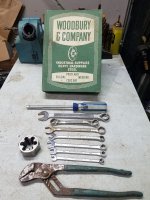
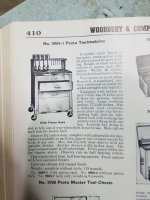
I picked up a 1951 Woodbury and Company industrial catalog today. Here it is in the top of photo #1. It seems to date from 1951, as noted at the bottom of the page in photo #2.
Photo #3 shows the page featuring Proto tool cabinets.
Photo #4 is a close-up of the Toolmobile
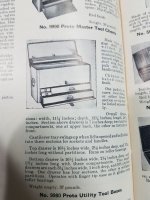
Photo #5 is a close-up of the Master #9990
Photo #6 is the page with the smaller Proto boxes and rolls
The title (headline) for each item seems to have been created by the printer, as they are consistent throughout the catalog, regardless of the vendor of the item. This is interesting in that illustrations would have been supplied to the printer by Proto, and it appears the text associated with them may or may not have also come from Proto. I say that because the text is consistent throughout the catalog, if font and size. The printer may have just set their type to match the vendor's description.
When I say that the vendor (Proto) provided the illustration, I base that on my childhood memory of seeing advertising illustration "cuts" that looked like rubber stamps that had been provided by vendors to my family's furniture store. These were used by the local newspaper when an ad was purchased. This was part of the "offset" printing process. They went away with the advent of modern "phototypeset" printing, which was introduced in 1949, but took some time to become widely used. If I remember correctly, the 3D "cut" was a reversed image, so it may have been used to cast a rubber plate for a rotary press.
Some of the illustrations lead me to believe that they used some older "cuts" for illustrations. The 3/4" drive socket illustration shows three grooves, and the 1/2" drive socket illustration shows no grooves on the 12-point version.
All this brings up questions about relying on printed information to date tools. It doesn't make it clearer, it just muddies the waters even more!

PS: I know a fellow who is an expert on the history of printing. I could confer with him if someone has questions about the printing process during the 20th Century.


 I am most certainly jelous of your friend who now has that proto tool mobile! They are not very common.