To avoid these ads, REGISTER NOW!

PSA about treated post'

DTE

Well-known member
Joined
Jul 13, 2013
Messages
996
Location
North Carolina
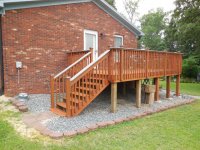
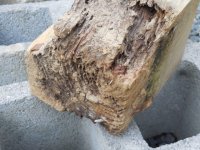
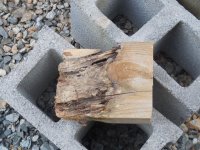
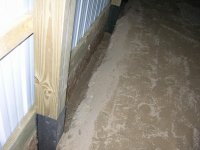
I thought I would share what I am working on right now and maybe save someone else some work down the road. I built this deck eighteen years ago and placed each 6 x 6 post on a concrete pad. Over the years the post' ended up being back filled with 1 - 2 inches of dirt and about the same amount of stone. I am fortunate that I could remove each post and cut off the rotten end and place them back on a couple solid four inch blocks. If I had it to do over I would sure have kept the post' above grade.
 

Attachments

  • Faceboook 020.JPG
    Faceboook 020.JPG
    138.5 KB · Views: 387
  • Faceboook 039.JPG
    Faceboook 039.JPG
    138.7 KB · Views: 375
  • Faceboook 038.JPG
    Faceboook 038.JPG
    138.5 KB · Views: 368
  • Faceboook 035.JPG
    Faceboook 035.JPG
    138.1 KB · Views: 395
  • Faceboook 037.JPG
    Faceboook 037.JPG
    136.9 KB · Views: 362
  • Faceboook 036.JPG
    Faceboook 036.JPG
    137.9 KB · Views: 354
  • Faceboook 021.JPG
    Faceboook 021.JPG
    137.6 KB · Views: 369
To avoid these ads, REGISTER NOW!

lakeroadster

Well-known member
Joined
Jan 19, 2015
Messages
5,166
Location
Central Colorado
Caveat Emptor.

The CCA of the wood selected needs to match the application.

Nothing wrong at all with wood below grade... if you select the correct pressure treatment CCA.

Choose wisely.

attachment.php
 

Attachments

  • CCA-C Chart.jpg
    CCA-C Chart.jpg
    37.7 KB · Views: 1,619
Last edited:
OP
D

DTE

Well-known member
Joined
Jul 13, 2013
Messages
996
Location
North Carolina
Caveat Emptor.

The CCA of the wood selected needs to match the application.

Nothing wrong at all with wood below grade... if you select the correct pressure treatment CCA.

Choose wisely.

attachment.php

Did not know there is a difference in treated wood.
 

theoldwizard1

Well-known member
Joined
Feb 22, 2011
Messages
43,132
Location
SE MI
I thought I would share what I am working on right now and maybe save someone else some work down the road. I built this deck eighteen years ago and placed each 6 x 6 post on a concrete pad. Over the years the post' ended up being back filled with 1 - 2 inches of dirt and about the same amount of stone.
What exactly do you mean by a "concrete pad" ?

Some local building codes require a concrete "cookie" typically the size of the hole and about 4"-6" thick on top of compact gravel. This should be below the frost line. The post can then be back filled with more compacted gravel.

They key to prevent rot is to give the water a place to go ! Compacted gravel will let the water in the hole disperse quickly.
 

lakeroadster

Well-known member
Joined
Jan 19, 2015
Messages
5,166
Location
Central Colorado
What exactly do you mean by a "concrete pad" ?

Some local building codes require a concrete "cookie" typically the size of the hole and about 4"-6" thick on top of compact gravel. This should be below the frost line. The post can then be back filled with more compacted gravel.

They key to prevent rot is to give the water a place to go ! Compacted gravel will let the water in the hole disperse quickly.

Wow.. really?

Dig a hole in clay soil. Now put in your compacted gravel. Add water. The water will go nowhere. The clay soil holds in the water, the fill does nothing to disperse the water.

Use the correct CCA level for the wood application. Fill the hole with the same soil that was dug out of the hole.

The key is to grade the top soil so the water runs away from the structure.
 
OP
D

DTE

Well-known member
Joined
Jul 13, 2013
Messages
996
Location
North Carolina
What exactly do you mean by a "concrete pad" ?

Some local building codes require a concrete "cookie" typically the size of the hole and about 4"-6" thick on top of compact gravel. This should be below the frost line. The post can then be back filled with more compacted gravel.

They key to prevent rot is to give the water a place to go ! Compacted gravel will let the water in the hole disperse quickly.

That is what happened the post were placed above grade at the time (18 yrs ago ) as for the pad they are about 16 inches square and I don't remember how thick they were but I would be sure they are at least 2 feet thick . Over the years we filled in under the deck evidently causing the problem.
 

ard

Well-known member
Joined
Feb 16, 2015
Messages
4,391
Location
Sierra Foothills... California
Caveat Emptor.

The CCA of the wood selected needs to match the application.

Nothing wrong at all with wood below grade... if you select the correct pressure treatment CCA.

Choose wisely.

Really good input. Many stores that sell treated lumber are clueless.

One comment- if you CUT the treated wood, you expose untreated. I will stand the treated end into a bucket of copper preservative. If too long, I will jury rig a tray of drench it repeatedly with a rag soaked.

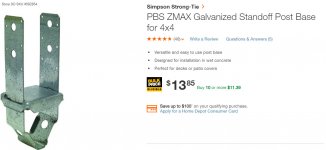
I prefer post base anchors with a standoff from the concrete.

:beer:
 

jdsac

Well-known member
Joined
Mar 2, 2011
Messages
565
I take treated posts & paint the end going into the ground with Henrys roofing patch- (not the tar type) to about 6" above grade- 2-3 coats allowing plenty of dry time. If they need to be cut, I cut the other end and liberly treat with copper type solution.
 

MushCreek

Well-known member
Joined
Jan 14, 2015
Messages
9,763
Location
Upstate South Carolina
I built my shed 8 years ago. It was up on deck blocks, but one corner was close to the ground, and wound up in the dirt. That corner rotted, but only where in direct contact with the soil. It's hard to find ground contact PT around here, and if it's cut, it needs to be treated. I prefer a raised concrete pad, and a metal post base to keep the post well out of the dirt.
 

CraigStu

Well-known member
Joined
May 22, 2014
Messages
4,025
Location
Blacksburg, Va
Wow, this is great info. I knew about the no ground contact wood but never knew there were so many grades. never knew that cutting the wood ruined the treatment. thanks for the info guys. I will add that a contractor who built a garage addition for me said this about fence posts, similar to wizards comment. He recommended digging the hole, poor in 4-6 inches of gravel, pound it down w/ the post, and then fill w/ the original dirt. He said that concrete under, or old school used to fill the entire hole, retains the water around the post. this was about fence posts and may be different for deck or sheds or anything where there will be considerable weight on the post.
 

misterpister

Member
Joined
Mar 2, 2017
Messages
7
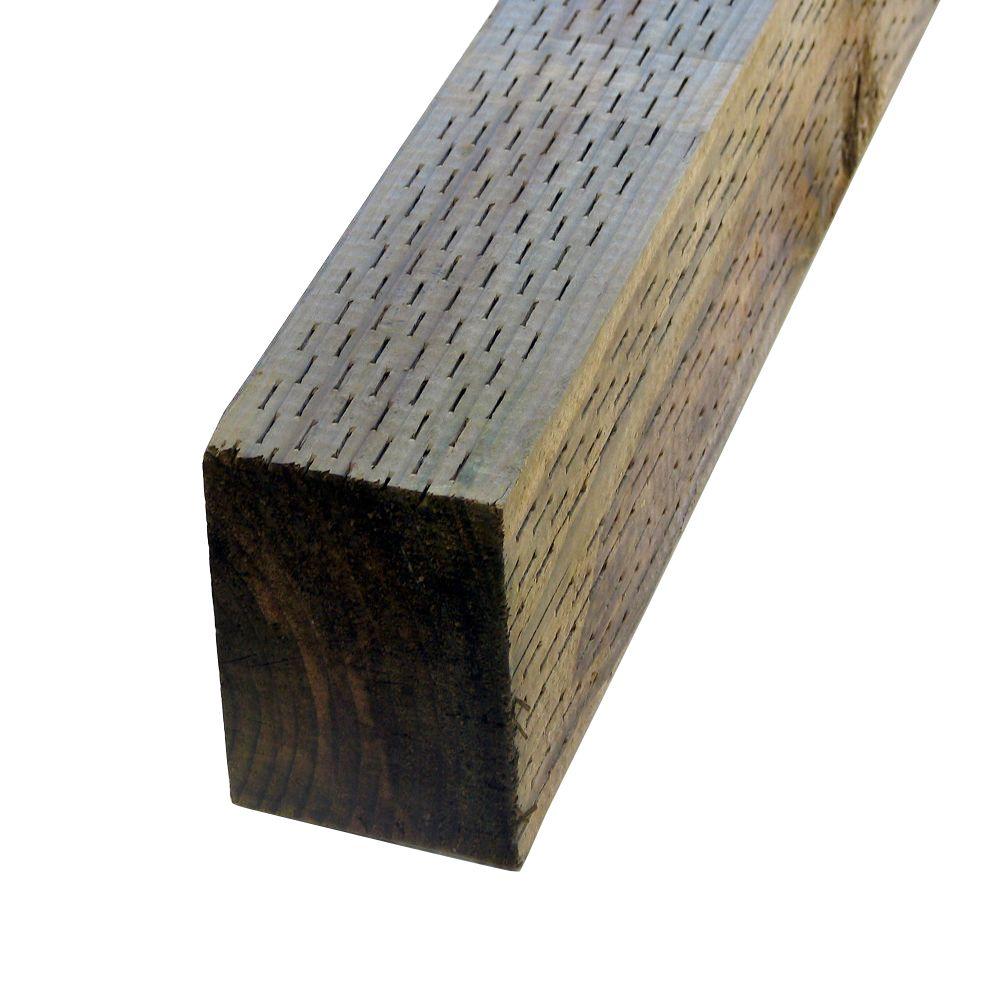
In-ground posts should be incised (or have perforations) which allow the treatment to get deeper into the wood.

pressure-treated-89346-64_1000.jpg
 

3rdgendslmech

Well-known member
Joined
Mar 12, 2017
Messages
499
Location
Maryland
I've got split rail fence all around my property. Between wind and rot I've changed a few posts, I noticed 2 things. Posts that were set in the hole on the dirt directly were rotten up through the concrete. There were 1-2 that had about 2 inches of concrete in the hole, then the post was set, then filled with concrete. These were only rotted off where the post met the concrete and we're partially covered with dirt also.
Correct me if I'm wrong but wasn't it in 2016-2017 that all pressure treated lumber had to be rated for ground contact? I just bought some lumber at Lowe's and on the tag it clearly says safe for ground contact
 

Monza Harry

Well-known member
Joined
Dec 29, 2018
Messages
1,433
Location
Windsor ON
I put up a pressure treated fence about 15-20 years ago and I have had to replace around 5 poles, 4 because the neighbours snow plow guy plied snow so high against my fence that the top was pushed in about 2' to 3' (6' tall), fence didn't break until a spring storm with some big winds came along, those poles showed no rot, just distress. The last one definitely had rot at ground level, at the cement/earth/wood intersection. My poles are in the ground 4' and I filled the ~10" Dia. holes with cement. Lumber from "Homers Place". If I have to redo this I will do the bottoms of the poles with some "basement wet proofing" [looks like tar, no idea what it really is]and possibly 6" of clear stone for drainage, but the water table is near that height in the wet spring so I'm on the fence about that one [pun intended]. I hope my somewhat related experience helps! All cuts were treated with "end grain preservative", pressure treated ends below grade [trim to height after setting] I also tried to keep the end off of the bottom (full encapsulation). Harry
 

Turbo

Well-known member
Joined
Sep 21, 2018
Messages
54
Location
Norcal
Anyone getting 15-20 years out of anything put in the ground , did good. Terry
 

joey1320

Well-known member
Joined
Jun 14, 2015
Messages
1,813
Location
NE Ohio
Concrete is purous and will let water soak into it and into the wood. Best thing to do is to build a concrete pier and install the post above ground, using a stainless steel bracket that separates the wood from the concrete.

Another thing one could do is coat the post with a water resistant membrane a la Mapei Mapelastic or something similar.
 

ard

Well-known member
Joined
Feb 16, 2015
Messages
4,391
Location
Sierra Foothills... California
Concrete is purous and will let water soak into it and into the wood. Best thing to do is to build a concrete pier and install the post above ground, using a stainless steel bracket that separates the wood from the concrete.
r.

I like pouring a footing, a short sonotube, and then a heavy post base with through bolts. Not the little **** on the shelf at HD, but their heavier duty stuff- a pair of 5/8" galve bolts with arms that come up a foot, serious 3, 7, 10 gauge metal.


simpson CB44, 66, also made in Stainless. CBSxx w standoffs...etc

And when the wood rots out in 20 years, your son will think "man dad was smart" as he unbolts them.

;)
 

mcbane

Well-known member
Joined
Jul 23, 2017
Messages
794
Location
California
Pressure treated wood isn’t what it used to be in 1990s. Expect it to rot quickly, to warp quickly, and to corrode electro galvanized fasteners. Hot dipped galvanized or stainless fasteners may last for the life of the structure, or at least the life of the PT materials.


Sent from my iPhone using Tapatalk
 

SeisMec

Well-known member
Joined
Aug 24, 2018
Messages
406
Location
Beryl, Utah
Pressure treated wood isn’t what it used to be in 1990s. Expect it to rot quickly, to warp quickly, and to corrode electro galvanized fasteners. Hot dipped galvanized or stainless fasteners may last for the life of the structure, or at least the life of the PT materials.

In the 90's the formulation was Chromated Copper Arsenate (CCA). When it broke down over time, it left arsenic in the soil. About 2000 or so (due to projected EPA regulation), the manufactures made a preemptive switches to different less toxic formulations. Alkaline Copper Quaternary (ACQ) is by far the most common.

Over and over you'll see ACQ described as "more corrosive" than the old stuff. It is! But the corrosion is galvanic - not acid. These types of corrosion are different animals altogether.

Galvanic corrosion requires three things: 1) Metal A.; 2) Metal B - anodically dissimilar to metal A; and 3) the presence of an electrolyte.

In the presence of an electrolyte (rain/dew), the metal lowest on the galvanic scale gives up it's metal to the other — it corrodes.
  • The greater the distance on the scale, the faster the corrosion.
  • The greater the electrolytically connected surface area of the recipent metal (relative to the donnar metal), the faster the corrosion.

IMHO, the take away from the above is — paint or seal every exposed surface of pressure treated lumber prior to assembly.
 
To avoid these ads, REGISTER NOW!

Radix2

Well-known member
Joined
May 28, 2014
Messages
1,853
Location
the thumb!, MI
The real takeaway imo on pressure treated lumber is that a large part of the business is straight up fraud.

It relies on the true premise that contractors, homeowners and lumber yards don't read or understand the specs on what is being sold.

The folks on here are a cut above because they RTFM.

The shear volume of non ground contact rated material sold says to me that the manufacturers know darn well their customers aren't getting what they need. Pallets and pallets of low concentration "landscape timbers" have no real use, posts, etc. all are sold to people thinking they are made for the obvious ground use. Shameful.
 

SeisMec

Well-known member
Joined
Aug 24, 2018
Messages
406
Location
Beryl, Utah
a large part of the business is straight up fraud.

It relies on the true premise that contractors, homeowners and lumber yards don't read or understand the specs on what is being sold.

Homeowners is one thing. There is zero excuse for contractors, lumber yards and the big box stores not knowing. This isn't something that just happened in the last year or two. It's been about 2 decades since the change. Where are the large, block letter signs saying "NOT FOR GROUND CONTACT!".

The shear volume of non ground contact rated material sold says to me that the manufacturers know darn well their customers aren't getting what they need

I think many building codes require all of the lumber in (attached) decks to be treated, not just the parts of the structure in ground contact.
 

lakeroadster

Well-known member
Joined
Jan 19, 2015
Messages
5,166
Location
Central Colorado
The real takeaway imo on pressure treated lumber is that a large part of the business is straight up fraud.

It relies on the true premise that contractors, homeowners and lumber yards don't read or understand the specs on what is being sold.

The folks on here are a cut above because they RTFM.

The shear volume of non ground contact rated material sold says to me that the manufacturers know darn well their customers aren't getting what they need. Pallets and pallets of low concentration "landscape timbers" have no real use, posts, etc. all are sold to people thinking they are made for the obvious ground use. Shameful.

It's not fraud, not by a long shot. As you say... RTFM.

What it is about is Personal Responsibility. Research, research, research.... and then make sure that is what you purchase.

But don't play the victim card. If you don't know what you are doing, seek the help of qualified professionals.
 

mrobins297aaa

Well-known member
Joined
Sep 20, 2010
Messages
3,283
Location
south east michigan
I'm in the camp to back fill around the post with what ever soil came out of the hole.
That's the way my barn was done in 2010, the inspector wanted a rat wall between the post and he said he didn't want to see any concrete touching the post so I ended up attaching roof shingles to the post..........if you look at the one picture you can see we used a piece of 1/2 osb board for a form on the one side which we never removed needless to say it didn't last long and rot away quickly.........the other pic is the sticker from the 6x6 treated post
 

Attachments

  • barn 6x6 post sticker.jpg
    barn 6x6 post sticker.jpg
    96 KB · Views: 94
  • DSCN6349.jpg
    DSCN6349.jpg
    148.3 KB · Views: 117
Last edited:

mcbane

Well-known member
Joined
Jul 23, 2017
Messages
794
Location
California

Bert_

Well-known member
Joined
Dec 24, 2016
Messages
9,716
Location
NW Iowa
I put up a pressure treated fence about 15-20 years ago and I have had to replace around 5 poles, 4 because the neighbours snow plow guy plied snow so high against my fence that the top was pushed in about 2' to 3' (6' tall), fence didn't break until a spring storm with some big winds came along, those poles showed no rot, just distress. The last one definitely had rot at ground level, at the cement/earth/wood intersection. My poles are in the ground 4' and I filled the ~10" Dia. holes with cement. Lumber from "Homers Place". If I have to redo this I will do the bottoms of the poles with some "basement wet proofing" [looks like tar, no idea what it really is]and possibly 6" of clear stone for drainage, but the water table is near that height in the wet spring so I'm on the fence about that one [pun intended]. I hope my somewhat related experience helps! All cuts were treated with "end grain preservative", pressure treated ends below grade [trim to height after setting] I also tried to keep the end off of the bottom (full encapsulation). Harry

I only use creosote post for building fence. I see creosote post that are 40 years old but a cca post is rotten after 20.
 

Bretny

Well-known member
Joined
Jul 31, 2017
Messages
3,918
Location
Dutchess county NY
18yrs on that deck...i would expect you got the life out of that wood even if it was ground contact. This is why i dont like wood in the ground where i live. Just imagine if those posts where a pole barn you put up 18yrs ago.
 

Kevin54

MEMBER EMERITUS
Joined
Jan 12, 2005
Messages
29,341
Location
Urbana, Ohio
Anyone getting 15-20 years out of anything put in the ground , did good. Terry

Who remembers watching This Old House when Bob Vila and Norm had it, maybe 35 years ago? They visited a place out in California where the foundation of the homes being built were made out of treated lumber post and plywood. And this was for basements. Wonder how that worked out for the owners. :lol_hitti
 

theoldwizard1

Well-known member
Joined
Feb 22, 2011
Messages
43,132
Location
SE MI
Dig a hole in clay soil. Now put in your compacted gravel. Add water. The water will go nowhere. The clay soil holds in the water, the fill does nothing to disperse the water.

Use the correct CCA level for the wood application. Fill the hole with the same soil that was dug out of the hole.
If you put some gravel UNDER the "cookie", water should pool down there.

The key is to grade the top soil so the water runs away from the structure.
Agree 100%
 

mmb617

Well-known member
Joined
Dec 5, 2010
Messages
4,424
Location
PA
Anyone getting 15-20 years out of anything put in the ground , did good. Terry

My pole bard went up in 1981.....still standing

I'm convinced the PT lumber being sold today is nowhere near as good as that from way back when PT lumber was a fairly new product, even if it does say it's rated for ground contact.

I put a stockade fence around my yard in the early 80's. Just about all the posts on one side of the yard are still in use today some 35 years later.

I did replace the fence on the other side of the yard a few years ago because the fence panels on that weather side were rotting out, and since I was going with chain link this time I pulled the old posts. Most of them were in really good shape although a few did have some rot.
 

MushCreek

Well-known member
Joined
Jan 14, 2015
Messages
9,763
Location
Upstate South Carolina
True. I put up a privacy fence in FL about 30 years ago, and it's still standing. Just used whatever the big box store was selling back then. I built a shed here 8 years ago, and part of the PT deck framing was in contact with the soil. It rotted already.

I bought a gallon of concentrated copper napthenate to treat the roof brackets on our house. You can mix it up to 40:1. It's STRONG stuff. You open the container and birds fall out of the sky. I'll bet the wood I treated with that stuff won't rot easily.
 

lakeroadster

Well-known member
Joined
Jan 19, 2015
Messages
5,166
Location
Central Colorado
...I ended up attaching roof shingles to the post..........

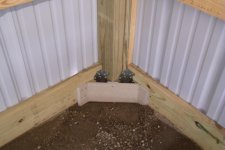
I did something similar, but used expansion joint material from HD. The gaps were filled with spray foam and allows the slab to float and not get hung up on the columns. They call it a floating slab for a reason.

attachment.php


attachment.php


attachment.php


attachment.php


If you put some gravel UNDER the "cookie", water should pool down there.

And that's wrong also. The concrete puck must sit on undisturbed earth. Set it on "gravel" and the gravel will settle, thus the building settles.

Your "gravel concept" works fine for a fence post, but not for a structural building column.
 

Attachments

  • Column Expansion Board.jpg
    Column Expansion Board.jpg
    140.5 KB · Views: 202
  • Corner Expansion Boards.jpg
    Corner Expansion Boards.jpg
    106.6 KB · Views: 20
  • Column Isolaters 001.jpg
    Column Isolaters 001.jpg
    39.7 KB · Views: 200
  • Column Isolaters 002.jpg
    Column Isolaters 002.jpg
    38.3 KB · Views: 201

yeldogt

Well-known member
Joined
Jan 2, 2012
Messages
18,184
Even in the 60's PT came in different grades -- but, it was all for ground contact -- I don't remember any that was not rated that way. Everybody switched to PT for deck structures when the green stuff became widely available in the 70's -- the more expensive stuff was water rated for bulkheads and docks.

Most of the stuff today is not rated for ground contact -- even the 4x4's I saw at HD over the weekend. Much of the landscape timbers .. what's the point?

When I redid my deck top a couple years ago the old PT from the late 90's was still perfect in almost every area .... The new stuff can fail in 10 years

The old stuff from the late
 

Git

Well-known member
Joined
May 18, 2008
Messages
6,894
Location
S Cal
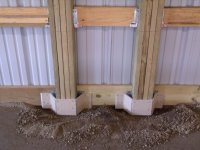
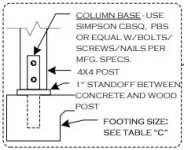
In my neck of the woods (S Cal) it is now required to have a 1" standoff between the concrete and the bottom of the post. I usually use these brackets
 

Attachments

  • GR8II-102.jpg
    GR8II-102.jpg
    84.2 KB · Views: 46
  • GR8II-101.jpg
    GR8II-101.jpg
    23.3 KB · Views: 48

mcbane

Well-known member
Joined
Jul 23, 2017
Messages
794
Location
California
The 1" standoff bases are great in terms of rot but are not intended to resist any bending moment. So they work to support posts under a structure that has some other means of lateral support but not work at all for a pole barn.
 

383

Well-known member
Joined
Aug 14, 2011
Messages
1,230
Location
Harrisonburg, VA
Caveat Emptor.

The CCA of the wood selected needs to match the application.

Nothing wrong at all with wood below grade... if you select the correct pressure treatment CCA.

Choose wisely.

attachment.php

Today, a lot of it is labeled "Not For Ground Contact". Label looks like this:

attachment.php

Wow.. really?

Dig a hole in clay soil. Now put in your compacted gravel. Add water. The water will go nowhere. The clay soil holds in the water, the fill does nothing to disperse the water.

Use the correct CCA level for the wood application. Fill the hole with the same soil that was dug out of the hole.

The key is to grade the top soil so the water runs away from the structure.

It's not fraud, not by a long shot. As you say... RTFM.

What it is about is Personal Responsibility. Research, research, research.... and then make sure that is what you purchase.

But don't play the victim card. If you don't know what you are doing, seek the help of qualified professionals.

This should be a sticky! There is so much mis-information about treated lumber and post frame buildings on the web, it's good to some good info for a change.
 

383

Well-known member
Joined
Aug 14, 2011
Messages
1,230
Location
Harrisonburg, VA
In-ground posts should be incised (or have perforations) which allow the treatment to get deeper into the wood.

pressure-treated-89346-64_1000.jpg

You must be on the Western side of the country. Here all treated lumber is southern yellow pine, none of it is perforated. Different species require the perforations because the treatment doesn't penetrate as well.
 

383

Well-known member
Joined
Aug 14, 2011
Messages
1,230
Location
Harrisonburg, VA
Anyone getting 15-20 years out of anything put in the ground , did good. Terry

18yrs on that deck...i would expect you got the life out of that wood even if it was ground contact. This is why i dont like wood in the ground where i live. Just imagine if those posts where a pole barn you put up 18yrs ago.

The company I work for has been building post frame buildings since 1964. When we celebrated our 50th anniversary in 2014, we went back to the first building we built and took pictures. I re-roofed one that we built in '68, posts were still fine.
 
To avoid these ads, REGISTER NOW!
Top Bottom